

Machine learning is poised to become a powerful tool for modern heat treatment, transforming decades of production data into actionable process intelligence. In this Technical Tuesday installment, Zachary C. Menard, CEO and co-founder of HRC Labs, draws on real-world case studies in carburizing and tempering to explore how predictive models can accelerate recipe development, optimize operations, and support more consistent decision-making. Rather than replacing metallurgical expertise, data-driven tools offer a pathway to continuous improvement, greater efficiency, and stronger competitive advantage.
This informative piece was first released in Heat Treat Today’s July 2026 Annual Super Brands Issue print edition.
Introduction
Heat treatment is one of the most operationally demanding and variable processes in modern manufacturing. It operates at the critical intersection of process design, material variability, and the strict performance requirements of industries as diverse as automotive, aerospace, and construction.
As a result, even highly experienced heat treaters must routinely make high-stakes decisions: how to converge on a new recipe without expensive trial-and-error; how to increase throughput without sacrificing quality; and whether a deviation warrants rework or scrap.
Heat treaters are uniquely positioned to benefit from advances in machine learning when confronting these decisions. Years of archived process data, hardness measurements, and quality records represent a largely untapped resource.
When systematically modeled, this data can power predictive models that map recipe parameters to metallurgical outcomes.
This approach is not without precedent. Similarly complex industrial processes — aggregates mining, cement manufacturing, and even steel casting — have increasingly adopted machine learning to reduce variability, optimize cycles, and proactively detect process drift. These gains have not replaced domain expertise; they have amplified it.
The following sections outline how machine learning, when thoughtfully integrated with metallurgical understanding and domain expertise, can serve as an enabling infrastructure for modern heat treatment.
What is Machine Learning?
Machine learning (ML) refers to computer algorithms designed to learn how a system behaves by leveraging that system’s data. Among the most relevant ML models for heat treatment are multilayer perceptrons (MLPs), which are designed to learn complex, nonlinear relationships between process inputs and observed outcomes.
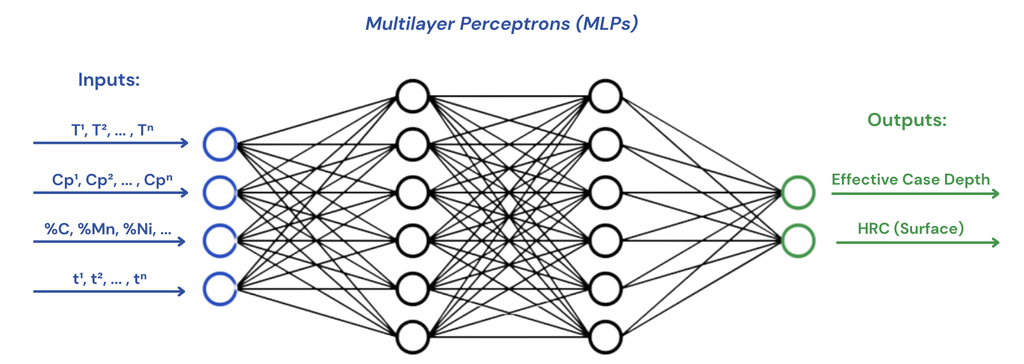
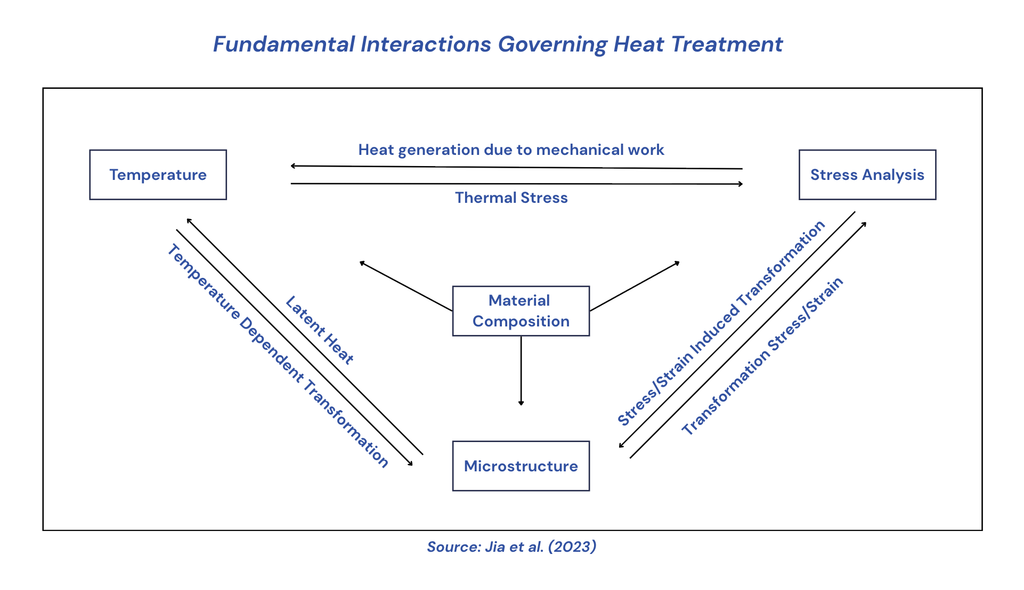
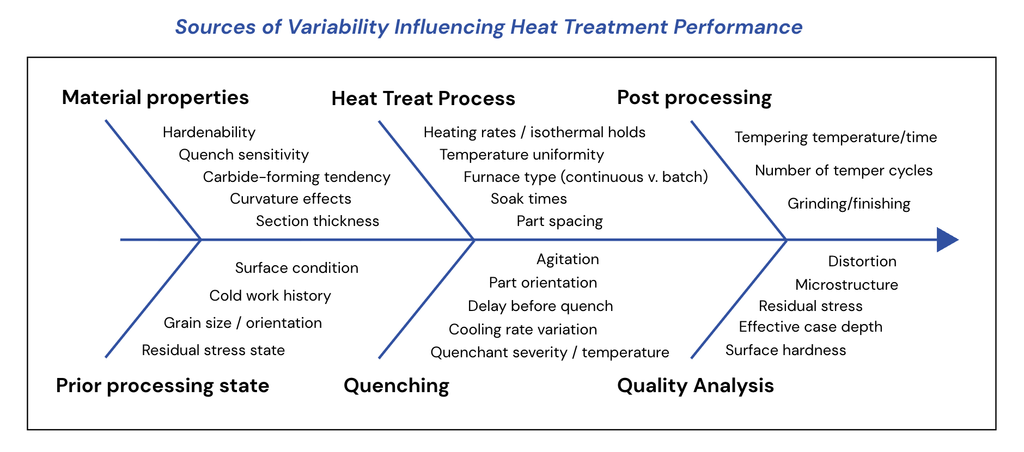
In heat treatment, outcomes such as surface hardness, effective case depth, distortion, or residual stress do not depend on any single variable. They emerge from the simultaneous interactions between variables like temperature, time, atmosphere composition, material composition, part geometry, and quench severity and uniformity, to name a few.
MLPs are well suited to modeling precisely this type of behavior. Rather than assuming a predefined relationship or physical law, they learn the mapping from process parameters to measured outcomes directly from historical production data. Layer by layer, the model captures increasingly subtle interactions among variables, enabling it to represent effects that are difficult to express with predetermined equations.
Importantly, once trained on sufficiently representative data, MLPs can:
- Predict part properties for proposed recipes in milliseconds.
- Evaluate hundreds of candidate parameter combinations rapidly.
- Provide explicit uncertainty estimates alongside predictions.
- Be tuned to individual furnaces, load configurations, or heat treatment techniques.
While MLPs are well suited to modeling the complexity of the heat treatment process, another class of machine learning models called decision trees are particularly effective for structured operational decisions. Heat treatment routinely requires categorical judgments, from rework decisions to detecting process drift to root cause analysis.
Decision trees can categorize heat treatment runs based on how they differ from historical runs. For example, the tree may organize a run based on its temperature deviations, fluctuations in carbon potential, or variation in effective case depth from the average. Each terminal node or “leaf” of the tree represents a cluster of historically similar runs.
Because these clusters are associated with prior corrective actions and results, the tree can provide probabilistic guidance grounded in historical precedent. For example, when analyzing a recent batch of parts that missed their target case depth, the tree might find that among comparable historical runs, 80% were successfully re-processed under a modified cycle, while 20% were scrapped. This enables faster root cause analysis and supports decision making.
Heat Treatment Applications
ML is particularly well suited to modeling and managing the many interacting variables that determine heat treatment outcomes. These capabilities translate into three practical applications: recipe development, process optimization, and auxiliary decision support.
Recipe Development
Heat treaters rely on operational experience, test coupons, and simulation tools to inform recipe design. However, new alloys, part geometries, or throughput demands often require iterative trial runs. Each additional load dedicated to experimentation represents furnace time removed from production.
Finite element simulations can narrow candidate recipes, but their accuracy depends on material properties, boundary conditions, and calibration to production conditions.
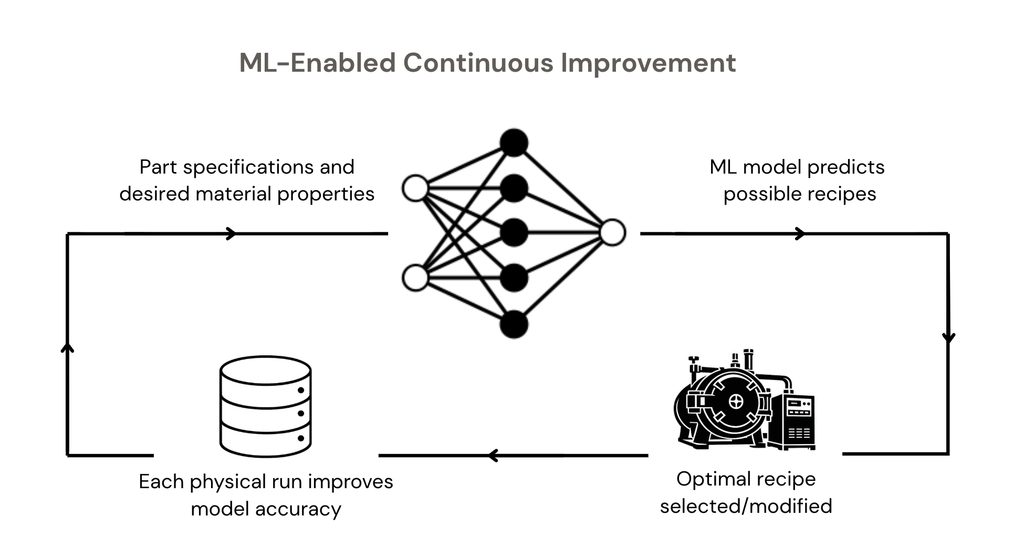
ML models such as MLPs offer a complementary approach to physical simulations. Trained on historical production data, they learn how a specific furnace, material, and process behave under real production conditions. Once trained, these models can rapidly evaluate candidate recipes against hardness, case depth, and distortion targets.
Importantly, predictions can be accompanied by uncertainty estimates, allowing heat treaters to assess risk alongside expected performance. By reducing the number of physical trial runs required to converge on a robust recipe, ML can accelerate the path from testing to production while preserving metallurgical oversight.
Process Optimization
Once a recipe has been demonstrated to meet specification, the focus shifts from feasibility to efficiency and robustness. The objective becomes reducing cycle time and energy consumption while maintaining process stability and required part properties.
In practice, optimization often proceeds through incremental parameter adjustments informed by experience. Soak times may be shortened or quench conditions modified in pursuit of efficiency gains. Yet the interdependence of heat treatment parameters makes it difficult to predict how such changes will affect process robustness.
ML models provide a structured framework for navigating this landscape. Once trained, they can:
- Evaluate a multitude of potential changes to a recipe.
- Estimate the impact of efficiency-driven adjustments on final properties.
- Quantify uncertainty, identifying parameter sets that are not only efficient but stable.
Rather than relying solely on sequential physical trials, heat treaters can assess proposed modifications computationally before allocating furnace capacity.
Each additional production run further refines the model. As data accumulate across varying materials, geometries, and operating conditions, predictive fidelity improves. Over time, optimization transitions from periodic study to continuous, data-driven improvement.
Auxiliary Decision Support
Recipe design and optimization are only part of the operational challenge in heat treatment. A substantial portion of heat treaters’ time is devoted to diagnosing deviations, determining appropriate corrective action, and monitoring for process drift.
When a batch fails to meet specification, multiple correlated factors may plausibly explain the deviation. As a result, root cause analysis often requires time-consuming review of process logs and historical records.
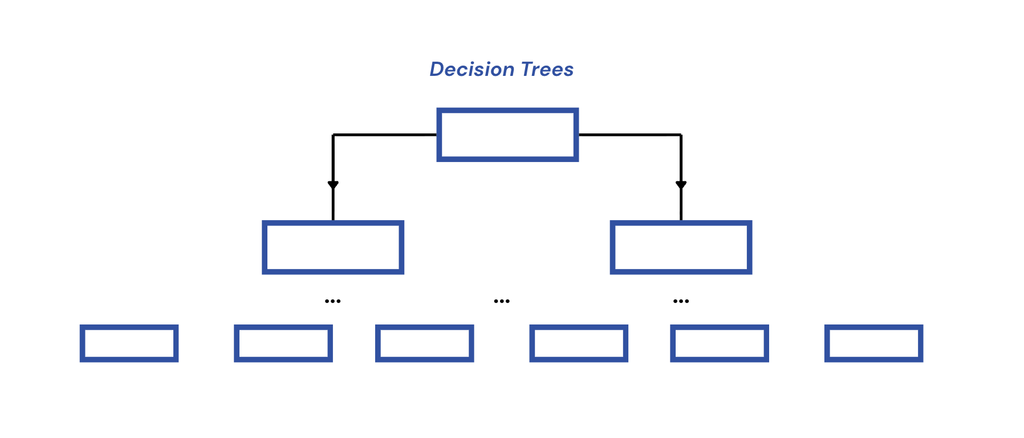
Decision-tree-based models provide a structured method for accelerating this analysis. By learning from historical runs and their documented outcomes, the model can classify a new deviation according to its similarity to past cases. For example, the model may determine that comparable historical runs were most frequently associated with temperature non-uniformity rather than alternative causes.
This approach offers three practical advantages:
- Faster root cause analysis and reduced diagnostic downtime.
- More consistent, data-backed rework decisions.
- Earlier detection of process drift and emerging equipment issues.
Importantly, these models do not override heat treaters’ judgment. Rather, they surface structured historical context that may otherwise remain fragmented across logs and institutional memory. Over time, this improves consistency, auditability, and knowledge transfer.
Machine Learning in Heat Treatment
The preceding sections have outlined several proposed applications of ML in heat treatment. The following sections examine documented cases of successful ML application in heat treatment.
Case Study 1: Carburizing
Jia et al. (2023) demonstrated the use of multilayer perceptrons to model the vacuum carburizing process for a low-alloy carbon steel cylinder. Using primarily simulation-derived data supplemented by limited experimental runs, the authors trained an MLP to predict case depth, surface carbon concentration, and surface hardness from process parameters including carburizing and diffusion temperatures, cycle durations, and carbon concentration levels.
Once trained, the model rapidly identified parameter combinations that satisfied specified hardness and case depth targets while reducing computational cost relative to traditional simulation tools.
Zhang et al. (2025) took a similar approach but focused on atmospheric carburizing. The study’s goal was to train an MLP to predict post-carburizing carbon concentration across multiple part geometries for SAE AISI 3316 gear steel. Representative test coupons were used to validate the simulation-derived training data against production runs.
The model predicted post-carburizing carbon concentration with average errors near 2%. While limited in scope, both studies demonstrate that ML can replicate complex diffusion-driven behavior and accelerate recipe evaluation. These investigations focused primarily on carbon concentration and hardness prediction; the same modeling frameworks could be extended to distortion and residual stress prediction.
Case Study 2: Tempering
To further explore the performance of ML in heat treatment, publicly available tempering data from the classic study of Hollomon and Jaffe (1945) were analyzed. Their model combines temperature and time into a single tempering severity parameter, M. While effective within specific steels, prediction errors increased substantially as carbon contents varied. This model failed in particular to extrapolate to the behavior of lower carbon steels, with errors surpassing 10 HRC in some cases.
To address this limitation, ML was used as a corrective layer on top of the traditional Hollomon-Jaffe model. The Hollomon-Jaffe equation provided baseline hardness predictions, while the ML model learned systematic corrections based on alloy composition and processing conditions. This approach reduced prediction error dramatically — from over 10 HRC in some cases to 2 HRC — while preserving the underlying metallurgical framework.
A common concern with ML models is that they behave like “black boxes.” However, modern interpretability tools allow engineers to examine how models arrive at their predictions. In this study, SHAP (SHapley Additive exPlanations) analysis was used to examine how the model corrected the Hollomon-Jaffe prediction. This revealed clear trends in how quantities like carbon concentration informed the model’s corrections. Rather than behaving like a black box, the model learned consistent metallurgical patterns in the data.
This case study illustrates how ML models can improve traditional approaches when they are limited by assumptions about physical parameters or cannot accommodate certain inputs. Unique furnace behavior, fixturing configurations, and part processing history are difficult to capture and calibrate using traditional simulation tools. Additional work should explore the integration of ML as a corrective layer for simulation software.
Strategic Implications and Competitive Advantage
The case studies presented here illustrate a broader principle: ML is most powerful in heat treatment not as a replacement for metallurgical understanding, but as a mechanism for formalizing and extending it.
When applied thoughtfully, ML can accelerate recipe development, reduce trial-and-error, and support structured diagnostics grounded in historical precedent. Unlike static optimization studies, trained models improve continuously as new production data become available. Over time, they become increasingly plant-specific, capturing nuances in furnace behavior, fixturing, material sourcing, and operating conditions that are difficult to encode with predefined equations.
Successful implementation will require high-quality process data and close collaboration between heat treaters and data scientists. ML is not a substitute for metallurgical expertise, but a tool for extending it.
The opportunity is substantial. Heat treatment has generated decades of process data that remain underutilized. Shops that convert this historical record into predictive intelligence will gain measurable advantages in efficiency, robustness, and process consistency. As competitive pressures increase and tolerances tighten, the ability to continuously learn from operations may become a defining differentiator.
Heat treatment has a rich history of innovation and experimentation. The integration of ML represents the next step in that progression.
Acknowledgements: The author would like to thank Dan Herring, The Heat Treat Doctor®, whose insight and guidance were instrumental in refining the direction of this work.
References
Hollomon, J. H., and L. D. Jaffe. 1945. “Time-Temperature Relations in Tempering Steel.” Transactions of the American Institute of Mining and Metallurgical Engineers 162: 223–49.
Jia, Hongliang, Dong Ju, and Jian Cao. 2023. “Machine Learning Based Optimization Method for Vacuum Carburizing Process and Its Application.” Journal of Materials Informatics 3: 9. https://doi.org/10.20517/jmi.2022.43.
Zhang, Y., Z. Tang, Q. Yin, et al. 2025. “Machine Learning Based Prediction of Carbon Concentration in Carburized Steel.” Scientific Reports 15: 33678. https://doi.org/10.1038/s41598-025-18531-8.
About The Author:

CEO and Co-Founder
HRC Labs
Zachary (Zach) Menard is the CEO and co-founder of HRC Labs, an industrial AI company focused on process optimization and decision support for heat treatment. He holds a B.S. in physics from Vanderbilt University with a background in computational physics and machine learning research.
For more information: Contact Zach Menard at zach.menard@hrc-digital.com.