

Heat Treat Radio #12: ITC Coatings
 Welcome to another episode of Heat Treat Radio, a periodic podcast where Heat Treat Radio host, Doug Glenn, discusses cutting-edge topics with industry-leading personalities. Below, you can either listen to the podcast by clicking on the audio play button, or you can read an edited version of the transcript. To see a complete list of other Heat Treat Radio episodes, click here.
Audio: Heat Treat Radio: ITC Coatings
In this conversation, Heat Treat Radio host, Doug Glenn, interviews Greg Odenthal of ITC Coatings, a company based in Fort Worth, Texas, which manufactures and installs high-temperature, energy-efficient ceramic coatings. Increasing the efficiency of your furnace by even 5 to 10 percent would a good thing. Doug and Greg are going to introduce you to a spray-on product that increases furnace efficiency by, on average, 10 to 15 percent and sometimes as high as 25 percent. It can be applied to nearly any furnace surface and can be applied in less than a week in most cases, sometimes even within a single day.
Click the play button below to listen.
Transcript: Heat Treat Radio: ITC Coatings
The following transcript has been edited for your reading enjoyment.
Thanks for joining us. I’m Doug Glenn, your Heat Treat Radio host and publisher of Heat Treat Today. Before we jump on the phone and call Greg Odenthal at ITC Coatings, let me encourage you to visit www.heattreattoday.com, especially if you’re a manufacturer with in-house heat treat operations. Our website targets content for heat treaters in the aerospace, automotive, medical, and energy sectors well as general manufacturing. We update the site with at least one new piece of content every weekday, and we typically publish technical content on Tuesdays, our Technical Tuesday feature.
So let’s get rolling on today’s podcast. I got on the phone and called Greg Odenthal. Greg is the director of engineering and technical applications for ITC Coatings. Let’s jump right into the phone call.
 Doug Glenn (DG): So, this is Doug Glenn with Heat Treat Radio. We’re here today, on the phone, with Greg Odenthal from ITC Coatings. So, we wanted to talk about a relatively interesting, not necessarily new, but perhaps new to many captive heat treaters and many heat treaters in the industry. It has to do with helping the insulating properties of furnaces and things of that sort. So, let’s start. First thing I want to do is welcome Greg. Greg, thanks for joining us, I appreciate you being here.
Greg Odenthal (GO): Thanks, Doug. I appreciate it. It is good to be here.
DG: So, without a lot of detail at this point, because we’ll get into a little more detail as we move forward, if you could give us the thirty-second elevator pitch on the product. And maybe as you are doing it, just tell us a bit about the company: the company name, where you are located, that type of thing.
GO: Sure thing. So it is ITC Coatings. We are located in Fort Worth, Texas. I sit in my office in Pittsburgh, Pennsylvania, and we also have a business development office in Raleigh, North Carolina. So, we manufacture and install high-temperature, energy-efficient ceramic coatings. These coatings have a multitude of uses in heat treat furnaces, kilns, reheat furnaces in the steel world. And really, anybody who is looking to reduce fuel consumption, reduce factory maintenance, increase product quality, should be looking at using our products.
What is it? Water-Based Ceramic Coatings

DG: Right. So, it is an energy saving product. It is applied to refractories. Without giving away the secret sauce, because we know there is a secret formula, give us a sense of what we are dealing with here. Is it a castable material? Is it a wool material? Is it a spray-on material? What is it? What is it made of? How does it work?
GO: Well, it’s neither of those. It is ceramic technology, and it’s ceramic coatings. These are water-based ceramic coatings that are applied only mils thick on top of a current existing refractory. That refractory can be castable, gunite, shotcrete, ceramic fiber, fire brick, insulating fire brick, hard brick — it has a multitude of uses. Unfortunately, at this point, I cannot disclose the chemical makeup because it is proprietary. But I will tell you that there is nothing in our coatings that one wouldn’t find in any of the current refractories in use today.
DG: So you are not introducing some sort of a strange, alien substance into the furnace, necessarily. It’s just normal material but it is formulated in such a way that you can get some pretty outstanding energy efficiencies.
GO: Absolutely. We take what’s currently being used in the market and based on percentages and what we have, we make a pretty unique product.
DG: A lot of people will say, well, this is a brand new product; if we buy it, if we use it, are we going to be the guinea pigs here? Tell us a little bit. What is the history? Has it been around a long time? Is it relatively new?
GO: Our product has been around since 1980. There was a gentleman and his wife, Feriz Delkic and Alice Delkic, that invented this product. They invented it for their own use. Ferris was manufacturing kilns back in the 1980s. He wanted his kilns to be the most efficient kilns on the market. So, in order to do that, he invented a ceramic coating to apply to the inside of the kiln over top of the refractory. And, low and behold, come to find out that now his kilns are the most efficient kilns on the market. Having that technology in his pocket, he kind of ventured out and tried to persuade or get the world to start using his coatings to reduce fuel consumption, increase product quality, [along with] a host of benefits that come along with it. We can talk about it a little later. So, yes, it has been around since 1980. It’s nothing new to the market. But, like you had made mention at the beginning of the interview, it’s probably new to quite a few people because if you never heard of it or you don’t realize what’s on the market, then, yes, it could be a new product.
The Savings
DG: Right. And just so we know — I mean, we’ll mention this at the end as well — people can find out a little bit more on your website: www.itccoatings.com. We will mention that again at the end. So, Greg, realistically, what type of energy savings are we talking about? You can give us low end, extremely great high end. But realistically what’s in the middle as well? What are you seeing as far as energy savings?
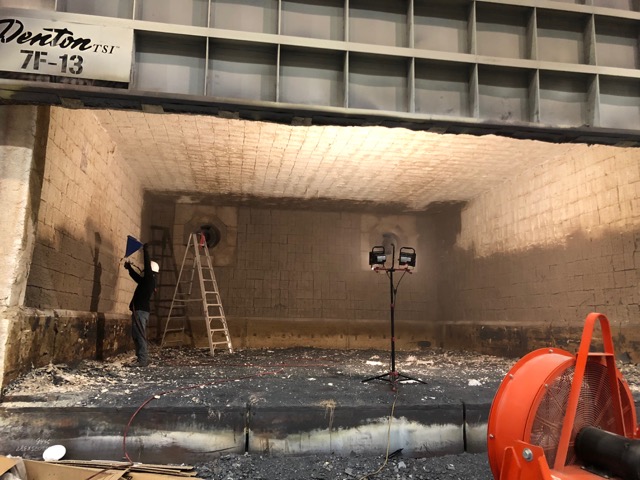
GO: Depending upon the application and depending upon the condition of the refractory, we’ve seen energy savings anywhere from 7 to 10 percent all the way up to 20 to 25 percent reductions in fuel consumption. Because of the broad range, you know, if I’m going in and I’m applying this coating on a brand new refractory lining, say it’s brand new fiber lining or even a brand new brick lining – that refractory is pretty intact. Obviously, it’s new. You don’t have a lot of spalled refractory or cracks or things of that nature so your fuel consumption at that point is low to begin with. The coatings at that point on a new lining are going to protect that refractory from the harmful effects of heat and thermal shock and spalling. It will increase its life. When you get into a lining that has been around for several years and it’s got a lot of wear on it, a lot of spalling, thermal cracking shocks, things of that nature, you’ve got a lot of avenues for heat to penetrate into that lining and escape through the shell. So, obviously, your fuel consumption is much greater. There is a broad range, but like I said, it depends upon the application and current condition of the refractory.
 DG: So, roughly speaking, a person that was going to use it could expect anywhere from 10 to 25 percent, 7 to 25 percent. Somewhere in that range?
GO: Yeah, I would say the average that we see currently today on installations is anywhere from 10 to 15 percent. On an average.
DG: That’s fair. And the way this works, just so we’re clear – it’s a reflective material. Is that right? I mean, essentially, is that how we are saving?
GO: Yes, yes, it is. It reflects probably about 90 percent of all the radiant energy that the burners put out.
DG: Right. And it’s most effective in the radiant spectrum, so to speak?
GO: Absolutely. When you get into the radiation, into the temperatures that most of our customers and our target audiences are operating at – when you are at 1200 degrees, 1500 degrees, the major mode of heat transfer is radiation which [is] temperature to the fourth power, that’s what we are after. We’re after re-radiating from the burners back into the furnace to capture that energy and reduce your fuel consumption. You know, you still get convection and conduction through coatings. That heat transfer still takes place, but at much lower temperatures and we aren’t really concerned about it. It’s the radiation spectrum that we’re after.
Application — DIY or Letting the Pros Handle It?
DG: So, just to kind of prep you and prep the people who are listening about what we are going to be talking about – we are going to talk in a minute about applying the product, and what does it take, dry out times, if any, and surface prep and stuff like that. But before I ask you about that, just to kind of whet our appetite here – do you have any good examples of installations, kind of case studies, that you could share, that might be of interest?
GO: We do have several listed on our website. I encourage listeners, obviously, to go to our website. We’ve had many successful applications over the years. One of the latest that we’ve just done here probably four or five months ago was McConway & Torley here in Pittsburgh in one of their austenitizing furnaces where we coated the entire ceramic fiber lining. Their major reason for using the coatings was they wanted to be able to reduce their turnaround time. And we did – by twenty minutes! Which now allows them to treat one additional load per week. It may not seem a lot but when you start applying the numbers and the savings to it, it’s pretty significant. So, one additional load per week for these guys is a significant amount of profit to their bottom line per year.
Along with that, like I said, which was one of the main reasons why they wanted to use this coating — we reduced their fuel consumption. We improved their temperature uniformity. You know, they were around plus or minus 40 degrees, we now have them down to plus or minus 25 degrees. So a big significant change there. Their refractory life is going to increase probably, and this is on an average as well, but their refractory longevity and life is going to increase three to five times. So, their maintenance on that fiber lining is going to greatly reduce. Fiber shrinks upon heat — it’s non-reversible. So you’ve got to shut the furnace down periodically and pack the joints with new fiber and continue running but the problem is the new fiber you just used to pack these joints as soon as you turn the furnace on the fiber shrinks. It’s just a constant maintenance nightmare, especially in a fiber-lined furnace. That was one of the latest that we did, but we have had numerous other applications throughout the years, specifically in the steel industry. We’ve got successful applications — ArcelorMittal, Nucor Steels, EVRAZ Rocky Mountain Steel in Colorado. And as far as heat treaters and forging houses — Finkl Steel in Chicago, Union Electric here in Pittsburgh. So we’ve got quite a laundry list of successful applications.
DG: All right, so let’s talk a little bit about application of the product. Just in a nutshell, what does it take to apply it? Is this a thermal spray? How do you apply it?
GO: It’s applied by spraying it on. It’s not thermal, thermally sprayed or applied. You know, the best way to apply it is — I tell a lot of our customers that want to do this themselves – the best way to apply it is to go to Home Depot or Lowes and buy yourself a textured drywall popper spray gun. You can get them for $70 or $80 and use that to apply it. It’s okay for heat treat furnaces that aren’t very large in size. We’ve done those that may be 32 feet long by 16 feet wide and 15 feet high — somewhere in that range. It’s okay in that size. When you move into a reheat furnace in a steel mill, there are sprayers that can be rented or purchased. They are also drywall spray guns, but they are self – contained with a 15-gallon hopper on the unit, so that the actual applicator is only holding onto a gun and not a hopper full of material. Which can get pretty heavy over time.
DG: Right. So it’s basically as simple as painting your house with a spray gun.
GO: Yeah, pretty much. You know some people will ask me, well I’ve got a paint sprayer here, can I use that? And the answer to that is “No.” Paint sprayers have filters and screens in them, and the problem is you’re going to filter out and screen out all of the ceramics that are in it, so, really all you’d be applying is the water that it’s mixed with.
DG: Okay, okay. So I assume you recommend that your team, your crew, applies it. It can be done by the homeowner, so to speak — the furnace owner — but probably better if your guys apply it?
GO: I would say initially, “Yes.” We always want to come in and do the first one, two, three applications for a customer. And during those applications, if they want to learn, they are more than welcome to sit there with us while we mix and apply so that they could get a good general knowledge and hands-on training at the time, to be able to move forward and apply it themselves. We do have some certified product installers around the country: NorHeat Treatment, Inc, out of Canada, Thermal Coating Solutions here in Pittsburgh. We do have some other people down south that do it for us. We have a gentleman over in Chicago that handles more or less our cement world and energy world, but, yeah, so, it can be applied by the customer but we definitely recommend ITC do the first one or two installs. Then you can learn the ropes.
Prep, Downtime, Restart
DG: Right. Now, how about surface preparation? So, I’m a, I’m a manufacturer, I’ve got a furnace in-house. It is up and running 24/7/365. I don’t want it to be down long. How much surface prep do I have to do if I take this thing out of service? How long is it out, and what do I need to do to get the surface ready, and how long, in fact, does installation and or any dry-out process take?
 GO: Well, again, I’ve been in some furnaces that are in really, really bad shape. So, surface prep, on a ceramic fiber-lined furnace — depending on how hard you run it, the fiber starts to devitrify and it gets the black crusty layer over that fiber which is really no good anymore. It’s just a glassy phase that has no insulating value to you whatsoever. So, that needs to be removed. It’s depending on the size of the furnace, depending on the size of the crew, but most installations that I have been involved with – three to four days at the most. And that can even apply to a large pusher type reheat furnace in a steel mill. You know, day one would be surface prep, clean up the refractory if it needs it. Days two, three, and four would be applying the coatings. And then after that, we are done. We get out of the way. If you’ve got a brand new furnace, we can walk in, open the door, and we can have that sprayed in eight to ten hours. You can have that done in one day. Like I said, application really depends on the condition of the refractory.
DG: Right. And as far as dry out, I mean a lot of times with a refractory installation, there’s dry out times, that type of stuff. What are we looking at? Does this stuff have to be dried out? Do we need to go low heat for quite a while or does it dry like paint?
GO: Once it’s applied, the recommendation is to let it dry for 24 hours. And, then, when you start the furnace, I say, 100 degrees an hour, when you get to about 250 or 300, I like to hold it there, maybe for an hour, just to start to drive that mechanical water out of it. And then after that, 100 degrees an hour to operating temperature because then you are going to start forming the chemical bond and drive off the chemical water. You are going to sinter that coating. And you have to remember, these are only mils thick, so it’s not like conventional refractories where you’ve got 8, 9, 10 inches, and you’ve got to hold per hour, per inch thickness at 250, and then 600 and then 9 . . . You know there’s no holds just due to the thinness of the application.
The Fine Print
DG: Okay, so once we put the ITC coating on, and we’re getting ready to fire up the furnace, do we have any concerns about any volatiles, any type of dangerous chemicals going to be off-gassing during that process or during the life of the product?
GO: Absolutely not. The coatings contain no harmful VOCs. So there is no off-gassing, and they’re not harmful to you or the environment. So, no, no volatiles.
DG: So, the other question that jumps to my mind is – you know every material has a different thermal coefficient of expansion when it heats up. It grows or shrinks in a different way. So, you are applying this mils-thin coating/surface over — you can put it over brick, you can put it over fiber. When they heat up, grow and expand and contract differently. Do we have issues here with this coating here cracking/spalling, that type of thing, because of the base material?
GO: No, we do not. The way the coatings are designed, the binder system is designed to move with the dimensional change of the substrate. When you’re at ambient temperature, they are very hard — like a coffee cup if you think about ceramics. But when you get into the 2200 degree/2300 degree range, you know everything at that point starts to soften up a bit – things grow and move. The binder system in the coatings allows the coatings to move with the dimensional change of the substrate. So, no, we do not really have any issues with expansion. And that holds true for metal as well. We’ve got a coating that is specifically designed to coat metal parts and increase the life of metal parts due to high-temperature oxidation of the metal.
DG: Okay. And how about, along the same line, I’m thinking that if there is any type of cracking at all — which sounds like there is not — but in some of these furnaces, especially if we’ve got high-velocity air flow inside of let’s say, for example, some sort of an annealing furnace that just requires high convective heat, a lot of airflow, a lot of velocity. Do we have any concerns about wind erosion so to speak?
GO: No, not necessarily. You know, if you’ve got high velocity, some furnaces do have a fiber lining in them with some velocity, and it tends to sometimes tear the fiber off, but once the coatings are applied, you’re encapsulating that fiber. And again, like I said, it’s got a hard shell to it. So, no, any velocity we are not really too concerned about velocity.
DG: It wouldn’t be an issue. Very briefly then, let’s just talk about what products are offered. I was looking through the website, [and it] looks like you’ve got three new install products if you will, and two fix it products. Can you just kind of run us down through those — what ‘s the difference between them, all that good stuff?
The Line-Up

GO: Sure, sure. So, you are right. We’ve got five products that we offer. Our workhorse product that can go over top of any kind of refractory – it’s very versatile high-temperature coating and it’s proven to achieve outstanding energy savings and refractory protection. That is our ITC100HT. Next is the ITC296A; that is a high purity top coat. It is resistant to salts, acidics – anywhere you have a very strange atmosphere or bad products of combustion. Some of our customers burn oil or they burn coke oven gas which develops vanadium and that vanadium starts to attack the refractory linings. So, in that instance, I would apply the 296A over top of the ITC100 to prevent any additional chemical attack to the 100HT. After that, we have ITC213 which is our coating for metals. It is specifically formulated for metal surfaces. And that can go over top of carbon steel, stainless steels, alloys, you know any type of metal surface. And what it does is, we’re preventing the erosion of that metal due to oxidation at high temperatures. There is a surface prep to the metal. Most metal we are going to put it over, unless it is brand new, and even brand new metal a lot of times you’ll have oils or machine grease from manufacturing. That all needs to be removed and the best way to do that is sandblast. Sandblast the part, put a very nice profile on it, and then apply the coatings.
DG: I see this also can be applied on graphite.
GO: You know, it can, depending upon how much graphite is actually in the product. On mag-carbon brick, we have a very hard time applying it do to the high percentage of graphite in the mag carbon brick. We can coat electrodes, so, it just depends on the percentage of graphite.
DG: Okay. So that’s 213?
GO: That’s 213. And then, after that, we have two repair products that are trowelable-consistency materials. And these are used, ITC200EZ and ITC148, [for] heavy-duty ceramic repairs. The 200 EZ is used mostly in the ceramics and pottery world. It’s a durable compound used to repair broken, chipped, cracked brick, castable fiber material – things of that nature. ITC148 heavy duty; you’ll find this in use where we’ve got a lot of abrasion — heavy industry like the steel mills. Guys will repair ladle lip rings. They’ll repair deltas sometimes for an EAF furnace. It’s very strong, And it’s got an abrasion resistant compound for repairing areas that are exposed to harsh environments and mechanical abuse. You know, like I said — ton issues, ladles, door jams on furnaces — things of that nature.
DG: Okay. So those are the two repair products. And I do see from looking at your website right now that you do actually have install kits and things of that sort so that you can buy the product and you can also buy some of the equipment necessary for installing.
GO: Yes, we do. Those kits, again, are geared toward the hobbyists, the smaller ceramics guys. You know when you get into the manufacturing world, you are going to want a much bigger, heavy-duty sprayer. But, we do. We do offer kits to the smaller hobbyists and ceramic people.
 DG: It might be worth saying that for some heat treaters who want to get started, who want to test this out on one of their smaller box furnaces, one of these kits may be a good way to start. Some of the bigger furnaces would be worth doing, too.
Okay, wrapping up here just shortly, any temperature range that this is not good in? I think you mentioned it’s okay for those lower temperature ranges, but it starts getting really effective when you are in the radiant heat spectrum. Any heat too high?
GO: No, not really that I have come across. You know the sweet spot on our bat is anywhere from 1600/1700 anywhere upwards of 3600/3800. You get into the medical waste incineration at those temperatures. You know, back in the day when Feriz was the original inventor, when he was out pushing his product, there had been testing in some product applications on the launchpad at NASA. So, I’m not exactly sure what the exit velocity and temperature of the combustion coming out of the rocket is, but I’m sure it’s pretty high and a pretty high velocity. He coated some of the process piping on the launch pad. Not that I have run into any temperatures that are too high for us. Again, the sweet spot on our bat, anywhere from 1600 to 3600s is not an issue.
DG: Well, safe to say, if our heat treaters are experiencing the temperatures and velocities of a NASA launchpad, we might want to talk to them about their process a little bit.
GO: I would think they would have a bigger problem than refractories.
DG: Yeah, exactly. Alright, super, so the last couple things I see that I wanted to mention here are, first off, these materials, most of them you can buy in gallons, or even pint sizes. I guess a lot of them come in different sizes, correct?
GO: We package it in pint sizes for the smaller hobbyist and smaller home kiln heat treater and knife makers, and then for when you get into the industry, we’ve got it in gallon containers and five-gallon containers.
DG: Okay, super. And then I also noticed, very nice to see, by the way, let me compliment you on this, I see your website is e-commerce friendly. So, people can actually go on and buy right online, I assume.
GO: You can buy right off our website. All of the information is listed there. You can buy with a credit card, or you can even go to the website.We do have what is listed as office@ITCCoatings if you are using a PO. You can go to that email and submit a PO for materials. So there are several ways to buy the product.
DG: Okay, so if you want to send an email, office@ITCcoatings.com will also get you there. Very good. How about, just as a reminder, website to find out more is www.itccoatings.com. With an S. You could take a look there. Also, Heat Treat Today will have an article on our site as well at www.heattreattoday.com. Be glad to connect you up with Greg. Well, if anybody has any questions and you would like to get a hold of Greg directly, just email me at doug@heattreattoday.com. Be glad to put you in touch with Greg if you have more questions. So, Greg, thanks a lot for the time. I appreciate it. If there is anything you want to add before we sign off?
GO: No, I think we covered quite a bit today. I appreciate you having me. Thank you very much. It was enjoyable.
So if you’re looking for a way to increase the thermal efficiency of your furnace, maybe as much as 10 to 15 percent, why not give Greg a call? Again, drop me an email at doug@heattreattoday.com if you’d like to get in touch with Greg.
You can listen to other Heat Treat Radio podcasts by doing one of three things. You can go to The Google and search for Heat Treat Radio, we’re the first thing that pops up. Or, you can go to www.heattreattoday.com and click on Heat Treat Radio under the Resources Tab. OR, you can go to iTunes or SoundCloud and search for us there.
If you have a topic you’d like to see featured on Heat Treat Radio, please drop me an email.
Heat Treat Radio is the sole property of Heat Treat Today and may not be reproduced without specific, written approval and appropriate attribution.
This issue of Heat Treat Radio was mixed and produced by Jonathan Lloyd, Butler, Pennsylvania.
I’m your host, Doug Glenn. Thanks for listening.

To find other Heat Treat Radio episodes, go to www.heattreattoday.com/radio and look in the list of Heat Treat Radio episodes listed.
Heat Treat Radio #12: ITC Coatings Read More »