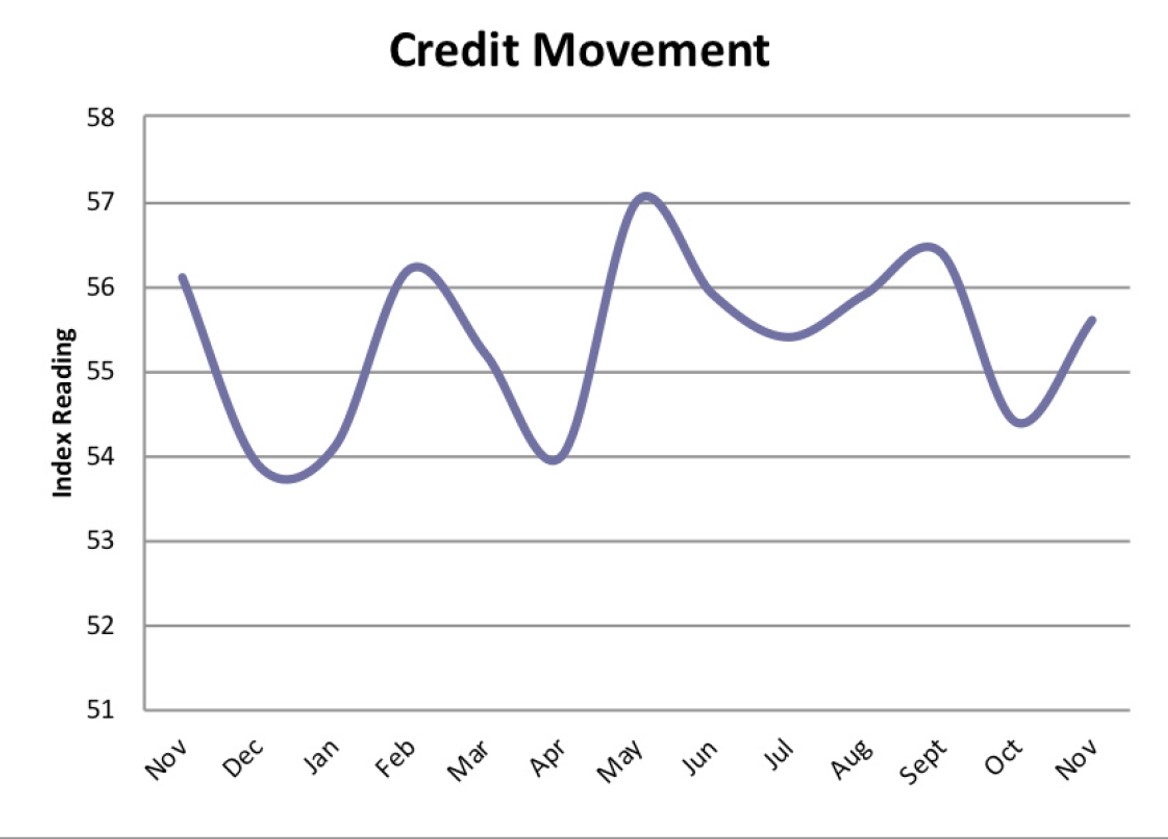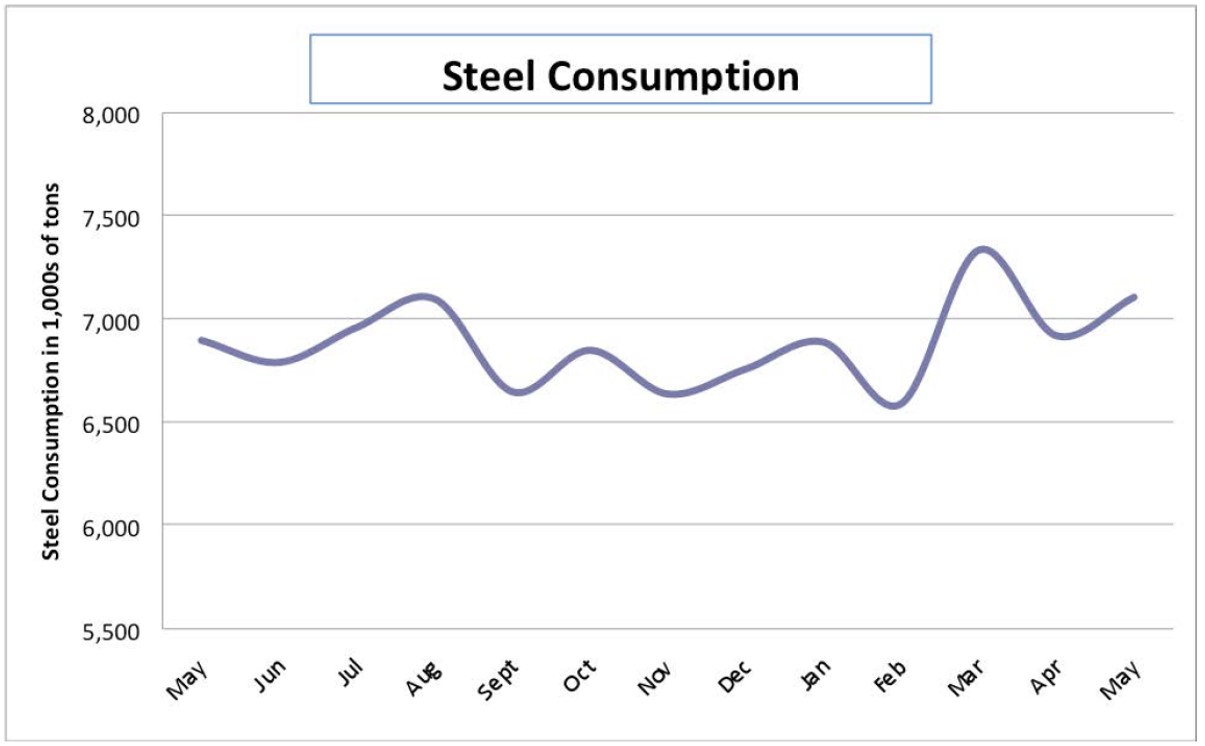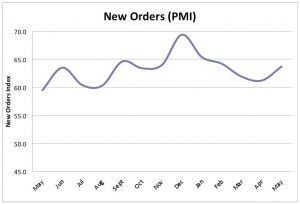


The economic report issued monthly to IHEA member company key executives showed what economists are calling a “transition” month with 5 indices showing an upward trend and 6 showing a downward trend. Among those moving upward: metal prices, capacity utilization, PMI, credit managers index, and the transportation index. Those heading south: auto/light truck sales, new home starts, steel consumption, capital expenditures, durable goods shipments, and factory orders.
This monthly report, which averages 12 pages every month, provides not only useful trending data but also in-depth analysis of each index. IHEA’s proprietary economist provides the analysis with special emphasis on how these movements affect the heat treat and thermal processing industries.
CapEx and five other indices moved down in May according to IHEA\’s Monthly Economic Report.
PMI Index showed signs of recovering in May. This and four other indicies moved upward.
For a full copy of the report, contact Anne Goyer by email (click here), Executive Vice President of the Industrial Heating Equipment Association (www.ihea.org).
Steel consumption, somewhat counter-intuitively, took a significant jump in April despite rising prices.
The rising price of steel along with three other negative moving indices were the only four downward-moving indices in May according to the authoritative monthly report issued by North America’s leading thermal processing equipment manufacturing association, the Industrial Heating Equipment Association (www.ihea.org).
Another negative indicator was the metal price index which reports on aluminum (up slightly), copper (steady), nickel (up slightly), and gold (steady). Given the anticipated and now-imposed steel and aluminum tariffs, it is uncertain what will happen to aluminum and steel prices although the report suggests that steel consumption was up not so much due to demand, but in anticipation of future shortages resulting from tariffs.
The PMI saw its fourth straight monthly decline.
Positive indices included industrial capacity utilization, new home starts, capital expenditures, and durable goods shipments.
Each month, the report details the movements and rationale behind 11-14 metal industry-specific indices. The full report is available to IHEA member companies.
To inquire about the full report, please contact Anne Goyer, Executive Director of IHEA by clicking here.
A must-attend event for thermprocess and industrial finishing & coatings executives, ITPS/IFCS will provide a unique platform for industry intelligence and collaboration. This two-day Summit will feature two joint general sessions with a total of ten presentations addressing topics of crucial importance to all manufacturing leadership, including:
Factories of the Future: What Does the Future Workforce Look Like? Dr. Irene Petrick, Market Innovation Director, Industrial Solutions Div./Internet of Things Group, Intel Corporation
Industry 4.0, Industrial Internet of Things, the Fourth Manufacturing Revolution, Artificial Intelligence – these terms have quickly become standard manufacturing terminology, but exactly how do they impact your business and your workforce? Dr. Petrick will address what manufacturers can expect on the factory floor as well as changes to their workforce as these once-ideological concepts become today’s reality.
Trends in Additive Manufacturing Todd Grimm, Founder and President, T.A. Grimm & Associates, Inc.
The hottest and likely fastest growing industrial technology over the past several years, Additive Manufacturing (AM) pops up in virtually every conversation about advanced manufacturing. AM expert Todd Grimm will offer insights on trends, metal and non-metal applications, and their impact on manufacturing that will assist thermprocessing and finishing business leaders in devising a strategy to leverage, or counter, AM’s impact.
Why I'm Attending: “This event is uniquely valuable in the thermal processing and finishing industries to C-level or equivalent people. I’ve found the 2-3 days to be an excellent opportunity to keep up with the latest “mega-trends” and as a refreshing time for thinking outside the box and making exceptionally valuable industry contacts.”
Doug Glenn, Publisher and Editor Heat Treat Today
[button link="www.itps-ifcs.com" size="default" icon="Select a Icon" side="right" target="blank" color="b70900" textcolor="ffffff"]Register Now[/button] Save 25% with discount code ED25C.
Registration discounts are available for IHEA, CCAI, MTI, CECOF, JIFMA, VDMA, Electrocoat Association and WiM members.
To register, or for complete Summit information, including hotel reservations and registration, visitwww.itps-ifcs.com.
Following several months of nothing but relatively good news, this month’s IHEA Executive Economic Summary Report shows some numbers dipping. As Chris Kuehl, the economist behind the report, states in his monthly in-depth analysis, “This month there is good news in bad data and some bad news in the good data. It is not always about whether an index is climbing this month or not. Sometimes it is the overall trend line and how it compares to what it might have been some months ago.”
Auto and light truck sales continue to be strong.
Every month, Dr. Kuehl, through IHEA, provides not only raw data that is of specific interest to the heat treating industry, but he also provides insightful analysis of what the numbers mean and why readers should care.
Dr. Chris Kuehl, economic analyst for IHEA, prepares the monthly IHEA Economic Trends Index.
The April report showed an increase in roughly half of the index numbers, including a surprisingly strong automobile and light truck sales index which, according to Kuehl, “continues to shock analysts as there is an assumption that the market is already saturated. It seems not to be the case as the consumer still has a desire for new wheels and if the current hike in gas prices accelerates there may soon be a new desire for those fuel sippers.”
Steel consumption continues to be weak.
Along with auto and truck sales, some of the other indices that also continued to climb were industrial capacity utilization, capital expenditures, and durable goods shipments.
Falling indices included the purchasing managers index, new home starts, and steel consumption.
Anne Goyer, Executive Director of IHEA
For a look at the complete report, contact Anne Goyer, Executive Director of the Industrial Heating Equipment Association (IHEA).
Special Report by Doug Glenn, Heat Treat Today Publisher
Doug Glenn, Publisher, Heat Treat Today
As mentioned in yesterday's special report, the Metal Treating Institute (MTI) and the Industrial Heating Equipment Association (IHEA) kicked off their combined triennial meeting yesterday in Scottsdale, Arizona, at the Talking Stick Resort.
For manufacturers with in-house heat treat departments, this event carries significance . . . even though it is not an event many (or any) of you might attend. It's at this event where the suppliers of your equipment, components, technology, and know-how update and hone their skills for helping you accomplish the heat treating you do every day.
Because many of you in the aerospace, automotive, medical, and energy sectors may know and recognize some of the attendees at this event (and because we all like seeing OUR pictures online!), today's Special Report is a selection of photos taken at last night's Opening Reception. Enjoy today's Special Report and let your favorite vendor know you saw them on Heat Treat Today if/when you see them next.
Also, special thanks goes out to these three generous sponsors for helping to underwrite the cost of this event:
Manufacturers with in-house heat treat would benefit from what’s going on this week in Scottsdale, Arizona. As many of you have expressed, experts are leaving your organizations, and they are not easy to replace.
Heat Treat Today recently had a manufacturer in the mid-Atlantic region call to say, “We need help with stress relieving!” They had nowhere to turn so they called us. This same type of thing is happening time and time again across the country as those with in-house heat treat knowledge retire or move on to other companies.
Where does a manufacturer with in-house heat treat turn for heat treating knowledge?
Besides subscribing to one of Heat TreatToday‘s regular newsletters and visiting the website periodically, in-house heat treaters can tap into the resources that have converged on Scottsdale this week. Starting today at the Talking Stick Resort in Scottsdale, North America’s largest gathering of heat treating industry professionals are holding a combined meeting with two of the nation’s most prestigious thermal processing organizations:
MTI — The Metal Treating Institute is a network of over 300 commercial/contract heat treating companies and suppliers.
Both of these organizations have separate semi-annual meetings, but once every 3 years they have a combined mega-meeting that brings in one of the largest gatherings of heat treat intelligence in all of North America. Companies from Canada, Mexico, and the USA are represented. This week’s meeting has drawn over 200 attendees and is full of educational sessions and networking opportunities to keep North America’s heat treat minds fresh and progressive.
Companies with in-house heat treat should consider tapping into one or both of these organizations to help them fill the brain drain that is happening and will continue to happen over the next decade.
Brain drain is a real phenomenon.
Heat TreatToday spoke with one company who estimated that up to 60 percent of the heat treat brains in their organization will retire within the next 10 years. This is not an isolated case. Baby boomers, who make up the vast majority of today’s heat treat industry brain trust, are beginning to retire and there are not enough metallurgists graduating from North American universities to fill the gap. Where are these manufacturers with in-house heat treat going to turn for specific, real-life heat treat help?
MTI CEO, Tom Morrison takes a “selfie” with Heat Treat Today’s Mary and Doug Glenn in Scottsdale, Arizona, as plans are being finalized for this week’s big heat treat brain trust meeting.
Both MTI and IHEA encourage manufacturers with in-house heat treat to join their organizations. This would be a great place to start. Both of these organizations are capable of fielding nearly any heat treat-related questions and if they don’t know the answers, they know people who will know the answers.
Both organizations also provide excellent training programs targeted especially for manufacturers with in-house heat treat.
IHEA’s combustion, safety, and induction seminars are all highly rated and reasonably priced. For more information on these courses, click here.
MTI offers a wide spectrum of heat treating courses in their “Heat Treat Academy”. Some are free, some come at a price. Click here for more information on the Heat Treat Academy.
So, here is a challenge. If you are a manufacturer with in-house heat treat, and your company is located near Scottsdale, Arizona, I suggest you send one or more of your top heat treat personnel over to the Talking Stick hotel/resort/casino sometime on Tuesday or Wednesday to join in on the meetings of top heat treat minds. If you’re brave and compulsive enough to take the challenge, please send me an email and I’ll help make the arrangements.
Otherwise, think about joining one or both of these organizations.
Finally, you can always contact Heat Treat Today with any heat treat related problems or questions.
The Industrial Heating Equipment Association’s monthly economic executive summary reported very strong gains for both automotive and light truck sales as well as new home starts. Regarding new home starts, here is an extended quote for the 12-page monthly report available in full to IHEA members:
The news in the housing sector is very good right now and that is in the face of those headwinds that have been referenced all year. Thus far the consumer is shrugging out the higher price of homes as well as the bigger down payments and there has been buying at a variety of levels – from the starter home to the much more expensive “McMansion.” The fastest growing segment is still the multi-family home and there are still major shortages of this kind of abode. The recovery this month after a down period the month before is somewhat related to the weather, but not as much as would have been assumed this time of year. There is evidence that housing activity is surging in the jobs data as well – over 60,000 jobs added in construction this month. The majority of these are in the housing sector as there has not been a huge recovery in either commercial construction or in public sector activity.
The dozen indicators reported were split evenly between those that were up and those that were down. Significant is the fact that the PMI saw a slight dip but has been strong, in the mid-sixties, for quite some time, reaching a peak in December 2017 at 70.
Anyone interested in receiving a copy of the full report which includes statistics and analysis of the following indicators should contact Anne Goyer, Executive Director of IHEA. You can email Anne by clicking here.
Orders for North American steel and aluminum have been on the rise since speculative talk about restrictions on the import of metals began last year, according to Tony Uphoff at Thomasnet.com, and the recent recommendation from U.S. Commerce Department Secretary Wilbur Ross to impose steep tariffs on foreign steel and aluminum seems to support the motivation behind the trend. Alcoa, Arconic, AK Steel, U.S. Steel, and Nucor were among the U.S. steel and aluminum manufacturers which saw increased activity prior to the announcement.
IHEA recently released its monthly Executive Economic Summary for January 2018.
The Industrial Heating Equipment Association (IHEA, www.ihea.org) recently released its monthly Executive Economic Summary for the month of January, the first release of 2018. The report, available in-full for IHEA members, indicated that 2018 is off to a very strong start with all but three indices moving strongly upward. PMI and New Automobile/Light Truck Sales along with one other index moved slightly downward while nearly all others moved positively including Capacity Utilization and Capital Expenditures.
Anne Goyer, Executive Director of IHEA.
In addition to reporting on 12 or more indices important to the thermal processing industry, this monthly IHEA report offers insightful analysis of each indices’ impact on the industry. The report, funded and syndicated by IHEA, is available, in-full to IHEA members.
To receive a full copy of the report on a monthly basis, please contact Anne Goyer, Executive Director of IHEA.
The Industrial Heating Equipment Association (IHEA) released its members-only report on 12 economic indicators for the month of August – 3 moving upwards, 3 flat, and 6 dipping slightly. The report, released in on September 15th, reported significant gains in new automotive and light truck sales, steel consumption and one other index.
Source: Google Images from Magzter.com
The September 15th report summarizes economic activity for the month of August which predates hurricanes Harvey and Irma which are expected to cause year-end turbulence in economic reporting. Effects of the hurricanes are anticipated to dowse economic activity in September and possibly into October, followed by a rebuilding boom in the final months of the year into 2018. IHEA reports that the effects of the hurricanes are unprecedented in recent history and will make predicting year-end results very difficult for the thermal processing industry.
The increase in new automotive and light truck sales, as well as the upward tick in steel consumption, are believed to be somewhat tied together and possibly aided by a fear of pending import steel tariffs.
In addition to automotive light truck sales and steel consumption, the monthly IHEA report also covers the following economic indices with professional analysis of their impact on the thermal processing industry specifically:
New home starts
Source: Google Images from DealerVideoShowroom.com
Industrial capacity utilization
Metal pricing – gold, aluminum, copper, nickel
New orders (PMI)
Capital expenditures
Durable goods
Factory orders
Credit movement
Transportation activity index
For more information about this report or for a copy of the report, contact IHEA Executive Director, Anne Goyer, at anne@goyermgt.com.