


Heat treat operations generate enormous amounts of data, but how can that information be used to improve process control, prevent failures, and make smarter decisions? In this episode of Heat Treat Radio, host Heather Falcone talks with Steven Christopher, vice president of Business Development for Super Systems, Inc., about how AI and automation are changing furnace data review, predictive maintenance, and quality assurance. They also discuss the importance of operator knowledge, effective data integration, and staying ahead of evolving specifications to improve heat treat operations.
Below, you can watch the video, listen to the podcast by clicking on the audio play button, or read an edited transcript.






The following transcript has been edited for your reading enjoyment.
Introduction
Heather Falcone: Hi, I’m Heather Falcone, and welcome to Heat Treat Radio. This podcast is produced by Heat Treat Today, and focuses on the real technical and operational decisions made in heat treating and thermal processing environments. Each episode covers practical knowledge, current challenges, and informed perspectives from people working directly in the industry.
Today, we’re talking about what your heat treat data is trying to tell you. We’re in person with the sponsor of our episode, Super Systems Inc. SSI develops and manufactures controls, sensors, software, and engineered systems for the thermal processing industry. With more than 100 years of industry experience, SSI helps heat treaters improve process control, traceability, efficiency, and product quality.
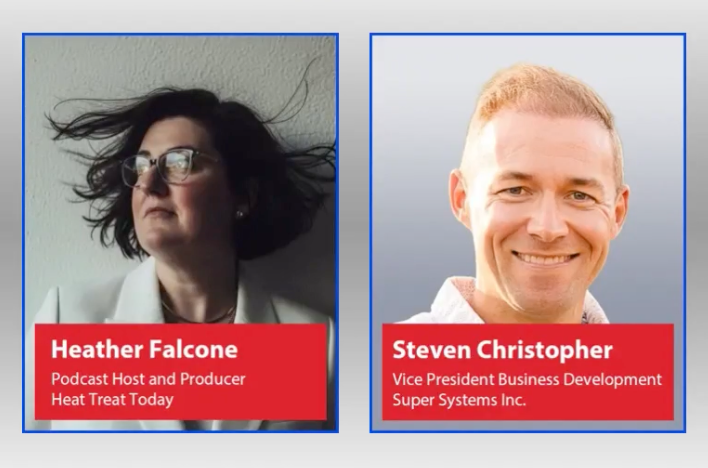
This is Steven Christopher. He’s the vice president of Business Development at Super Systems. He’s a Purdue engineering graduate who started his career in pharmaceutical maintenance before moving into commercial heat treating, working in a Nadcap certified operation serving both automotive and aerospace customers with processes including nitriding, carburizing, plasma ion, and vacuum heat treating. He spent more than a decade with Super Systems.
Furnace retrofits, working with heat treaters around the world, this guy has done everything. He’s also authored technical work on vacuum furnace automation and process controls. He was part of Heat Treat Today’s inaugural 40 Under 40 class. He also lead the West Coast operations. Thank you for joining me today, Steven. I appreciate it.
Steven Christopher: Thanks for having me.
What Furnace Data Can Reveal (2:42)
Heather Falcone: We’re starting off with the first question. We’re talking about what heat treat furnace data can actually tell you, and the reason I wanted to talk about this is that there is just so much of it. When the furnace run is complete and someone is reviewing the data, what are the things that we, as heat treaters, are most likely to miss?
Steven Christopher: So much, right? The answer is it’s always the small stuff. I like to use this example: how many Nadcap audits have you been on at this point?
Heather Falcone: As many years as we’ve known each other, double that probably.
Steven Christopher: Right, and then you’ve sat in on peer reviews and so forth.
Heather Falcone: Yes, exactly.
Steven Christopher: A couple of years ago, everyone started saying, ” I got this NCR because I missed this pyrometry finding. I didn’t record this correction factor. I didn’t do the math correctly. I made some mistake.” So what happened? A few people came in and created pyrometry software to avoid all these problems, to help dot the I’s and cross the T’s. It’s wonderful. The problem with data review, and the challenging part of data review for us, is that it’s not as perfect a fit and not as defined as SATs and TUSs. So, it was always a challenge and difficult for us to do. But I think that becomes a perfect fit for where AI and computing power are going.
Going back to your original question, I think data review is where pyrometry was two and three years ago, but it’s there now. The human brain, the human experience, is all focused on the big stuff. In terms of heat treat, I’m worried about time and temperature. Did I get there? Did I overshoot? But the devil is in the details. For us that means: was my dew point negative enough? Was my quench temperature where I needed it to be? Did it rise too much? All of these little things are the challenge for us, and that’s what’s exciting.
Where we are now is that we’re able to review charts in a reasonable amount of time and tell people, “This was good, this was bad, or maybe you just need to look here and explore a little bit more.”
Heather Falcone: Well, I think it’s also important to know because so many of our furnace issues look minor on the surface. So what are you looking for that ultimately is going to become a bigger issue down the pipe?
Steven Christopher: Everything. All these specs are driven by problems. They wouldn’t be in the spec if it weren’t challenging and creating a problem, whether metallurgically speaking or otherwise. But I think that’s what makes it fun. And the reality is that if heat treating were easy and all these little problems didn’t exist, every manufacturer would be doing it in-house. So I think the problems are what create the space for the commercial world to exist.
Heather Falcone: I would love for us to grow out of that pain mentality, though. There are a lot of steps between what the customer requires and what ultimately gets programmed into the furnace. How do we see that process break down? How do we get out of learning by trial by fire? Give me an example, because we have so much, and all these different systems give us an abundance of data points that can look really minor on the surface. Where is the big problem lying?
Steven Christopher: Everywhere. That’s the fun part of heat treat, right?
Heather Falcone: I don’t know that it’s fun, even if it’s true.
Steven Christopher: Even the small stuff can punch above its weight class and be the big stuff. It’s easy to lose sight of all these small things that can manifest into bigger problems. And if it were easy, there wouldn’t be room for commercial heat treaters, because everybody would just do it in-house and manufacture it. So the minor stuff really can have a big impact. I think the other challenge is that half of the problems can show up on a chart, and half of the problems don’t. On the chart, can I measure my dew point and quench and temperature and all the stuff we just talked about? Sure, that’s easy, and then we can review it. What about the other stuff?

I racked parts too densely, and then I went to quench and have problems localized to this part of the basket but not that part. Or I nitrided and I have poor case on some parts because someone didn’t wear gloves racking the parts. It’s really infinite, and it’s really difficult to capture all of that in a chart and then review. So I think the challenging part is that even with all the best practices in place, there’s still a human element to heat treat, and you have to make sure the practices, the procedures, and the discipline are all in tip-top shape on the shop floor.
From Specifications to Furnace Recipes (7:18)
Heather Falcone: The human element is really interesting because there are a lot of steps between what the spec says, what the customer requires, and what actually gets programmed into the furnace. Walk me through where you see that process break down.
Steven Christopher: Well, the first answer was the simple stuff. Now it’s the people. The harder answer is where we decide what to program in and what we’re just going to watch and monitor. Vacuum is big on the West Coast. Obviously that’s what brought me out here, working with you thirteen years ago. So AMS2769 details all this. Table two talks about the temperatures and all the different types of equipment and material, and that’s the easy part. Ninety-nine percent of the time everybody gets that right. I think where it starts to get difficult is when you drive down into the details. Section three talks about dew point. Table four talks about vacuum leak-up rates, etc.
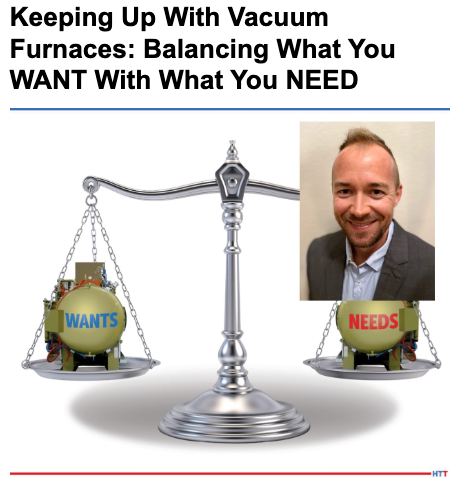
To your original question about what you program and what you don’t, I think what blurs the line is what’s driven by the recipe and what’s the kind of stuff that happens behind the scenes but ultimately still impacts the specs and the requirements that allow you to sign off and ship parts, because at the end of the day, that’s what we care about. So I think it’s interesting and challenging to decide what we’re going to program into recipes and what we are not going to. If we’re not going to, is that just going to be a deviation on the equipment that sounds the horn or tells somebody to come over and check something? Or are we going to build that into the process and prevent it from running additional jobs, or people from moving forward?
Heather Falcone: Chasing down root cause and making things more efficient, as opposed to just programming what might be on the paper.
Steven Christopher: Totally. But I would say that if you had asked me this question when we met thirteen or so years ago, I would have said, “Yes, there’s all this data. We want to program all these things.” But maybe I wouldn’t have had a roadmap of how to do it. And I think that’s true for my 20 years of heat treat experience. No longer. Today it’s ready. I think the computing power, AI, all those things add up, and we’re at a point where we can evaluate everything and make good decisions based on it. That includes not just the recipe side, but also everything we’re building into the background.
Heather Falcone: What’s interesting about that, and I think we’ll cover this a little later, is that SSI is right on the forefront of that. We’re going to talk about maybe some up-and-coming new stuff.
Managing Specification Changes (10:04)
Heather Falcone: What’s not exciting, though, is spec changes. The reason we talk about spec changes is that they overwhelm our teams, whether it’s quality, engineering, or the operator on the floor. So how do you make sure that a change actually makes it into the recipe instead of everybody assuming that somebody else handled it?
Steven Christopher: It’s difficult. At the end of the day, all these types of procedural challenges are only overcome by good people, good practices, quality systems, all of that. And this goes back to my commercial heat treating days. It’s really easy to get complacent on the contract review side. You get a part in for the 10,000th time, some spec has evolved, wherever it may be, and it’s ultimately your burden to make sure that you read it. If you’re lucky, there are bubbles on the chart or on the spec that comes in, the little lines. Maybe they changed a word. I don’t know. But somehow it’s your problem.
I was walking around FNA last week, and I saw a couple of ERP systems that were scanning specs or potential jobs. The optical-to-text character—
Heather Falcone: The OCR.
Steven Christopher: The OCR technology was amazing, and it was cool that it could take any document and turn it into meaningful characters, then take those characters and turn them into steps, and ultimately drive their process. I’m excited to see how that comes into the spec world, because now when you get these types of contracts, what can we scan and what can’t we?
The last part of this, because it’s a difficult topic: I always think the best defense is a good offense. Get out ahead of things. I love the saying “either have a seat at the table or be on the menu,” and I think the best way for any of us to do that is to participate.

You probably travel 50 weeks a year to different Nadcap things and MTI and customer events, or whatever. It’s a million things. But I think it’s important for anyone in heat treat to get out and be active in those, whether it’s Nadcap or AMEC or MTI or whatever your industry standard is. It’s not really important which. If you’re part of those conversations, you can see what’s coming before it gets to your front desk, and that’s what allows you to get out ahead of things and make sure you know what’s coming.
Heather Falcone: Not only that, but you get to participate. If they write something poorly, you can vote against it, or you can speak up and say, “Hey, we actually run these parts for you, and if you put this in, it’s going to raise your price 300%, or it’s going to stop us from being able to ship on time.”. Getting in at the committee level or the task group level, like you said, I would love for every single person to do that. There can be a lot of steps between what the customer requires and what actually gets programmed into the furnace, so let’s talk about where you see that process breaking down.
Steven Christopher: That’s a really challenging one, because there’s a blurred line between what I’m going to run in terms of the recipe and all the other stuff I care about that allows me to ship parts Here’s my example: AMS2769. There are the surface-level requirements. I have to go to this temperature. I think table two talks about this. You have to go to this temperature, and you have to hold for this many hours, and so on. That’s the easy stuff, and it transfers into the programs.
I think what’s more challenging is when you take a deeper dive into section 3.3 talking about dew points or section four talking about leak-up rates. I think all these things are really important, but where’s the natural fit for them? Are leak-up rates built into the recipe, or are they not? They both matter when you ship parts at the end of the day. How do we decide what’s the best home for them?
Before the last few years, you had no choice. Systems weren’t complicated enough and weren’t intelligent enough to bring all of these things under one roof and make decisions. That has changed. Now I think it’s a procedural thing. How much do we want to build into this? Or if something deviates, do we just want to sound an alarm horn, turn on a light, etc.? This circles back to the original question of what we decide goes in the program and what doesn’t. I think that’s going to be a user-level or case-by-case decision. But we’re ready. For the first time in my 20 years of heat treat, it’s not something we’re talking about, it’s something we’re doing and we’re ready for. It’s exciting.
Heather Falcone: And we’re ready for it, and let’s talk about the readiness that comes with spec changes, because very few times are we ready for that, unless you’re on the forefront, which we’ll circle back to again. How do you make sure that when a spec changes, the changes actually get flowed down instead of everyone assuming that somebody else handled it?
Steven Christopher: At the end of the day, it’s all driven internally by your good people, good practices, good procedures, good quality systems. None of that is going to change. But I do think there may be some new opportunities.
Going back to changing specs and contract review, going back to my days in commercial heat treat, it’s so easy to get complacent. If you’ve processed a part for the 10,000th time, you’re going to run it like you did the other 9,999. But they do evolve. They do change. And if you’re lucky enough, your customer will tell you that it changed. They’ll put a little bubble on the spec. Maybe they’ll change a word and not tell you about it. But it doesn’t matter. The burden is on you as the heat treater.
Going back to FNA and spec review, enter AI. I was walking around FNA and saw a couple of vendors in the ERP space talking about optical character recognition, where I can scan this document, convert it into meaningful steps, and then create my traveler or whatever.
I think that’s going to come into specs as well. As things change, I can just scan a document and see whether it’s the exact same as it was those other 10,000 times, or whether it flags something I need to do something about. I think that’s one aspect: OCR and how that can change that review. But I love saying that the best defense is a good offense, and I’ve always loved the saying that you either need to have a seat at the table or be on the menu. It’s important here because specs are evolving daily, weekly. When one is off the menu, the next one is on. So I encourage everybody to become active in whether it’s Nadcap or AMEC or MTI or whatever your specs are.
Join. Participate. It’s not a call to action, it’s just a benefit to your organization. If you know what’s being talked about now, what changes are coming in the industry, and when things are going to final ballot, you know when to tell your people, “Start keeping an eye out for this, because for this product that we run, there’s going to be a change.” So getting out ahead of it is certainly the best offense, and I encourage everybody to get involved.
Heather Falcone: And most people don’t even know that you can get involved when we’re still considering the change.
Steven Christopher: You can literally just show up in Pittsburgh and participate.
Heather Falcone: Exactly, and you can have an opinion, and they have to listen to you. Our voice is just as important as any other voice.
Steven Christopher: And I always like going to the meetings because it’s a big group of people, but there’s a small group of people that really have influence, and it’s not because they were handed a wand. It’s because they just showed up. You’re one of them. There are a lot of others who get involved, but they’re there, they show up every time, and they’re very welcoming. When I show up, it’s always, “Hey, so glad to have you here. Can you help in here? Are you willing to do this?” And it’s exciting to be a part of. The more the merrier.
AI and Automation in Heat Treating (20:36)
Heather Falcone: Now, humans are still driving the industry, even though we have a ton of automation coming in, and I really want to touch on that because I don’t think we’re talking about it enough. Is every other podcast you listen to about AI and automation? Yes. And specific to our industry, there is so much more that we can automate now than we ever had before when it comes to reviewing furnace runs specifically. So what are we ready to do as far as system realities? What can it check for us? Where do we still need someone who knows what they’re looking at? What frontier have we hit?
Steven Christopher: Well, it would be generic here to dive into AI. I beat up the chart review earlier, but the reality is that it’s in a different place than it was even a year ago, and two or three years ago certainly. I think the power that AI gives us is the volume of data.
I was a room chair, or host, at the FNA technical sessions last week. My session was focused on AI, so I got to listen to a lot of really intelligent people share where they are. What I like about talking about AI, and back to your question, automation, is that there are two certainties I took from last week. One, everybody knows its benefits, and it’s here, and there’s no disagreement about that. It has its space. Everybody wants onboard. The other thing is that everybody thinks they’re behind the eight ball. There are super users where I sit there and think, “Oh my goodness, you’re way ahead of everybody else.” And then there are people who haven’t even opened up ChatGPT or Claude.
Heather Falcone: I had a guy on the floor walk up to me and show me the app he had just vibe coded on his phone in about 20 minutes, and I was like, “I need to take a class.”
Steven Christopher: I know. When you see the super users, you think, “I need to be that person.” But how is it that people on both ends of the spectrum both think they’re behind? So in terms of automation, what matters today isn’t being the super user using AI in every facet of your daily life. It’s recognizing the possible impact and taking steps every day to move in that direction. We have internal meetings weekly about what we are doing, what we can make more efficient, and where we want to be six months from now, a year from now. It’s hard to think much beyond that, because who knows where this is going? It’s weekly, monthly, it’s changing. In fact, sometimes I’ll ask the same question I did last week and get a better answer, because it just wasn’t quite there.
Heather Falcone: The universities can’t even make it through a whole semester. They’re teaching courses on AI, and they have to throw out the curriculum in the middle of it and start over. It is evolving in real time here, and we’ll be a part of it. So on automation specifically, because the technology is moving at such a rapid pace, it’s only as good as the requirements behind it. How do you make sure the system is actually checking against the right information in the first place?
Steven Christopher: We’re on the downstream end of that, because we’re not necessarily the ones receiving the specs and doing the contract review. We’re getting what’s happening next. But it’s the same sandbox, so we have to be very aware of it. Procedurally speaking, everything at SSI now is revision controlled: who changed what, when they changed it, what was changed. That could be anything from recipes to what other specs they changed in our system.
We’re also in an interesting space because we both receive data and produce data. We’re talking to all this equipment, and we’re getting information from this sensor and this analyzer and so on. But we’re also getting it from people. We have operators telling us what they were doing last, and quality people are interacting. So we’re getting a ton of data from both equipment and people, and then we’re producing results.
Automating Process Verification with GoalPost (25:04)
Steven Christopher: Going back to your original question about how we tie the specs in and make sure you’re doing what you’re supposed to be doing, I’d say it’s twofold. The one current thing for us, which we’ve been talking about at FNA again last week, is GoalPost, the big software we’re discussing. That is essentially our auditing process for “did I run what I said I was going to run?” It is the answer. It’s the time saver. Labor is a real problem now.
Heather Falcone: When I saw it, I almost fell over. I was standing there, and every inspector I’ve ever worked with is just going to die.
Steven Christopher: I showed 50 people last week at FNA, and they all said, “Well, that is just going to save me however many hours a week.”
Heather Falcone: It’s incredible.
Steven Christopher: The idea is that you build a specification, you build a program, and then did it do what you told it to do? How many things can go wrong?
Heather Falcone: Multitudes.
Steven Christopher: Overshoot, undershoot. We’re talking about quench and dew points and flows and dissociations. It’s a million different things. Rather than having to go through a chart, because even a good person on their best day, and for the most part we don’t always have the best people, it’s a challenge.
Heather Falcone: We’re working with what we have. The industry is changing so much.
Steven Christopher: And that’s not a knock. But even the best person on the best day, this is a challenge. And for that best person, do they have all the time in the day to review these charts? Nobody has all the time in the day.
Heather Falcone: And the volume that a normal heat treater, commercial or captive, is dealing with.
Steven Christopher: A hundred percent. So now we have this challenge of review, and GoalPost allows people to literally, at the click of a button, tell me: did I do what I was supposed to do?
Heather Falcone: It’s so cool. It’s like red and green. Green, good. Red, bad.
Steven Christopher: Go, no-go. It just passes. So we’re really excited about that.
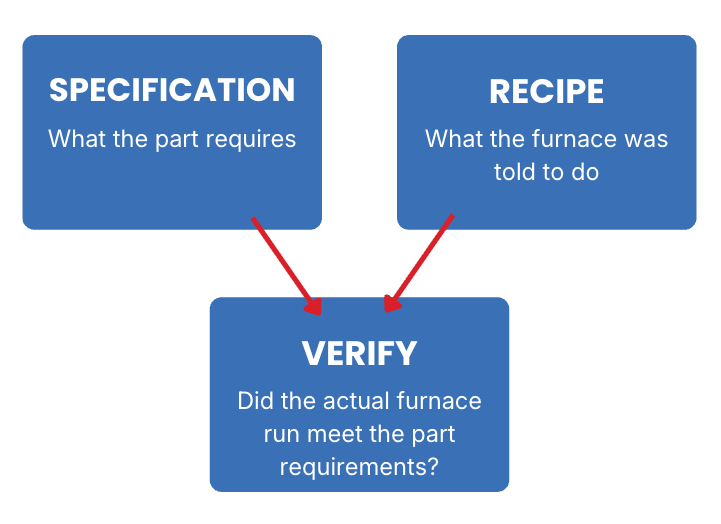
But back to the crux of the original question, which was how do we make sure we’re checking the right information in the first place? One of the big realizations we had early on was that you can build all these sanity checks into your recipe. What if somebody runs the wrong recipe? If you’re checking yourself against yourself, no, you always have a peer — you have to have a peer review process. So for us, that was an important realization: I can’t just create a recipe and then ask, “Did that recipe do what it needed to do?” I need to create both a recipe and a specification, because the specification is what’s tied to the part, and the recipe is tied to the part as well. Now those can work together to say, “Did I do what I needed to for this part, to get the right metallurgy, to get it out the door?”
Heather Falcone: Exactly. And it’s important because let’s say the run falls outside the process requirements. What information does the quality team really need in front of them to make a good decision about what actually happens to those parts? Disposition, contacting the customer. Did they scrap the load.
Real-Time Quality and Operator Knowledge (28:10)
Steven Christopher: Absolutely. I think waiting for quality to raise the red flag is maybe not the right answer. We can’t wait until the end to say, “We made a mistake.” We have to catch it in real time. I know you have a couple of boys, and I have a few, but I came up with this example a while back when someone was asking me pretty much the same question. It’s relevant to heat treat. When you come home and the kids are out of school and you see a pizza baking in the oven with no timer set, do you wait until smoke is coming out of the oven before you go? No. You figure it out. You adjust on the fly. So I think what we need to do in heat treat is this: we can do all this automation at the end.
I love GoalPost, I love the idea that we’re going to tell you that it’s good or bad. But what I’d love is if everything were good every time. So we need to make people aware, and we need to empower operators, because I think so often it’s easy to blame operators — they started the wrong recipe, they did this, they didn’t do that. Well, how many times can we do that before we say we need to change the way we’re doing things, or give them the tools to do what they do? Because I’ll be honest, no one knows the equipment better than the operators.
Heather Falcone: A hundred percent, and they know how it’s operating day in and day out.
Steven Christopher: Right, and they know the noises that are normal and the smells that are normal, and that this is fine for this process. So we need to empower them to free up their time, so that when they’re out there walking around, racking parts, doing whatever, they can say, “This isn’t normal,” or bring someone over to take a look at the job. A million ways things can go wrong, and I think what’s important is that we don’t wait until the end to flag that. We make people aware so they can make adjustments in real time.
Heather Falcone: While things are going wrong, or have been going wrong, what are the best practices to make sure those parts don’t accidentally move along while we’re still trying to figure it out? Does GoalPost have anything about that?
Steven Christopher: GoalPost is part of a bigger software platform we have called LoadEntry, so that would be more of a LoadEntry thing. What’s nice is that we’ve taken a lot of custom solutions and found a nice non-custom solution that seems to work for everybody, so we’re pretty proud that we’ve built it out to where it works.
Heather Falcone: Okay, small plug for the program development team, because we have submitted suggestions and then they build them in, and that is a very valuable thing to heat treaters, commercial, captive, or otherwise. Having your software team actually listen to feedback is so important.
Steven Christopher: Absolutely, and that’s what makes us great. We’re not heat treaters. We’re not on the front line every day seeing how these parts fail. But what we do is have a completely open relationship where we receive feedback, we prioritize it, and then we ultimately build it into our systems.
Connecting Systems and Sharing Data (32:07)
Heather Falcone: When stuff goes wrong, LE3 stops it. Tell me about that.
Steven Christopher: LE3 stops it, but here’s the challenge we face in heat treat. I always hear the word “silos.” There’s this silo. I have this server that does this. I have that server that does that. I have this server that’s still on XP, so it doesn’t play nice with anybody. My personal favorite: we bought this piece of equipment, but the IP addresses aren’t what we wanted, so we’re living with it offline.
Steven Christopher: You’ve got all these silos, and the more features people add, the taller these silos get. We have to connect these things. We have all the bridges between the silos. We have to build these bridges, and we have to allow data to go from silo to silo and back and forth. And of course, we’ve all got our secret sauce. There’s going to be something we don’t want to share. That’s what makes every company special. But the reality is we have to be willing to talk with other people.
I’ll go back to LoadEntry since you mentioned it earlier. We built this maintenance module maybe three or four years ago. It was pretty simple. You could build maintenance tasks, from applying grease to replacing belts to whatever. Or you could say, “I want to do pyrometry in this furnace,” or anything else.
The point was you could schedule things and build routines that would then lock out equipment. We were very proud of this. We went into our first shop, and they said, “We love everything about this. We’re going to do our pyrometry in here, we’re going to do this, but we have a maintenance system already, and we really like it.” We said, “Okay.” So we went to the second shop and they said, “We love everything about this. We’ll do our maintenance in here, but we have a pyrometry system that we really like.”
Heather Falcone: I’m sensing a theme here.
Steven Christopher: So we’re caught in the middle, and what do you do in this situation? We’re not Apple. We can’t tell everybody to buy only SSI product, although we’d like to.
Heather Falcone: Well, you try.
Steven Christopher: We try. But we had to find a way to play nice with everybody. This goes back to your original question about how you prevent problems downstream. We thought we had that, and we do have that solved, at least on the recipe front with this maintenance lockout feature. But we needed to find a way to open up and play nice with everybody. We have an API, which I think most software has at this point, to share information, and that’s the bridge connecting all these silos together. That’s been important for us: to build systems and to partner with people who want to build systems and share information. At the end of the day, there are a lot of different software components out there. Everybody needs something a little bit different. You’re either going to make your customer’s life easier by playing nice, or you’re going to be a challenge.
Heather Falcone: It’s more about playing nice. I’m saying you personally, the ubiquitous “you” as SSI, seem to understand that heat treaters generate an enormous amount of data. I’m not sure everyone is really using it beyond proving that the rod can ship.
Using Historical Data for Predictive Maintenance (35:26)
Heather Falcone: On that topic, now that SSI has integrated and is partnering and has all these different features, what should we be looking for in the history, in how it ran, to identify recurring problems that could improve the process?
Steven Christopher: Absolutely. We’ve been good at collecting data for a long time. But where we’ve struggled in the past is taking that data and turning it into really good information, because data is just taking up space on the server. What can I do with that information? If you asked me this question ten years ago, I would have said, “No, we’re not doing enough with it,” but I wouldn’t have really known what that meant exactly. It just sits there, like you said. I know it’s there, and I can look at things — and five years ago I would have said the same — but have you heard of AI?
Heather Falcone: I think we talked about that just a smidge.
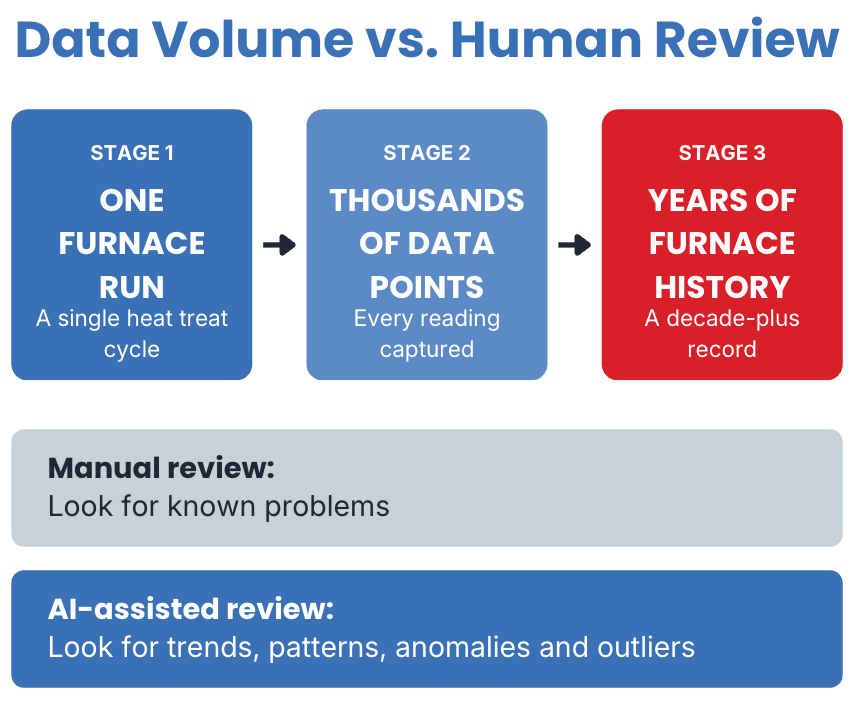
Steven Christopher: AI? Yes. I think AI is coming. This is going to change everything. When we’re talking about 10,000, 100,000, however many data points, and then looking at that over a process run, that’s a big task. AI changes this, because now we can look at those same 10,000, 100,000 data points not just over a run, but over 10, 15, 20 years. So we’re really excited about what this means in terms of data review, what we can do with it, and what we don’t know about it.
I think the best example is that data collectors have always talked about preventive maintenance. I’ve installed vibration sensors here or some analyzer there and tried to glean information from them, but really you’re looking for high and low limits. AI is going to change that, because now we can start to look for trends, patterns, anomalies, outliers, the things you can’t see just looking over time if you’re doing chart review. But it can. So I’m excited to feed in a ton of data, or rather our customers feed in a ton of data, because we keep our hands off of it, and see where it goes.
Heather Falcone: The nice thing about that is you aren’t looking at just a snapshot in time. You can now start to aggregate, and predictability of a furnace becomes something you don’t have to just hope and pray for.
Steven Christopher: There’s a black box. Is it working?
Heather Falcone: Right? It’s not just on, off, go, no-go. You can actually see the trends over time, like you said, but using your own data. Before, maybe we had to rely on the Heat Treat Doctor or somebody teaching us what we should look for, but now we can actually use our own stuff.
Steven Christopher: Get ahead of it.
Heather Falcone: Wouldn’t that be cool, to be preventive like we always wanted to be?
Steven Christopher: That’s the goal, right?
Heather Falcone: If we’re now looking at this data, it’s going to expose things like maintenance problems, draining issues, recurring process problems. What have you seen?
Steven Christopher: I do think we’re on the front end of it. When we talk about all these AI models, we’re all still very much on the training side of things. We’re feeding data and trying to learn from it. But let’s go back to the vibration example. What’s normal, what’s not? When we start talking about vacuum furnaces and elements, when do I need to replace these? When is it really a problem? Before, we’d put amp meters on and measure, compare volts and amps, and this one has deviated, or this one is again outside those tolerances. But maybe that’s normal for this size load, or whatever has changed.
Heather Falcone: This furnace or inside the furnace.
Steven Christopher: Or maybe it has degraded over time and it’s different than it was before, but it’s maybe not bad. Maybe it doesn’t need to be replaced, it just needs a little adjustment. Burners needing tuning, all sorts of things. But I think one problem we have is that we want to be proactive, but the reality is we’re reactive in heat treat. Part of that is that production is king, so you run stuff until it can’t run anymore.
The other thing is that we don’t know what decisions to make, because we’ve got all this data, but we don’t really know when it’s a red flag and when it’s not. I think the important part is to get ahead of everything. I don’t want to wait to fail a TUS and then have to go through the last three months of product impact, which has a high cost.

I want to be able to look at load TCs, analyze them in real time, and say, “These are starting to trend in one direction. Maybe you should do a TUS this month instead of waiting until next month.” And of course, nobody is going to like that, because that’s more work. But if it catches it out of tolerance, this is a benefit to everybody.
Heather Falcone: A failed survey is disastrous. You’re back on your initial frequency, initial TUSs, and that is so expensive in itself. If anybody stopped to quantify the cost of poor quality compared to a preventive TUS.
Steven Christopher: If you can prevent it once, that’s great.
Heather Falcone: So much cheaper, and so much faster. Then you have furnaces down, you’re swapping controls, you’re doing leak tests.
Improving Furnace Utilization and Scheduling (40:34)
Steven Christopher: Speaking of furnaces down, I think utilization is a good point. Uptime, downtime. That’s where AI is really going for us. Within that, again, it comes back to this LoadEntry module we talked about, but scheduling is a big one for us. It’s in a gray area, because ERP systems schedule, but people still have their whiteboards that they schedule on.
Heather Falcone: I was going to say, what are you talking about? We have an Excel spreadsheet.
Steven Christopher: Right, but wouldn’t it be cool if the system just did that for you? What’s neat in getting into utilization and AI is one very simple thing we do. When you go to schedule a load, if you have a job that’s five hours of heat on your whiteboard, how much time does that take? About five hours?
Heather Falcone: However long you put the little brackets on in the black marker.
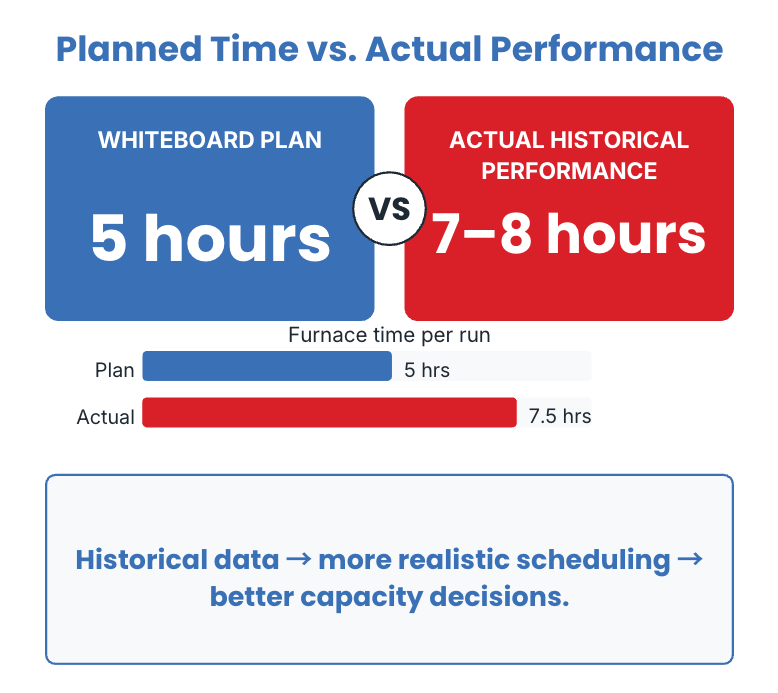
Steven Christopher: But our system is looking at the last 10 or 20 times you ran that. As that process changes because the elements are going bad, it’s taking longer to heat up and cool down. It’s not a five-hour run, it’s a seven-hour or eight-hour run, and we’re placing and allocating that much time in the system. But what I think is really neat about AI’s potential is how we can improve our scheduling, understand our true capacities, and maybe even forecast jobs.
We’re good at looking for triggers and big events, but there are leading and lagging indicators all over this world. With AI, we can start to predict things that will allow us to anticipate what jobs are coming up and what jobs I can combine. Maybe I think I need more equipment, and maybe I just need to do a better job scheduling. That’s the kind of stuff we’re asking ourselves every day: how can we do that? And then going back to the specs and the customer requirements, that’s the real challenge for us: how do we work all that into it?
Upgrades, Workforce Challenges, and Training (42:23)
Heather Falcone: We have so many layers of complexity in the industry, because a lot of our listeners work with older furnaces, or multiple controller types, or different generations of equipment, and they really have limited resources. So if we want to make things better for traceability and verification, where would you tell them to start?
Steven Christopher: I think modern systems are all built around automation, communication, and transparency. They’ve got all these cool features built into them. But in the abstract, when you’re talking about doing upgrades at a facility, what’s important is to surround yourself with good people. I was given that advice a long time ago: if you surround yourself with great people, great things happen. And I think you can replace “people” with “companies” and it’s the same thing. Any time you’re talking about upgrading equipment, it’s really important to partner with someone you can pick up the phone and talk to, because problems are going to arise, and it’s going to be about whether you can solve them together.
Steven Christopher: Let’s talk about labor. I think right now we’re seeing the warning signs. People think it’s bad, but I think those are really just the warning signs. The problem is coming, maybe five years out or later. It’s coming. The challenge we have as an industry is bringing people on, retaining them, and then training them.
From our part, I think another really great consideration when you talk about controllers, especially for commercial shops that have vacuum and endothermic and nitriding and ten other processes, is how I can shorten the time from a new hire to an expert. When it comes to controllers, I think it’s important to work with people who understand all of that type of equipment and can work with you to make all those experiences as similar as possible, so that you can train somebody once and they just get the rest of it.
Heather Falcone: It’s so disruptive. The changeover and the brain drain, and the loss of knowledge is a problem we’re going to have to face as an industry. It’s not just us, it’s everybody.
A Practical First Step with AI (45:01)
Heather Falcone: But if we’re going to give one practical thing — and this is your last chance for a takeaway before we wrap up — in the next 30 days, what is going to make a difference in their shop or on their floor?
Steven Christopher: In 30 days, you’re not going to replace controls. You’re not going to overhaul your quality system. You’re not going to change culture. You start these things—
Heather Falcone: You can start, yes.
Steven Christopher: Right. But earlier I said that part two of talking to people about AI was that everybody felt they were behind. No matter where they were, they felt they were behind. So I think what people could do in the next 30 days, and I’m going to focus on AI one last time here, is take that first step. The first step is always the most difficult to make, and it’s also the most rewarding.
So if you’re asking me what someone can do in the next 30 days, I think it’s decide to take that first step. It doesn’t have to be what Jim Collins calls a BHAG, a big, hairy, audacious goal. It doesn’t have to be something that’s going to revolutionize your business. It could be something that makes you mildly more efficient or solves a small problem you have. Because I think the cool thing about this is that the more you use it, the more you want to use it.

Steven Christopher: So part one, use AI, and part two, empower somebody to use it. I think naturally it’s a great fit for younger people because their brains are just wired that way. But it’s really easy for everybody. You just have to get out there and use it. I think that’s important. In the next 30 days, if you’re not using AI in some fashion, find a way to take that first step.
Heather Falcone: And it doesn’t even have to be heat treating, honestly. It can be a grocery list, your next trip, it could be anything at this point. I’m shocked at the applications.
On that note, thanks for joining us today. I’m so grateful to Steven Christopher for joining me in this conversation. Thank you.
Steven Christopher: Thank you for having me.
About the Guest

Vice President of Business Development
Super Systems, Inc.
Steven Christopher is a Purdue engineering graduate who started his career in pharmaceutical maintenance before moving into commercial heat treating, working in a Nadcap-certified operation serving both automotive and aerospace customers with processes including nitriding, carburizing, plasma ion, and vacuum heat treating. He’s spent more than a decade with Super Systems, Inc., with hands-on experience designing control systems, writing PLC logic, supporting furnace retrofits, and working with heat treaters around the world. Steven has also authored technical work on vacuum furnace automation and process control, was part of Heat Treat Today’s inaugural 40 Under 40 class and today leads SSi’s West Coast operations while helping connect customer needs directly to the company’s engineering and R&D teams.
For more information: Contact Steven Christopher at schristopher@supersystems.com.