

A small amount of hidden water at the bottom of a quench tank can rapidly escalate into a violent fire hazard. In this Technical Tuesday installment, Bruno Scomazzon, general manager of Precision Heat Treat Ltd., discusses how free water develops, why conventional testing can miss it, and the practical steps heat treaters can take to detect and eliminate the risk.
This informative piece was first released in Heat Treat Today’s July 2026 Annual Super Brands Issue print edition.
Most heat treat shops never see the danger building beneath the surface of their quench oil. Drop by drop, water stratifies, tipping the balance and awakening the dragon.
In an integral quench furnace, quenching is a controlled process. When a hot load is submerged, vapor is generated below the surface, rising and mixing with the furnace atmosphere. Oil temperature, atmosphere, and vapor generation are managed so that any combustion remains contained, with gases and vapor generated and relieved in a controlled manner. Under normal conditions, the process is stable and predictable.
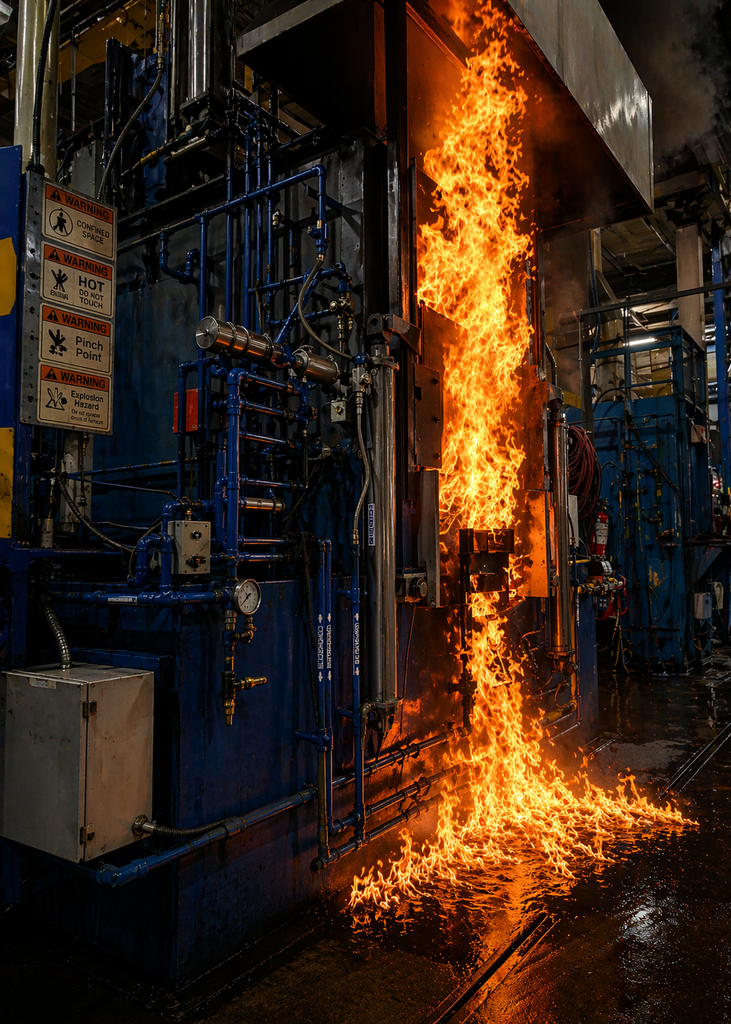
Add water, and you introduce a completely different hazard. It can turn violent before you understand or can react to what you are seeing. In this scenario, when the hot load is submerged, water at the bottom of the tank flashes instantly to steam, expanding roughly 1,600 times in volume. That expansion happens almost instantly, and the resulting increase in volume overwhelms the system.
As the steam rises, each bubble becomes coated with oil. Rapid expansion displaces oil and generates a large volume of vapor in a very short period of time. In a confined quench chamber, that surge carries oil and vapor together toward the burn-off vent and the doors.
There are typically two doors in the system, and they behave very differently. The inner door separates the hot zone from the quench tank. During quenching, the hot zone is typically operating around 1550°F. If oil is forced into the hot zone, it will vaporize and burn, generating products of combustion that can lead to a more severe internal event. However, this is not where the external fire develops. The outer door separates the quench chamber from the outside. During a surge, oil and vapor push upon this door and can be forced out. When the flammable oil vapor and furnace atmosphere reach an ignition source such as the flame curtain pilot, it will ignite violently.
At that point, the fire is no longer confined or controlled. Oil that reaches the exterior can spread along the floor and around the base of the furnace. Once outside the chamber, any oil present becomes fuel, and the fire can spread quickly.
How Water and Oil Interact
Two different conditions exist: dissolved water and free water. Dissolved water is moisture within the oil, typically when the oil is hot. It is part of normal operation and must be monitored. Elevated dissolved water levels are mainly a performance and control problem, not the immediate hazard. But if it continues to rise, it leads to free water, which is the hazard. Free water is water that has separated from the oil and settled to the bottom of the tank.
As a general guideline for dissolved water:
- Below 100 ppm (0.01%): very good
- 100–200 ppm (0.01–0.02%): acceptable
- 200–500 ppm (0.02–0.05%): caution range
- Above 500 ppm (0.05%): corrective action required
These values apply to dissolved water in the oil — not the free water condition at the bottom of the tank, which is the condition of greatest concern. As the oil cools, its ability to hold moisture decreases. Excess water comes out of solution, forms small droplets, and over time settles to the bottom. This creates stratification — the formation of distinct layers. Oil floats above, leaving a layer of free water at the bottom. That bottom layer is the dangerous condition, the same condition that drives the surge event described earlier.
Water Does Not Just Appear — It Gets Introduced
Common water sources include condensation during shutdowns and startups, along with operator or maintenance oversights that allow water or contaminated oil to enter the system. On older units, water-cooled components can develop leaks over time, allowing water to enter the oil slowly and go unnoticed. Leaking roof components or failed hood caps can also allow water to reach the furnace and make its way into the tank.
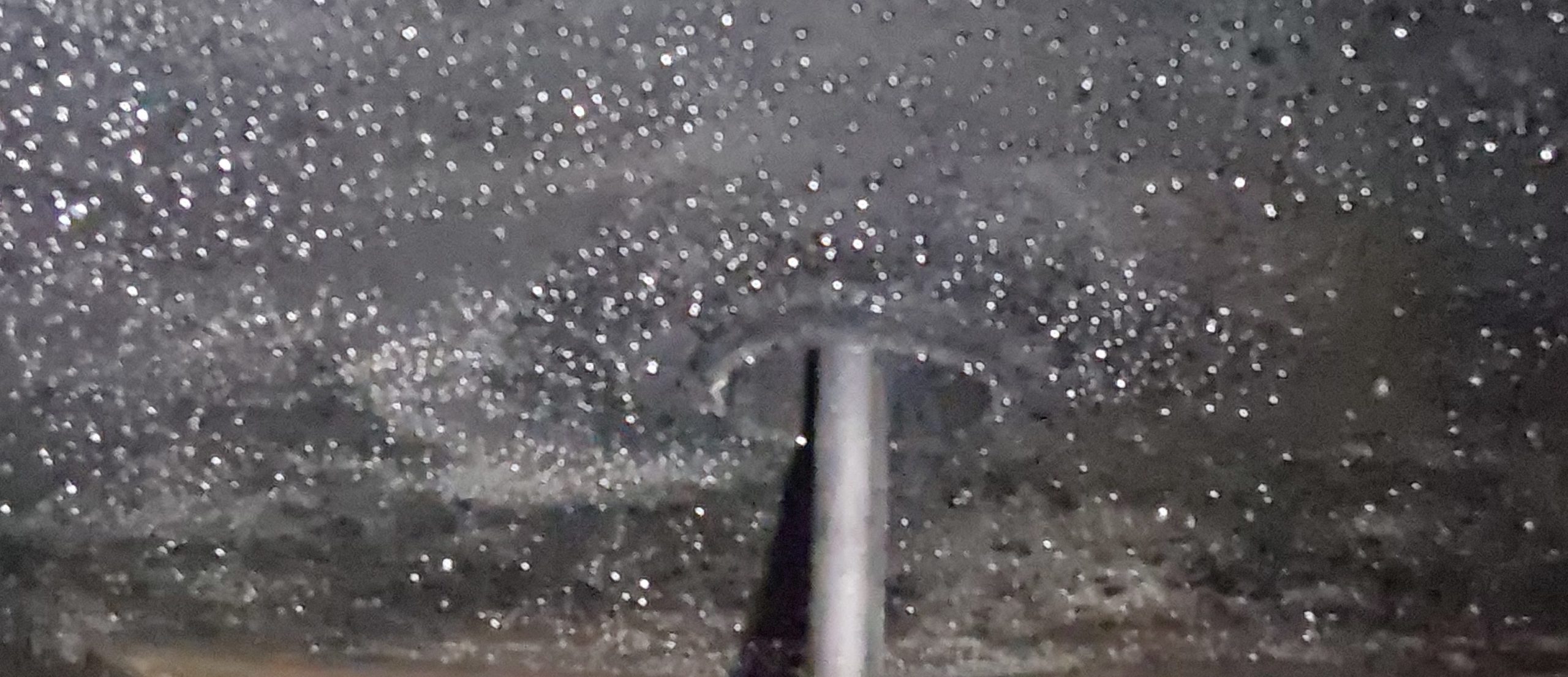
Because this develops gradually and often out of sight, everyone in the shop needs to stay alert. If something does not look right, or behave abnormally, report it immediately.
Detecting Water: What the Operator Sees First
Detecting free water in a quench tank is not as straightforward as it sounds. In many cases, the first indication is not a test result but a change in furnace behavior.
Changes in burn-off flame height, flame recovery time, unusual oil discharge (“burping”), or abnormal sounds during quenching are often early warning signs that something in the system has changed. All furnace operators should be trained to recognize these changes and treat them as indicators that the condition of the quench may no longer be normal.
Confirming with Sampling and Testing
Most monitoring systems measure dissolved water in circulating oil — not free water at the bottom. That distinction matters. Water that is mixed in the oil can be measured and trended. Water that has separated and settled to the bottom may not be detected by standard sampling methods. A sample taken from a circulating line or mid-depth in the tank can show acceptable results while free water remains undetected. These values are typically determined through lab analysis or in-shop test kits that measure dissolved water in quench oil. Standard tank sampling does not distinguish between dissolved and free water. That is why where you take the sample matters as much as how you test it.
Bottom sampling is critical. Pulling oil from the lowest point in the tank after the furnace has been idle, such as over a weekend, is often the best way to identify free water. If you do not already have a way to sample from the bottom of your tank, you should plan to install a dedicated drain or sample port. A bottom sample should be part of your weekly oil monitoring.
In the absence of a dedicated bottom drain, a simple method can still be used. Tubing can be inserted down through the fill or access point until it reaches the bottom. By sealing the top of the tube, the oil column inside is held in place as it is withdrawn, allowing a sample from the lowest point in the tank. The sample must be taken before any agitation or circulation begins. If the oil has been disturbed, the water can be temporarily mixed and the true condition at the bottom may not be seen.
The sample is placed in a clear glass beaker and allowed to stand. If water is present in any significant amount, it will usually be obvious, especially when compared to a sample taken from mid-depth or circulating oil. If it is not obvious, a crackle test can be used as a quick field check. A small sample of oil is placed on a hot surface, typically around 300–350°F. If free water is present, it flashes to steam and produces visible bubbling or crackling.
In practice, the severity of the reaction gives a clear visual indication of the condition:
- No reaction: acceptable, continue to run
- Light fizz or fine bubbles: trace water present, monitor
- Moderate crackle or popping: plan corrective action
- Strong crackle or aggressive bubbling: correct the condition before continuing
A consistent reaction across samples is the key indicator. This is not a precise measurement, but it is a reliable field guide. If it is reacting hard, you are already past where you want to be.
Sending samples for quarterly lab analysis provides a more complete picture of oil condition, including water content, oxidation, viscosity, contamination, and quench performance. This helps track dissolved water levels and overall oil health. In-shop test kits and commercial monitoring systems are also available, but none replace the need to understand what is happening at the bottom of the tank.
Removing Free Water from the Quench Tank
When free water is present at the bottom of the tank, it must be removed. This is an immediate hazard. In practice, removing oil from the top-down is often the most controlled approach. Oil is siphoned from the surface, working downward and stopping about a foot above the bottom to avoid disturbing the settled water layer.
This allows clean oil to be removed first while leaving the water undisturbed. Attempting to remove water directly through a bottom drain is not always effective, particularly in larger tanks, as it can pull both water and usable oil and disturb the interface between the two.
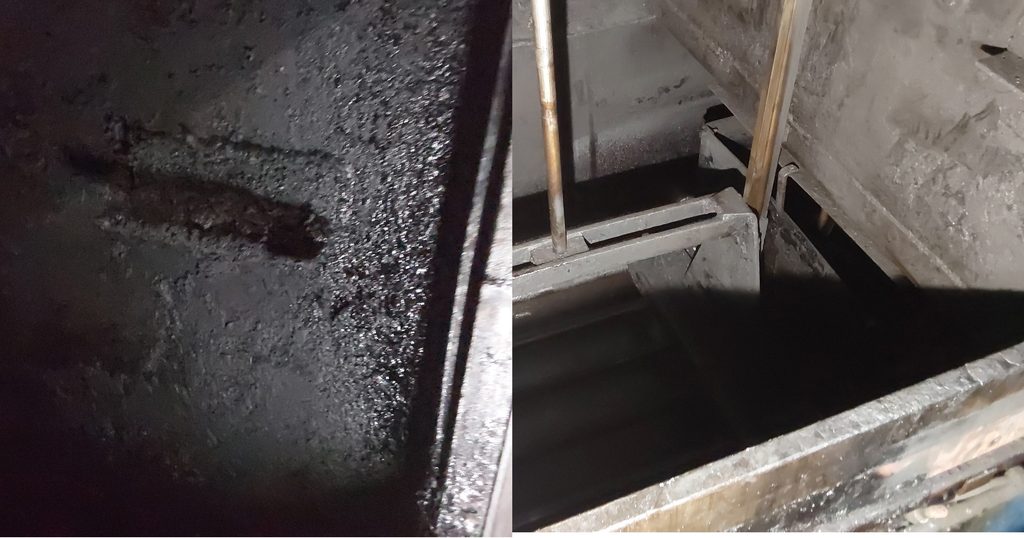
The removed oil can be placed into totes and allowed to sit undisturbed for several days so any remaining water can separate and settle. Clean oil can then be recovered from the top. The remaining oil and water mixture in both the tank and tote should be recycled. Other methods, such as vacuum dehydration or oil reclamation systems, can be used where available and are often more effective at removing both free and dissolved water, but are not always practical in every shop.
With the oil removed, this is an ideal time to carry out thorough tank cleaning. Over time, quench oils form sludge, a combination of oxidation byproducts, degraded oil, carbon, scale, and fines from processed parts. This material settles to the bottom, can trap and hold water, and hide it from normal sampling. As it builds up, it interferes with oil flow and agitation, affecting quench performance.
Tanks require periodic cleaning, typically every 12 to 18 months, depending on usage and condition. This is the time to remove sludge and clean deposits from the walls and ceiling.
It is also an opportunity to inspect agitation systems, elevators, rollers, and other components, and carry out preventative maintenance. Proper lockout procedures and confined space protocols must be followed.
The Bottom Line
Free water is an immediate hazard. If allowed to accumulate, it can trigger a rapid pressure event and an uncontrolled fire. Once it starts, it escalates quickly and is difficult to contain, putting personnel and the entire operation at risk.
Regular bottom sampling for free water must be part of your quality control.
Acknowledgements
The author would like to thank Daniel H. Herring, “The Heat Treat Doctor®” at The HERRING GROUP, Inc.
About The Author:
General Manager
Precision Heat Treat Ltd.
Bruno Scomazzon is the general manager of Precision Heat Treat Ltd. in Surrey, British Columbia, Canada, with over 40 years of experience in metallurgical processes and heat treating operations.
For more information: Contact Bruno Scomazzon at bruno@precisionheattreat.com.