

For applications requiring exceptional wear resistance, corrosion protection, and rapid processing, salt bath nitriding continues to be a reliable surface engineering solution. In this article, Daniel H. Herring, aka “The Heat Treat Doctor,” and Dr. Edward Rolinski, a senior scientist and recognized authority on plasma and ion nitriding, explain how salt bath nitriding can create a durable compound layer that helps parts last longer and perform better across a wide range of industrial applications.
If you’re looking for a broader introduction, watch for the upcoming print feature, “Nitriding Selection Guide: Gas, Plasma, or Salt Bath?” for an overview of nitriding, its key benefits, and a side-by-side of the three primary nitriding processes.
Salt bath nitriding, like gas nitriding, has been around for a very long time and is still in active use today. This method introduces nitrogen, and sometimes carbon, into the surface layer of steels, cast iron, and sintered powder metal by immersing the part in a molten salt bath containing nitrogen-bearing salts at elevated temperatures. The process enhances wear resistance, fatigue strength, corrosion resistance, and surface hardness without significantly affecting the core mechanical properties of the base material.
Salt bath nitriding has ability to form a thick compound zone up to 0.025 mm (0.001 inches). The process can enhance the corrosion resistance of steels, particularly when combined with post-oxidation. Also, salt bath nitriding is an excellent way to improve tribological properties of the treated components (“Melonite®/QPQ Process,” HEF USA).
A diverse range of industries and products leverage this process (e.g., automotive, aerospace, oil & gas; hydraulic and pneumatic machinery, firearms, metal forming and forging tools, material handling equipment, and tooling). Components like camshafts, gears, piston pins, hydraulic systems, and cutting tools benefit from the enhanced surface properties imparted by this process.
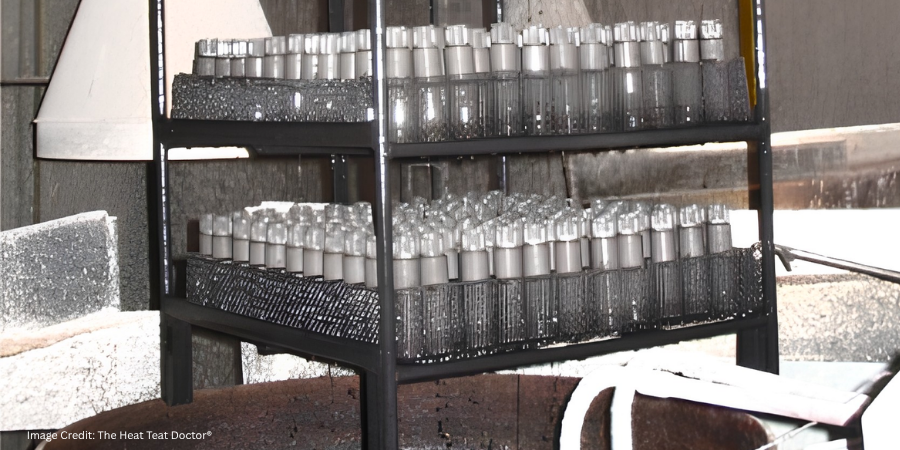
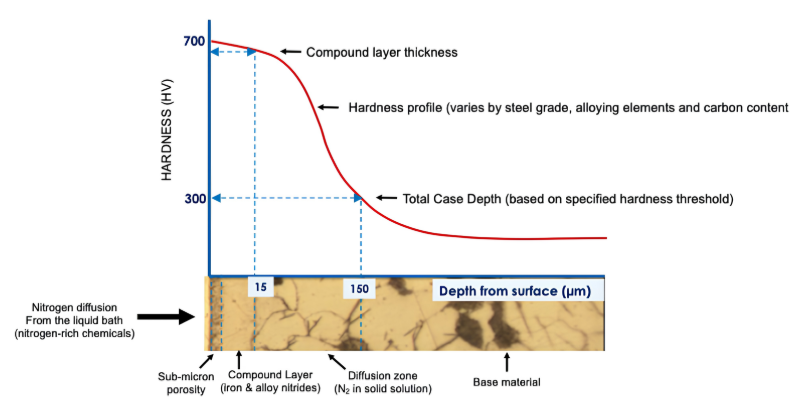
Salt bath nitriding is performed at temperatures typically ranging from 500°C to 630°C (930°F to 1165°F) to produce a controlled and highly uniform release of nitrogen at the surface of the workpiece (Figure 1). Nitrogen diffuses into, and chemically combines with, nitride-forming elements in the metal, producing a tough, ductile compound layer with exceptional mechanical properties through a catalytic reaction. This hard compound layer has wear properties that are reportedly 200% to 1000% greater than the original material, and greatly enhanced resistance to corrosion, galling, and scuffing (Pye, 2003).
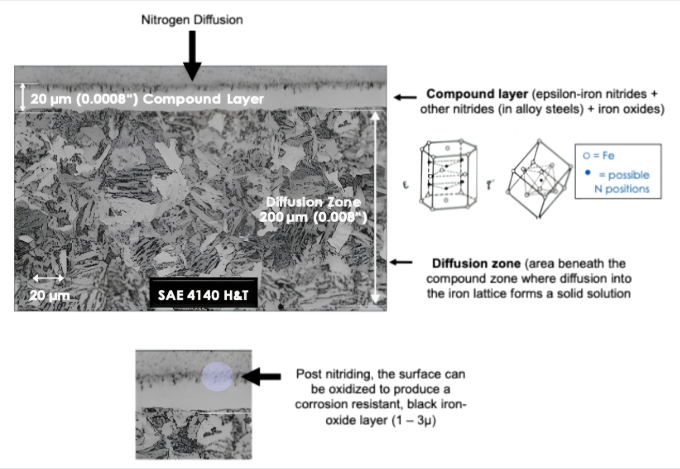
The salt reacts with the metal surface to form a hardened compound layer (primarily composed of ε-iron nitride and γ’-iron nitride) and a diffusion zone beneath it where nitrogen atoms diffuse into the metal matrix (Figure 2).
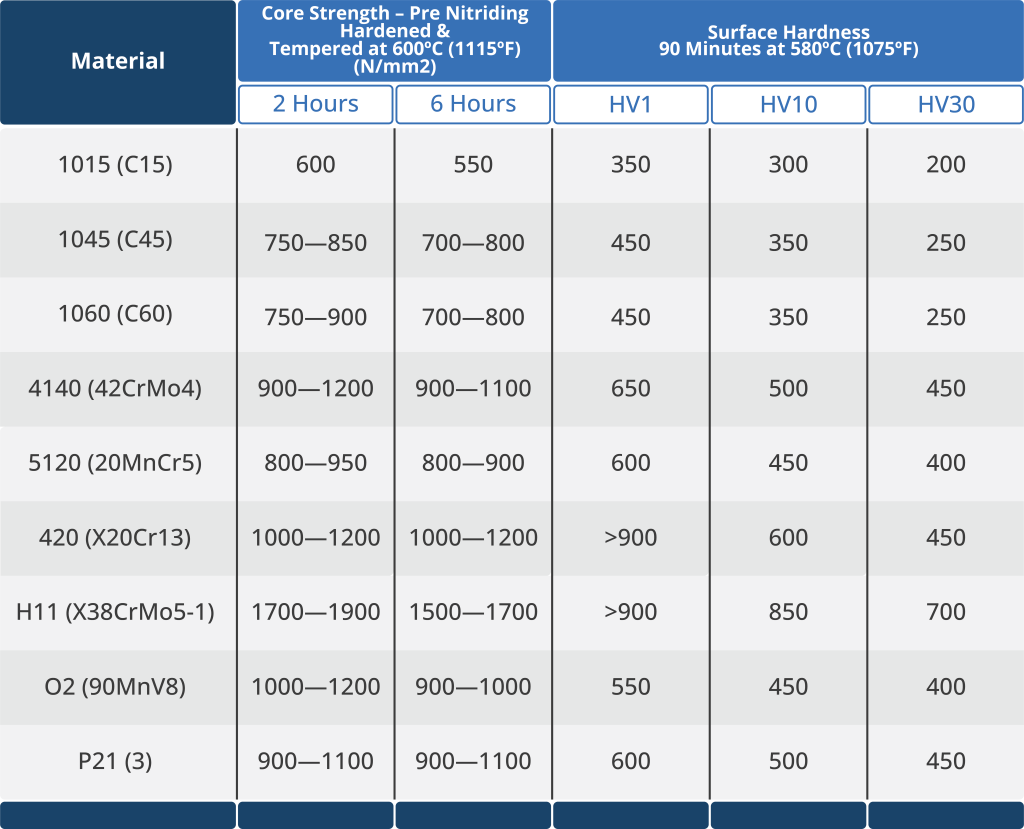
Case depth is a function of both treatment time and material. The final surface hardness is a function of the material composition. Higher percentages of nitride forming elements (Cr, Mo, Al, V, Mn, Ti, W) produce higher surface hardnesses (Table A).
Salt bath nitriding remains a valuable surface engineering technique due to its effectiveness in enhancing durability, wear resistance, and corrosion performance. While environmental and safety concerns exist, advancements in salt chemistry and waste management continue to make this process viable for modern industrial applications.
References
Boßlet, Jochim. n.d. Melonite®/QPQ Process Brochure. HEF Durferrit.
Herring, Daniel H. and Edward Roliński. 2026. “Nitriding Selection Guide: Gas, Plasma, or Salt Bath?” Heat Teat Today, August.
Pye, David. 2003. Practical Nitriding and Ferritic Nitrocarburizing. Materials Park, OH: ASM International.
About The Authors

(The Heat Treat Doctor®)
The HERRING GROUP, Inc.
Dan Herring, who is most well known as The Heat Treat Doctor®, has been in the industry for over 50 years. He spent the first 25 years in heat treating prior to launching his consulting business, The HERRING GROUP in 1995. His vast experience in the field includes materials science, engineering, metallurgy, equipment design, process and application specialist, and new product research. He is the author of six books and over 1000 technical articles.

Dr. Edward Rolinski, affectionately known as “Doctor Glow,” is a distinguished senior scientist having spearheaded research on plasma/ion nitriding since the 1970s. He holds advanced degrees in manufacturing technology and metallurgy, including a PhD and Doctor of Science. His focus has been on plasma nitriding processes, especially involving titanium alloys and powder metallurgy. Over his career, Dr. Rolinski authored numerous influential technical chapters and articles, including for ASTM International and the ASM Handbook, and is a prolific contributor to industry publications. After decades of leadership and innovation in surface engineering and heat treating, he is now a consultant in the heat treating industry.
For more information: Contact Dan at dherring@heat-treat-doctor.com.