

Among today’s nitriding technologies, gas nitriding remains the most widely used process for enhancing surface hardness, wear resistance, and fatigue performance while preserving dimensional stability. In this Technical Tuesday installment, Daniel H. Herring, aka “The Heat Treat Doctor®,” and Dr. Edward Rolinski, a senior scientist and recognized authority on plasma and ion nitriding, explain where gas nitriding excels, its process advantages and limitations, and the applications best suited for the technology.
If you’re looking for a broader introduction, watch for the upcoming print feature, “Nitriding Selection Guide: Gas, Plasma, or Salt Bath?” for an overview of nitriding, its key benefits, and a side-by-side of the three primary nitriding processes.
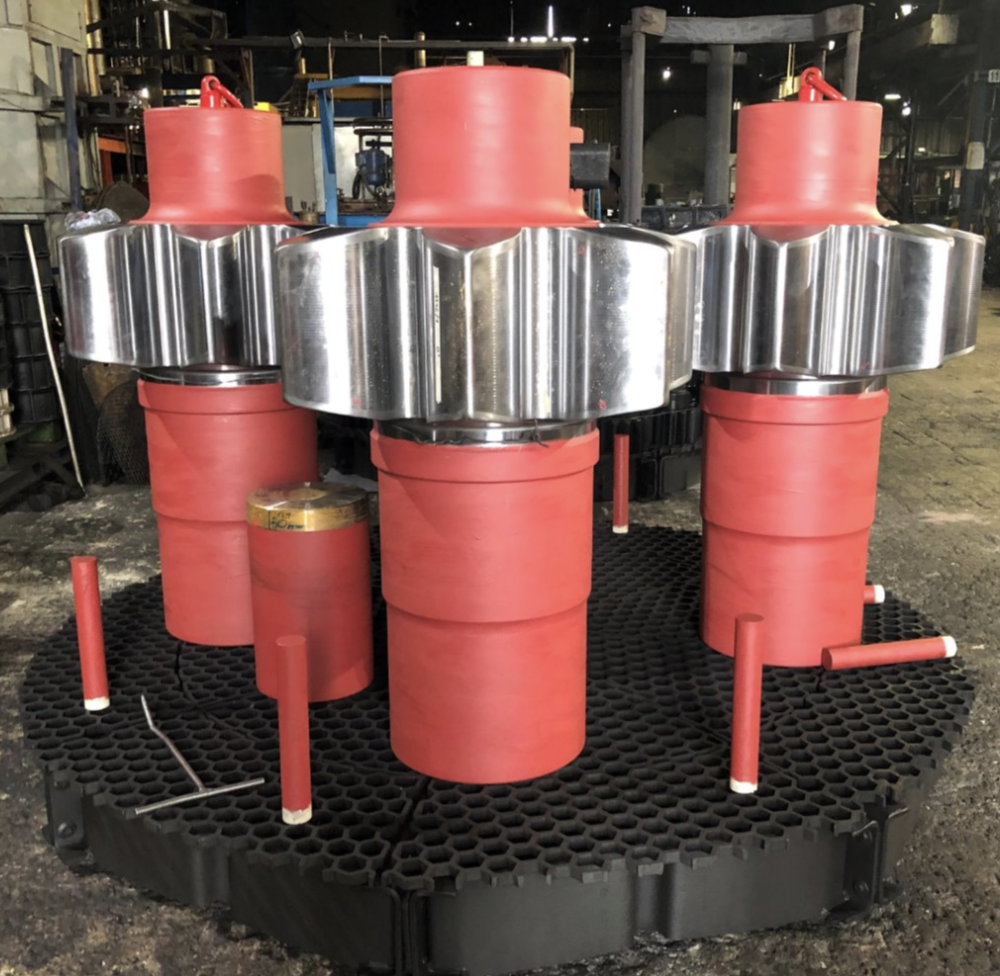
Gas nitriding represents 60–70% of all nitriding processes. The main benefit of gas nitriding, specifically when compared to plasma nitriding, is its ability to harden the entire surface of the component. Masking can be done by copper plating or painting with a nitriding-specific stop-off paint (Figure 1). Modern gas nitriding processes also allow treating of stainless steel, where PVC and other chemicals are used for surface pre-activation. Maintenance increases when these activating agents are used.
Case depths are typically total case depths (core hardness + 50 HV0.5) and vary by material (see Table B in Herring et al. 2026). Caution should be used when stating a required case depth as a number of definitions for total case depth are in use.
Another benefit of using gas nitriding is its ability to form a thick compound zone up to 0.025 mm (0.001 inches). The process can enhance the corrosion resistance of steels, particularly combined with post-oxidation. Also, gas nitriding is an excellent way to improve tribological properties of the treated components (Senatorski et al. 2017). Modern controls allow for automatic process adjustment over the length of the cycle and control of the nitriding atmosphere based on nitriding potential (Kn value) or ammonia dissociation rate (Herring 2020; Winter and Kalucki 2013). This allows for precise growth of the compound zone type and thickness, tight case depth ranges, and repeatability.
Dimensional change in nitrided parts, typically very small, is governed largely by composition, tempering temperatures, time/temperature of nitriding, relative thickness of case/core, shape of the part, and areas masked off to prevent nitriding. The amount of growth is usually constant for identical parts nitrided in different batches by a fixed processing cycle. After the amount of growth for a particular part has been determined experimentally, allowance for it can be made prior to nitriding during final machining prior to nitriding.
Sharp corners or edges should be avoided on parts to be nitrided, because the projections formed at sharp corners receive higher nitrogen concentration and are susceptible to brittleness and chipping. These sharp edges nitride through the section and are without support from a soft ductile core.
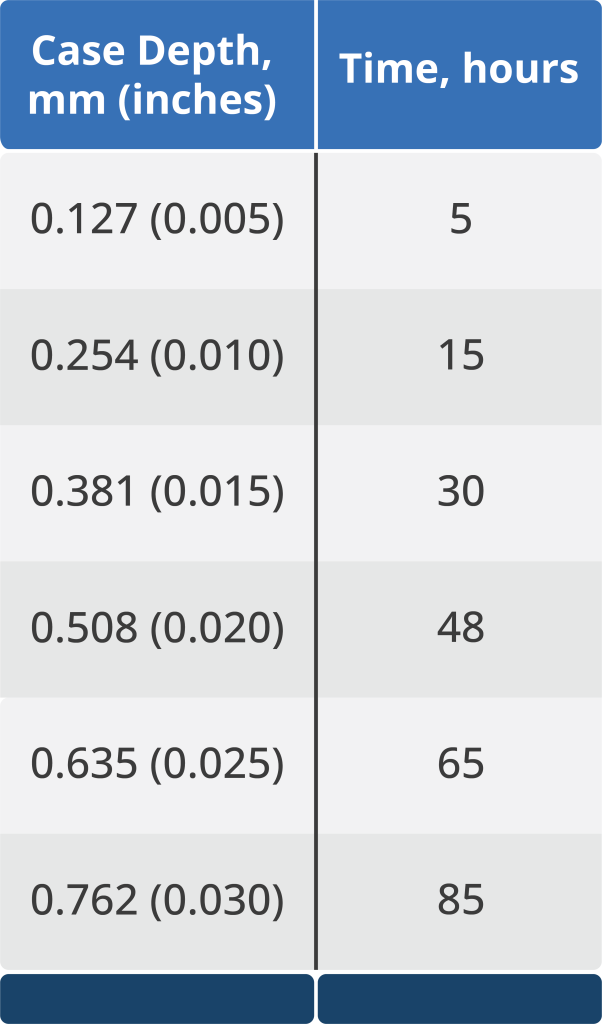
In the single stage process, a temperature range of 500°C–540°C (925°F–1005°F) is typical, and process times range from 1 to 100 hours (Table A). The dissociation rate of ammonia is held in the range of 15% to 30%. The process produces a brittle, nitrogen-rich white layer at the surface comprised of various iron nitrides (Fe2-3N, Fe4N). One advantage of this thick white layer is that it will provide longer component service life in abrasive and adhesive wear applications.
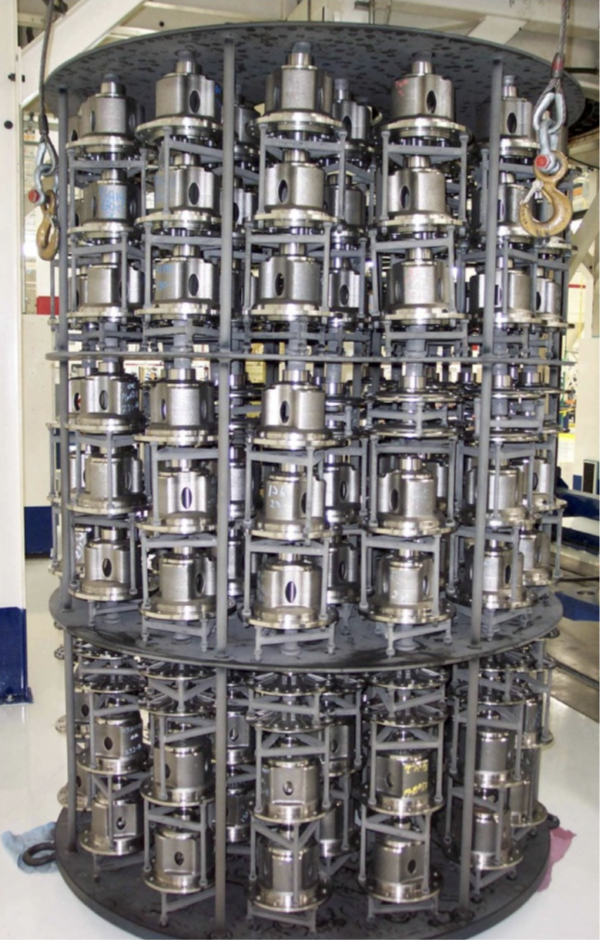
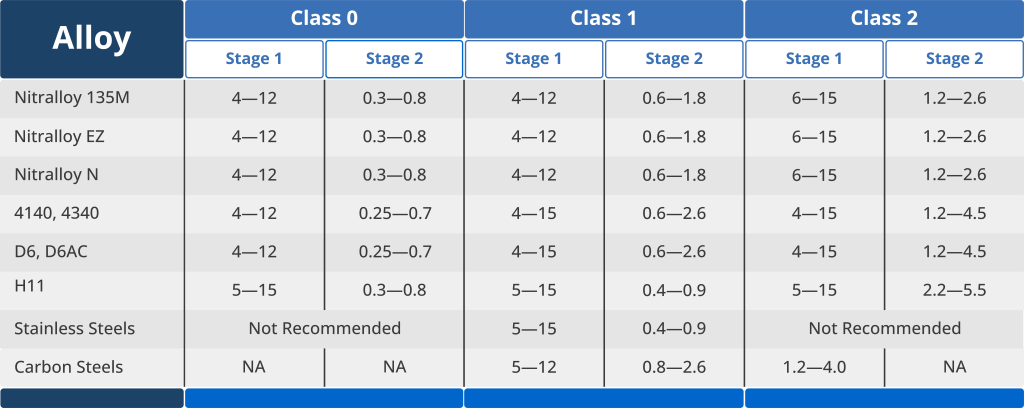
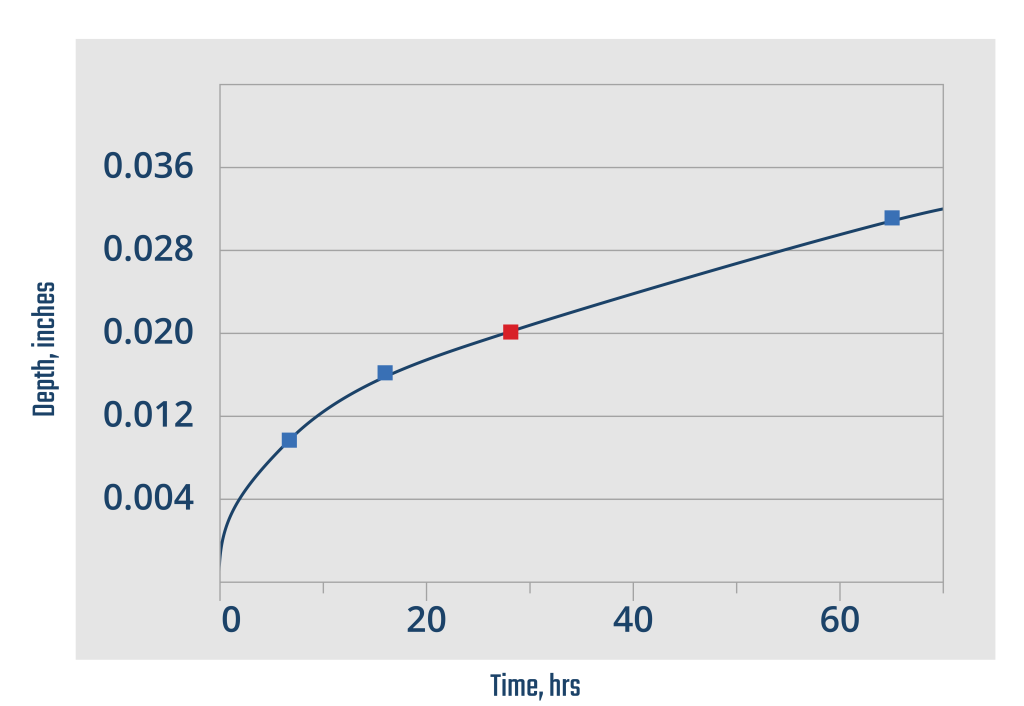
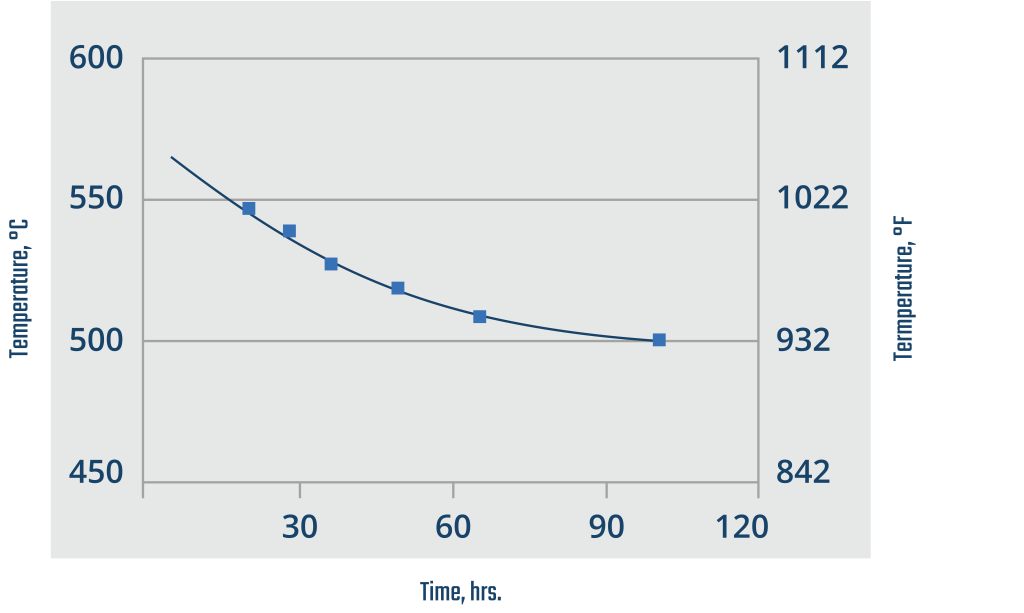
Most parts, however, are nitrided in a two- or even three-stage process and not ground after nitriding (Table C). This affords them excellent dimensional stability (Herring 2011). Case depth is affected by temperature (Figure 3), time (Figure 4), nitriding potential (if there is not a compound zone formed), and how the total case depth is defined.
References
Herring, Daniel H. 2011. “Principles of Gas Nitriding, Parts 1–4.” Industrial Heating, April–May.
Herring, Daniel H. 2020. “An Overview of Nitriding—Technology and Tribological Benefits.” Industrial Heating, March.
Herring, Daniel H. and Edward Roliński. 2026. “Nitriding Selection Guide: Gas, Plasma, or Salt Bath?” Heat Teat Today, August.
SAE International. n.d. AMS 2759/10 Aerospace Material Standard (latest revision).
Senatorski, J., J. Tacikowski, E. Roliński, and S. Lampman. 2017. “Tribology of Nitrided and Nitrocarburized Steels.” In ASM Handbook, Vol. 18: Friction, Lubrication, and Wear Technology, edited by George E. Totten, 638–652. Materials Park, OH: ASM International.
Winter, K. M., and J. Kalucki. 2013. “Gas Nitriding and Gas Nitrocarburizing of Steels.” In ASM Handbook, Vol. 4A: Steel Treating—Fundamentals and Processes, edited by Jon I. Dossett and George E. Totten, 647–679. Materials Park, OH: ASM International.
About The Authors

(The Heat Treat Doctor®)
The HERRING GROUP, Inc.
Dan Herring, who is most well known as The Heat Treat Doctor®, has been in the industry for over 50 years. He spent the first 25 years in heat treating prior to launching his consulting business, The HERRING GROUP in 1995. His vast experience in the field includes materials science, engineering, metallurgy, equipment design, process and application specialist, and new product research. He is the author of six books and over 1000 technical articles.

Dr. Edward Rolinski, affectionately known as “Doctor Glow,” is a distinguished senior scientist having spearheaded research on plasma/ion nitriding since the 1970s. He holds advanced degrees in manufacturing technology and metallurgy, including a PhD and Doctor of Science. His focus has been on plasma nitriding processes, especially involving titanium alloys and powder metallurgy. Over his career, Dr. Rolinski authored numerous influential technical chapters and articles, including for ASTM International and the ASM Handbook, and is a prolific contributor to industry publications. After decades of leadership and innovation in surface engineering and heat treating, he is now a consultant in the heat treating industry.
For more information: Contact Dan at dherring@heat-treat-doctor.com.