As manufacturers push toward ambitious sustainability targets, heat treatment remains both essential and energy intensive, making efficiency gains critical. In this Technical Tuesday installment, Myles McCarthy, a senior sustainability and climate leader at Bodycote, highlights utilization as a powerful, often overlooked lever, showing how maximizing furnace loading and focusing on energy per component can significantly reduce emissions and improve overall process performance.
This informative piece was first released in Heat Treat Today’s May 2026 Sustainable Heat Treat Technologies print edition.
The drive toward more sustainable manufacturing continues to gather momentum across sectors like aerospace, automotive, and advanced engineering. While political priorities may fluctuate, the direction is clear: manufacturers are under increasing pressure to reduce emissions, improve energy efficiency, and demonstrate measurable progress against ambitious environmental targets. For many organizations, thermal processing sits at the center of this challenge.
Heat treatment, hot isostatic pressing (HIP), and specialist surface technologies are essential to the performance, safety, and longevity of critical components. Without them, components would not perform as designed, leading to higher raw material consumption, increased emissions, and excessive waste. Yet, thermal processing is also one of the most energy-intensive stages of manufacturing. In some industries, thermal processing can account for 25–35% of a component’s carbon footprint.
As a result, attention is increasingly drawn not just to what processes are used, but how efficiently they are delivered.
Beyond Furnace Efficiency
Much of the conversation around sustainable heat treatment has focused on equipment: furnace design, insulation, electrification, and the transition to renewable energy sources. These are all important developments, and they continue to play a key role in reducing emissions.
However, an equally important and often overlooked factor is utilization. The energy consumed during a heat treatment cycle is largely fixed, regardless of whether a furnace is fully loaded or only partially utilized. As a result, the true energy intensity of heat treatment is not simply a function of furnace efficiency, but of energy consumed per component processed.
In practice, this means that two identical furnaces operating under different loading conditions can produce significantly different carbon outcomes.
The Impact of Underutilization
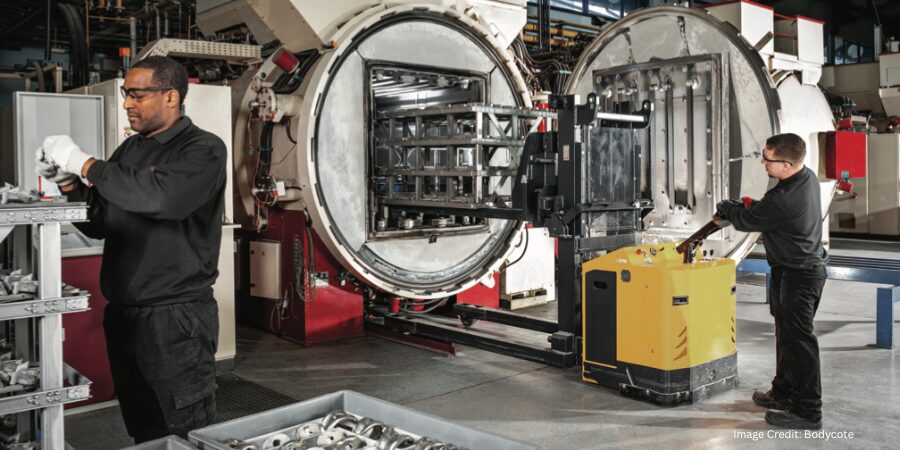
In many in-house environments, heat treatment is one step within a broader manufacturing process. Production variability, batch sizes, scheduling constraints, and part mix can all lead to suboptimal furnace loading. Partial loads, idle time between cycles, and non-continuous operation are common realities.
From an operational perspective, these challenges are often unavoidable. From a sustainability perspective, however, they have a direct impact, increasing energy consumption per component, raising associated carbon emissions and reducing overall process efficiency.
In this context, even highly efficient equipment may not deliver optimal environmental performance if it is not consistently utilized to capacity.
Utilization as a Sustainability Lever
This raises an important question for manufacturing leaders and heat treatment engineers: What is the true energy cost per treated component, and how much of that is driven by utilization rather than technology?
Increasingly, improving sustainability outcomes is less about incremental gains in furnace design and more about maximizing throughput efficiency. Higher and more consistent utilization levels enable lower energy consumption per unit processed, improved process stability and repeatability, and reduced waste associated with inefficient batch cycles. In some cases, higher utilization has been shown to reduce carbon per component by up to 60%. In simple terms, a well-utilized process is often a more sustainable process.
Rethinking Traditional Boundaries
Achieving consistently high utilization is not always straightforward within a single manufacturing site. Demand variability, product diversity, and production scheduling can all limit the ability to fully optimize furnace loading.
As sustainability targets become more demanding, some organizations are beginning to explore how these constraints can be addressed more strategically. In particular, there is growing recognition that where heat treatment takes place can influence overall efficiency outcomes, especially when greater consistency of loading and throughput can be achieved.
In environments where demand from multiple sources can be aggregated, including across organizational boundaries, it becomes possible to operate equipment closer to optimal utilization levels on a sustained basis. This can improve energy efficiency per component while maintaining process control and quality standards.
At the same time, continued advances in process technology, such as vacuum processing and low-pressure carburizing, are enabling more efficient and repeatable outcomes, particularly when combined with modern, well-utilized infrastructure.
The Role of Data in Decision Making
As expectations around sustainability reporting increase, decisions related to thermal processing are also becoming more data driven. Manufacturers are increasingly required to understand and report the carbon footprint of individual components, not just emissions at site level. This shift is placing greater emphasis on measuring energy consumption and emissions at process level, including the impact of utilization.
Tools and methodologies aligned with recognized standards are enabling more accurate modeling of energy consumption per cycle and per component, emissions associated with different processing routes, and the comparative impact of alternative operating models. This data allows engineers and decision makers to move beyond assumptions and evaluate thermal processing strategies based on measurable environmental performance.
Balancing Control, Efficiency, and Sustainability
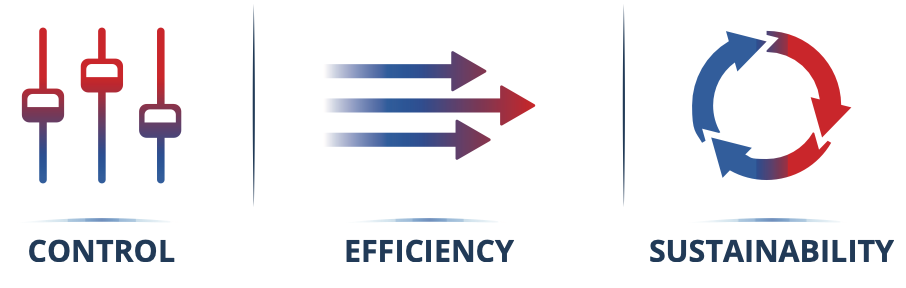
For decades, the benchmark of a well-run heat treatment operation was control, over equipment, processes, and supply. That principle remains important. However, the definition of control is evolving. Today, control increasingly includes visibility of process performance, confidence in quality and repeatability, and the ability to meet sustainability targets alongside production requirements. In this context, improving utilization is emerging as a key consideration. It offers a practical and measurable way to reduce energy intensity without compromising technical outcomes.
A Shift in Perspective
Sustainability in thermal processing is often framed in terms of new technologies or alternative energy sources. While these remain critical, utilization highlights a broader point. Efficiency is not just designed into equipment; it is achieved through how that equipment is used.
As manufacturers continue to navigate the complexities of decarbonization, focusing on energy per component rather than energy per cycle provides a more complete picture of performance. This shift in perspective does not prescribe a single solution. Instead, it encourages a more holistic evaluation of thermal processing, one that considers utilization, technology, data, and operational context together.
Successful Examples of High Utilization, Advanced Heat Treatment
Future heat treatment facilities must deliver the reliability, quality, and flexibility demanded by leading OEMs and their suppliers, while meeting efficiency and sustainability challenges in global markets, such as aerospace and automotive. An outsourced approach, supported by local and dedicated specialist capacity, can meet these needs.
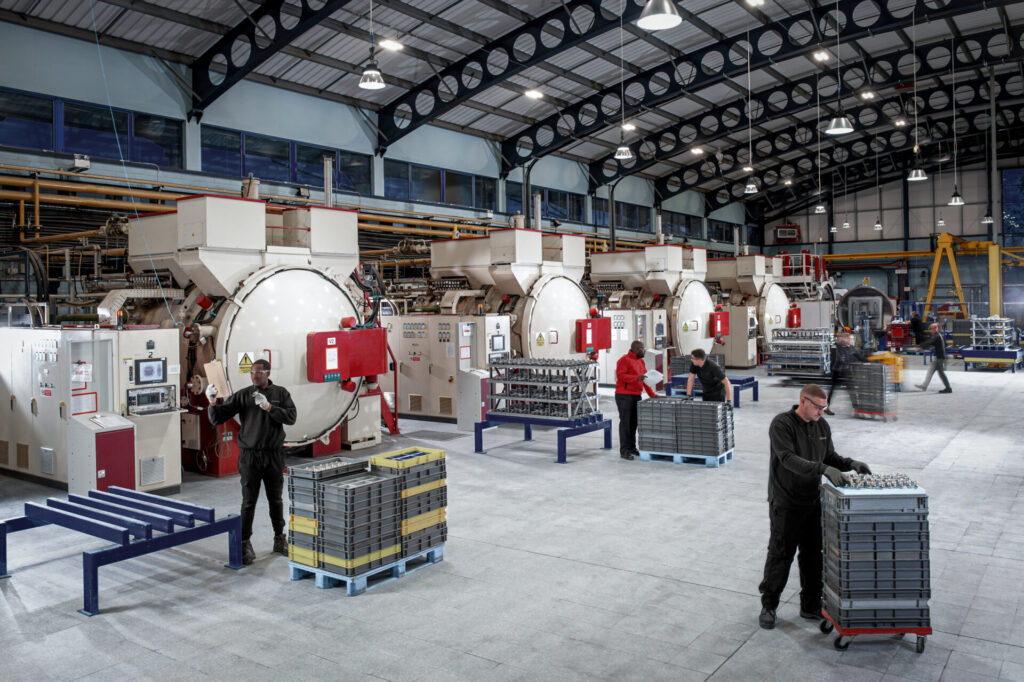
Bodycote’s heat treatment plants in Derby and Rotherham — combining advanced heat treatment and densification services — are examples of a co-located outsourced model. The aerospace partnership behind these plants demonstrates three decades of reliable, dedicated, and flexible capacity, aligned to core customer requirements.
A key advantage is utilization. By complementing core aerospace demand with additional volumes from other clients and markets, these facilities maximize utilization, driving higher efficiency, lower cost per part, and improved sustainability performance.
Both sites operate highly utilized, fully electric furnaces powered by 100% renewable electricity, enabling zero-emission thermal processing. Alongside electrification, ongoing investment in energy efficiency continues to reduce consumption. The Derby site (opened in 1999) recently installed a closed-circuit adiabatic cooling system, replacing evaporative towers and delivering electricity savings of 73%, reducing peak load and associated emissions, and cutting water use by over 85%, while eliminating chemical dosing and cleaning.
These examples demonstrate how specialist providers can deliver both advanced technical capability and low-carbon infrastructure for modern aerospace manufacturing.
Similar approaches are emerging across the aerospace industry, as manufacturers replace legacy fossil-fuel-based heat treatment with more efficient outsourced solutions. These partnerships support ambitious Scope 1 and 2 emissions reductions while ensuring long-term access to modern, lower-carbon processing capacity operated at consistently high utilization.
From Energy Per Cycle to Energy Per Component
Thermal processing will remain an essential part of advanced manufacturing. Its energy intensity makes it a natural focus for sustainability efforts, but also a significant opportunity for improvement.
Focusing on utilization shifts the conversation from how much energy a furnace consumes to how effectively that energy is used. This highlights a more meaningful measure of performance: not energy per cycle, but energy per component.
As sustainability expectations continue to rise, engineers and manufacturing leaders are being asked not only to ensure process integrity, but to demonstrate measurable efficiency and carbon performance.
In that context, the most effective improvements may not come from new equipment alone, but from rethinking how processes are operated, optimized, and where appropriate, configured.
Because ultimately, sustainable heat treatment is not just about using less energy — it is about using energy more effectively.
About The Author:

VP, Group Sustainability
Bodycote plc
Myles McCarthy is a senior sustainability and climate leader within Bodycote’s sustainability team, focused on driving and delivering corporate strategies that support the transition to more sustainable businesses. He has 25 years of experience working with boards and senior management of global businesses, both as an external climate advisor and as an in-house sustainability lead.
For more information: Contact Myles McCarthy at Myles.McCarthy@bodycote.com.