



The Ultra-Clean Revolution: Why All-Metal Hot Zones Are Becoming the New Standard
As aerospace, defense, and medical applications demand tighter chemistry and flawless surfaces, heat treaters are accelerating their move toward all-metal hot zones and ultra-high-vacuum systems. The push for cleaner processing is quickly reshaping expectations not only for commercial heat treaters, but also for in-house heat treat operations supporting mission-critical production.
Today’s original content brings together recent Heat Treat Today reporting on all-metal hot zones, next-generation vacuum systems, and supply-chain investments redefining clean processing for aerospace, defense, and medical work.
All-Metal Hot Zones Drive Cleaner, More Predictable Processing
Heat treaters serving medical, aerospace, and turbine production continue to adopt all-metal hot zones to reduce contamination risk, stabilize vacuum performance, and deliver more consistent surface conditions.
Solar Atmospheres has expanded its all-metal vacuum furnace capacity across multiple locations in 2025, most recently at its Western Pennsylvania facility dedicated to critical medical work. The system features an all-molybdenum hot zone, finely polished stainless-steel cold wall, and dual isolation valves to maintain vacuum integrity, accompanied by a major clean-room expansion to support downstream handling.
Earlier this year, the company added a similar all-metal furnace at its Hermitage campus. Designed for precipitation-hardened stainless steels, nickel-and cobalt-based superalloys, titanium, and niobium, the system reflects the rising expectations placed on heat treat environments supporting high-performance material systems.
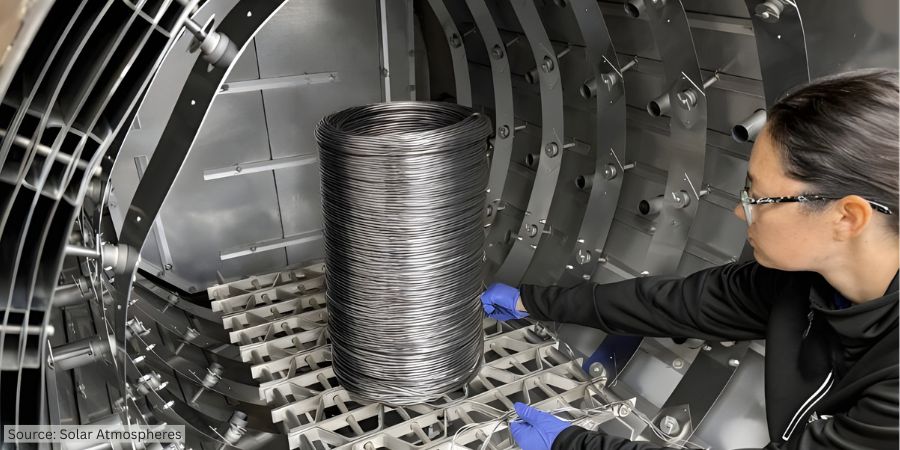
Michael Johnson, sales director at Solar Atmospheres of Western Pennsylvania, underscored the significance of the shift, noting that the all-metal design delivers “the purest possible processing environment” and produces “pristine end products that meet the most demanding industry standards.”
With vacuum levels reaching below 5 × 10⁻⁶ Torr through a diffusion pump, oversized main valve, and polished stainless chamber, these furnaces support bright, contamination-free results — conditions increasingly relevant to in-house heat treaters tasked with eliminating process variation.
See the full articles here: Solar Atmospheres Expands for Medical Industry and All-Metal Hot Zone Furnace for Solar Atmospheres
High-Performance Vacuum Systems Support Tighter Internal Specifications
Across the industry, new vacuum systems are being introduced that emphasize uniform quenching, reduced gas consumption, and shorter cycle times — benefits that resonate strongly with in-house heat treat teams striving for throughput without sacrificing metallurgical integrity.
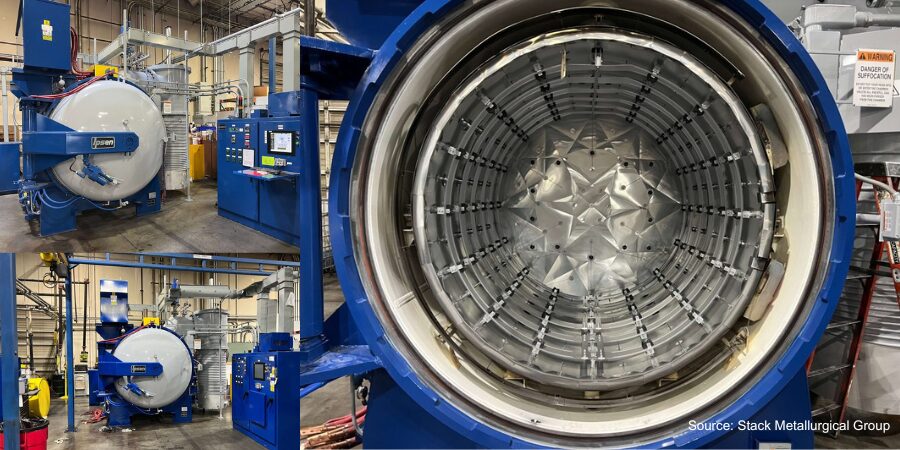
A recent example is the addition of a 6-bar Ipsen TurboTreater horizontal vacuum furnace at Stack Metallurgical Group‘s Portland, Oregon facility. It’s designed for 360-degree uniform quenching and engineered to reduce cycle times by up to 20 percent. Its versatility — supporting hardening, tempering, brazing, sintering, annealing, and more — illustrates the broader trend toward equipment that supports multiple metallurgical pathways while maintaining low-contamination processing.
While not an all-metal hot zone, SMG’s investment signals the same market direction: vacuum systems are increasingly becoming the backbone for operators who prioritize clean surfaces, repeatable thermal cycles, and consistent downstream machining performance.
See the full article here: Stack Metallurgical Group Increases Operations with Horizontal Vacuum Furnace
High Purity Feedstock Becomes a Process-Control Advantage
Arconic Corporation has recently invested $57.5 million in an effort to boost high purity aluminum (HPA) capacity for aerospace and defense applications at its Davenport Works plant, a major in-house heat treating operation. The expansion strengthens both its full thermal processing line and the broader aerospace and defense supply chain.
By the same token, this manufacturer is upstream in product development. For aerospace manufacturers of aluminum products with in-house heat treaters, access to cleaner feedstock translates into more predictable microstructures, fewer surprises at the furnace, and reduced process deviations, which is a meaningful advantage as specifications tighten.

Diana Perreiah, Arconic’s EVP of Rolled Products North America, positioned the investment as a deliberate step toward enhancing U.S. industrial capability, emphasizing that the expansion supports the advanced manufacturing base required for next-generation platforms. Her comments highlight a growing recognition that material purity upstream directly influences thermal processing reliability downstream.
The project includes two new furnaces, automation upgrades, and modernized controls, ensuring consistent supply of the high purity aluminum essential for complex structures ranging from aircraft wing skins to high-strength defense components.
See the full article here: Arconic $57.5 Million High Purity Aluminum Production Expansion for Aerospace & Defense
Toward a New Standard for Mission-Critical Work
Across furnaces, feedstock, and facility upgrades, the direction is unmistakable: the industry is moving rapidly toward ultra-clean, tightly controlled thermal environments.
For in-house heat treat departments, the message is clear. These technologies are not simply expanding commercial heat treat capacity — they are redefining expectations for internal operations where scrap reduction, audit readiness, and end-to-end process reliability are central.
All-metal hot zones, advanced vacuum systems, and high purity input materials are quickly becoming a baseline for meeting stringent performance requirements for many in today’s aerospace, defense, and medical applications.

The Ultra-Clean Revolution: Why All-Metal Hot Zones Are Becoming the New Standard Read More »