

vacuum heat treatment

HTA Group Increases Heat Treat Capability with 2 Vacuum Furnaces

Source: SECO/WARWICK

HTD Size-PR LogoHTA Group (HTA) purchased two vacuum furnaces to augment its support for Australian defense capabilities. The equipment will provide heat treatment processes for HTA’s manufacturing customers in the region to meet defense customer and quality specifications. The project was developed in response to customer demand and market analysis identifying gaps in Australia’s advanced manufacturing industrial framework.

The two new Vector® single chamber high-pressure quench vacuum furnaces from SECO/VACUUM will go to HTA's Melbourne and Sydney commercial heat treatment facilities to provide expanded processing capabilities to support the Australian defense industry.

"HTA is the only Australian Nadcap-approved thermal processor and has had ongoing success with commercial and aerospace operations to date," commented Dr. Karen Stanton, director of Corporate and Strategy at HTA (pictured in the headline image above). "Increasing the footprint of heat treatment assets through the establishment of this capability in Melbourne and Sydney will increase the ability of defense component manufacturers to deliver projects faster and allow them direct access to a qualified local supply chain."

Norm Tucker
Director of Operations
HTA Group

"SECO/WARWICK Group has the most advanced and user-friendly vacuum furnaces on the market," added Norm Tucker, director of Operations at HTA. "But equally important to me is the way we can collaborate with their team to determine the best furnace features and capabilities to do the job. These two new Vector furnaces will be the first of their capability in Sydney and Melbourne and will be used to heat treat high strength components such as landing gear or brazing engine parts and opening up advanced processing capabilities to our new and current customers."

Piotr Zawistowski
Managing Director
SECO/VACUUM TECHNOLOGIES, USA
Source: secowarwick.com

"HTA has been very smart about how they approach their growth, measuring business opportunities through research and thoughtfulness and looking carefully at the potential upside of their investments," noted Piotr Zawistowski, managing director at SECO/VACUUM. "We are proud to be an integral partner in their planning and execution."

The addition of Vector® vacuum furnaces to HTA’s processing capabilities follows 7 other installations of SECO/WARWICK products in Brisbane and Los Angeles CA, including high-pressure gas quench vacuum furnaces, vacuum aluminum brazing furnaces, and tempering/stress relieving furnaces.

HTA Group Increases Heat Treat Capability with 2 Vacuum Furnaces Read More »

45′ Long Seamless Nickel Alloy Tubes Vacuum Heat Treated Successfully

Michael Johnson
Sales Manager
Solar Atmospheres of Western PA

HTD Size-PR LogoSolar Atmospheres of Western PA successfully vacuum heat treated what is reported to be the largest and longest load of nickel alloy tubing ever in a commercial vacuum furnace. The mission was to preserve the crucial elements of brightness and cleanliness of the 45-foot-long seamless tubing while meeting extremely stringent mechanical properties.

“We spent countless hours reviewing critical systems such as triplicate pumping systems and redundant hot zone controls for any unforeseeable event that might arise during the 100+ hour run,” stated Michael Johnson, sales director at Solar Atmospheres of Western PA. “We are also fortunate that we can rely on our furnace manufacturing division, Solar Manufacturing, for guidance should any issue arise. This successful run will ignite a production campaign for the next 5 years, once again boosting confidence that this 48 foot vacuum furnace will surpass our customers’ expectations.”


Editor’s Note:

We suspected that this is a significant heat treating accomplishment, so we asked industry consultant and expert Dan Herring for perspective.  Here are the questions and his responses. The following is provided by Heat Treat Today and not Solar Atmospheres of Western PA.

HTT: In what industries might these tubes be used?

DH:  Typical examples would include steam generator tubing in nuclear power plants, high temperature aircraft systems, the oil and gas extraction industry, and anywhere applications call for corrosion/pressure/temperature resistant tubes/pipe.

HTT: Is there anything special about processing nickel alloy tubing?

DH: Yes. In order to maximize corrosion resistance, one must keep the surfaces of the tubes as oxide-free as possible. Hence, the use of vacuum. Also, the long lengths of the pipe means fewer welded joints (fewer joints means a stronger pipe, and likely more resistant to corrosion).

HTT: Is this release noteworthy?

DH: It is absolutely noteworthy. This demonstrates size capability available in only a handful (if that many) heat treat shops IN THE WORLD.

45′ Long Seamless Nickel Alloy Tubes Vacuum Heat Treated Successfully Read More »

How Heat Treatment Helped a Hydroplane

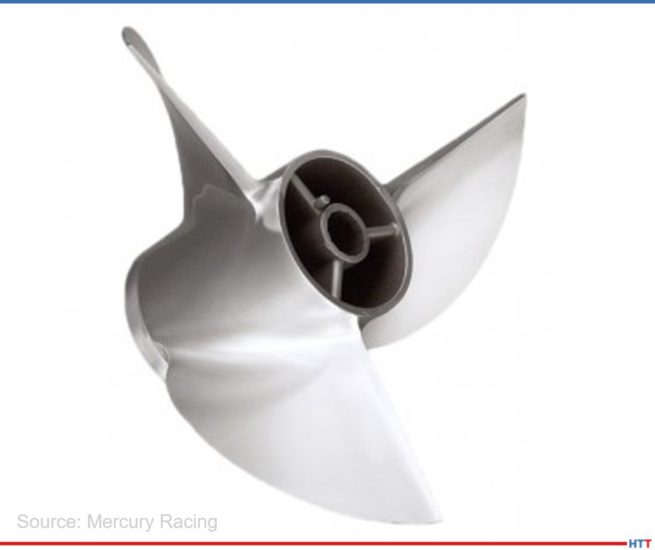
HTD Size-PR LogoA hydroplane racing team located in Cinnaminson, NJ had three propeller blades heat treated to ensure parts were free of scale and keep the blades from shearing apart. The propellers will now withstand the RPM and torque conditions of racing without failing. Also, the hardening will protect the blades from impact with potential debris in the water.

This case study/press release from the heat treater, Metlab, goes into detail to describe the propellers and how heat treatment changed the material.


A modern unlimited hydroplane is the world’s fastest racing boat, capable of speeds greater than 200 mph. These boats represent the product of over 100 years of evolution in race boat design and materials with the most powerful engines, most advanced construction techniques, and the best safety systems available in boat racing today. A typical unlimited hydroplane can weigh a minimum of 6,750 pounds.

All unlimited hydroplanes are a “three-point” design, meaning they are designed only to touch the water at three points when racing – at the rear of the two front sponsons (the projections of the hull in front of the driver cockpit) and the propeller at the rear of the boat. Most of the unlimited class boats are powered by Chinook helicopter Lycoming T55 L7 turboprop engines, generating up to 3,000 HP.

Metlab, which is known for offering a wide variety of thermal processing solutions, had the opportunity to heat treat a series of propellers for a hydroplane racing team located in Cinnaminson, NJ.

The propellers must meet strict design criteria imposed by the Union Internationale Motonautique (or “UIM,” headquartered in Europe), not only for propellers but for the entire boat design. The propellers are typically 16″ in diameter and have three blades. Different pitch propellers are chosen for use based on course length, conditions, and starting position. It is not uncommon for a racing propeller to cost more than $15,000.

Propeller: Mercury Racing – T.E. Clever model

The propeller creates the distinctive “rooster tail” behind the boat, raising literally tons of water into the air for up to 300 feet behind the boat. They are made from several different materials, but the steel of choice is 17-4 PH stainless steel chosen for its mechanical properties and corrosion resistance. The propeller must support a significant portion of the boat’s weight while rotating up to 14,000 RPM.

Three propeller blades were heat treated for the client to the H-900 condition (900°F/ hours at heat). They were age hardened in a vacuum furnace to ensure parts were free of scale. The high tensile strength (200 KSI) produced by the heat treatment keeps the blades from shearing apart; the excellent ductility associated with the heat-treated material allows the propellers to withstand the RPM and torque conditions without failing. And a hardness of HRC 40 protects the blades from impact with potential debris in the water. 17-4 PH stainless steel properly heat treated also benefits from increasing torsional fatigue strength, a common cause of propeller failure.

Metlab provides heat treating solutions for highly technical parts and components. Consult with a metallurgical specialist at Metlab about your specifications and heat treating requirements.

How Heat Treatment Helped a Hydroplane Read More »

Skip to content