

PhoenixTM

Temperature Monitoring and Surveying Solutions for Carburizing Auto Components: Introduction

This is the first in a 4-part series by Dr. Steve Offley (“Dr. O”), Product Marketing Manager at PhoenixTM, on the technical challenges of monitoring low-pressure carburizing (LPC) furnaces. This introductory article explains the LPC process and general monitoring needs and challenges. 


Carburizing Process

Dr. Steve Offley (“Dr. O”), Product Marketing Manager PhoenixTM

Carburizing has rapidly become one of the most critical heat treatment processes employed in the manufacture of automotive components. Also referred to as case hardening, it provides necessary surface resistance to wear while maintaining toughness and core strength essential for hardworking automotive parts.

The carburizing heat treatment process is commonly applied to low carbon steel parts after machining, as well as high alloy steel bearings, gears, and other components. Being critical to product performance, monitoring and controlling the product temperature in the heat treatment process is essential.

The carburizing process is achieved by heat treating the product in a carbon-rich environment, typically at a temperature of 900 – 1050 °C / 1652 – 1922 °F. The temperature and process time significantly influences the depth of carbon diffusion and associated surface characteristics. It is critical to the process that, following diffusion, a rapid quenching of the product is performed in which the temperature is rapidly decreased. This generates the microstructure giving the enhanced surface hardness while maintaining a soft and tough product core.

Increasing in popularity in the carburizing market is the use of batch or semi-continuous batch low-pressure carburizing furnaces. New furnace technology employs the dissociation of acetylene (or propane) to produce carbon in an oxygen-free low-pressure vacuum environment, which diffuses to a controlled depth in the steel surface. Following the diffusion, the product is transferred to a high-pressure gas quench chamber where it is rapidly gas cooled using typical N2 or Helium up to 20 bar.

An alternative to gas quenching is the use of an oil quench, used commonly in continuous carburizing furnaces where the products are plunged into an oil bath.


Fig 1: Schematics of the LPC Carburizing process showing the Temperature and Pressure steps

Temperature Monitoring Challenges in Low-Pressure Carburizing

As already stated, the success of the carburizing process is governed by careful control of both the process temperature and duration in the heating and quench stages. Obviously, when considering temperature, we are interested in the product temperature, not the furnace. Measuring product temperature through a carburizing process, although possible using trailing thermocouples, as performed historically, is neither easy nor safe, and it disrupts production for lengthy periods.

PhoenixTM provides a superior solution with the use of a “thru-process” temperature monitoring system. As the name suggests, the PhoenixTM temperature profiling system is designed to travel through the thermal process, measuring the product and or furnace environment from start to finish. The system can be incorporated into a standard production run so does not compromise productivity. A high accuracy, multi-channel data logger records temperature from thermocouple inputs, located at points of interest on, in, or around the product being thermally treated. To protect the data logger as it travels through the hostile furnace, a thermal barrier is employed to keep the logger at a safe working temperature to prevent damage and ensure accuracy of measurement. The barrier also obviously needs to protect during the quench, whether that be against high pressure or oil ingress if the quench can’t be avoided.

Employing the PhoenixTM system a complete thermal record of the product throughout the entire process can be collected. A popular enhancement to the system is the use of 2-way RF telemetry, providing real-time process monitoring directly from the furnace, useful for either profiling or performing a live Temperature Uniformity Survey (TUS). The product temperature can be viewed live and downloaded at any point in the furnace. Raw temperature data collected from the process can be converted into useful information using one of the custom-designed PhoenixTM Thermal View Software packages available. The thermal graph can be reviewed and analyzed to give a traceable, certified record of the process performance. Such information is critical to satisfying CQI-9, AMS2750, and other regulatory demands. Fully TUS-compliant reports can be produced in moments from the simple and intuitive software, making accurate TUS a simple and quick task. Information can be used to not only prove product quality but provide the means to confidently change process characteristics to improve productivity and process efficiency (Optimize Diffusion, Soak and Quench).

Temperature Monitoring and Surveying Solutions for Carburizing Auto Components: Introduction Read More »

15 Quick Heat Treat News Items to Keep You Current

15 Quick Heat Treat News Items to Keep You Current

Heat Treat Today offers News Chatter, a feature highlighting representative moves, transactions, and kudos from around the industry.

Personnel & Company Chatter

  • Professor Chris Sutcliffe, Director of Research and Development (R&D) at Renishaw‘s Additive Manufacturing Products Division (AMPD), was awarded a prestigious Silver Medal from the Royal Academy of Engineering (RAE), recognizing his role in driving the development of metal 3D printed implants for use in human and veterinary surgery and celebrating his successful commercialization of additive manufacturing products as part of his work with Renishaw, the University of Liverpool, Stryker Orthopaedics and Fusion Implants Ltd.
  • Michael Handscombe joins UK-based Phoenix Temperature Measurement as National and International Sales Manager to support PhoenixTM temperature monitoring solutions used in industrial heat treatment and furnace surveying and other industries.
  • One of five new vacuum furnaces, with an all-metal hotzone and 15 bar Argon quenching with an 8,000lb capacity, have been delivered to the Cleveland division of Paulo and will be ready for production late July. This represents the first step of a larger expansion that includes a new building.
  • Two large heat-treating furnaces were recently rebuilt and upgraded at Metlab, a heat treatment and surface enhancement company located in Wyndmoor, Pennsylvania. The furnaces, designated P-1 and P-2, are believed to be the largest atmosphere-controlled pit furnaces in North America and are used to neutral harden, carburize and harden, nitride, anneal, and stress relieve large components or multiple quantities of parts.
  • A 20-foot long car bottom air furnace capable of handling a workload up to 30,000 lbs will be installed at Solar Atmospheres of Western PA during July 2018 and surveyed in accordance with AMS2750. With a maximum operating temperature of 1400°F, this furnace will accommodate not only the tempering of large tool steel components but also age hardening of 15-5 PH, 17-4 PH, and nickel-based alloys. Although Solar is typically known as a “vacuum only” heat treater, the company notes the need for heat treating non-finished parts and materials in accordance with the same specifications (AMS, MIL, Boeing and Airbus) within different atmospheres where surface oxidation is permissible.
  • Robrecht Himpe retired from his position as CEO of ArcelorMittal North America and CEO of AM/NS Calvert on July 1, as well as his duties with ArcelorMittal’s executive management team. He has been with the group for 37 years and will be succeeded as ArcelorMittal North America CEO by Brad Davey, who has been serving as chief marketing officer of ArcelorMittal North America and head of global automotive.
  • Team, Inc., an industrial services company based in Houston, Texas, recently announced that Arthur F. Victorson, President of the Inspection and Heat Treating segment, will retire from the company on September 30, 2018. In connection with his retirement, Mr. Victorson will transition from his current role, effective July 15, 2018, and serve as a special advisor to Amerino Gatti, Team’s Chief Executive Officer, to ensure a seamless transition. Team anticipates naming a successor to Mr. Victorson in the near future.
  • A partnership has been formed between Plibrico, based in Northbrook, Illinois, and Upstate Refractory Services, headquartered in Newark, New York.
  • John Hynes has been promoted at Paulo to Director of Information Systems from his previous role as Manager of Information Technology.  John has been with Paulo for just over one year, strengthening the company’s IT position.

Equipment Chatter

  • A natural gas-fired, enhanced-duty, walk-in oven was recently shipped to the technology industry by Wisconsin Oven Corporation for use in post-curing refractory material. With a maximum operating temperature of 300°F, the oven was designed with the capacity to heat 8,000 pounds of steel and 4,000 pounds of refractory material from 70° to 150° F within 180 minutes.
  • A 1400°F electric, inert atmosphere tempering furnace from Grieve Corporation, No. 885, is currently being used for heat treating weldments at a customer’s facility.  
  • An India-based conglomerate recently commissioned an aluminum automotive casting heat treatment system from CAN-ENG Furnaces International Limited for its new greenfield North American expansion in South Carolina.

Kudos Chatter

  • The F-35 Joint Program Office of The Pentagon and Lockheed Martin delivered the 300th production F-35 aircraft, a US Air Force F-35A, to be delivered to Hill Air Force Base, Utah. “The F-35 weapons system is a key enabler of our National Defense Strategy and is providing our warfighters the combat-proven, advanced capabilities they need to meet mission requirements,” said Vice Admiral Mat Winter, program executive officer for the F-35 Joint Program Office. The first 300 F-35s include 197 F-35A conventional takeoff and landing (CTOL) variants, 75 F-35B short takeoff/vertical landing (STOVL) variants, and 28 F-35C carrier variants (CV) and have been delivered to U.S. and international customers. More than 620 pilots and 5,600 maintainers have been trained, and the F-35 fleet has surpassed more than 140,000 cumulative flight hours.
  • The first Future Aluminum Forum was held on 8th & 9th May 2018 in Milan, Italy, with more than 150 delegates from across the aluminum manufacturing and processing industries gathering to hear from technical experts and uncover the myths behind Industry 4.0 and what this means for the manufacturing value chain. An Advisory Board was established to develop a strategic approach towards integrating Industry 4.0 across the aluminum manufacturing and processing sectors.
  • A center for aerospace air management systems, Liebherr-Aerospace Toulouse SAS, in Toulouse, France, recently obtained accreditation from the National Aerospace and Defense Contractors Accreditation Program (NADCAP) for its materials testing laboratory. This accreditation follows an audit conducted in early March 2018 by the Performance Review Institute (PRI), which focused on both the overall quality system of the laboratory and the practice of static and dynamic mechanical tests.


Heat Treat Today celebrates with our heat treatment industry partners by highlighting their accomplishments and announcements here on our News Chatter page. Please send any information you feel may be of interest to manufacturers with in-house heat treat departments especially in the aerospace, automotive, medical, and energy sectors to the editor at editor@heattreattoday.com.

15 Quick Heat Treat News Items to Keep You Current Read More »

A Dozen Quick Heat Treat News Items to Keep You Current

A Dozen Quick Heat Treat News Items to Keep You Current

Heat Treat Today offers News Chatter, a feature highlighting representative moves, transactions, and kudos from around the industry.

Personnel and Company Chatter

  • Lars Jonsson has been appointed new employee representative to the Bulten AB board for a term of office of three years. Lars has been employed at Bulten’s plant in Hallstahammar since 1984 where he has worked as a machine operator until two years ago when he switched to tool maker. Bulten is a supplier of fasteners to the international automotive industry.
  • Paulo’s Cleveland division is expanding to add 50,000 sq ft, allow for the installation of more vacuum heat treatment furnaces, and provide optimized flow of work through the facility. The Cleveland plant primarily serves the aerospace, power generation, and agriculture industries and specializes in precise high-temperature vacuum heat treatment and brazing of nickel-based superalloys.
  • James R. Darsey, executive vice president of raw materials for Nucor Corporation announced his upcoming retirement after more than 39 years of service with Nucor.  Effective June 10, 2018, Craig A. Feldman will be promoted to the role of executive vice president of raw materials.  Mr. Feldman began his career with the David J. Joseph Company (DJJ) in 1986 and stayed with the company, becoming president of DJJ in 2013. When DJJ was acquired by Nucor in 2008, Feldman became a vice president and general manager of Nucor Corporation.  Upon his promotion to EVP, Mr. Feldman will retain his role as president of DJJ.
  • Dr. Steve Offley recently joined Phoenix Temperature Measurement as Product Marketing Manager, bringing over 21 years of experience in the industrial process temperature monitoring industry. Besides promoting and marketing PhoenixTM’s temperature monitoring productions, Dr. Offley will focus on development of new and innovative processes temperature-monitoring solutions.
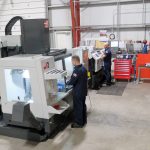
  • Solar Atmospheres of Western PA recently installed a second machining center to support its newest service for customers – tensile testing. By adding a brand new fully programmable 8100 RPM Haas VF2 milling center, Solar is now able to support the machining of flat tensile specimens. This machining ability fully complements the function of the 10,000 PSI hydraulic jaw that is an integral component of the Tinius Olsen 300SL tensile machine. These massive hydraulic jaws can grip either threaded round or flat specimens.

Equipment Chatter

  • A 750°F (399°C), gas-fired cabinet oven was recently supplied by Grieve Corporation to be used for baking radiator cores at the customer’s facility. The workspace dimensions of this oven, the No. 1046, measure 80″ W x 88″ D x 18″ H, with a 76″ wide x 76″ long, 750 lb. capacity pneumatic operated rollout shelf with an insulated plug to seal doorway opening.
  • An intermediate-sized front-loading box furnace was recently delivered to the Canadian Government Forestry Division. L&L Special Furnace Co., Inc., equipped the furnace, which meets Canadian electrical standards, with an atmosphere-sealed case for use with inert gas to displace oxygen and minimize surface de-carb. It is purged with inert gas prior to loading and the parts are then heated under a controlled atmosphere. There is a 1″ NPT survey port located on the right side of the furnace employed for calibration and uniformity surveys.
  • An aerospace and defense company recently purchased a rotary hearth furnace to heat treat state-of-the-art equipment, specifically to process specialized gears for helicopters. Ipsen plans to deliver the rotary hearth furnace early next year.

Kudos Chatter

  • Advanced Heat Treat Corp. recently reported that its Iowa (MidPort-Corporate Office and Burton Ave, Waterloo) and Michigan locations have successfully transitioned from ISO/TS 16949:2009 to ISO 9001:2015 / IATF 16949:2016.
  • Stock Drive Products/Sterling Instrument (SDP/SI) has also announced that it meets all certification requirements of the new ISO 9001:2015 + AS9100D standard, maintaining processes that provide superior components and assemblies with detailed quality reporting.
  • Harbison Walker International (HWI), based in western Pennsylvania, adds its announcement to the mix, reporting that its Thomasville, Georgia, monolithic/precast facility recently became the first of the company’s North American locations to earn ISO 9001:2015 certification, followed by HWI’s South Shore, Kentucky, plant becoming the first refractory brick manufacturing plant in North America to achieve the same status. Both plants achieved this quality system recognition based on the recommendation of SRI Quality System Registrar.
  • Rio Tinto celebrates the distinction of being the first company in the world to receive certification under the Aluminium Stewardship Initiative (ASI), the highest internationally recognized standard for robust environmental, social and governance practices across the aluminum lifecycle of production, use, and recycling. The certification follows an independent third party audit and covers a range of operations, from bauxite mining to alumina refining, aluminum smelting, the creation of value-added products, transformation and recycling, and associated activities. Rio Tinto’s five aluminum smelters, the Vaudreuil refinery, casting and spent potlining treatment centers, and associated infrastructure such as power, port and railway facilities in Quebec, Canada, have been certified, along with the Gove bauxite mine in Australia.

Heat Treat Today is pleased to join in the announcements of growth and achievement throughout the industry by highlighting them here on our News Chatter page. Please send any information you feel may be of interest to manufacturers with in-house heat treat departments especially in the aerospace, automotive, medical, and energy sectors to the editor at editor@heattreattoday.com.

A Dozen Quick Heat Treat News Items to Keep You Current Read More »

Skip to content