Manufacturing Heat Treat News

European Drilling Tools Manufacturer Commissions Furnace System

A European manufacturer of hard rock drilling tools recently contracted to purchase a gas nitro carburizing turnkey installation, complete with furnace, control system, and technology.

The selected technology and customized process recipes provided by Nitrex Metals Inc meet the customer’s technological requirements.

European Drilling Tools Manufacturer Commissions Furnace System Read More »

Voestalpine Expands 3D Metal Printing Activities to Asia and North America

In April 2017, a new research center for 3D printing of highly complex metal components launched operations in Singapore, as part of an expansion project that will include two more production plants in Taiwan and Canada in August and the fall. At the same time, voestalpine, a global technology and capital goods group, is expanding metal powder production for additive manufacturing at its subsidiaries Böhler Edelstahl GmbH & Co KG, Austria, and Uddeholms AB, Sweden. These operations follow the successful start of the voestalpine Additive Manufacturing Center in Düsseldorf, Germany, in 2016.

In metal additive manufacturing—also known as 3D printing—digital design data is used to add material layer by layer in order to create highly complex parts with completely new forms and functionalities without any material loss. The base material is different types of processed metal powder. Metal-based additive manufacturing is expanding in sectors such as the aerospace, automotive, tool making, and medical industries that require very sophisticated custom products.

voestalpine Technology Institute Asia, set to open in August 2017 in Taiwan, is the Group’s third research center for metal additive manufacturing. In addition, capacity for high-tech printing for both research and commercial purposes is being built up in Toronto, the first voestalpine site for this manufacturing process in the NAFTA region.

Voestalpine Expands 3D Metal Printing Activities to Asia and North America Read More »

EJ Americas Begins Construction on New Iron Foundry


EJ Americas, a global organization producing and distributing iron castings for municipal and infrastructure programs, broke ground in July for a greenfield foundry being built in Elmira, Michigan, 20 miles east of its current and original location in Warner Township. The new foundry is expected to be in operation by Fall 2018.

Founded in 1883 and previously known as East Jordan Iron Works and rebranded as EJ in 2011, the foundry has an operation that includes a cupola melting shop for ductile iron, three molding lines — automated green-sand molding, no-bake molding, and HWS molding for parts up to 76×60 in. EJ provides castings to the agricultural, forestry, marine and railroad industries, with a niche as a supplier of castings for water, sewer, and drainage systems and telecom and utility networks, and is best known for its production of manhole and utility covers, drainage grates, warning plates, tree grates, fire hydrants, grate valves and other specialized castings.

At the current location, the foundry has automated finish machining, coating, and assembly and testing for fire hydrants and valves. The new foundry in Michigan will expand casting capabilities, although specific details about the melting and casting operation have not been released. The company has a second U.S. plant in Ardmore, Oklahoma, and a network of foundries in Australia, Canada, France, and Ireland.  The corporate headquarters, pattern shop, product development group, water products, and regional sales office will remain in East Jordan.


EJ Americas Begins Construction on New Iron Foundry Read More »

Tracked Vehicle Rollers Get Controlled Heat Treatment Using Movicon SCADA

Source: Process and Control Today


The accuracy and energy efficiency of the heat treatment for rollers used in heavy duty tracked vehicles such as earth moving equipment, construction, and mining equipment, diesel and natural gas engines, and industrial gas turbines have been improved by the use of a control system based on Movicon SCADA.

The automated production line is part of a large factory in Bologna, Italy, and comes complete with a tempering process involving various heat treatment furnaces, one for annealing,  one for austenitizing, one for the tempering process used for the final heat treatment and three baths for the in‐between quenching process of the austenitized pieces. This is followed by the final stage where a programmed controlled robot is used for the palletization stage to unload, and store finished pieces transported through on the conveyor. The first step is the austenitizing process involving an annealing furnace which heats the metal to obtain a uniform solid structure with complete solubilization of the Cementite (iron carbide) to improve and reinforce both steel roller resistance and endurance. This is followed by the quenching process where three banks have been provided to shunt through more pieces quicker into the first available bath to increase the plant’s productive capacity and protect their quality which may diminish if exposed too long in open air. The baths carry out a repeated process of cooling and tempering by reheating the pieces at specific temperature ranges until the metal reaches the perfect hardness suited for the rollers’ purpose. Once this process is completed, the pieces continue on to the tempering furnace for the final process where they are reheated to a temperature lower than the one used in the quenching stage. Once this temperature has been reached the pieces are then slowly cooled down with temperatures gradually lowered until completely cooled to ensure that tension is reduced within the metal without altering its hardness. When finished the pieces are then ready for palletization by being stacked onto pallets and stored appropriately and ready for the next procedures.

Read more: “Tracked Vehicle Rollers Get Controlled Heat Treatment Using Movicon SCADA”

Tracked Vehicle Rollers Get Controlled Heat Treatment Using Movicon SCADA Read More »

TMK IPSCO restarts operations at Tulsa Port of Catoosa

Source:  Tulsa World

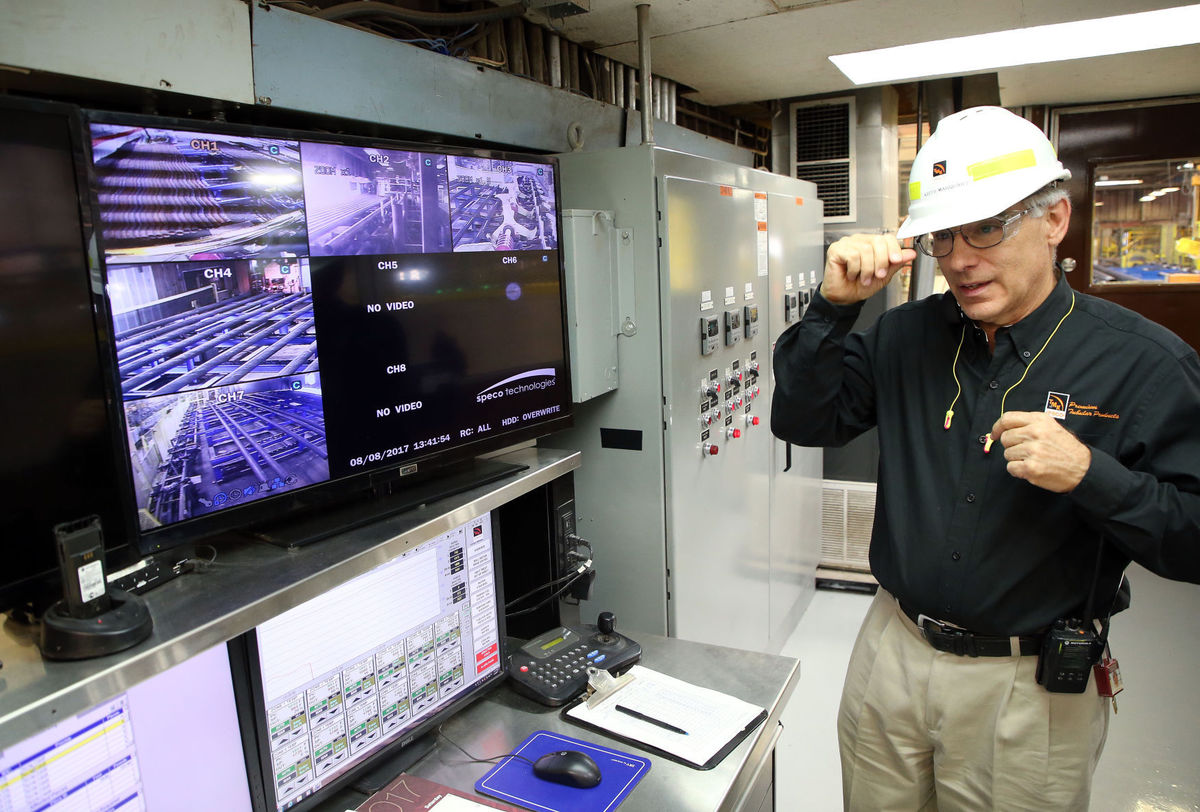
Keith Marquart leads a tour of the control room of the TMK IPSCO facility at the Tulsa Port of Catoosa. Photo Credit: Cory Young/Tulsa World

When the price of oil nosedived, one of this area’s casualties was TMK IPSCO, which idled its plant in September 2015.

“There was really no business for us,” said Joel Mastervich, vice president and chief operating officer of the company, which does welding, heat-treating, and threading on pipes used in drilling operations. “We had to make tough decisions back then. So we did.”

TMK IPSCO celebrated the restart of operations—and the creation of 168 jobs by year’s end—at a news conference August 8, 2017, at the Tulsa Port of Catoosa.

Read more: “Manufacturer restarts operations at Tulsa Port of Catoosa

TMK IPSCO restarts operations at Tulsa Port of Catoosa Read More »

CHTE Distinguished Service Award Goes to Cummins Inc. Employee

Dr. Rick Sisson of Worcester Polytechnic Institute (WPI) in Worcester, Mass. (L) presents the Distinguished Service Award to Cummins Inc. employee Steve Ferdon (R)
Steve Ferdon, director of Global Engineering Technology in the Fuel Systems Business Unit at Cummins Inc., has been awarded the Distinguished Service Award from the Center for Heat Treating Excellence (CHTE) at Worcester Polytechnic Institute (WPI). The award is presented to an individual who has made significant, commendable, and long-standing contributions to the promotion of CHTE, as well as the industry.

A member of CHTE since 2010, Ferdon has served as chair of its board of directors since 2012. His leadership at CHTE has contributed to mentoring the next generation of engineers, formalizing industrial membership governance of the board of directors, and sharing technical knowledge of heat treating applications with members. Dr. Rick Sisson, George F. Fuller professor of Mechanical Engineering at WPI and technical director of CHTE, presented Ferdon with the award.

According to Sisson, Ferdon has impacted the advancement of CHTE.  “From a technical standpoint, he brings a broad perspective to the industry,” said Sisson. “Cummins works with an extensive network of heat treating service providers from all over the world, applying multiple processes for ferrous alloys, and Steve shares a great deal of what Cummins has learned with our industrial members.”

Sisson also noted Ferdon’s efforts to bring the next generation of engineers to the meetings where they can learn practical experience from industry leaders.


CHTE Distinguished Service Award Goes to Cummins Inc. Employee Read More »

Nucor Steel Gallatin Orders Hot Strip Galvanizing Line with “Heat-to-Coat” Technology

Nucor Steel Gallatin, based in Ghent, Kentucky, recently ordered a “heat-to-coat” pickling and galvanizing line with an annual capacity of 500,000 tons of galvanized hot strip. The “heat-to-coat” technology is characterized by the compact and operator-friendly U-shape design, the turbulence pickling system, the high-power inductive heating system, the FOEN galvanizing equipment and the Drever after pot cooling system. The system will be delivered from a single source, SMS Group; startup is anticipated for 2019.

The “heat-to-coat” process permits the production of galvanized steel strip with durable corrosion protection, as well as an increased mechanical load-capacity while still maintaining low production and investment costs. Due to the integrated inductive galvannealing furnace the line is also able to produce galvannealed strips. There is a broad area of applications for galvanized hot strip, especially in construction, transportation and automotive industry. Furthermore, it is possible to substitute galvanized cold strip with hot strip. The ‘U-shape’ design allows a quick and easy bypass of the coating section in order to use the line as a continuous pickling line and produce just pickled and oiled material. The emission-free, inductive furnace operates with electrical energy, and a special fume exhaust system will be integrated which ensures low emission rates for the whole process.

Nucor Steel Gallatin Orders Hot Strip Galvanizing Line with “Heat-to-Coat” Technology Read More »

NLMK Lipetsk Upgrades Hot-Rolling Operations

NLMK Group, an international steelmaking company with operations in Russia, the US, and the European Union, is upgrading hot-rolled steel production at the Lipetsk site in western Russia. The plan is to install a new walking-beam reheating furnace to streamline the slab heating process. The new furnace will replace the outdated pusher-type furnaces currently operational at the facility.

The new furnace (No.2) with a capacity of 320 tonnes/hour (about 2.25 million tonnes per year) will boost the productivity of Mill 2000, increase the quality of steel products due to using a more advanced technology for feeding slabs to the mill, enable a significant reduction in energy consumption and minimize environmental impact.

The Hot Rolling Shop currently operates 5 reheating furnaces in turn with a total maximum capacity of 1,500 tonnes of slabs per hour (in 2016, 6.24 million tonnes of hot-rolled steel was produced). Three of them are already equipped with walking beams; the two remaining pusher-type furnaces will be replaced by the new furnace.

“The new furnace will enable a 110 ktpa increase in hot-strip mill productivity, and an improvement in the quality of HRC by eliminating surface defects in the process of preheating slabs that can occur in pusher-type furnaces. Specific natural gas consumption will decrease by 49%. Consumption of energy required for subsequent rolling will reduce by 20%, and air emissions will be almost halved,” said Konstantin Lagutin, NLMK Group Vice President for Investment Projects.

Construction and assembly activities are scheduled to begin in the fourth quarter of 2017 with an estimated launch date late in 2019. During maintenance, slabs for the hot-strip mill will be preheated by four of the five existing reheating furnaces. The upgrade of furnace No. 2 will have no impact on the production program. Main process equipment will be supplied by Tenova (Italy), with NLMK Engineering acting as the chief designer.

NLMK Lipetsk Upgrades Hot-Rolling Operations Read More »

BAE Systems Begins Production on First Royal Navy Type 26 Global Combat Ship

Production on the first of the new Type 26 Global Combat Ships for the UK Royal Navy began with the push of a button last month at the BAE Systems shipyard in Glasgow, Scotland.

BAE Systems welcomed Sir Michael Fallon MP, Secretary of State for Defense, to its Glasgow facility to signal the start of production following the UK Government’s recent award of a contract for the first three ships to be built in this series. This advances the work already underway to construct five River Class Offshore Patrol Vessels and provides a strong foundation for the next two decades of shipbuilding in Scotland. During his speech, the Defense Secretary unveiled the name of the first ship as Glasgow.

The Type 26 Global Combat Ship will be a world-class anti-submarine warfare vessel, replacing the Type 23 anti-submarine variant frigates, with the premier ship due to be delivered to the Royal Navy in the mid-2020s. Globally deployable, the flexible mission bay, aviation facilities, and combat systems ensure it will be capable of undertaking a wide range of roles from high-intensity warfare to humanitarian assistance, either operating independently or as part of a task group.

The ship benefits from the latest advances in digital technologies, including 3D and virtual reality, to ensure that the ship’s design is refined earlier in the process.  This has enabled BAE Systems to work in collaboration with the Ministry of Defense and the Royal Navy to ensure every zone of the ship has the requirements of its crew at the heart of the design.

BAE Systems Begins Production on First Royal Navy Type 26 Global Combat Ship Read More »

Electro-Spec Expansion to Include Heat Treating Services

Source: SC Department of Commerce

Electro-Spec, Inc., a specialty plating manufacturer headquartered in Franklin, Indiana, announced plans to locate a new 10,000 square foot production operations in Lexington, South Carolina. The facility will be outfitted to serve the medical, telecommunications, aerospace, and automotive industries with electroplating and passivating processes, including heat treating, annealing, and stress relieving services suitable for a range of gold, silver, copper alloy, nickel alloy materials.

Process annealing capabilities go up to 1,000 °F, carried out in a protective nitrogen environment to eliminate heat scale. Parts are prepared in a specialized pre-treating process, which includes vacuum vapor degreasing and thorough cleaning.

With a customer base in North America, Asia, and Europe, Electro-Spec projects the new development will bring $3.1 million of capital investment and create 53 new jobs at the facility located at 307 Industrial Drive in Lexington. Hiring is expected to begin in Fall 2017.

“South Carolina’s reputation as a manufacturing powerhouse continues to help us attract companies from around the world. We’re proud that Electro-Spec has selected Lexington County to establish its new operations, and we look forward to watching this partnership grow in the years to come,” Secretary of Commerce Bobby Hitt said.


Electro-Spec Expansion to Include Heat Treating Services Read More »

Skip to content