

Lindberg/MPH

Parts Cleaning: What the Experts Are Saying

OCIn the past, the topic of parts cleaning was not one that garnered much attention in the heat treating industry, but today, things have changed. Interest in parts cleaning is at an all-time high and that makes the need for parts cleaning discussion of vital importance in all types of heat treatment processes.

This article appears in Heat Treat Today's 2021 Automotive August print edition. Go to our digital editions archive to access the entire print edition online!


Heat Treat Today wanted to discover why parts washing is such an important step in the heat treat process and about its growing value, so we contacted respected industry experts for an in-depth analysis of the growing popularity of this important step in heat treating.

The following experts contributed to this analysis: Fred Hamizadeh, American Axle & Manufacturing (AAM); Mark Hemsath, Nitrex Heat Treating Services (HTS); Tyler Wheeler, Ecoclean; Experts at Lindberg/MPH; Andreas Fritz, HEMO GmbH; Richard Ott, LINAMAR GEAR; and Professor Rick Sisson, Center for Heat Treating Excellence (CHTE) at Worchester Polytechnic Institute (WPI).

Heat Treat Today asked 13 questions regarding parts washing and encouraged the experts to answer as many as they wished. The following article is a compilation of their experienced insight.

What role does parts cleaning play in the heat treat process and component quality? What is the cost or consequence for heat treating when cleaning is not done correctly? Any anecdotes you can share with us?

Fred Hamizadeh
Director of
Heat Treat & Facilities Process
American Axle & Manufacturing

Fred Hamizadeh, the director of Heat Treat & Facilities Process at American Axle & Manufacturing (AAM), says, “As a captive heat treater (supplying parts that are used in a final assembly), cleanliness of parts is of paramount importance to the longevity and durability of the final product. Parts that are completely unclean prior to heat treating can cause non-uniform case; and uncleaned parts after quenching can cause a multitude of issues, from failure in post-heat treat operations to higher cost of tooling due to contaminated surface, to fi res in temper furnaces from burn-off of the remnant oils on the surface of parts.”

Mark Hemsath
Vice President
of Sales, Americas
Nitrex Heat
Treating Services

Mark Hemsath, the vice president of Sales, Americas, at Nitrex Heat Treating Services replies, “For many surface engineering treatments like gas nitriding and ferritic nitrocarburizing, surface cleanliness is very important. Various oils and organic substances can impede—selectively or broadly—diffusion and surface activity. Some surface contaminants will bake on or ‘varnish’. Some can be removed with slow heating and purging or vacuum, or even surface activation, but it is not a reliable science. Either way, by positively cleaning them beforehand, problems are avoided. The issues occur when the composition and/or concentration of surface contaminants are not well known or preannounced. Pre-washing and cleaning take time, cost money, and must be studied and discussed with customers prior to any start of production. When parts are promised ‘clean', but arrive coated in an unknown rust preventative or cutting/forming oils, they need to be cleaned.”

Tyler Wheeler
Product Line Manager
Ecoclean

Ecoclean’s Tyler Wheeler, a product line manager, shares, “Cleaning plays a critical role that will directly affect the success of the heat treating process. While sometimes looked at as a nonvalue-added process, the consequences of not cleaning correctly are many and can be costly. Depending on the method of heat treating, quality issues may range from staining, discoloration, inconsistent properties, and even damage severe enough to scrap entire batches. Not only are there consequences for the workpieces themselves, but these problems may extend to damaging the heat treating equipment itself, leading to downtime and expensive repairs.”

The experts at Lindberg/MPH report there are several benefits to cleaning parts prior to any heat treating. They say: “By washing the parts prior to heat treating, it assures that the furnace chamber will remain conditioned and free from vapors, resins, binders, or solvents that could attack the refractory lining or heating elements and cause pre-mature failure of those items.”

What about the cost or consequences when the cleaning is not done correctly? “Washing parts prior to any thermal process, removes any layer of machine or cutting oils etc., which can be baked on and require additional and costly processes such as grit blasting, machining, or grinding to remove the unwanted layer on the surface of the parts.”

The Lindberg/MPH experts had an interesting anecdote to share about the importance of parts cleaning: “A customer was using a simple spray washer to clean small sun gears with an inner spline. The parts were to be carburized afterwards. The spray washer didn’t remove the machine oil used in the broaching process. During the carburizing process, the machine oil acted as a shield and didn’t allow the carbon to penetrate the ID properly, thus causing part failure on the gears. Afterwards, a dunk washer with heated water and a dry-off was purchased to clean the parts.”

Andreas Fritz
CEO
HEMO GmbH

Andreas Fritz, CEO at HEMO GmbH, explains, “Cleaning has always played a role in heat treatment. The question was always, ‘How clean is enough to keep the cleaning process as cheap as possible?’ Nowadays, especially in LPC or nitriding processes, the cleaning quality is at least equal to the hardening quality, because heat treaters understand that these processes belong together. There are no good hardening results without good cleaning quality.”

Additionally, Fritz continues, “a cleaned surface lowers the risk of defective goods after heat treatment by helping to provide a very good hardening depth and compound layer.”

Fritz shares a company-altering anecdote: “In the mid-1990s, we sold the first machine to a Bosch automotive supplier which had a captive heat treatment department. They delivered the cleaned and then hardened goods to Bosch, and their QM sent the goods back stating they were not hardened.

“Our customer asked if they checked the hardening quality, and Bosch replied: no, because the parts were not black; therefore, coming to the conclusion that they had simply forgotten to harden them. The supplier invited them to see that the parts were cleaned in a new way with a solvent-based cleaning machine under full vacuum. Since they came out spot-free after cleaning, there was no oil left, which formerly cracked on the surface and left the black color. The result was that for a couple of years, Bosch wrote on drawings that the parts had to be HEMO-cleaned before hardening. This was our start in the heat treatment industry and today, we make 50% of our annual turnover there.”

LINAMAR GEAR’s Richard Ott, a senior process engineer, offers his perspective, “Pre-cleaning and post-washing are very important because all parts coming into our plant can’t have any contamination on them. After heat treating, all parts are washed and blown off before temper.”

Historically, cleaning has not received the attention it deserves in the heat treat process. Have you seen any positive changes in perception among heat treaters in recent years?

Wheeler of Ecoclean addresses the perception of value: “Historically, the cleaning process has been looked at as a non-value-added necessity of manufacturing. However, this attitude is becoming a thing of the past for companies who invest in a quality cleaning process. As of late, customers have placed a greater focus on their cleaning processes both before and after heat treating as quality and production demands continue to increase. A proper cleaning process can eliminate scrap, increase uptime, and lead to a better-quality product for the end customer, which may translate into additional orders. When considering the holistic benefits of a proper and robust clean process, the old mentality is starting to change.”

The experts at Lindberg/MPH reply, “For many years washing parts before or after heat treating was considered an optional process and often bypassed. Today, most commercial and captive heat treaters are using parts cleaning as a necessity, particularly in the growing vacuum heat treating sector, where any contamination is detrimental to the hot zone and pumping systems.”

HEMO’s Fritz explains, “Commercial heat treaters specifically, changed their minds very early because they saw the chance to cover the various cleanliness demands of all hardening methods and processes with one single cleaning system. The hybrid cleaning system which made it possible to clean with solvent or with water or in combination in the same machine, made it possible for them to ensure hardening quality for any incoming good, no matter which residue was on it.

“They were able to cut down costs by using only one cleaning system and by increasing the income per ton due to increased quality and less defective parts.

“The captive heat treaters changed when they sent parts outside to commercial heat treaters while they did annual maintenance or when they didn’t have enough of their own capacity. The returned parts were of much better quality; and they started introducing this kind of cleaning system as well.”

Hemsath of Nitrex agrees about rising standards: “Similar to other areas of heat treatment, OEMs continue to raise their standards for part cleanliness. Sometimes these standards are rooted in functional requirements such as minimizing the number of foreign particles in a closed system in the finished product and other times the requirements are purely aesthetic. In either case, the result is that, in recent years, heat treaters have been required to devote more resources to improve their cleaning processes proactively during the quoting/process design stages, or reactively as a result of non-conformance. Many commercial heat treaters have come to understand that evaluating the cleaning needs of a part and implementing a robust cleaning process before production begins results in a better customer experience as well as improved long-term profitability.”

AAM’s Hamizadeh concurs with a positive change in perception: “Yes! As automotive industry reliability demands are increased, more and more attention is placed on all aspects of cleanliness, which includes heat treat washers.”

Ott, of LINAMAR GEAR, shares evidence of the rise in parts cleaning importance, saying, “Yes, our washers are checked twice a day for concentration and cleanliness.”

How can heat treaters determine their cleaning needs?

Rick Sisson
George F. Fuller
Professor and Director of the Center
for Heating Excellence (CHTE)
Worchester Polytechnic Institute

Rick Sisson, the George F. Fuller Professor and director of the Center for Heating Excellence (CHTE) at Worchester Polytechnic Institute (WPI), explains, “The incoming materials should be carefully examined visually to identify the type and quantity of surface contamination. Look for heavy oil, light oil, cutting fluids and/or rust, and scales. The cleaning process should be selected to remove the type of surface contamination identified. In general, a cleaning process should be included prior to heat treating to ensure a predictable response to the heat treating or surface modification process.”

Sisson continues, “The heat treater must confer with their customer to determine the post-heat treat cleaning requirements. If the part will be ground or machined after heat treat, then post-heat treat cleaning is not required. However, if the part is ready to be shipped, then the appearance is important. For medical applications, any discoloration may be a cause for rejection. The surface finish may be important and should be discussed with the customer.

“The pre-heat treat cleaning requirements are determined by the effects of cleanliness on the heat treat performance. For surface treating, a dirty surface may affect the carburization or nitriding performance. Nitriding is very sensitive to the surface cleanliness. A fingerprint can inhibit the nitrogen uptake and result in soft spots. Carburizing is less sensitive to oils and grease, but corrosion products may inhibit the surface reactions and cause soft spots. However, it is best practice to examine the preheat treat parts and clean away the oils and grease. Corrosion products (aka rust) and cutting fluids ensure a uniform response to the heat treating process,” Sisson concludes.

Hamizadeh of AAM states, “Most customers should have a specification. Start by reviewing the provided prints and follow up with the final customer to determine if parts are further washed with dedicated process washers prior to installation in the final product.”

He concludes, “Nevertheless, heat treaters must provide a part which is clean, uniform in color, and free of quench oil on surfaces and cavities. Parts must also not exhibit any markings from oxidized quench oil (tiger stripes), either.”

“We are in-house heat treaters. Our customers require spotless parts and if they’re not, then we need to clean them,” explains Ott of LINAMAR GEAR.

Fritz from HEMO shares his perspective: “Heat treaters usually have their own labs to check the hardening quality. If the quality is not stable, the cleaning could be the reason. Additionally, they could send parts outside to be cleaned in a different way. Then do the hardening in their shop to see if there is a difference. In most cases, their customers tell them if the quality is not good. We are then the ones to offer our experience and take them to the next level.”

Ecoclean’s Wheeler describes their process in determining cleaning needs: “When determining the needs of a cleaning system, it is essential to understand the incoming contaminants on the part. In addition, one needs to understand which upstream manufacturing processes were used, the requirements of the heat-treating process, and which type of heat-treating process is being used. Not all cleaning systems are created equally, and not all approaches work in every scenario. For example, phosphate-coated parts coming from a stamping process will require a different cleaning system than a machined part. Working together closely with your cleaning equipment supplier is the best way to ensure that the best cleaning process is implemented for your specific application.”

How do the requirements for cleaning differ between pre- and post-heat treating?

The experts at Lindberg/MPH explain: “Pre-washing parts ahead of heat treating is needed to remove any oils or solvents that can remain on the parts. Also, some parts can hold wash water and some residue that can be carried into the furnace, and those must be blown-off or dried before the next operation.”

They continue: “Post-washing parts, particularly after oil quenching, is needed to remove any oil that might be trapped—parts such as pistons, valves, and gears with recessed areas. Most of those batch washers are fitted with a dunk or oscillation feature where the load is completely submerged, then drained and dried before moving to the tempering process. For many years, a single washer was used for both pre- and post-washing, but that practice has largely stopped.”

Nitrex’s Hemsath states, “When oil quenching in vacuum oil quench furnaces or standard integral quench furnaces, the oil is known, and it must be removed prior to temper operations. Quench oils are often difficult to remove completely, especially in hot oil quenching applications. Tempering can help with further removal of the oils, or it can make the situation worse by baking on quench oil residues into tough, difficult-to-remove deposits. With post-cleaning, the contaminants are well known, and they do not impede the heat treatment or surface engineering.” Hemsath continues, “Contaminants on the part’s pre-heat treatment must be removed for vacuum furnace operations to protect the equipment and prevent carbon pickup on the parts. Pre-contaminants must also be removed to help with processes such as gas nitriding, FNC, and low-pressure carburizing (LPC). Since LPC is a vacuum process, precleaning is more critical than with gas atmosphere carburizing, where the hot hydrogen gas can be effective at assisting with pre-cleaning of parts. However, even in atmosphere heat treating, minimizing the number of foreign substances entering the furnace on each part will help ensure a more consistent process and extend quench oil life.”

Wheeler of Ecoclean states, “Different goals and objectives drive the requirements of the pre-and post-heat treat cleaning systems. A pre-heat treat cleaning process aims to remove all contaminants produced by the upstream manufacturing process that could negatively affect the heat treating process. Without a proper pre-cleaning process, the heat treating may not be effective, parts could be damaged, and even the heat treating equipment itself could face damage. The goal of the post-heat treat cleaning system is to ensure that the final product meets the quality demands of the customer or end-use application. The needs of these systems may be driven by strict specifications which limit the number of allowable particulates and even the maximum size of each particle.”

Hamizadeh of AAM agrees that the processes are in no way similar. He says, “Drastically different. Pre-wash is intended to clean the product from any upstream contaminants, cutting fluids to provide a clean, uniform surface for process. Additionally, pre-wash is used to protect the heat treat equipment from contamination from oils and chemicals, which will have an adverse effect on lining or internal alloy components of the furnaces.”

He further explains, “Post-washers are historically built to remove the bulk quench oil from the part. However, it is more common that parts have irregular shapes, hidden holes, and geometries that make it difficult to remove trapped oils.”

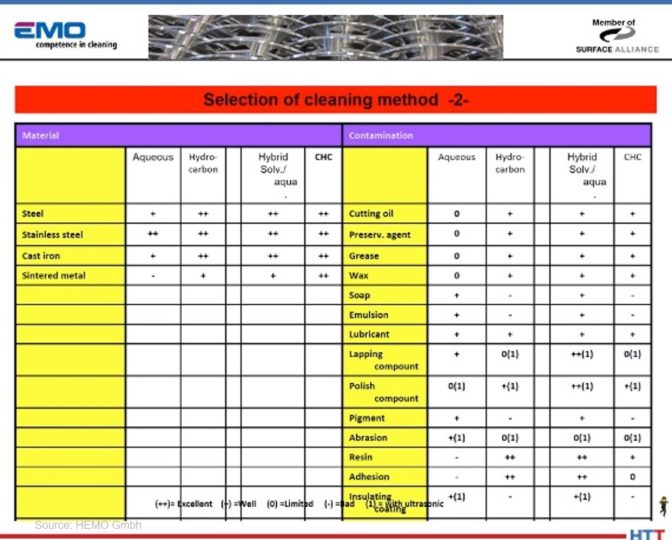
“In the case of pre-cleaning, we make a difference between organic and inorganic residues,” Fritz of HEMO contends. “An old chemical says, ‘Similar dissolves similar.’ Hence, it is important to identify the residues of parts before pre-cleaning.”

He continues, “Water-based coolant should be cleaned with water and detergent because solvent would leave white spots caused by salts.”

“Oil is organic and should be removed by solvents like hydrocarbon or modified alcohol because water and oil are not a good mixture,” explains Fritz. “Anybody who first cleans an oily pan before a glass in the same bath knows that. Sometimes the parts have both kinds of residues on them due to several production processes before heat treatment. Then a hybrid cleaning machine is the perfect solution, because it first takes away the organics with solvent and then the inorganic spots with water.”

He concludes, “In the case of post-cleaning, we mainly talk about cleaning after oil quenching. In this case, water is the worst solution because the cleaning quality is not good, and the amount of wastewater is immense. A pure solvent machine is the best option for this scenario.”

How does cleaning differ between commercial heat treat shops and in-house/captive heat treat departments?

Sisson of CHTE describes the difference this way: “The need for cleaning remains the same. Captive heat treaters will have the benefit of heat treating the same parts over time and should document the contamination identified and the cleaning methods used. Frequently the parts will be coming from a machining or surface finishing operation. A discussion with the machine shop will identify the contamination.

“Commercial shops will see a wide variety of parts and should develop an incoming materials evaluation process to determine the type and extent of surface contamination. As part of this incoming material evaluation process a cleaning process should be specified for each incoming part. The process to remove grease and oil is different from corrosion products.”

How clean is clean anyway? How can one determine cleanliness? How can heat treaters identify the right cleaning method for their applications? What should they pay attention to?

“Specifications based on design and final function of the part will determine the cleanliness requirement,” Hamizadeh of AAM points out. “It is imperative to determine the cleanliness requirements prior to processing the parts. This could be surface chemical, oil contamination, or particulate allowed on part in terms of grams allowed per part or number of particles of determined size per part. Pay attention to customer contractual requirements based on RFQ or part print, or customer specs as stated in part drawings.”

“When answering this question, we need to ask ourselves: ‘What is the end goal of the cleaning process and what contaminants am I removing?’” Wheeler of Ecoclean begins. “Not all contaminants are created equally, nor will they successfully be removed using the same approach. The types of equipment, process steps, machine parameters, and chemicals used for cleaning need to be chosen carefully to ensure a successful and robust process.”

He explains: “Cleaning prior to heat treating is focused on preparing the parts for a successful heat treat, which means we need a surface free of oils, coolants, and particulates. In addition to the cleaning aspect, it is also crucial to sufficiently dry the parts before treating them to prevent damage during the heat treating process. A simple test to check for cleanliness prior to heat treat is to perform a ‘water break test,’ where clean water is rinsed across the surface with a goal of seeing a continuous film of water running across the whole part without being interrupted. A more scientific approach involves measuring the surface energy of the piece by using a contact angle measurement tool or Dyne pens.”

Wheeler clarifies: “When asking how clean the parts need to be post-heat treatment, there may be drastic differences based on customer quality requirements and the end-use of the workpiece. These requirements can range from simple visual cleanliness checks to strict maximum residual particle size limitations. The evaluation for conformity to these high-end specifications will require the use of multiple pieces of lab equipment, including expensive particle measuring and counting microscopes.” CHTE’s Sisson illustrates, “As we have seen in old movies, the butler wears white gloves and after rubbing the surface any contamination can be seen. There is a limited number of types of surface contamination for heat treaters to identify: heavy oils, light oils, cutting fluids, and corrosion products (rust and scales). Knowledge of the part history will help identify the contamination and therefore the cleaning method.

“The largest impact will be on nitriding and ferritic nitrocarburizing (FNC) processes. Surface contamination inhibits the absorption of nitrogen by interfering with the decomposition of ammonia on the steel surface. Even the grease from fingerprints can cause soft spots,” he concludes.

HEMO’s Fritz shares, “Clean can be visually clean or when you wipe a cleaned part or when a part is not dirty after the hardening process because it was cleaned well before.”

In determining cleanliness, Fritz continues, “Optically, for example, use an ink pen that shows the surface tension. A high surface tension shows a well cleaned surface.”

And finally, identifying the right cleaning method and focus: “First thing is to always identify the residues which are on the parts. If this is identified the cleaning process can be selected accordingly.”

What might be the impact for furnaces if components are not cleaned thoroughly?

Fritz of HEMO answers, “The residues vaporize and crack on the furnace walls. The walls then must be stained new in short intervals. This can be prevented by using a better cleaning system.”

“Heat treating oily parts will cause the oils to burn and fill the room with smoke and oil vapors. These gases and the smoke will deposit in the furnace and reduce performance and furnace life,” shares Sisson of CHTE.

The experts at Lindberg/MPH explain, “For many years unwashed parts were placed in tempering furnaces to burn-off the machine oils rather than washing. Over time, all that machine oil saturated the furnace brickwork or coated the heating elements, which had to be replaced much sooner than needed. Today, due to some environmental issues, that ‘smokebomb’ has become a problem, and the washer has become a sound solution and a proven benefit.”

AAM’s Hamizadeh says, “I’ve seen carburizing furnaces become contaminated with chemicals from prewash. They glazed the hard refractory into a glass and caused adhesion between silicon carbide rails and alloy base trays.” He continues: “We’ve also seen excessive smoking from temper progress to an occasional, but rare fire in a temper furnace or a more probable fire in exhaust ducts due to oil film build up.”
What cleaning options are available? What are their pros and cons?

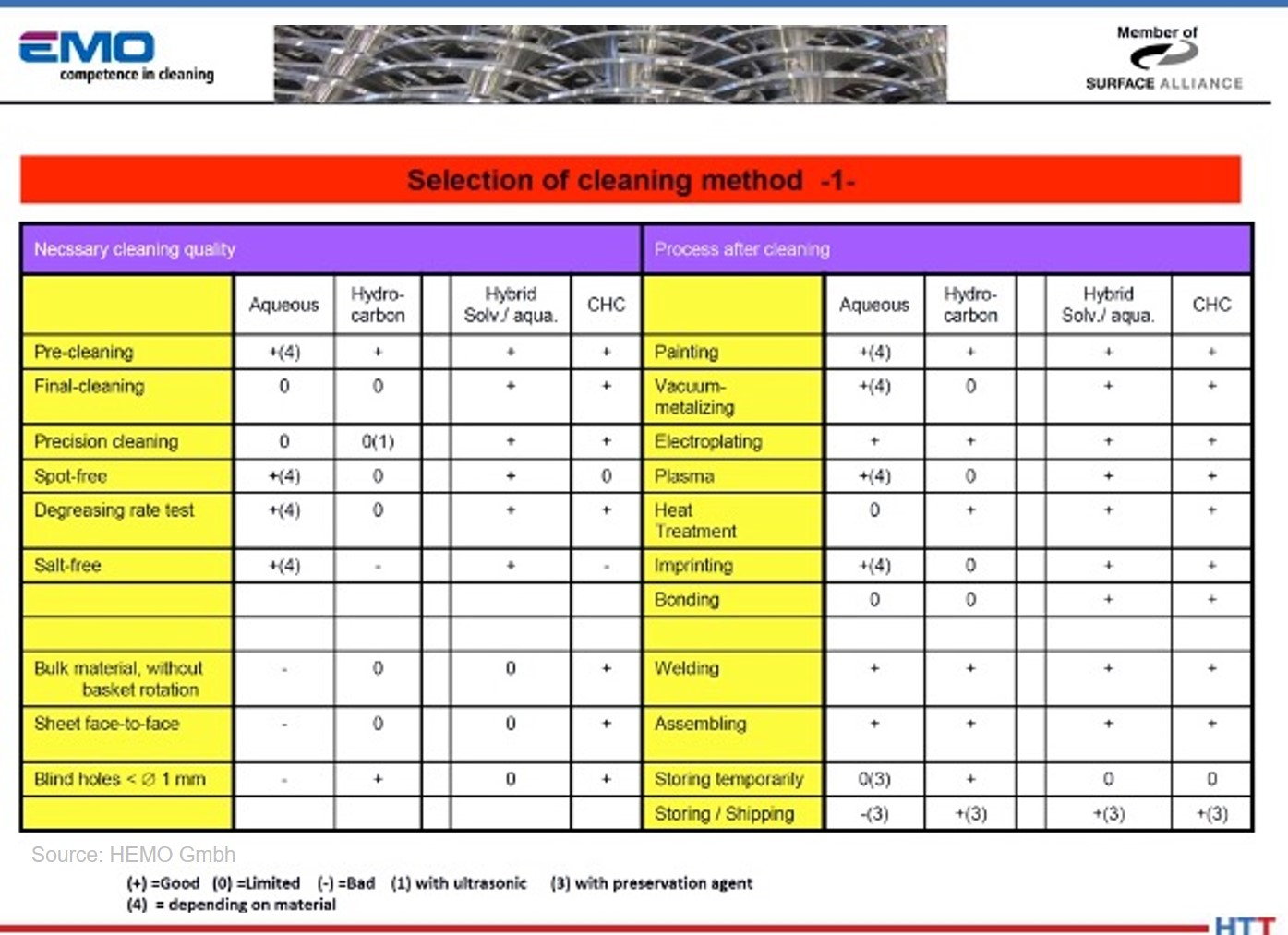
“Traditional batch or continuous spray washers with or without dunk is an absolute minimum,” states Hamizadeh of AAM. “Other equipment such as Aichelin’s Flexiclean Vacuum washer can do a fabulous job without the use of solvents. Today—as a minimum—prewash systems should have a 3-tank system of wash, rinse & rinse, and blowoff. Post-washers should have 4-stages: 2-wash, followed by 2-rinse, and blowoff dry stage. Conventional washers are very cost-effective. Newer technology washers, with the use of advanced skimmers, multistage filtration, and ultrasonics to get the best agitation possible, will improve the capability of the machine. Dedicated and custom designed line washers perform the best, but also cost the most.”

HEMO’s Fritz shares, “I think the inline water-based dip and spray cleaners with hot air or vacuum drying are still fine for 50% of all applications in heat treatment. Anything else would be too expensive and simply not necessary. But for higher demands, more sophisticated systems are necessary. There you find top or front-loading full vacuum machines which can run water with detergent, solvents, or both.”

“For most washers, added features such as skimmers, oil traps, and dual-can type filters are very popular,” point out Lindberg/MPH experts. “These options help in keeping the washing media cleaner and free from loose metal, chips, and free carbon. The cost of these items is minimal compared to dumping several hundred gallons of water and many chemicals on a regular basis.”

They conclude, “Most washers, especially those fitted with the dunk features, are built with stainless steel tanks and all structures that are submerged in the washing solution. The extra cost for stainless steel far outweighs the cost of replacing a mild steel-lined tank or coated tank, which both have a much shorter life than the stainless-steel units.”

Apart from technical cleanliness, are there other aspects that heat treaters should consider in their choice of the right cleaning solution? Do certain materials demand specific cleaning precautions? What cleaning methods will be particularly suited to specific types of soils?

LINAMAR GEAR’S Ott says, “Washer chemistry that will remove oil and other surface contaminants and possibly leave a protective coating on the parts may be worth developing, so that flash rusting will not occur before the tempering operation.”

AAM’s Hamizadeh explains, “For specific parts and materials, specific washers with specific chemicals are needed. All parts should be compared to detergents used, temperatures, and agitation/spray pressures they can endure.”

“They should consider the quality of the final product,” Fritz of HEMO details. “They should consider environmental issues like wastewater, amount of detergent, heating energy, etc. They should consider cycle time and the degree of cleanliness required. Altogether it will lead them to a total cost of operation consideration, and they will find out that a high investment doesn’t mean higher operating cost over the lifetime of the equipment.”

He shares that “Copper and aluminum, especially, must be handled with care when selecting a way of cleaning.”

What common issues do heat treaters experience in the cleaning process? And how can these be avoided?

Nitrex’s Hemsath explains, “There are various methods for cleaning from vapor degreasing to ultrasonic methods. Each has benefits and negatives, such as environmental impact issues or cleaning of various contaminants completely. Another issue is part orientation and cost of parts handling. Continuous small parts cleaning can allow better part orientation, say, for cylinders. However, the labor content adds to costs for individual parts placement. No operation, especially commercial heat treat operations, can have all the cleaning options. It is not uncommon to hand-clean parts that are difficult to clean in a batch or continuous processes. The biggest problem is not knowing what the exact contaminants are.”

“Complex part geometries and pack density of the load are common load issues that are faced. Regular maintenance of washers—filters, skimmers, titration practices to maintain chemical balance—will all affect their performance. A regimented SPC and quality control specification should be required to ensure all work is completed and signed off by appropriate quality team members,” states Hamizadeh of AAM.

Fritz of HEMO cautions, “The biggest issue is the white layer or spots on the parts which result from inorganic residues. They pollute their water-based cleaning media with oil and other organics and then the media is not strong enough to additionally clean off the inorganics. This can cause soft spots on the surface after the hardening process. “The second big thing,” he says, “is that the cleaning quality is decreasing with every cycle. In a solvent machine with a good distillation device, you always have a constant quality.”

Have you noticed any changing requirements or expectations in terms of cleaning quality for heat treat processes over the last 5 years?

Hamizadeh of AAM answers affirmatively, “Yes. Tighter specs for amount of carry over oil or oil residue on parts.”

HEMO’s Fritz concurs, “The requirements change because the industry is changing. We go to electric vehicles, which means we need to harden new kinds of parts that are made of new kinds of materials, alloys, and composites. This means a modification of the hardening and of the cleaning process.”

Ott from LINAMAR GEAR has noticed, “Parts are compared to vacuum heat treat, so the cleanliness is very important, especially in automotive.”

What challenges do you think will confront heat treaters in the next 5 years, specifically regarding parts cleaning? Where do you see trends heading?

“Electric drive units will require a reexamination of the part washing and available technologies. It’s going to become more difficult. Not easier,” believes AAM’s Hamizadeh.

Fritz of HEMO predicts, “The main challenge will be to stay alive. With the rise of the electric car, fewer parts will be heat treated. Heat treaters must offer the best possible quality for reasonable prices in order to survive. This is not possible with the old way of cleaning.” He sees trends “. . . still going to vacuum. LPC is very strong and will be increasing. Additionally, gas and plasma nitriding will increase. Especially in those cases, a clean surface is the only way to have a reliable hardening process with consistent quality.”

Fritz concludes, “The other trend is small batches. That is the reason why we redesigned our small cleaning machines to also be able to survive in the heat treatment environment.”

“Totally clean parts,” is the challenge Ott of LINAMAR GEAR sees.

How can heat treaters balance the need for component cleanliness and cost-effectiveness for their operation?

Ecoclean’s Wheeler maintains, “When searching for the balance between cleanliness and cost, defining what costs are genuinely associated with cleaning is essential. Some of these costs may be obvious, while others may not be so clear at first glance. In too many instances, the actual lifecycle costs of owning and operating a cleaning system are not taken into consideration as the main focus is instead the upfront investment of the machine itself.

Utility costs, chemical usage, waste disposal, and maintenance are only some of the expenses that will add up over the life of a piece of equipment which may significantly impact its cost-effectiveness over an alternative solution. One example in this instance is using a vacuum solvent cleaning system over an aqueous-based machine. While the solvent system will typically come with a higher upfront purchase price, it is generally more cost effective to own in the long run when compared to the water-based system.”

Wheeler continues, “The other question that one should ask when deciding on how much to spend on a cleaning system is what the cost of purchasing the wrong system is. How much will be spent on scrapped parts, repairing damaged heat treating equipment, and downtime caused by the improper cleaning of parts? These may not always seem obvious upfront, yet they are actual costs that every manufacturer may face. While there is no one-size-fits-all approach for every company, it is essential to consider all obvious and hidden costs associated with the cleaning process when looking for the balance between price and quality.”

“For captive heat treaters,” Hemsath of Nitrex answers, “their contaminant stream is much better understood, and a solution can be custom engineered to provide repeatable results. For commercial heat treat facilities, cleaning operations have to satisfy many part sizes, orientations, and a multitude of contaminations that are often not well understood. So, the cleaning operation must be a process that gets most of the contaminants on most of the parts. Good communication with the part maker is essential to prevent problems, especially in long-term programs where the same parts are heat treated for many years.”

“They must do a total cost of operation examination of their whole process in order to find the right system,” encourages Fritz of HEMO.

These experts have spoken and offered much valuable insight into the world of parts cleaning. No longer can this process be viewed as “a non-value-added necessity of manufacturing,” as Tyler Wheeler of Ecoclean observed. Today, parts cleaning is proving to be an important component for success in heat treating.


For more information, contact the experts:

Fred Hamizadeh, Director of Heat Treat & Facilities Process, American Axle & Manufacturing, Fred.Hamizadeh@aam.com

Mark Hemsath, Vice President of Sales, Americas, Nitrex Heat Treating Services, mark.hemsath@nitrex.com

Tyler Wheeler, Product Line Manager, Ecoclean, Tyler.Wheeler@ecoclean-group.net

Lindberg/MPH, lindbergmph@lindbergmph.com, 269.849.2700

Andreas Fritz, CEO, HEMO GmbH, a.fritz@hemo-gmbh-de

Richard Ott, Senior Process Engineer, LINAMAR GEAR, Richard.Ott@Linamar.com

Rick Sisson, George F. Fuller Professor & Director of the Center for Heating Excellence, Worchester Polytechnic Institute, sisson@wpi.edu

technical Tuesday

Parts Cleaning: What the Experts Are Saying Read More »
Homocarb Pit Furnace Dispatched to Power Industry

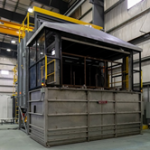
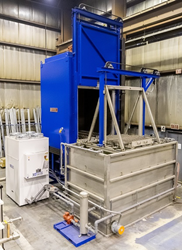
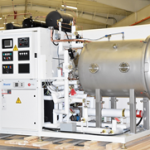
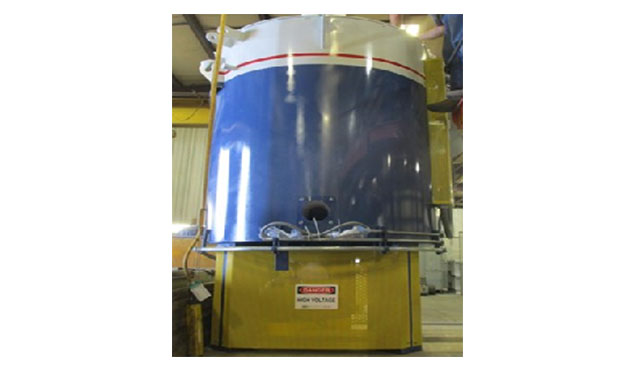
An electrically heated homocarb pit furnace was recently shipped to a manufacturer in the power industry. It is designed to work with a protective carbonaceous atmosphere. The top loading furnace, from Lindberg/MPH, is ideal for case carburizing, hardening, annealing, and carbon restoration at temperatures up to 1750°F. Gross workload is 1600 pounds, with temperature uniformity of +/-25°F at 1650°F.

The furnace can accommodate a work basket with a 25-inch diameter that is 48 inches deep, providing a clear work volume of 13.64 cubic feet. A retort minimizes atmosphere consumption and furnace-conditioning time between loads. The cover lid utilizes an electrically operated boom lift, which provides ease of loading and unloading.

(source: Lindberg/MPH)

Homocarb Pit Furnace Dispatched to Power Industry Read More »

Auto Parts Maker Purchases Hot Stamping Furnace

An international automotive corporation that designs, develops, and manufactures metal automotive components recently received a hot stamping furnace from a manufacturer of standard and custom industrial heat treat furnaces.

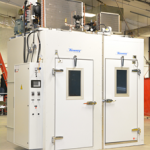
The Gestamp Research and Development facility, located in Auburn Hills, Michigan, added an electrically heated, four chamber hot stamping furnace built by Lindberg/MPH, an industrial thermal processor.

Bill St. Thomas
Business Development Manager Lindberg/MPH

“This Lindberg/MPH hot stamping furnace provides uniform heating for a wide variety of high-strength steels or aluminum materials prior to hot stamping or hydro-forming applications. The team at Gestamp has been incredible to work with on this project and we are proud to be their supplier,” said Bill St. Thomas, Business Development Manager.

The furnace is integrated at the Gestamp facility with a robotic transfer system and hydraulic hot stamping press. The four chambers operate independently with the top chamber designated for aluminum treatment. This type of hot stamping system allows the customer the flexibility to treat different steels simultaneously and takes up a much smaller footprint than a continuous system.

Auto Parts Maker Purchases Hot Stamping Furnace Read More »

A Dozen & a Half Quick Heat Treat News Items to Keep You Current

A Dozen & a Half Quick Heat Treat News Items to Keep You Current

Heat Treat Today offers News Chatter, a feature highlighting representative moves, transactions, and kudos from around the industry.

Personnel and Company Chatter

  • Mike Woolery has recently joined Plibrico Company, LLC,  as its purchasing manager. Woolery will report directly to the company’s Chief Financial Officer, Rob Wasieleski.
  • The recent acquisition of the SME Group by Dana Incorporated, as well as the Drive Systems segment of Oerlikon Group, including the Graziano and Fairfield brands, has resulted in the addition of five facilities throughout China.
  • Gasbarre Industrial Furnace Systems is pleased to announce the promotion of Mike Harrison to Engineering Manager for Gasbarre (formerly J.L. Becker), in Plymouth, MI.
  • A global investment firm recently announced that it has closed its purchase of StandardAero. The Carlyle Group completed the purchase from Veritas Capital. StandardAero is a global provider of repair and maintenance services to the aviation industry.
  • R. Joseph Stratman, Chief Digital Officer and Executive Vice President of Nucor Corporation, recently announced plans to retire on June 8, 2019, after more than 29 years of service with Nucor. Effective May 19, 2019, MaryEmily Slate will be promoted to Executive Vice President and will assume responsibilities for the Tubular Products Group, logistics and certain joint ventures.
  • Saint-Gobain Coating Solutions, Amherst, N.Y., has recently appointed Tim Vitorino, a member of the ASM Thermal Spray Society, to the position of Product Manager for Thermal Spray Powders. In this role, he will have global responsibility for the current TSP portfolio and for new product development.

Equipment Chatter

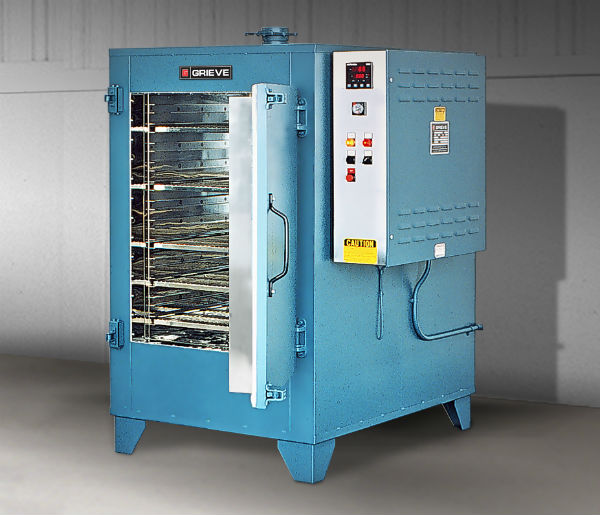
  • A modified shelf oven, No. 879 from Grieve Corporation, heats to 350°F (177°C) and is currently used for pre-heating bulk friction material in trays at the customer’s facility.
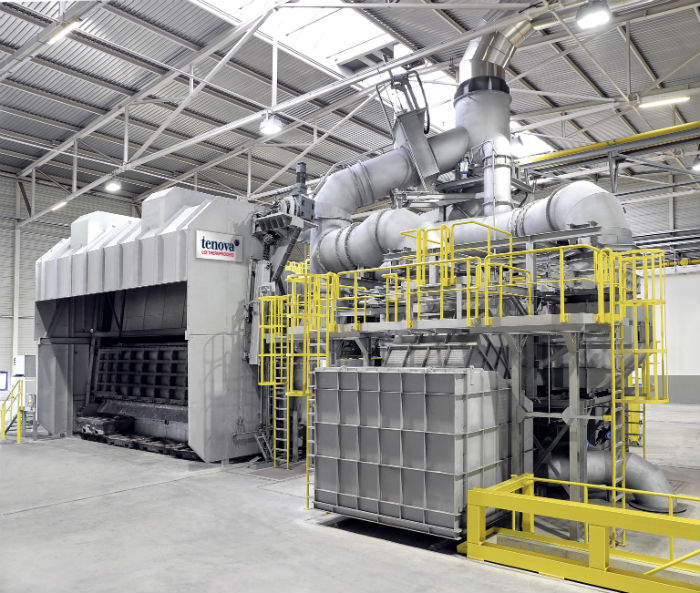
  • A continuous annealing and chemical pretreatment line for processing strip coils for the aluminum market has been contracted by Henan Tongren Aluminum Co. Ltd, which specializes in aluminum products. Tenova will deliver the new line, which will process automotive and aircraft aluminum alloys, family series 2XXX, 5XXX, 6XXX and 7XXX.
  • A new 12’ long car-bottom vacuum furnace with advanced pumping system and rapid cooling capability has been ordered for Solar Atmospheres’ Greenville, South Carolina, facility. The horizontal vacuum furnace has been manufactured by sister company Solar Manufacturing; installation is scheduled for early 2020.
  • Two CaseMaster Evolution® (CMe) vacuum furnaces have recently been delivered to an aerospace components manufacturer, and an additional CMefurnace has gone to a performance automotive manufacturer, from SECO/WARWICK Group.

  • A Gruenberg explosion resistant truck-in oven has been shipped to the defense security industry by Thermal Product Solutions.
  • An electrically heated horizontal solution treat system with a maximum oven operating temperature of 1,100°F and a chiller system has been shipped to a manufacturer in the aerospace industry by Wisconsin Oven Corporation. Guaranteed temperature uniformity of ±10°F at set points of 870°F, 920°F, & 985°F was documented with a twelve (12) point profile test in an empty oven chamber under static operating conditions and was performed in accordance with BAC 5621F specifications.
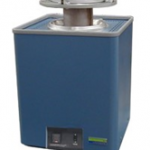
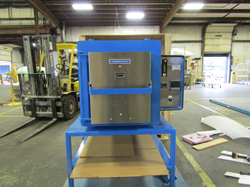
  • A 2012°F (1100°C) crucible furnace has been shipped to a research and development laboratory in the nuclear industry by Lindberg/MPH. This crucible furnace will be used for a wide variety of laboratory melting applications, including annealing, ashing, carbon firing, ceramic firing, hardening, melting, nitriding, normalizing, sintering, solution treating, and stress relieving.


Kudos Chatter

StandardAero recently celebrated the delivery of the company’s 500th CFM International CFM56-7B turbofan engine from its overhaul facility in Winnipeg, MB, Canada. This milestone engine powered a Boeing 737 Next Generation passenger jet operated by a major North American airline supported by StandardAero via offload agreements with its valued partner GE Aviation. StandardAero launched its CFM56-7B program in June 2009,

Precision Micro is now certified to ISO 13485 – the internationally recognized quality management system for medical device manufacturers. The accreditation was awarded following a successful site audit conducted by the British Standards Institution (BSI), the national standards body of the United Kingdom.

Stratolaunch Systems Corporation recently completed the first flight of the world’s largest all-composite aircraft, the Stratolaunch. With a dual fuselage design and wingspan greater than the length of an American football field, the Stratolaunch aircraft took flight at 0658 PDT from the Mojave Air and Space Port. Achieving a maximum speed of 189 miles per hour, the plane flew for 2.5 hours over the Mojave Desert at altitudes up to 17,000 feet. As part of the initial flight, the pilots evaluated aircraft performance and handling qualities before landing successfully back at the Mojave Air and Space Port.

JTEKT North America (JNA), a supplier of steering systems, driveline components and bearing technologies was recognized with an Excellent Award in Technology & Development from Toyota Motor North America, Inc. (TMNA) at its Annual Supplier Business Meeting (ABM) in March.

The leading producer of flat-rolled aluminum products recently hosted a ribbon cutting celebration to commemorate a $4.5 million investment at its facility in Warren, Ohio. Through this investment, Novelis, Inc., will provide greater versatility for pretreatments, improves operational efficiency and reduces costs over time.


Heat Treat Today is pleased to join in the announcements of growth and achievement throughout the industry by highlighting them here on our News Chatter page. Please send any information you feel may be of interest to manufacturers with in-house heat treat departments especially in the aerospace, automotive, medical, and energy sectors to the editor at editor@heattreattoday.com.


A Dozen & a Half Quick Heat Treat News Items to Keep You Current Read More »

A Dozen & a Half Quick Heat Treat News Items to Keep You Current

A Dozen & a Half Quick Heat Treat News Items to Keep You Current

Heat Treat Today offers News Chatter, a feature highlighting representative moves, transactions, and kudos from around the industry.

Personnel and Company Chatter

  • Dustin Lawhon was recently promoted to Regional Sales Manager at Paulo, responsible for establishing relationships with new customers in the Great Lakes Region.
  • A manufacturer of metal components for the automotive industry recently inaugurated its new plant in San Luis Potosí, Mexico. Gestamp‘s new plant for manufacturing chassis parts will be equipped with state-of-the-art machinery for hot stamping and hydroforming, among other technologies.
  • A large oil pipeline project in South America will have its nickel-based, flat-rolled products supplied by Allegheny Technologies Incorporated (ATI), with shipments beginning in second quarter 2019 and scheduled to be completed by year-end.
  • A company providing machine safeguarding solutions announced that it has launched a new Combustion Safety division that provides turnkey solutions for organizations that use thermal processes in their operations. Rockford Systems LLC‘s new expanded division will be led by Robert Sanderson P.E. who has been appointed to the position of Director of Business Development.
  • A mutual cooperation has been declared for the realization of a revolutionary concept for a significantly CO2-reduced steel production, commonly developed by two companies: Tenova–a company of the Techint Group specialized in innovative solutions for the metals and mining industries–and Salzgitter AG– among the leaders in innovative and sustainable steel and technology products. The name of the concept is SALCOS (SAlzgitter Low CO2 Steelmaking) and its aim is to undergo a stepwise transformation process of the integrated steelmaking route, moving from carbon-intensive steel production based on Blast-Furnaces towards a Direct Reduction and Electric Arc Furnace route, including the flexible incremental utilization of hydrogen. This concept is capable of reducing CO2 emissions up to 95% with respect to the entire steel production route.

  • Vacuum heat treating has been added to Paulo’s Monterrey Division plant which has been focusing on stress relieving and ferritic nitrocarburizing since startup. Since startup processing has been focused on stress relieving and ferritic nitrocarburizing.  Adding vacuum equipment is the first step to expanding critical aerospace brazing to include both argon and nitrogen quenching.  The working zone measures 48”x48”x48” with a 3500lb capacity and a maximum temperature of 2400F. The installation will include tempering and testing equipment to support both annealing and hardening processes for a variety of materials.
  • Timothy J. Harris will join ATI as Senior Vice President, Chief Digital and Information Officer, effective May 6, 2019.
  • A Cleveland-based distributor of heat treat furnaces, pumps, and products, Mountain Rep, has partnered with RÜBIG, an Austrian industrial furnace manufacturer.
  • Andrew Yazot will move from his position as International Sales Manager for Ipsen to Midwest Regional Sales Owner, effective immediately. In this position Yazot covers nine states in the Midwest, replacing former Midwest Regional Sales Owner Matt Clinite, who was promoted to Ipsen Customer Service Sales Manager last month. Yazot, who joined the company in 2009, holds a degree in mechanical engineering and has worked in technical sales for more than two decades.

Equipment Chatter

  • A 2200°F (1200°C) crucible furnace was shipped to a company in the energy industry by Lindberg/MPH. The crucible furnace may be used for a number of applications and processes, including annealing, ashing, carbon firing, ceramic firing, hardening, melting, metalizing, normalizing, sintering, solution treating, and stress relieving.
  • A southeastern US manufacturer of various items used in the production of heavy equipment and transportation devices has purchased a dual chamber heat treating furnace from L&L Special Furnace Co, Inc. The furnace will be used to heat treat the tooling used to manufacture these items.
  • A cooling chamber is currently being used for cooling oven trucks of steel parts at the customer’s facility. The No. 807 was supplied by Grieve Corporation.
  • A manufacturer in the composite industry has purchased a natural gas-fired heavy duty walk-in furnace from Wisconsin Oven Corporation.

Kudos Chatter

  • An aerospace maintenance and heat treatment manufacturer based in Elizabeth, Indiana, has launched a new website in order to reach clients across the U.S. and internationally. SAS-INC. is made up of Simpson Alloy Services Inc. and Simpson Aerospace Services.
  • GE Aviation was selected by Aviation Week & Space Technology as a winner of the 62nd annual Laureate Awards, honoring extraordinary achievements in aerospace.
  • PhoenixTM Ltd has been accredited in accordance with recognized International Standards ISO/IEC 17025:2017, general requirements for competence in testing or calibration laboratories.
  • Aleris has been recognized for the second consecutive year with the accredited supplier award by Airbus at a Supply Chain and Quality Improvement Program (SQIP) event in Toulouse, France.
  • Cambridge Heat Treating Inc. CFO Cheryl Mortimer is the recipient of the Women Entrepreneurship Fund and was recognized at an event with Ontario MP Bryan May. Cambridge Heat Treatment Inc. was selected to receive a contribution of up to $100,000 through the WEF program.


Heat Treat Today is pleased to join in the announcements of growth and achievement throughout the industry by highlighting them here on our News Chatter page. Please send any information you feel may be of interest to manufacturers with in-house heat treat departments especially in the aerospace, automotive, medical, and energy sectors to the editor at editor@heattreattoday.com.


A Dozen & a Half Quick Heat Treat News Items to Keep You Current Read More »

15 Quick Heat Treat News Items to Keep You Current

15 Quick Heat Treat News Items to Keep You Current

Heat Treat Today offers News Chatter, a feature highlighting representative moves, transactions, and kudos from around the industry.

Personnel and Company Chatter

  • Leroy M. Ball has recently been appointed to the Board of Directors at Allegheny Technologies Incorporated (ATI). Ball, 50, is president and CEO of Koppers Holdings Inc.
  • Heat Treat Today 2018 40 Under 40 recipient Matt Clinite of Ipsen USA has recently been promoted from Midwest Regional Sales Owner to Customer Service Sales Manager, effective immediately. Clinite joined the company in June 2014 as a Sales Engineer.
  • Vesuvius plc recently announced that it has acquired CCPI Inc., a specialty refractories producer focused on tundish (steel continuous casting) applications and aluminum. Based in Ohio, CCPI will become part of Vesuvius’ Advanced Refractories business unit.
  • Gasbarre has announced that the company will no longer be using the J.L. Becker name, but instead, are transitioning to its new name, Gasbarre Thermal Processing Systems. Thermal Processing Systems is one of the three new business units that now comprise Gasbarre Products, Inc. The other two units are Powder Compaction Solutions and Manufacturing Technologies.
  • Marisa A. Oeltjen has been added to the Bluestreak I Bright AM™  team as customer success support specialist. Ryan Wenzel, working from Bluestreak I Bright AM™’s Northeast Ohio location, serves as a database analyst and key member of the tech support group.
  • Howard Kimberley has joined Aeromet International as Chief Executive Officer. Kimberley has extensive experience in the aerospace industry including senior executive positions at GKN and Hampson Industries, and most recently as CEO of international aerospace group Shimtech since its formation in 2011.
  • Abbott Furnace Company recently announced it will be hosting its Fifth Annual Continuous Brazing Symposium in Mexico this spring in Puebla, Mexico from May 21 – 23, 2019.
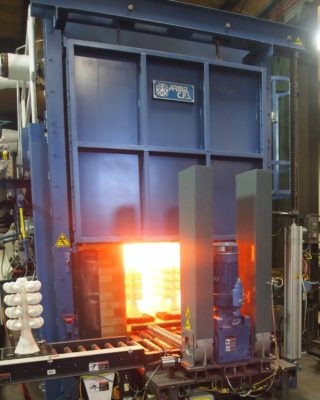
  • A European manufacturer of investment castings for the medical industry recently purchased a gas-fired pusher furnace from Armil CFS, Inc. The 2-row pusher furnace will be used for the burnout and pre-heating of investment casting molds.
  • A midwestern facility of a US-based manufacturer of safety-critical fasteners and assembly solutions has purchased a new MB48-120 mesh belt furnace from AFC-Holcroft, replacing an older AFC-Holcroft installation. The new mesh belt furnace will be used in the production of metal fasteners.
  • Several orders have been met by SECO/WARWICK for various equipment and systems: 1) An American manufacturer of flat rolled aluminum sheet recently added a new SECO/WARWICK sow and T-bar preheat furnace system 2) The main producer of forgings in Central Europe for strategic markets recently invested in a single-chamber furnace type PEK. 3) A manufacturer of high quality matrix forgings, construction connectors and manual tools purchased a CaseMaster AFS – a multipurpose Sealed Quench chamber furnace, intended for thermal and thermo-chemical treatment in a controlled endothermic atmosphere.  4) SECO/WARWICK provided an additional atmosphere generator system to a supplier of engineered carbon and graphite solutions for severe service lubrication applications in the aerospace, petrochemical, energy, industrial, and defense sectors. 5) The company updated and simultaneously extended a box furnace’s productive longevity for a leading international participant in the field of precious metals and advanced materials. 
  • Lindberg/MPH announced the shipment of a single-zone tube furnace to an engineering company in the nuclear power industry.

Kudos Chatter

U.S. Rep. Mike Kelly (PA) meets with Onex Inc and members of NWIRC

  • U.S. Rep. Mike Kelly (PA) recently met with Onex Inc and members of NWIRC with the purpose of hearing firsthand from Onex employees about NIST MEP’s impact on Pennsylvania’s manufacturing industry.
  • Dana Incorporated‘s motor and inverter joint venture, TM4, recently announced it has reached a major milestone with the production of its 12,000th TM4 SUMO™ electric powertrain for buses and commercial vehicles in China.
  • For the ninth time, The Timken Company, a world leader in engineered bearings and power transmission products, has been recognized as one of the World’s Most Ethical Companies. Ethisphere Institute is a global leader in defining and advancing the standards of ethical business practices.


Special Mention

On Valentine’s Day, Thermcraft lost its founder, Mr. Morris L. Crafton, at 93. In 1971, Mr. Crafton and his wife Clara founded Thermcraft on the principle of providing the best customer service available in the thermal processing industry.

Born in West Palm Beach, Florida, Mr. Crafton grew up in North Carolina and served in the US Navy during WWII, and then after college, he was called again to serve his country during the Korean War. After his military service, Mr. Crafton  moved his family to Washington, PA, where he ran a popcorn business and, in time, became a partner in a business that manufactured replacement heating elements for industrial and laboratory furnaces.

After returning to North Carolina, he decided to start his own company. With the full support of his wife Clara, they secured a small warehouse in downtown Winston Salem and began making replacement heating elements for industrial and laboratory furnace applications.

Thermcraft was moved to its current facility in 1979, just a few miles south to the edge of Winston Salem. Through new product development and various acquisitions, the Craftons began to grow Thermcraft into the company it is today.

Mr. Crafton lost Clara to cancer in 1995. He eventually turned the reigns of Thermcraft over to his son Tom, but that didn’t stop Mr. Crafton from being involved in the day-to-day business. He continued to drive himself to work well into his 92nd year, making mail runs and performing various other tasks. He enjoyed a daily walk through the factory, talking to his employees and staying on top of what was going on within his company.

Mr. Crafton will be missed by all who knew him. He will be remembered as a strong leader who was kind and generous to those around him. He had a great sense-of-humor and often left those he met with the saying, “glad you got to see me.”

“We are certainly glad we had the opportunity to meet you, Mr. Crafton,” is the sentiment of all at Thermcraft.

Heat Treat Today offers its condolences to the family of Mr. Morris Crafton and the team at Thermcraft.


Heat Treat Today is pleased to join in the announcements of growth and achievement throughout the industry by highlighting them here on our News Chatter page. Please send any information you feel may be of interest to manufacturers with in-house heat treat departments especially in the aerospace, automotive, medical, and energy sectors to the editor at editor@heattreattoday.com.


15 Quick Heat Treat News Items to Keep You Current Read More »

15 Quick Heat Treat News Items to Keep You Current

Heat Treat Today offers News Chatter, a feature highlighting representative moves, transactions, and kudos from around the industry.

Personnel and Company Chatter

  • Roger Smith has recently been appointed Technical Manager at Plibrico Company, LLC.  Smith will be responsible for development of innovative refractory formulas, oversee product quality, and assist in identifying the best materials for refractory construction projects.
  • William “Bill” Cowell has been promoted to the position of Vice President of Operations at Advanced Heat Treat Corp. (AHT). Cowell, who has been at AHT since 1999, will oversee operations for all AHT  facilities.
  • Wirco has announced the promotion of Aaron Fisher to Vice President of our Fabrication Division. Aaron has been with Wirco for 19 years. In addition, Wirco welcomes Marco Möser as the Vice President of our Foundry Division.
  • Thomas G. Gasbarre has stepped down as Chief Executive Officer of Gasbarre Products, Inc, a position he has held since his father George Gasbarre, the founder of the company, retired in 1990. Gasbarre also announced that Tom’s son, Alex Gasbarre, has been appointed Chief Executive Officer and is now leading the development and execution of the company’s short- and long-term strategies. Heath Jenkins has been promoted and will succeed Alex as President, Press & Automation, and Manufacturing Technologies.
  • John C Plant has been appointed to serve as Chairman and Chief Executive Officer at Arconic Inc. The Board has also appointed Elmer L. Doty, a current Director, to serve as Chief Operating Officer, and Arthur D. Collins, Jr., a current Director, to serve as Lead Director. These appointments are effective immediately.
  • Xerox, based in Norwalk, Connecticut, has acquired metal additive manufacturing company Vader Systems, which will enable it to offer its customers access to low-cost metal additive manufacturing with a greater variety of metals. Based in Buffalo, New York, Vader Systems is a developer of liquid metal additive manufacturing technology.
  • Several convection ovens were supplied to a manufacturer of small medical parts in the southern U.S. by Lucifer Furnaces. Model 42-B18 has a working chamber size of 9”H x 9”W x 18”L and heats to 1200°F.
  • A floor-standing furnace has been shipped by L&L Special Furnace Co., Inc. to a worldwide leader of high tech ceramics and associated components located in the Northeastern United States. The furnace will be used for glass components along with fiber optics and research and development. It will also be used to fill in on various thermal projects and development.
  • A Treet-All™ Box Furnace has been shipped to a Japan-based global battery manufacturing company by Lindberg/MPH.  The maximum temperature rating of this light industrial box furnace is 2050°F and has work chamber dimensions of 18” wide x 36” deep x 18” high. The Treet-All™ Light Industrial Box Furnace is suited for multiple applications, including annealing, ashing, austempering, brazing, preheating, solution treating, stress relieving, and normalizing.
  • A supplier of the aerospace industry received shipment of a Electrically Heated Horizontal Quench Solution Treat System from Wisconsin Oven Corporation. The Horizontal Quench Solution Treat System has a maximum oven operating temperature of 1,200° F and work zone dimensions of 5’4″ wide x 5’6″ long x 5’4″ high (above the rollers).
  • Chromalox, a thermal technology provider, recently contracted with Sierra Monitor Corporation  to enable cloud system connectivity on their Heat Trace solution.
  • A cabinet oven is being used to finish batch loads of metal parts at a customer’s facility. The No. 828 is a 500°F (260°C) cabinet oven from Grieve Corporation.
  • A recycling and melting group has ordered for installation a Twin-Chamber Melting Furnace TCF® from Tenova LOI Thermprocess. Italy-based Fonderie Pandolfo specializes in processing of aluminum, mainly for extrusions. The casted billets are mainly extruded in the extrusion shops of the main European extruders.

Kudos Chatter

  • Buehler, an ITW Company, and ASM International are celebrating 75 of continuous partnership in 2019. Buehler has continuously supported of the ASM World Training Center in Novelty, Ohio, through its innovations for metallography and hardness testing, solutions for the newest materials and participation in ASM International activities.
  • Pennsylvania-based Onex Inc recently completed a forge furnace refractory reline in one week.

Heat Treat Today is pleased to join in the announcements of growth and achievement throughout the industry by highlighting them here on our News Chatter page. Please send any information you feel may be of interest to manufacturers with in-house heat treat departments especially in the aerospace, automotive, medical, and energy sectors to the editor at editor@heattreattoday.com.

15 Quick Heat Treat News Items to Keep You Current Read More »

A Dozen Quick Heat Treat News Items to Keep You Current

A Dozen Quick Heat Treat News Items to Keep You Current

Heat Treat Today offers News Chatter, a feature highlighting representative moves, transactions, and kudos from around the industry.

Personnel and Company Chatter

  • John Finch has joined Plibrico Company LLC as the Southeastern Territory Manager. Mr. Finch, an accomplished refractory professional and is an active member of several different industry and refractory associations.
  • Timothy C. Fish has joined the sales team at Solar Atmospheres of Western PA as Regional Sales Manager, focusing on the Midwest region.
  • Triumph Fabrications is being acquired by Arlington Capital Partners. Triumph consists of four companies that manufacture, coat, and assemble complex sheet metal components for fixed wing and rotorcraft platforms. Heat treating and annealing are included in the operations.
  • A new state-of-the-art aluminum billet manufacturing facility will be constructed in the Rapids East Commerce Center in the City of Wisconsin Rapids, Wisconsin. Matalco Inc., a member of the Giampaolo Group, will house the new facility in a 110,000 sq ft manufacturing plant, which at full production capacity, will produce in excess of 230 million pounds of high-quality aluminum billet. This is part of a larger investment plan to construct several greenfield aluminum remelt facilities for billet and rolling slab production in North America.

  • A series of gas nitriding and tempering furnaces have been installed at a commercial heat treatment company specializing in mold & die steel heat treatment for its newly formed division. The horizontal gas nitriding furnaces supplied by JGEF Furnaces can produce a hard clean substrate onto which is deposited a duplex layer with high hardness values. The JGEF tempering furnace series will help the manufacturer achieve a pre-vacuum protective atmosphere for tempering, and the atmosphere in the furnace chamber will reduce the oxidative decarburization reaction of the heat-treated workpiece. The furnace has a load capacity of 11023 pounds and an operating temperature range of 302-1202°F
  • Grupo TTT, one of the leaders in heat and surface treatments, recently added a SECO/WARWICK vacuum heat treatment and brazing system equipped with high-pressure gas quench to their Bergara, Spain, facility to run a variety of processes. This is the fourth system purchased by Grupo TTT with an earlier installation in Europe, and two systems currently in operation in Mexico.
  • Three box furnaces have been shipped for installation by Lindberg/MPH. An unnamed customer purchased one Temperite™ Box Furnace and one Treet-All™ Box Furnace to work in tandem. The Temperite™ Box Furnace is configured for aging, annealing, austempering, baking, solution treating, and tempering applications, while the Treet-All™ Box Furnace is configured for annealing, ashing, austempering, brazing, preheating, and solution treating applications. In addition, Lindberg/MPH  announced the shipment of one Treet-All™ Box Furnace to the technology industry. The maximum temperature rating of this light industrial box furnace is 2050°F.
  • A state-of-the-art continuous mesh belt heat treat system has been commissioned for the production of high-quality automotive fasteners. CAN-ENG Furnaces International Ltd was selected for a project in the Piedmont Region of Italy, one of four installation locations for this globally recognized producer of specialty automotive fasteners.
  • A Blue M Friction-Aire® Safety Oven, which provides a controlled heat source without heating elements, was recently shipped to a manufacturer of consumer products by Thermal Product Solutions.

Kudos Chatter

  • StandardAero’s Maryville, Tennessee facility recently completed and shipped its 10,000th auxiliary power unit (APU) repair since the nearly 25 years it has been providing APU MRO services to the industry. The specific 10,000th repair was on a Honeywell model 36-150RJ APU for a regional aircraft operator.
  • Allied Mineral Products has launched a new Chinese-language website. The website, alliedchina.com, targets the local business market in China while actively engaging existing customers. In Northern China, Allied’s manufacturing facility in Tianjin celebrated its 20th anniversary last year.
  • The ASM Materials Education Foundation is pleased to announce the winners of the 2018 ASM Materials Genome Toolkit competition. As determined by an independent review committee, the undergraduate engineering departments at Georgia Institute of Technology, Louisiana Technological University, Montana Technological University, and Worcester Polytechnic Institute will receive a three-year site license for a suite of Thermo-Calc software tools intended to aid in the instruction of computational materials design, an emerging engineering practice deemed essential to the success of the U.S. Materials Genome Initiative (MGI) and global leadership in manufacturing.

Heat Treat Today is pleased to join in the announcements of growth and achievement throughout the industry by highlighting them here on our News Chatter page. Please send any information you feel may be of interest to manufacturers with in-house heat treat departments especially in the aerospace, automotive, medical, and energy sectors to the editor at editor@heattreattoday.com.

A Dozen Quick Heat Treat News Items to Keep You Current Read More »

15 Quick Heat Treat News Items to Keep You Current

15 Quick Heat Treat News Items to Keep You Current

Heat Treat Today offers News Chatter, a feature highlighting representative moves, transactions, and kudos from around the industry.

Personnel and Company Chatter

  • AFC-Holcroft has announced the addition of Daniel Hill as the newest member of their sales team. Hill will be based out of the company’s headquarters in Wixom, Michigan, focusing on key account management as well as new lead generation. Hill will report to Tracy Dougherty, Sales Manager at AFC-Holcroft.
  • Solar Atmospheres’ CEO, Roger A. Jones, was awarded the distinguished honor of ASM Fellow (FASM) at the ASM Awards Dinner on Tuesday, October 16, 2018. According to ASM, “The honor of Fellow represents recognition of distinguished contributions in the field of materials science and engineering, and develops a broadly based forum for technical and professional leaders to serve as advisors to the Society.” Roger’s citation reads: “For advancing production vacuum thermal processes and procedures for large and heavy assemblies utilizing state of the art vacuum furnaces, for the enhancement of the overall heat treating industry.”
  • A company that specializes in automated manufacturing solutions for automotive manufacturers among other industries, Innovative Automation, has acquired Tridan International, which supplies machinery for the production of heat exchangers, evaporators and condensers commonly used in manufacturing. This acquisition includes all ongoing operations of the company from their 88,000 square foot facility in Danville, IL.
  • StandardAero, the world’s largest independent Pratt & Whitney Canada PT6A Designated Overhaul Facility (DOF) with Distribution rights, has recently inducted the first five PT6A-68 engines at its Summerside facility on Prince Edward Island, Canada.  StandardAero has provided full-service support for the PT6A-68 since 2013 but is now in the process of transferring its support of the engine model to its Summerside facility, as part of the company’s Center of Excellence (COE) activity, announced in May 2018.
  • Caterpillar, Inc, has announced that a closed South Carolina casting facility will house its new $13.5 million, 103,000-square-foot building in Hodges where it will produce specialty castings for various engines and transmissions in Caterpillar’s line of products.
  • Schenck Process, which engages in the design, manufacture, and supply of applied measuring and process technology, announced the acquisition of Process Components Ltd, a UK based designer and manufacturer of powder processing and handling equipment, components and spare parts, and its subsidiaries.
  • Braidy Industries and its subsidiary Veloxint recently announced five new executive appointments. Julio Ramirez will take on the position of Chief Financial Officer at Braidy. At Veloxint, Major General Kevin McNeely (Ret.) joins as Chief Operations Officer; Dr. Phoebe Kwan will take on the role of Chief Commercial Officer; Dr. Judson “Jud” Marte will be Vice President of Product Development; and John Gaspervich joins Veloxint as Executive Vice President of Manufacturing.

Equipment Chatter

  • A forced air recirculating oven was supplied by Lucifer Furnaces to a manufacturer of medical & aerospace parts and will be used to heat treat 17-4 stainless steel.
  • A tool and die manufacturer recently expanded its in-house heat treat capabilities with a Vector® furnace, one of the SECO/VACUUM (a SECO/WARWICK Group company) flagship vacuum furnaces. The purchase process included validation tests of tooling dies in a similar nearby furnace with positive results. The furnace being delivered is a  horizontal, front-loading Vector furnace with a capacity of 2,650 lbs.
  • A leading provider of metal additive manufacturing (AM) solutions recently announced that a prominent Southeast Asian aerospace parts manufacturer has purchased a dual-purpose Electron Beam Additive Manufacturing (EBAM®) and EB Welding System. Sciaky, Inc., a subsidiary of Phillips Service Industries, Inc. (PSI), provided the one-of-a-kind hybrid machine to be customized with special controls to switch from 3D printing to welding in a quick and easy process. The manufacturer will utilize the system to 3D print metal structures, as well as weld dissimilar materials and refractory alloys for these structures and other aerospace parts.
  • Four Gruenberg explosion resistant Class “A” truck-in-ovens were shipped to the pharmaceutical industry by Thermal Product Solutions. The pharmaceutical ovens are rated for Class A operation to handle processing solvents per the NFPA 86 specifications.
  • A continuous mesh belt conveyor furnace was shipped by Lindberg/MPH to the computer market. This conveyor furnace is configured for soldering process applications, provides a heating and cooling process environment under a nitrogen/hydrogen blended atmosphere, and will be heated to the customer’s specified temperature (maximum of 1000°C).
  • A leading supplier of the automobile industry received shipment of a natural gas-fired two zone conveyor oven from Wisconsin Oven Corporation. The conveyor oven will be used for stress relieving automotive springs and has the design capacity to heat approximately 11,000 pounds of springs per hour. The overall work chamber dimensions of this stress relieving oven are 11’3” wide x 24’3” long x 14’0” high. The maximum operating temperature is 650°C (1202° F) with guaranteed temperature uniformity of ±5°C at set points of 520°C (968° F) and 570° C (1058° F) to ensure the conveyor oven meets the CQI-9, 3rd edition process Table E for stress relieving/annealing.

Kudos Chatter


  • In 2019, AGMA will expand upon the legacy and success of Gear Expo, launching the Motion + Power Technology Expo (MPT Expo). The new show will continue its focus on gears and mechanical power transmission while adding fluid power and electric drive exhibitors to provide all power transmission options to our attendees
  • eldec LLC recently unveiled a new website for manufacturing professionals who use induction heating, brazing, shrink fitting, pre-heating for laser welding, or annealing in their manufacturing processes. The new site provides updates on company and product information, trade shows, and manufacturing and equipment maintenance tips. It can be accessed at www.inductionheatingexperts.com.


Heat Treat Today is pleased to join in the announcements of growth and achievement throughout the industry by highlighting them here on our News Chatter page. Please send any information you feel may be of interest to manufacturers with in-house heat treat departments especially in the aerospace, automotive, medical, and energy sectors to the editor at editor@heattreattoday.com.

15 Quick Heat Treat News Items to Keep You Current Read More »

15 Quick Heat Treat News Items to Keep You Current

15 Quick Heat Treat News Items to Keep You Current

Heat Treat Today offers News Chatter, a feature highlighting representative moves, transactions, and kudos from around the industry.

Personnel and Company Chatter

  • D. Scott MacKenzie, PhD., Senior Research Scientist–Metallurgy at Houghton International, was elected by the International Federation of Heat Treating and Surface Engineering (IFHTSE) to serve as president for a two-year term. Dr. MacKenzie has been the ASM representative to IFHTSE Executive Committee since 2015 and was awarded ASM Fellow in 2007; he has also published over 150 publications and books, mainly in the field of heat treating and quenching.
  • A new generation of leadership takes over at Michigan-based, flat-rolled steel distributor Grand Steel Products Inc. Jim Barnett, retiring as president and COO, announced that his son, Michael Barnett, has assumed those roles, having started with the company in 2006 and overseeing growth through the purchase of an operations building in 2008, purchase and installation of a slitting line in 2011, and office renovations and additions in 2014. Michael also assisted in the formation of Barnett Industrial Properties and Grand Steel Transport, where he is a Partner. This year, Jim and Michael also added a new company within the same property of Grand Steel Products’ by adding Steel Testing Laboratory (STL).
  • ASM International recently announced that member John Storm, president and CEO of Contour Hardening Inc. (CHI), passed away on May 13, 2018, at the age of 63. "John helped pioneer work with dual frequency induction hardening to strengthen gears and shafts by creating a uniform hardened case pattern. In 1986 . . . he ventured out to co-found CHI with the goal of supplying the industry with innovative induction hardening systems. . . He holds over 200 U.S. and International patents on a variety of processes and applications."
  • The Aluminum Extruders Council (AEC) announced that R. Scott Kelley, president and CEO of Service Center Metals in Prince George, Virginia, was elected to serve as chairman of the Aluminum Extruders Council.  Mr. Kelley has been a member of the AEC Board of Directors since 2013 when he served as an Independent Extruder Director until he was elected to the Executive Committee in 2016 as Vice Chairman of the Council.
  • Gervais Jacques, Managing Director--Atlantic at Rio Tinto Aluminum, has been appointed Chair of the International Aluminium Institute (IAI). As IAI Chair he succeeds Hilde Merete Aasheim, executive vice president of Hydro's Aluminum Metal business, at the end of her two-year tenure.
  • Mary Pernacciaro has been named Director of Quality Management Systems at Illinois-baesd ADVANCED Heat Treating Inc, overseeing maintenance and improvements within the company’s quality systems.
  • Gerdau S.A. recently announced that Chia Yuan Wang, currently the Supply Chain Vice-President in North America, was appointed as the new president for its North American Long Steel Operation, succeeding the CEO of Gerdau, Gustavo Werneck, who was temporarily serving in the position during the last three months. Wang has almost 30 years of experience at Gerdau and held several positions in Brazil, Canada, China, and the United States.
  • Germany’s leading engine manufacturer, MTU Aero Engines AG, recently announced the formation of a separate department, Additive Manufacturing, to explore conceptual designs of applications and constructions from a bionics viewpoint, push the development of the production technology forward, and industrialize the entire process chain. Dr. Jürgen Kraus has assembled a team of around 30 professionals from various technical disciplines: design engineers, structural mechanics engineers, process specialists, and operations scheduling experts.
  • GE Additive recently released an update to its Concept Laser M2 cusing and M2 cusing Multilaser machines to provide aerospace, automotive, medical customers with an increased level of productivity and reliability. The upgrades include a new gas flow system and a higher build chamber with a z-axis of 350 mm and newly designed heating.

Equipment Chatter

  • A two-zone walk-in temperature humidity cycling room was recently shipped by Tenney Environmental announced the shipment of a two- zone walk-in temperature humidity cycling room to replicate negative pressure housing conditions to test door locks during the design phase. In addition, Tenney announced shipment of a vacuum temperature space simulation system for the manufacturer of laser guidance modules for satellites and other space equipment that is used to assure precise locations of equipment while they are docking together.
  • A manufacturer of recreational vehicles recently received shipment of a gas-fired aluminum stack melting and holding furnace from Lindberg/MPH to provide additional melting capacity and efficiency for a new die casting machine installation. Lindbergh/MPH also recently announced shipment of a box furnace with retort to a laboratory in Canada to be used to test parts in a hydrogen atmosphere. The temperature range is 212°F to approximately 2200°F and the customer will run it at a maximum temperature of 1922°F.
  • A natural gas-fired enhanced duty walk-in furnace was recently manufactured for a transportation technology company by Wisconsin Oven Company to be used for heat treating baskets of aluminum parts. The heat-treating equipment has a maximum temperature rating of 600°F (315°C) and has sufficient capacity to heat 1,312 pounds (5,952 kg) of aluminum from 70°F (21°C) to 482°F (250°C) within 120 minutes when loaded into an ambient oven. Wisconsin Oven Company also manufactured a custom electrically heated enhanced duty walk-in oven for an aerospace parts manufacturer to be used for curing composites. The maximum operating temperature of this composite curing oven is 500°F.
  • An order for advanced tubes has been received by Sandvik Materials Technology from a company related to the energy segment.

Kudos Chatter

  • The Buehler Wilson® Reference Block Laboratory in Binghamton, New York, has achieved accreditation to ISO/IEC 17025 by A2LA (American Association for Laboratory Accreditation) for Rockwell, Knoop, Vickers, and Brinell hardness test blocks and indenters. A2LA is in full conformance with the standards of the International Organization for Standardization (ISO) and the International Electro-Technical Commission (IEC), including ISO/IEC 17025. Buehler markets the reference blocks along with the Wilson hardness testers and DiaMet software globally.
  • The world’s largest independent Pratt & Whitney Canada authorized PT6A Designated Overhaul Facility (DOF) with distribution rights on certain engine models, StandardAero, is celebrating its second anniversary as a chosen supplier of PT6A engine maintenance to business aircraft manufacturers Textron Aviation.


Heat Treat Today is pleased to join in the announcements of growth and achievement throughout the industry by highlighting them here on our News Chatter page. Please send any information you feel may be of interest to manufacturers with in-house heat treat departments especially in the aerospace, automotive, medical, and energy sectors to the editor at editor@heattreattoday.com.

15 Quick Heat Treat News Items to Keep You Current Read More »

Skip to content