


Conrad Kacsik Instruments

Jason Schulze on Understanding AMS 2750E — Alternate SAT

Heat Treat Today Original ContentJason Schulze, Conrad Kacsik Instruments, Inc.


This is the third in a series of articles by AMS 2750 expert, Jason Schulze. Please submit your AMS 2750 questions for Jason to Doug@HeatTreatToday.com.


Introduction

Of all the changes made to AMS2750 through the years, the Alternate Systems Accuracy Test (ALT SAT) is arguably the one that has had the largest impact within the heat treat industry. The requirements for the ALT SAT, as presented in AMS2750E, make up just 0.008% of the specification as a whole; yet these requirements account for an inordinate amount of time spent on discussion and debate.

Below, we’ll discuss the requirements of the ALT SAT as they are presented in both AMS2750E, and in the Nadcap Pyrometry Guide.

ALT SAT Applicability

Prior to revision E of AMS2750, a load thermocouple that was single-use, or which was replaced more often than the applicable SAT frequency, did not require an SAT of any kind. During the time period when Revision D was in effect, the Alternate SAT did not exist. This meant that if you used a load thermocouple and had a documented single-use statement or replacement schedule, which ensured the usage did not exceed the applicable SAT frequency within your internal procedures, that particular load sensor was not subject to the SAT requirements of AMS2750D.

AMS2750D page 14, paragraph 3.4.1.2

3.4.1.2 An SAT is not required for sensors whose only function is over-temperature control, load sensors that are limited to a single use (one furnace load/cycle), sensors not used for acceptance as part of production heat treatment, or load sensors whose replacement frequency is shorter than the SAT frequency. See 3.1.8.4 and 3.1.8.5.

When AMS2750E replaced AMS2750D, the ALT SAT was introduced. In addition to the ALT SAT, paragraphs 3.4.4 through 3.4.4.3 were also inserted:

AMS2750E pg 19, para 3.4.4

3.4.4 The SAT can be accomplished using any one of 3 methods:

3.4.4.1 Perform an SAT following the requirments in 3.4.5

3.4.4.2 Alternate SAT process defined in 3.4.6

3.4.4.3 SAT Waiver process, as described in 3.4.7

By stating that the SAT “…can be accomplished using any one of 3 methods”, this section has often been misinterpreted to mean that a supplier may simply choose which type of SAT they wish to implement. This is not the case.

An ALT SAT must be performed on any thermocouple that is either

  1. single use, or
  2. replaced more often that the applicable SAT frequency.

Throughout the industry, these two items typically apply to load thermocouples. As an example, let’s assume that a non-expendable load thermocouple is used in a furnace that is designated as a Type A, Class 5 furnace. This would put the standard SAT frequency at quarterly (no SAT extension & parts-furnace). If the non-expendable load thermocouple that was used had a documented replacement frequency of monthly, the ALT SAT requirements would apply to this particular load thermocouple.

In the example above, a supplier could not accomplish the SAT “…using any one of the 3 methods” – the ALT SAT requirements would be required for that particular load thermocouple system and would need to be accounted for in the supplier’s internal pyrometry procedure.

ALT SAT Requirements

The ALT SAT requirements can be split up into a single main requirement and two sub-requirements which suppliers may choose to implement.  The main requirement is:

  • Calibration of instruments at the point at which the sensor is connected.

This means that, wherever the thermocouple is connected directly, instrument calibration must take place at this point. Let’s look at a vacuum furnace as an example.

Vacuum Furnace showing Location A and Location B for an Alternate SAT
Vacuum Furnace showing Location A and Location B for an Alternate SAT (photo courtesy: PVT Inc.)

Location A indicates where load thermocouples will be plugged in directly. Location B is where the extension wire from inside the furnace travels to the outside of the furnace and then on to the recording instruments. Location A is where the calibration of the recording instrument must take place per the ALT SAT requirements. This requirement in no way changes the standard requirements for instrument calibrations as they are presented in AMS2750E; it only specifies exactly where the instrument calibration must take place within the furnace sensor system. Your internal pyrometry procedure must state that this is a requirement.

The next paragraphs, 3.4.6.1.1 & 3.4.6.1.2, are where the supplier must read and understand both paragraphs in order to make a choice regarding which option best suits their furnace set-up and production. Let’s break both paragraphs down.

Option Number 1

3.4.6.1.1 - Establish appropriate calibration limits for sensors which when combined with the calibration of the instrument/lead wire and connector, will meet the SAT requirements of Table 6 or 7, as appropriate.

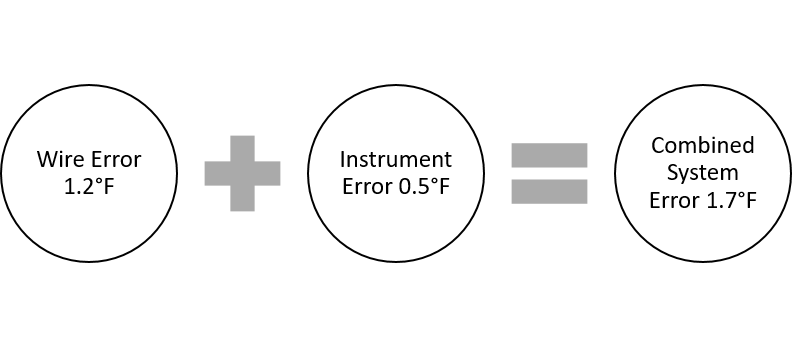
There are several ways to go about conforming to this paragraph. Keep in mind, that when choosing an option you are dealing with 2 variables; the error of the instrument which records the thermocouples in question and the error of the thermocouples themselves.

a) This option relieves you of one of the variables stated above. When calibrating your instruments which the thermocouples are plugged in to, ensure there is absolutely no error at all. Adjustments (offsets) may need to be made to accomplish this. This means that, if you do not permit offsets currently, you will either need to account for them in your procedures or choose option “b” below. Once you’ve established that your instrument has no error, you restrict the error of the thermocouples you purchase not to exceed the appropriate SAT difference stated in Table 6 or 7.

As an example, let’s assume you have a vacuum furnace that uses 2 load thermocouples which are single use only. The furnace is classified as a Type A, Class 2 furnace – this means the Maximum SAT difference is ±3°F or 0.3% of the reading.  You would ensure that the recording instrument for those 2 channels recording the load temperature have no error. Then, order load thermocouples which have an error of ±3°F or 0.3% of the reading, or less.

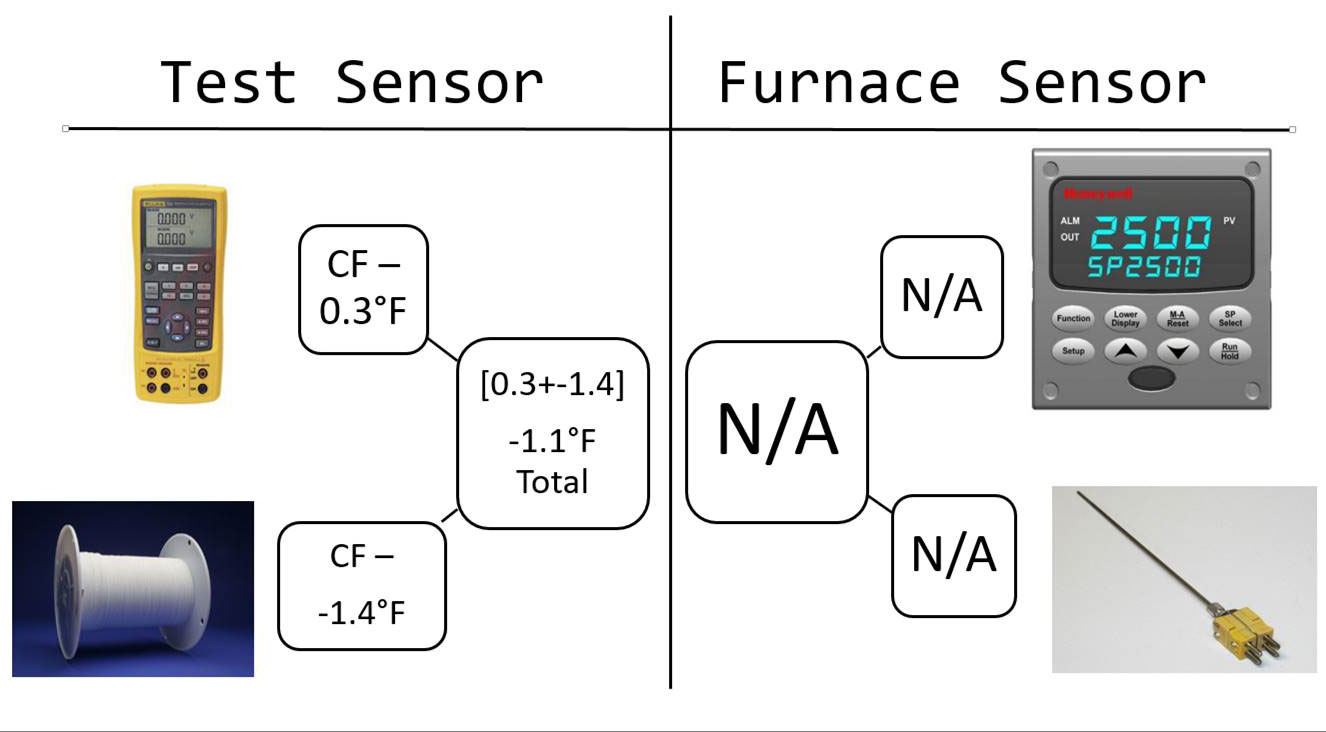
b) This option is most attractive to those who do not wish to allow offsets within their heat treat operation. To accomplish this, you compare the error of the specific channels of the instrument the thermocouples in question plug into, to the error of the thermocouples themselves. The resulting value cannot exceed the maximum error permitted for the appropriate furnace class. Internal pyrometry procedures specifically state how thermocouple wire will be received and the ALT SAT calculation accomplished prior to releasing the thermocouple wire to production. There are two variables that must be verified in this option. Anytime one of these two variables change, the calculation must be obtained. The Nadcap Pyrometry Reference Guide requires that this calculation be evaluated at the instrument (chart recorder) calibration points (min, max & middle 1/3rd.)
Overview of a Calculation – Single Temperature

For Your Consideration

There has been some confusion in the industry that the ALT SAT process, specifically Option B above, must be accomplished at the furnace. This misunderstanding includes suppliers using a Field Test Instrument to simulate the min, max and middle 1/3rd of the instrument calibration temperatures in an effort to obtain the error of the instrument channels in question. This amounts to nothing more than an additional instrument calibration; one could simply obtain the error from the current instrument calibration instead of performing extra work at the furnace.

Option A and B above would be performed as a desk operation; none of the tasks would be performed at the actual furnace.

Conclusion

The ALT SAT process has been successfully implemented by many suppliers in the Aerospace Industry; both Nadcap approved and non-Nadcap. As with any AMS2750E process, detailed procedures and training are key to executing the ALT SAT process.

Submit Your Questions

Please feel free to submit your questions and I will answer appropriately in future articles. Submit your questions by sending an email to doug@heattreattoday.com.

Jason Schulze on Understanding AMS 2750E — Alternate SAT Read More »

Modern Industries Receives Control System Upgrade

Modern Industries,  a Pennsylvania – based commercial heat treater, received a plant wide Control System upgrade from the Engineering Division of Conrad Kacsik Instrument Systems. The project consisted of the replacement of the legacy controls on over 30 furnaces and pieces of equipment within the facility. This included vacuum furnaces, integral quench lines, tempers, nitriders, cast belt’s, and generators.

All of the upgraded equipment is now encompassed within a plant wide Supervisory Control and Data Acquisition System. The system is comprised of Honeywell HC 900 controllers and control station operator interfaces for logic and process control; and Specview HMI (Human Machine Interface) Software for centralized furnace supervision and data collection. The individual control stations are capable of storing over 200 days-worth of data; and Specview allows all of this information to be archived to a server on the plant-wide network.

Conrad Kacsik’s Engineering Team worked closely with the facility’s personnel to develop customized programs that would enhance operational productivity. For example, Specview was programmed to mirror all of the individual control station screens, and to provide furnace operators with Recipe Management capability. Customized screens were also developed to enable customer names, part numbers, part quantities, and additional information to be combined with individual furnace data.

The combination control station / Specview    HMI package delivers a redundant control and data acquisition system that eliminates the possibility of data loss.

Remote seat licenses were also incorporated into the system. Facility personnel now have the capability of logging in to a network pc to control the furnaces, develop new programs, or review production charts.

The system also enables remote access for Conrad Kacsik’s Engineering Team to provide assistance with control scheme changes, problem diagnostics, and general system maintenance and support.

According to Dennis Sweny, Co-President of Modern Industries, he was somewhat skeptical at the inception of the project. Modern had never embarked on such a large scale, plant-wide upgrade. Maintaining production capacity during the installation was imperative. Conrad Kacsik’s Engineering Team worked with Modern’s staff to ensure this was accomplished. Dennis also stated that upon completion of the project, he was pleasantly surprised at the timeliness and ease of transition from the legacy controls to the new system; as well as the minimal number of problems encountered compared to what he had anticipated for a project of this magnitude. In fact, Modern has worked with Conrad Kacsik to expand upon the original scope of the project to further customize the system to meet the specific needs of Modern Industries. Sweny concluded by stating that the benefits of the project have far exceeded his expectations.

Modern Industries Receives Control System Upgrade Read More »

Jason Schulze on Understanding AMS 2750E — Standard SAT Description

Dan Bender, Understanding the Short Circuit Current RatingJason Schulze, Conrad Kacsik Instruments, Inc.


This is the second in a series of articles by AMS 2750 expert, Jason Schulze. Don't miss the Q&A section at the bottom of this article and please submit your AMS 2750 questions for Jason to Doug@HeatTreatToday.com.


Introduction

Considering the abundant number of Nadcap heat treat audits performed in a single year, the area receiving the most findings is pyrometry, and within this group, system accuracy testing (SAT) is the third most common finding.

The SAT process has been refined through each revision of AMS2750 (C through E). We’ve seen SAT thermocouple requirements, for example, gradually incorporated into the tables but not within the body of the specification. Also, we’ve seen the definition of a SAT incorporated into revision D within the definitions section; however, with revision E it was added to the body of the specification.

AMS2750E presents three optional methods for performance of SATs that must be implemented; the Standard (or Regular) SAT, the Alternate SAT, and the SAT Waiver. Within this article, we will focus on the Standard SAT process.

Standard SAT Description – AMS 2750E

AMS2750E has defined the Standard SAT as:

An on-site comparison of the instrument/leadwire/sensor readings or values, with the readings or values of a calibrated test instrument/leadwire/sensor to determine if the measured temperature deviations are within applicable requirements. Performed to assure the accuracy of the furnace control and recorder system in each control zone.

Put simply, an SAT is a comparison of two systems: the furnace system (whether control, monitoring, or load) against a test system. It’s important to recognize that the comparison is being made against two systems and not against an instrument or thermocouple alone. Each system is made up of three variables:

  1. the instrument
  2. the lead wire
  3. the sensor


image-1

SAT Procedure

There is no general SAT procedure that can be applied for every supplier. Each supplier has their own needs as well as their own mechanical arrangement of thermocouples within their furnace system. The key to conformity is to ensure that, once a method for performing an SAT on a furnace is established, it is documented (i.e., in detail, including photos, if necessary) and repeated each time an SAT is performed. Some requirements to incorporate into your system are:

1) The tip-to-tip distance between the furnace system thermocouple and the test system thermocouple cannot exceed 3 inches.

2) The test thermocouple shall be in the same position/depth as the initial test.

3) The furnace is cycled and maintained at a temperature normally used during production.

4) Each system that makes up the applicable instrumentation type must be tested.

SAT Difference

Many findings arise from suppliers calculating the SAT Difference incorrectly. AMS 2750E states the following as a way to calculate the SAT Difference.

The difference calculated between the reading of the furnace sensor system being tested (sensor, lead wire, and instrument) and the corrected reading of the test sensor system (after test sensor and test instrument correction factors are applied) shall be recorded as the system accuracy test difference. Applicable correction factors shall be applied algebraically.

I’ve highlighted the word “corrected” as it applies to the test instrument systems because this seems to be a source of frequent findings. The furnace system does not get corrected, the test system does get corrected.


image-2

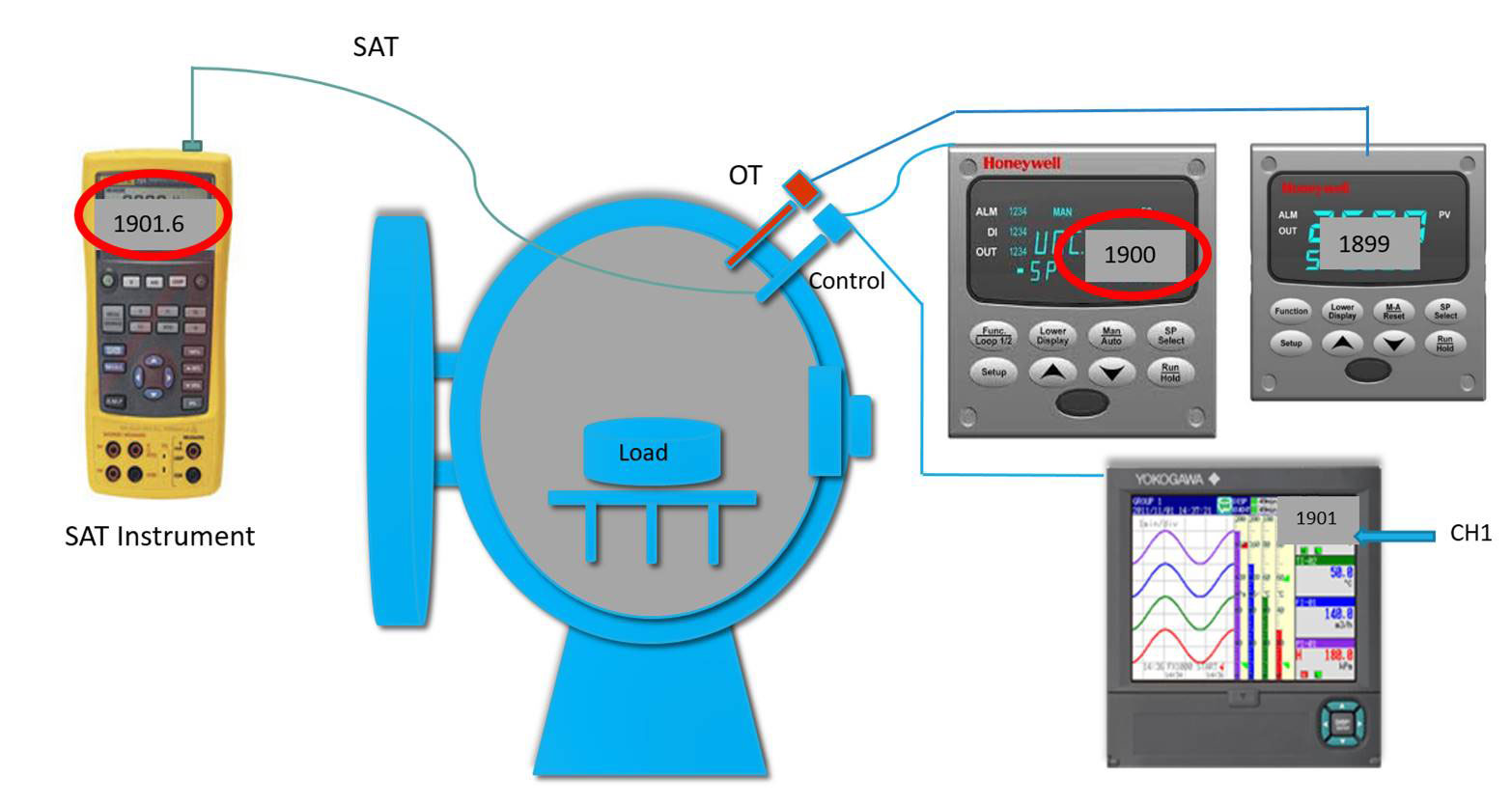
As an example, let’s consider a vacuum furnace which has had an SAT performed. The vacuum furnace is designated a Class 3 (±15°F) Type D furnace. Let’s assume no additional furnace thermocouples are employed and we are performing an SAT on the control and recording systems. The readings obtained are below in the picture.

image-3


*The example above is not an SAT Certification. It’s an example of how to calculate the SAT Difference in a given situation.

Conclusion

SATs can be difficult depending on the equipment and processes suppliers have. As always, it’s important to receive comprehensive training regarding the specific requirements of System Accuracy Testing as they apply to your facility. There are many particular aspects of SATs that may not have been accounted for in this article. If you have specific questions, please email them to doug@heattreattoday.com, and I will answer them in an upcoming article.

Submit Your Questions

Please feel free to submit your questions, and I will answer appropriately in future articles.

Out next topic will focus on the requirements and execution of an Alternate SAT per AMS2750E, the requirements of AC7102/8 and the Pyrometry Guide.   


Q/A with Jason Schulz

Q: When calculating the SAT Difference, should I include the correction factors of the furnace sensor?

A: No, the correction factor from the furnace sensor is not to be included in the SAT Difference calculation.

Q: How do I account for an internal (pre-programmed) TUS offset within the controller when calculating the SAT Difference?

A: Internal or electronic TUS offset must be algebraically removed when calculating the SAT Difference.  Below is an example that includes an electronic TUS offset of -2°F.


sat-qa

Q: I operate a furnace with 2 load sensors. One of them is used to signal the start and end of each soak cycle, the other is reference only. Do I have to perform an SAT on the load thermocouple I use as a reference only thermocouple?

A: Any thermocouple that is not used as product acceptance may be deemed reference only and is not subject to the SAT requirements of AMS2750E. Nadcap requires that the reference only thermocouples be accounted for in internal procedures.

Q: When performing my bi-weekly SAT, I get a difference of +2.6°F on one test and two weeks later I get a difference of -3°F; this constitutes a spread (within two weeks) of 5.6°F. Would this be cause for SAT failure?

A: According to AMS2750E and Nadcap, no, this would not constitute a failed SAT, though is something to be cautious of. This type of shift in SAT results does reflect some sort of change or degradation of the system being tested. A well-established tack, in this case, is to plot SAT results as part of an SPC (statistical process control) program which will govern future replacement of system thermocouples and/or leadwire (in the case when large difference is SAT results over a pre-determined amount). A documented SPC system for SAT results would also satisfy the requirements of AC7102/8(NA) page 2, paragraph 3.12.

Jason Schulze on Understanding AMS 2750E — Standard SAT Description Read More »

Skip to content