

Charlie Li

16 Quick Heat Treat News Chatter Items to Keep You Current

Heat Treat Today offers News Chatter, a feature highlighting representative moves, transactions, and kudos from around the industry.

Personnel & Company Chatter

  • Bill Gornicki was recently appointed Director of Sales at ECM-USA, Inc. in Pleasant Prairie, WI.
  • AFC-Holcroft, in Wixom, MI, recently moved its European satellite office from Delémont, Switzerland, to Swiebodzin, Poland, as necessitated by the retirement of their Director of European Operations. The new director, Marek Kedzierzynski, will be based out of Poland.
  • Wire Experts Group, the parent company to Pelican Wire and Rubadue Wire, recently announced the newest members of their leadership team and their respective roles: Brinson White will now lead the Engineering & Maintenance teams at both Pelican and Rubadue as WEG Director of Engineering; Mike Skorupa has been named Director of Continuous Improvement across all business units; and Kevin Clements has been named Global Supply Chain Manager. 
  • RETECH Systems, LLC, a SECO/WARWICK Group company, has finalized plans to relocate its headquarters from Ukiah, CA, to Buffalo, NY.
  • Charlie Li, of DANTE Solutions, began teaching a new master-level Mechanical Engineering class entitled “Advanced Manufacturing Processes: Heat Treatment of Steels” at Cleveland State University.

  • Solar Atmospheres has purchased two microscopes, one a ZEISS AxioVert A1 Inverted Materials Microscope and the other a a Hitachi smart Scanning Electron Microscope, to enable them to better serve the needs of their customers.
  • Magnetic Specialties, Inc. recently shipped two 510KVA, three phase step down 6-pulse rectifier transformers and DC inductors for use in industrial rectifier applications.
  • The Grieve Corporation recently installed their new electrically-heated 2000°F inert atmosphere heavy-duty box furnace to be used for heat treating titanium at a customer’s facility.
  • Gasbarre Thermal Processing Systems recently commissioned a model CVPQ Continuous Vacuum Furnace with 5 BAR pressure quench capabilities, and a precision gas nitriding and ferritic nitrocarburizing furnace, in the Midwestern United States.
  • Ipsen USA offers free evaluations of any brand of vacuum heat-treating system in the United States. An Ipsen Customer Service team member will check all major components of the furnace and provide a written health report with a suggested 18-month maintenance plan.
  • Tenova recently received the official notice to proceed with the new Hot Dip Galvanizing (HDG) line for NLMK Group in Lipetsk, Russia.
  • Pries Enterprises finished a 50,000 sq ft expansion and installation of a state-of-the-art anodizing line, making them the only vertically integrated extruder-anodizer fabricator in their immediate area.
  • Grupo Mess was recently named an exclusive Buehler distributor of metallographic and hardness equipment in Mexico.
  • Aerospace Testing & Pyrometry recently announced the opening of their newest regional office in Greenville, SC. The territory will include North Carolina, South Carolina, Virginia, Georgia, Tennessee and Alabama.
  • Constellium SE was recently recognized with the “Best Performer Award” by Airbus.
  • Advanced Heat Treat Corp. recently announced that it has added gas nitriding to its Nadcap® accreditation.
Grupo Mess

Heat Treat Today is pleased to join in the announcements of growth and achievement throughout the industry by highlighting them here on our News Chatter page. Please send any information you feel may be of interest to manufacturers with in-house heat treat departments especially in the aerospace, automotive, medical, and energy sectors to editor@heattreattoday.com

16 Quick Heat Treat News Chatter Items to Keep You Current Read More »

A Baker’s Dozen Quick Heat Treat News Items to Keep You Current

A Baker’s Dozen Quick Heat Treat News Items to Keep You Current

Heat Treat Today offers News Chatter, a feature highlighting representative moves, transactions, and kudos from around the industry.

Personnel and Company Chatter

  • Tom Spicer recently joined Gasbarre Industrial Furnace Systems (OEM of J.L. Becker brand equipment) as a Field Service Technician. Tom brings over 20 years of industry experience to the Plymouth, Michigan, company, having previously worked with OEMs assembling and servicing equipment and in maintenance at a commercial heat treat facility.
  • Changes at DANTE: The month of May saw the transition of Dan Londrico and Stefan Habean from intern to staff engineer. Charlie Li moved from Vice President to President of the company, and Lynn Ferguson became Emeritus. Edward Lee, a mechanical engineering student at The Ohio State University, joined the DANTE team as an intern.
  • Sławomir Woźniak has been appointed by the Supervisory Board at the SECO/WARWICK Group to the role of President of the Management Board. The new President has been appointed for the same period as the joint term of the new Management Board, which spans the next three full financial years.
  • Ajax TOCCO Magnethermic / Emmedi would like to congratulate Don Gibeaut on his election to Chairman of the North American Management Board of Directors (NAMB) for the International Tube Association (ITA). Don is the product manager for ATM’s Tubular Products Division.
  • A materials technology engineering group recently completed a partial acquisition of a provider of metal additive manufacturing (AM) services and advanced end-use components. Sandvik acquired a 30% stake in privately owned Beam IT, which supplies metal AM end components to demanding industries, including automotive, energy and aerospace, and holds several relevant quality certifications to serve these industries.
  • A new hot isostatic press (HIP) has been delivered and installed at Paulo’s Cleveland Division. The furnace was built by Quintus Technologies. The 30,000-sqft expansion to house the HIP vessel is complete and will provide the Cleveland Division room for additional expansion to support customer needs.
  • GE Additive recently announced that the company has made a significant investment in its electron beam melting (EBM) technology, with the purchase of an additional 17 A2X systems and 10 Spectra H systems. Avio Aero, a GE Aviation company, currently operates a fleet of 35 Arcam machines at its recently expanded site in Cameri, Italy. The additional EBM systems will be installed at GE Aviation and Avio Aero facilities in the US and Europe and will be used primarily for the production of titanium aluminide (TiAl) blades on the low-pressure turbine for the GE9X engine.
  • Metal Exchange Corporation (MEC), headquartered in St. Louis, MO, is forming a new joint venture with Novellini Industries Srl in Mantova, Italy. Called novALmec, the newly formed company will supply aluminum billet capacity to the European market.
  • An automotive supplier recently ordered a nitrocarburizing furnace for a new component line for a major carmaker. SECO/WARWICK commissioned the high-volume, horizontal retort furnaces, which will allow the customer to produce parts for North American suppliers. In addition to ferritic nitrocarburizing, the furnaces can provide clean, stress relief processing.
  • Four atmosphere controlled, aluminum coil annealing furnaces, which will be used to anneal automotive body stock and common alloy sheet coils, have been ordered by a leading U.S. aluminum producer from Consolidated Engineering Company.
  • A quench tank has been installed by Baker Furnace, a division of Thermal Product Solutions, for a supplier in the heat treatment industry. The customer had two quench tanks and three drop bottom furnaces and needed the third quench tank in order to optimize quench loads per day.
  • During the 2019 CCAI Annual Meeting in Hilton Head, South Carolina, the Chemical Coaters Association International held their annual awards ceremony to recognize the CCAI Chapter Users and Suppliers of the Year and announce the 2019 James F. & David J. Wright Lifetime Achievement Award recipient. The 2018-19 Chapter Award winners are: Central States Chapter – Frank Laster, A-1 Paint Powder and Sandblasting LLC and Ron Cudzilo, George Koch Sons LLC; Georgia Chapter – Wayne Pettyjohn, Georgia Power Company; Las Vegas Chapter – Tony Sclafani, AR Iron, LLC and Sercy Spears, TIGER Drylac, Inc. USA; Northern Illinois Chapter – Matt Ambrose, Henkel Corporation; Salt Lake City Chapter – Ginny Phommavongsay, Martin Door Mfg.; Southern California Chapter – Shivie Dhillon, Sundial Powder Coating, Tony Sclafani, AR Iron, LLC and Luis Hernandez, Coral Chemical Co.; Twin Cities Chapter – Mark Walsworth, Retired and Jim Henningsen, Troy Chemical; West Michigan Chapter – In memory of Herb Knape, Knape Industries Inc., and Jason Meekof, Industrial Metal Cleaning; and Wisconsin Chapter – Justin Jarmuz, Wacker Neuson Corp. and Matt Roeser, DuBois Chemical Co.
  • During the July 9th Collier County Board of County Commissioners meeting, Pelican Wire was named the Collier County ‘Business of the Month’ and was recognized by the Board for being a manufacturing leader in Collier County for over forty years.
  • On July 11th, Solar Atmospheres hosted 28 high school students enrolled in the Summer Engineering Institute (SEI) at Lehigh University. The group also included a few members of Lehigh University undergraduate students and staff. The SEI program, under the guidance of Director Dr. Laura Moyer, is a two-week residential program, running two sessions back to back. Students are nominated by faculty of local high schools, and the program specifically targets under-represented groups including girls, first-generation students, and students who might otherwise have limited opportunities to study in the fields of science, technology, engineering, and math (STEM).

Heat Treat Today is pleased to join in the announcements of growth and achievement throughout the industry by highlighting them here on our News Chatter page. Please send any information you feel may be of interest to manufacturers with in-house heat treat departments especially in the aerospace, automotive, medical, and energy sectors to the editor at editor@heattreattoday.com

A Baker’s Dozen Quick Heat Treat News Items to Keep You Current Read More »

Distortion Analysis of Landing Gear During Oil Quench: A Case Study

Charlie Li

A thermal process modeling company used its heat treatment simulation software to explore oil quench sensitivities on the distortion of a large landing gear made of 300M, a vacuum melted low alloy steel that includes vanadium and a higher silicon composition.

DANTE Solutions, an engineering consulting and software company specializing in metallurgical process engineering and thermal/stress analyses of metal parts and components, was approached to examine local stagnant oil flow and immersion, among other sensitivities, for this critical aerospace component.

Zhichao (Charlie) Li, Ph.D., vice president of DANTE Solutions, was the lead researcher and author of this study.


Case Study

Problem Statement

Part:

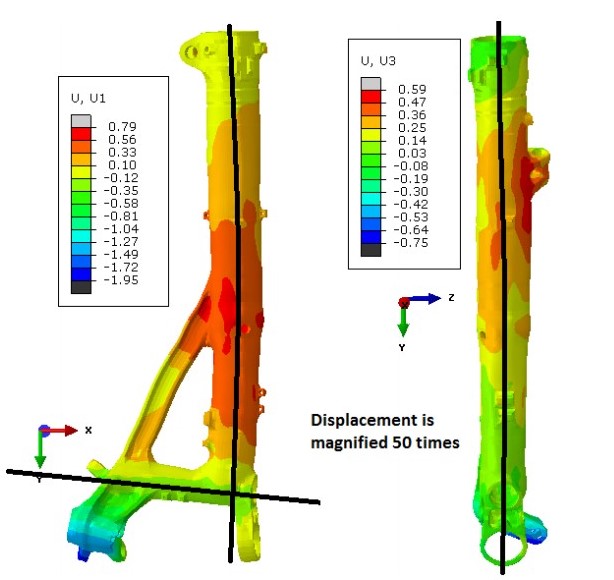
3 modes of distortion that are of concern
  • 2.5 meter tall landing gear
  • 0.25 meter main tube diameter
  • AISI 300M material

Problem:

  • Large distortions after oil quenching in the following distortion modes:
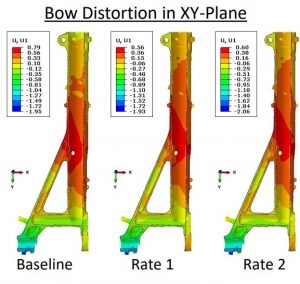
    • Bow in XY-Plane
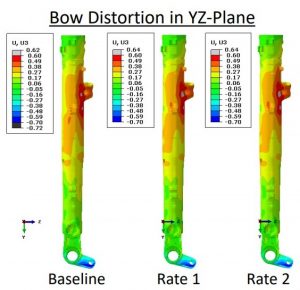
    • Bow in YZ-Plane
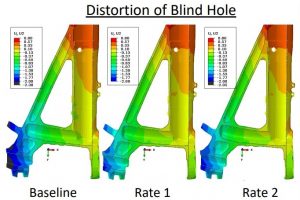
    • Straightness of a Blind Hole
  • All distortion modes shown in the figures make assembly of the entire structure very difficult.
  • Immersion into the oil tank is the main focus of the distortion analysis.

Process Description

  • Part is austenitized in pit furnace at 1607°F (875°C).
  • A 45-second step is included for the removal of the landing gear from the pit furnace.
  • 75-second open-air transfer from pit furnace to oil quench tank. The landing gear is immersed into the oil with a speed of 203.2 mm/sec, with the immersion direction shown in the figure. It takes 11.885 seconds to immerse the entire gear in the oil tank.
  • The landing gear is held in the oil for 5 minutes.
  • Tempering not considered, due to negligible effects on distortion.
Temperature (°C), Austenite (fraction), horizontal displacement (mm), and vertical displacement (mm) at the end of the immersion process; section cut, looking inside the part.

Model Description

  • Model contains 281,265 nodes and 258,272 hex elements.
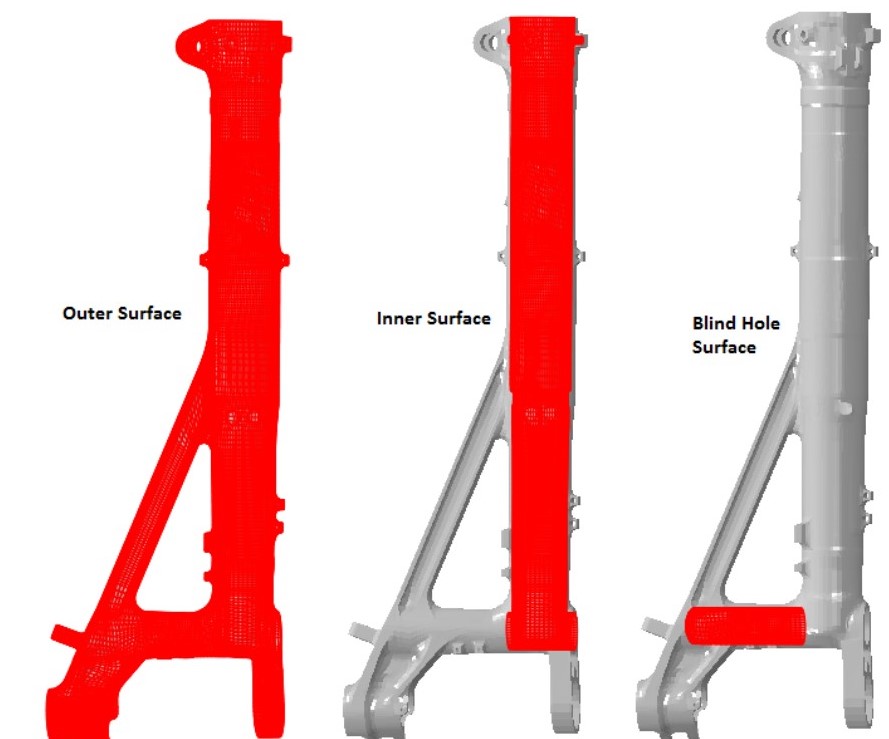
  • 3 surfaces defined for heat transfer boundary conditions.
  • Oil flow stagnation is expected inside the main tube (Inner Surface) and the blind hole.
  • Different thermal boundary conditions are applied to the outer surface and the inner surface, as shown to the right.
  • The blind hole and the inner surface have the same thermal boundary conditions in the baseline model.
  • During immersion, oil enters the blind hole first and then begins to fill up the main tube.
  • In the baseline model, the oil level rising speed inside the bore is assumed to be 20% of the landing gear immersion speed.


Modeling Approach

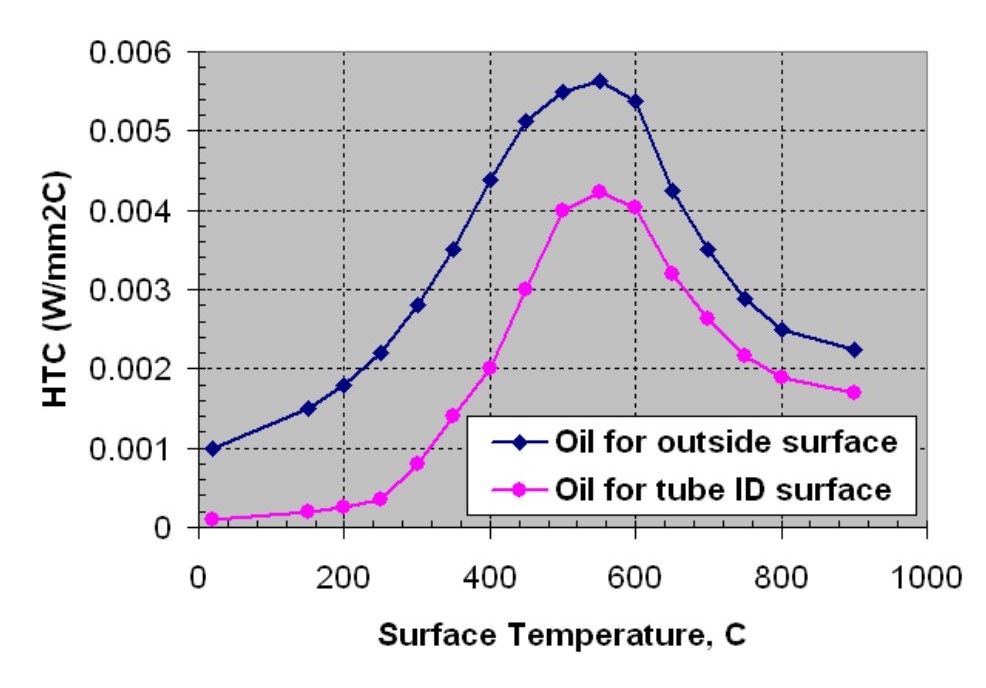
  • Define heat transfer coefficients as a function of temperature for the oil tank.
    • Thermocouples placed at various locations on a dummy landing gear, which was
      approximately the same overall dimensions and mass. Improve 300M material data in DANTE material database using dilatometry testing.
  • Improve 300M material data in DANTE material database using dilatometry testing.
  • Perform sensitivity study to determine phenomena critical to distortion modes of interest.
    • Oil flow stagnancy in blind hole during immersion: The more stagnancy, the lower the heat transfer on this surface. Baseline assumed to be the most stagnant. Two faster heat transfer rates examined.
    • Oil flow stagnancy around structural support arm: The more stagnancy, the lower the heat transfer on this surface. Baseline assumed to be least stagnant. Two slower heat transfer rates examined.
    • Oil fill rate of the main tube during immersion into the oil: The slower the oil fills up the main tube, the larger the temperature and phase transformation gradient is in the axial direction of the tube. Baseline assumed the slowest fill rate. Three faster fill rates were examined.
    • Immersion direction: Immersion direction sets up axial temperature/phase transformation gradients and also determines how the main tube is filled. The Baseline immersion direction causes oil to enter through the blind hole first and then into the main tube. Opposite immersion direction is examined, which causes oil to enter the open end of the main tube first.

Blind Hole Quench Rate Sensitivity

Figure 8. Temperature (°C) in the blind hole at the end of immersion for the three cases.
  • Heat transfer is increased in the blind hole during the
    immersion process; all other heat transfer rates
    remain the same as the baseline model during
    immersion.
  • All heat transfer rates are identical to the baseline
    after the part is fully immersed in the oil.
  • Baseline model assumes blind hole heat transfer is
    equivalent to the main tube inner diameter heat
    transfer during and after the immersion process.
  • Rate 2 has a faster heat transfer rate than the baseline.
  • Rate 1 has a faster heat transfer rate than Rate 2.
  • Figure 8 shows a significant difference in temperature between the three cases at the end of the immersion process.
  • Heat transfer rates explored in the blind hole do not contribute
    to the tilting of the blind hole.
  • Figure 9 shows that the angle of the hole is the same, regardless of the quench rate.
  • Modification of the blind hole to increase the heat transfer rate
    in the hole to help improve the straightness of the blind hole is not necessary.
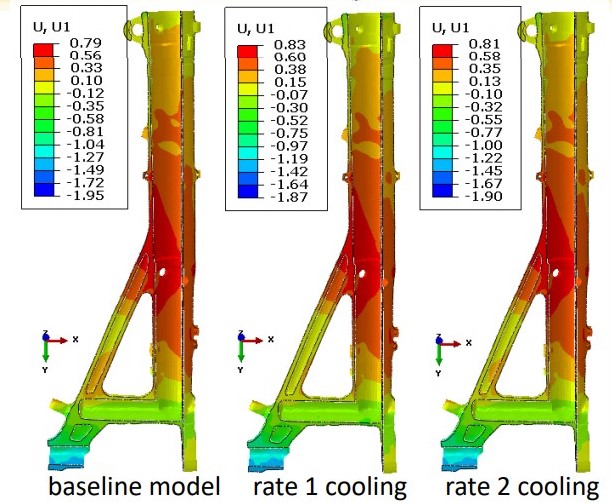
  • Heat transfer rates explored in the blind hole do not contribute significantly to the bow distortion in the XYPlane or the YZ-Plane.
  • Figure 10 shows that the bow distortion is made slightly worse by increasing the heat transfer rate in the blind hole during immersion, but is not significantly worse.
  • Modification of the blind hole to increase the heat transfer rate in the hole to help improve the bow distortion is not necessary.
Figure 9
Figure 10.

Structural Beam Quench Rate Sensitivity

  • Reduced heat transfer of the structural arm is examined.
    • Oil flow stagnancy is assumed to reduce heat transfer rate on arm.
    • 2 slower heat transfer rates compared with baseline.
    • Baseline assumes the same heat transfer rate on the structural arm as on the main tube OD.
  • Figure to the left shows the reduced heat transfer rate surfaces of the structural arm.
  • Rate 1 is slower than Baseline.
  • Rate 2 is slower than Rate 1.
  • Figure below shows the temperature difference in the structural beam at the end of the immersion process.
  • Approximately 212°F (100°C) difference between Baseline and Rate 1
  • Approximately 392°F (200°C) difference between Baseline and Rate 2


  • Bow distortion in xy-plane has a non- Distortion of Blind Hole linear response to oil stagnancy around the structural beam.
  • Rate 1 produced the least amount of bow in xy-plane.
  • Baseline produces the greatest amount of bow in xy-plane.
  • Distortion of blind hole has a non-linear response to oil stagnancy around the structural beam.
  • Rate 1 produced the straightest blind hole.
  • Baseline produces the greatest amount of distortion of the blind hole.
  • Bow distortion in yz-plane has no sensitivity to oil stagnancy around the structural beam.
  • The non-symmetric mass near the top of the landing gear has the most influence on the yz-plane bow distortion.
  • Figure 15 shows lower bainite phase fraction at the end of the quenching process.

    Figure 15
  • Slower heat transfer rate of the structural beam results in significantly different amounts of lower bainite.
    • The slower the heat transfer, the more lower bainite formed.
  • Increased amounts of bainite reduce bow distortion in xy-plane, but the response is non-linear.
    • Rate 2 caused slightly more distortion than Rate 1, but less distortion than the Baseline.
  • Increased amounts of bainite reduce distortion of the blind hole, but the response is non-linear.
    • Rate 2 caused slightly more distortion than Rate 1, but less distortion than the Baseline.

Oil Fill Rate in Main Tube Sensitivity

  • The rate at which the oil fills the main tube is critical to the phase transformation timings and the phases formed.
  • The immersion speed of the landing gear is 203.2 mm/sec.
  • Baseline assumes the inside of the tube fills up at 20% of this value (40.64 mm/sec).
  • Three different fill speeds were explored:
    • 50% (101.6 mm/sec)
    • 100% (203.2 mm/sec)
    • 200% (406.4 mm/sec) Assumes pressure build up forces oil up the inside of the tube.
  • Figure 16 compares temperature inside tube at end of immersion for four cases.
Figure 16


  • The oil fill rate of the main tube during the immersion process has a very significant effect on all three modes of distortion.

From top left clockwise

  • Bow distortion in yz-plane has a non-linear response to the fill speed (Figure 17)
    • 50% produces the worst bow
    • 100% & 200% are very similar, with 200% slightly worse
  • Bow distortion in xy-plane has a non-linear response to the fill speed (Figure 18)
    • 50% produces the least bow
    • 100% produces the worst bow
  • Straightness of the blind hole has a linear response to the fill speed (Figure 19)
    • Slowest fill speed has least distortion
    • Fastest fill speed has the worst distortion

  • Difference in lower bainite was the cause for differences in distortion with respect to oil stagnancy around the structural beam previously shown.
  • Differences in distortion from the oil fill rate of the main tube are not caused by microstructural phase differences.
  • Figure 18 shows that Martensite and Lower Bainite are the same for all fill speeds.
  • Differences in distortion are caused by the transformation timing along the axis of the landing gear.


Immersion Direction Sensitivity

Figure 19
  • Distortion sensitivity to the immersion direction was examined.
  • Figure 19 compares temperature profile at the end of the immersion process for the two immersion directions.
  • The Baseline has oil enter the blind hole first and then fill up the tube at a rate that is 20% of the immersion speed.
    • Oil spills over the top of the tube and the tube is flooded with oil.
  • The reversed immersion has oil enter the tube first and fills at the immersion speed.
  • Figure 20

    Reversing the immersion direction also reverses the axial temperature gradient.

    • Martensite transformation starts at the open tube end when the immersion direction is reversed.
    • Martensite transformation starts by the blind hole first for the Baseline.
    • Reversing the axial phase transformation gradient can have significant effects on bow distortion and axial displacement.
  • Figure 20 shows the vertical displacement around the blind hole for the Baseline and the Reversed Immersion.
  • Reversing the immersion direction had a very minor impact on the straightness of the blind hole.
    • Closed side of blind hole was pulled further down by reversing the immersion direction, but the closed side
      Figure 21

      was not pulled up as much.

  • Figure 21 shows the bow distortion in the XY-Plane for the Baseline and the Reversed Immersion.
  • Reversing the immersion direction has a significant effect on the bow distortion in the XY-Plane, nearly doubling it.
  • Reversing the immersion direction has no effect on the bow distortion in the YZ-Plane.


Conclusions

  • Four process parameters were evaluated for distortion sensitivities for a large landing gear component:
    • Oil stagnancy inside a blind hole, oil stagnancy around a structural support beam, oil fill rate into the main tube as the landing gear is lowered into the oil tank, and immersion direction of the landing gear.
  • Three distortion modes were evaluated:
    • Bow distortion in XY-Plane, bow distortion in YZ-Plane, and straightness of a blind hole.
  • Bow distortion in the XY-Plane IS significantly affected by oil stagnancy around structural support beam, oil fill rate up the main tube, and the immersion direction.
    • Bow distortion in the XY-Plane is mainly controlled by the behavior of the structural support beam.
  • Bow distortion in the XY-Plane IS NOT significantly affected by oil stagnancy in the blind hole.
  • Bow distortion in the YZ-Plane IS significantly affected by oil fill rate of the main tube.
    • Bow distortion in the YZ-Plane is mainly controlled by a fitting near the open end of the tube that contributes to non-symmetric mass around the main tube in that area.
  • Bow distortion in the YZ-Plane IS NOT significantly affected by oil stagnancy in the blind hole, oil stagnancy around the structural support beam, or the immersion direction.
  • Straightness of the blind hole IS significantly affected by oil stagnancy around structural support beam and the oil fill rate up the main tube .
    • Straightness of the blind hole is mainly controlled by the structural support beam behavior.
  • Straightness of the blind hole IS NOT significantly affected by oil stagnancy inside the blind hole or the immersion direction.
  • Modifications to the quenching process were made to improve the distortion response of the landing gear.
    • Modeling results were used to direct the modifications.
    • Customer considered changes proprietary and did not share.
  • Benefit of using heat treatment simulation over physical experiments to perform sensitivity studies was shown.
    • Ability to modify, and see the effects of, just one process parameter with simulation is easy.
    • Ability to modify, and see the effects of, just one process parameter with experiments is very difficult, if not impossible.
    • Cost of simulation is minimal.
    • Cost of physical experiments can be very high.


Text developed from powerpoint version. Click here to view or for more information on DANTE case studies.


Distortion Analysis of Landing Gear During Oil Quench: A Case Study Read More »

Skip to content