


Anne Goyer

IHEA Monthly Economic Report: “I don’t really know” and That’s OK

The monthly Industrial Heating Equipment Association (IHEA) Executive Economic Summary this September reiterates the point that it has been making for several months this year: economic growth plus negative economic indicators equals “I don’t really know” what will happen in the economy.

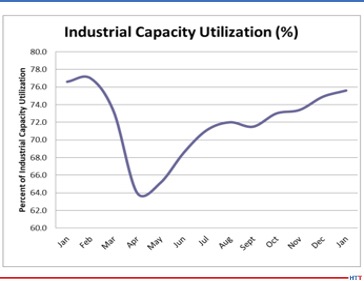
Industrial Capacity Utilization
Source: IHEA

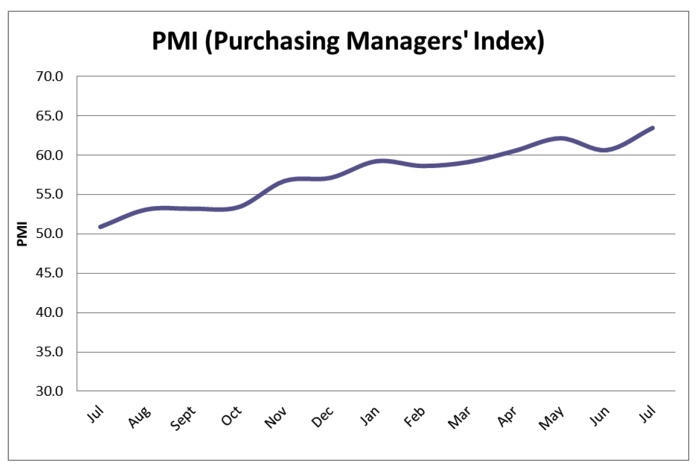
First, the summary takes time to look at contradicting economic indicators. The first example is in GDP growth: While Q1 and Q2 exhibited persistent negative GDP growth, Q3 projections of 1.3% positive growth is a promising sign that the threat of a recession is starting to fade. Other indicators also show borderline economic stability and possibly growth; with unemployment rates being low and seeing capacity utilization numbers in normal range and the Purchasing Manager’s Index in expansion zone (both just barely), “there are as many factors suggesting recession as there are factors that point towards slow growth but growth, nonetheless.” The economic summary projects the following in this borderline hopeful situation: “My own analysis of the situation (for what it is worth) is that the US will escape a formal recession in 2022 or 2023 but will experience a downturn of some significance as compared to where we were in 2021.”

Purchasing Managers’ Index
Source: IHEA

Second, the summary evaluates the causes for inflation, a hot topic and a very visible, uncomfortable sign. We’re looking at three variables for this assessment: lockdowns, the energy crisis, and reshoring. “The estimate,” relates the economic summary, “is that the lockdowns cost upwards of $10 trillion in lost wages, shuttered business, health care costs and the like. The $800 billion [in U.S. stimulus money] did not offset the economic loss and was therefore not inflationary. There was a surge in inflation in early 2021 as the restrictions started to lift and people started to spend again but most of that pressure had dissipated by Q3. There would have been reduction in inflation pressure had there not been other factors.” The next cause for inflation, the energy crisis, was caused by the War in the Ukraine since Russia’s invasion of the Ukraine effectively cut off the world’s second largest producer of oil from the global economy. The energy crisis and inability to access many goods after shutdowns and wartime supply chain disruptions has also led to much reshoring in the U.S. With reshoring — an indication of growth — comes near inevitable price increases at the expense of more secure supply chain lines: “As companies return to the U.S., they will naturally encounter higher costs – for labor, for land and the like. They will see higher regulatory costs and will encounter more limits. These will add to the costs even as these companies benefit from a more reliable supply chain.”

Anne Goyer, Executive Director of IHEA
Anne Goyer
Executive Director
IHEA

Check out the full report to see specific index growth and analysis which is available to IHEA member companies. For membership information, and a full copy of the 11-page report, contact Anne Goyerexecutive director of the Industrial Heating Equipment Association (IHEA). Email Anne by clicking here.


.

Search for heat treat solution providers and suppliers on Heat Treat Buyers Guide.com


IHEA Monthly Economic Report: “I don’t really know” and That’s OK Read More »
IHEA Monthly Economic Report: Hopeful Horizon Now Approaching

The most recent monthly Industrial Heating Equipment Association’s (IHEA) Executive Economic Summary released in June shares that there are pessimistic and optimistic readings of the data at every turn. While companies seem to be a little confused about whether to expect constriction or growth, the report rightfully notes that "[the] reality is that the U.S. economy is diverse and at any given moment there are sectors that are growing and shrinking – especially in the manufacturing community." Today's summary highlights the diversity of what to expect in the economy.

"The price of steel and aluminum has been rising and fast. There is nothing especially surprising about this fact but the impact on operating costs can’t be underestimated. Fully 77.6% report rising costs and we all know full well what has been taking place in the energy sector."

A quick aside: The dominant factor influencing global economics is war in the Ukraine. The direct effects of Ukrainian agricultural product disruptions -- like wheat and corn -- is compounded by sanctions on Russia which leads to a decreased supply of oil. This stress in the energy market has triggered global inflation that everyone has experience with. For manufacturers, the price of steel and aluminum is rising fast. "There is nothing especially surprising about this fact," the economic summary reads, "but the impact on operating costs can’t be underestimated."

75% of manufacturers are small businesses, which means they will experience the smallest economic changes very keenly. So, while capacity utilization numbers are growing and have just reached into the acceptable utilization zone -- that is, between 80% and 85% where there is relatively low downtime and few bottle-necks -- many small operations businesses will take longer to adjust to new machinery purchases or employees.

To gauge whether or not to prepare for a recession, one should look at the order activity and employment habits of manufacturers. If order activity is stable or increasing, this is a good indicator that manufacturers expect to be able to fulfill more orders and grow with demand. Similarly with employment, when manufactures hire and keep a stable number of workers instead of laying off or decreasing the number of workers, this is also a good indication of a growth economy. Both of these conditions are shown to be true, reports this month's economic summary.

To end on an encouraging note, there isn't reason to believe that most manufacturers are concerned about a recession. With 55.1% expecting business growth and 31.1% expecting business stability, manufacturers remain on track with their capital investment plans to handle these positive expectations. Part of this is linked to the shortage of workers with the right skill set; so expect manufacturers to continue investing in technologies and robots to meet this lack.

Anne Goyer, Executive Director of IHEA
Anne Goyer
Executive Director
IHEA

Check out the full report to see specific index growth and analysis which is available to IHEA member companies. For membership information, and a full copy of the 11-page report, contact Anne Goyerexecutive director of the Industrial Heating Equipment Association (IHEA). Email Anne by clicking here.


.

Search for heat treat solution providers and suppliers on Heat Treat Buyers Guide.com


IHEA Monthly Economic Report: Hopeful Horizon Now Approaching Read More »

IHEA Monthly Economic Report: It’s Not the 1980s

Rather than mirror the doom and gloom projections from the media, this economic report does not project the 1980s to our present situation. The monthly Industrial Heating Equipment Association’s (IHEA) Executive Economic Summary released in May remains proactive, warning against statements of doom and gloom, while recognizing three very real drivers of economic concern: inflation, labor, demand.

“[The] data for the new orders index has actually improved a bit and is nearly at 60. That is clearly expansion and growth and when this is taking place with
new orders the influence on the overall economy is very positive.”
“The bottom line is that economists are about as reliable as meteorologists when it comes to predicting,” the report reads. So rather than perpetuate the gloomy forecasts, the report proposes warnings in several “if” statements: “If the inflation doesn’t come down, if the price of energy stays high, if the supply chain remains broken, if labor is in short supply, if the pandemic surges again, if the Ukraine war doesn’t end.” These factors may not change fast or fast enough, but we will cross that bridge when we get there.

“Watch for a rethink of tariffs on imported steel and aluminum. Most of the relaxation will affect European producers as there is not much enthusiasm for lowering tariffs on China or other Asian producers.

The first driver of economic concern is consistent with the report released in March: inflation. Currently, the two reasons can be attributed to war in the Ukraine as sanctions on oil have been placed on the third largest oil producer, and supply chain breakdown due to the pandemic. The latter continues to be exacerbated as China has gone into fierce lockdowns. “The loss of the world’s third largest oil and gas producer,” the report continues, “sent prices spiking and there was a similar reaction when it comes to food as this part of the world produced 25% of the world’s wheat.”

The second driver is also familiar — the need for labor and combatting labor costs. While not unanticipated, the increasing demand for skilled workers indicates that we have not properly prepared for this need. In fact, the report asserts that “[there] has been no concentrated effort to train the needed workforce, no reform of immigration, [and] no move to change the retirement age.” This means that skilled employees have more bargaining power as companies — not workers — compete to meet their need.

Anne Goyer, Executive Director of IHEA
Anne Goyer
Executive Director
IHEA

Lastly, the driver of economic concern is high consumer demand in a time of shortage. “In a time of shortage, people and businesses hoard, and that only makes the overall situation worse,” reads the report, and even though the “flood of money” offered to people during pandemic recession fueled excessive growth — nearly 6% — the overhang is mostly gone. There is still some remaining, despite inflation, to encourage spending; it is this area of demand that the Federal Reserve can directly affect if it so chooses.

Check out the full report to see specific index growth and analysis which is available to IHEA member companies. For membership information, and a full copy of the 11-page report, contact Anne Goyerexecutive director of the Industrial Heating Equipment Association (IHEA). Email Anne by clicking here.


.

Search for heat treat solution providers and suppliers on Heat Treat Buyers Guide.com


IHEA Monthly Economic Report: It’s Not the 1980s Read More »

IHEA Monthly Economic Report: Lions, Tigers, and Bears?

"The inventory levels for almost every industrial metal have been as low as they have been in decades and at the same time there has been more demand as industry starts to stage a recovery in key areas."

As we emerge from pandemic slowdowns and disruptions, there are still "lions, tigers, and bears — oh my!" that manufacturers face. The monthly Industrial Heating Equipment Association’s (IHEA) Executive Economic Summary released in February notes that in economic terms, it has been "inflation, supply chain, and labor — oh my!" for several months, but at least two of these may be letting up in 2022.

First, inflation. Inflation is the highest it has been in decades: 7.5%. The report reveals the reasons why this is the case: "For the better part of the last four decades the US was able to essentially export inflation . . . If one was facing higher labor costs and higher production costs the easiest response was to either produce or source overseas where the costs were dramatically lower." Now, many U.S. companies are undoing this in light of rowing costs from overseas suppliers and supply chain upheaval.

And high inflation rates and the supply chain are recovering. While the "stimulus effort dumped the equivalent of the Japanese GDP into the hands of consumers," they were unable to continue normal purchasing habits, and cash tied up in savings contributed to inflation. But now, consumers have fed most of that cash back into the economy. Additionally, producers are slowly catching up with demand, which will stabilize commodity costs from contributing to inflation. The last contributing factor to inflation is less positive; the report notes that cost of labor -- having risen over the course of the pandemic -- are unlikely to come down, which will likely inhibit the full return "back to normal." Still, even the supply chain's 2021 recovery is cause for celebration, having been "far more aggressive than anyone had expected and producers were unprepared. They are starting to gain ground and by mid-year they are expected to have caught up with the majority of current consumer demand. The primary issue now is China."

Steel consumption will surge later this year as orders from Congress's infrastructure spending plan are placed.

Unfortunately, the retirements of key workers as well as a simple lack of hands put pressures on labor costs. Paired with increased wage demands, "Skilled workers have more leverage than they have ever had and the number one means by which companies are expanding their workforce is by poaching from one another." This leads to paying new hires and longtime employees higher wages to disincentivize job hopping.

Anne Goyer, Executive Director of IHEA

The report concludes, "labor costs soared by over 5.0% last year and these costs are heading in the same direction in 2022."While we may not be out the thicket yet, there is still hope along two of the three economic indicators.

Check out the full report to see specific index growth and analysis which is available to IHEA member companies. For membership information, and a full copy of the 12-page report, contact Anne Goyerexecutive director of the Industrial Heating Equipment Association (IHEA). Email Anne by clicking here.


.

Search for heat treat solution providers and suppliers on Heat Treat Buyers Guide.com


IHEA Monthly Economic Report: Lions, Tigers, and Bears? Read More »

IHEA Monthly Economic Report: The Good. The Bad. The Ugly.

"That sense of euphoria over the rapid growth sustained since the start of the year has started to fade and not for the reason that was expected," states July's Industrial Heating Equipment Association’s (IHEA) Executive Economic Summary. Remember at the beginning of the year, there was an expectation that there would be growth, but it would hopefully be a bit slow. That was preferred because then "producers would be able to keep pace with demand and that would minimize the inflation threat."

As indicated, when looking at the data for capacity utilization, there has been a great deal more investment in equipment, machinery, and technology in the last few months. The swift recovery of the economy convinced many companies they needed to move quickly to meet that surge in demand.

The report explains that "What we actually got was an economy on fire with a 6.5% growth rate in Q2. Suddenly the inflation threat was real as producers were quickly overwhelmed." But, as everyone was preparing for growth, Covid reared its ugly head again. "Now we see potential decline in the last half of the year as those protocols and restrictions reappear. "Will there be another lockdown? Will consumers retreat again and send the service sector back into recession?" Those are vital questions that are begging for answers.

Businesses had two possible responses to the early surge, both based on consumer action: add capacity to meet the demand and trust the surge will continue or hold tight and possibly lose business to competitors. The summary reports, "Until roughly a month ago, it would have been a good bet to assume that demand would continue to grow – all the signs and indicators were pointing that way. Today the story is far less clear. The resumption of pandemic protocols has been an immense disappointment and has created significant tension."

The data from the PMI has been getting progressively better and these are very high numbers in general. (The PMI index indicates expansion when the numbers are above 50 and contraction when they are below 50. The last time the index was even close to that decline was a year ago when the reading was 50.9 and it has been climbing ever since.) The unique aspect of the PMI is that it is current and honest – it is literally a monthly assessment of what industries are buying.

So, where does that leave the U.S. economy for the remainder of the year? There are three scenarios: the good, the bad, and the ugly. The good is one in which "people basically adjust to the protocols with some patience. . . . If that is the case, the expectation is that growth rates will be relatively unaffected." The bad suggests that "consumers do not adapt well and begin to shift their behaviors back to what they were last year – shunning events, restaurants, travel, and other public activity." And the ugly scenario could result if "the outbreak gets bad enough that lockdowns are reimposed."

The report concludes that "consumer growth and tension are not good companions." Time will reveal the consumer's chosen scenario.

Anne Goyer, Executive Director of IHEA

Check out the full report to see specific index growth and analysis, which is available to IHEA member companies. For membership information, and a full copy of  the 12-page report, contact Anne Goyer, executive director of the Industrial Heating Equipment Association (IHEA). Email Anne by clicking here.


IHEA Monthly Economic Report: The Good. The Bad. The Ugly. Read More »

IHEA Monthly Economic Report: Be Careful What You Wish For

We are living in a volatile and ever-changing world right now— on many fronts. And so, when April's Industrial Heating Equipment Association’s (IHEA) Executive Economic Summary begins, "Be careful what you wish for – you just might get it," it causes one to pause. There have been areas of growth during the early months of 2021, but as the report states, "With growth come the challenges of growth. . ."

The demand for steel has been spiking and as a result the prices have been trending up as well. (Data courtesy of IHEA)

"Everything in this month’s report points to further growth and that is good except when it isn’t," the summary continues. What can challenge economic growth? Inflation and the three planks of inflation are commodity price hikes, wage hikes, and overall increase in money supply. Because of the growth, "the inflation threats are here to stay for a while." While the time frame isn't known, the two drivers that will contribute to its longevity or brevity are demand and supply. The report explains, "The demand side is pushing inflation for the moment – there is too much for the producers to keep pace with. The suppliers were not ready for this level of demand and remain a little cautious as far as how long that demand holds." It appears that the demand is real and that production will ramp up to meet the demand.

The one potential sticky point may be the money supply driver for inflation mentioned earlier. The economic report continues, "In normal circumstances there is a limit to inflation tolerance that stems from the willingness and ability to pay the higher prices." So, either the consumer has the means to pay the higher price or he deems it too high and will forgo the purchase. But today, with "close to $5.5 trillion in excess savings worldwide. . . the consumer will complain about the higher price, but then they will shrug their collective shoulders and pay anyway because they want the good or service offered and they have the money to pay for it. Those that will be left behind will be those that don’t have the money set aside or lack the ability to increase their personal money supply – the fixed income consumer and the company that is locked into their current pricing structure."

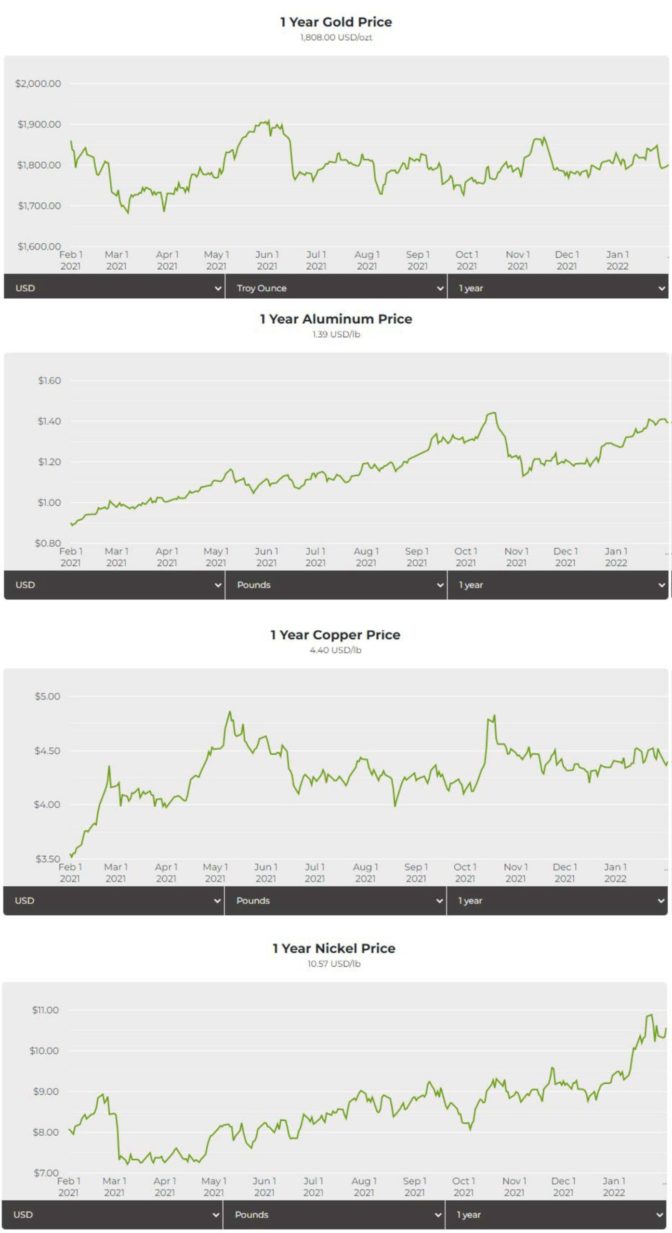
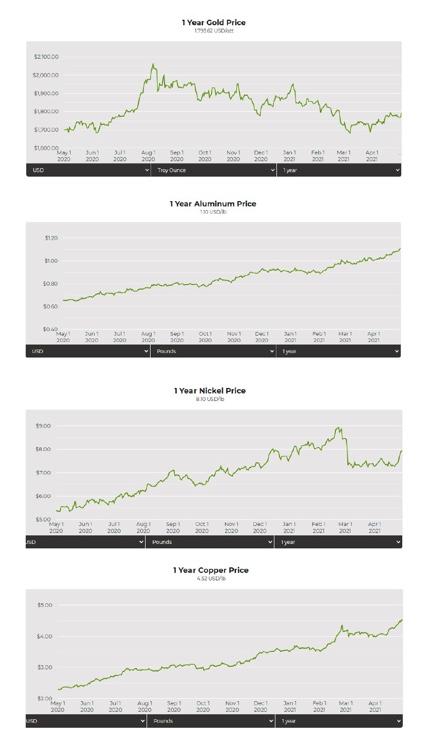
Copper, steel, aluminum and nearly everything else has seen sharp hikes to near record levels. The main reason for the price surge has been demand in excess of what had been predicted coupled with producers remaining on the cautious side. (Data courtesy of IHEA)

The report concludes with the expectation, barring no unexpected crisis, that "inflation pressures will ease by the end of the summer or early fall as the producers catch up with demand. This is the season of hurricanes and storms capable of creating issues that cascade through the markets and there is more fragility in the system than has normally been the case."

Check out the full report to see specific index growth and analysis which is available to IHEA member companies. For membership information, and a full copy of  the 12-page report, contact Anne Goyer, executive director of the Industrial Heating Equipment Association (IHEA). Email Anne by clicking here.

Anne Goyer, Executive Director of IHEA

IHEA Monthly Economic Report: Be Careful What You Wish For Read More »

IHEA Monthly Economic Report: Dark Economic Clouds Cautiously Giving Way to Bright Recovery

“It is not that there is no longer anything to be concerned about as far as the economy is concerned, but the constant worries about whether the impact of the recession would fade seems to be ending. . . . The aggressive recovery predictions that were dismissed a month or so ago are now seen as the most likely.” This optimistic introduction leads February’s Industrial Heating Equipment Association’s (IHEA) Executive Economic Summary.

There are three factors that account for this enthusiasm, the summary reports. The first is the acceleration of vaccine distribution. “The US is now ranked number five in the world in terms of numbers vaccinated (behind only a few Asian states like Japan and Taiwan).” This has helped to reduce pandemic protocols. The second factor is that consumers have money and are willing to spend it. The summary states, “There is an estimated $6 trillion on the sidelines between consumers, investors and the business community. The consumer alone sits on over $2 trillion.” And finally, the third factor is tied to the money that will be infused into the economy by the $1.9 trillion stimulus/rescue plan.

The measurement of capacity utilization is a key indicator for future activity. It basically measures how efficiently a manufacturer is operating – do they have slack capacity in terms of either the machinery or their workforce? At the moment, the capacity numbers are a very long way from provoking inflation.

But, there’s that “what if,” hanging out there. The report cautions, “There is always a caveat when talking economics and that stimulus money is behind some of the trepidation regarding the future of the economic growth pattern. The risk from the stimulus is that it will overheat the economy and trigger a serious burst of inflation. If that surge in prices is dramatic enough, it could provoke the Fed to hike rates and start to put a damper on the growth we are starting to see.”

There are three prime motivators for inflation. The first one, wage inflation, hasn’t been an issue since there are still millions of people out of work. The second motivator, which has been manifesting dramatically is the price of commodities. They have been rising quickly–think oil and lumber prices. The third motivator is the money supply issue which could potentially lead to much angst. “The US economy is about to get hit with nearly $2 trillion just when there is substantial growth underway. This has the potential to set off a cycle of money chasing money. There will be a substantial part of the consumer population that will see some of this money and will be eager to spend it. If there is too much demand and not enough supply the price of things will go up.”

In conclusion, it will be interesting to see the response from the Fed–currently, there doesn’t seem to be a desire to hike rates– as well as the spending of the consumer. Will they continue to spend on services or for long-desired products? Hopefully, there are economic sunny days ahead.

The purchasing managers’ index is fairly volatile at the moment, but the good news is that the numbers have been consistently in the 60s for the last several months and anything over 50 is considered expansionary.

Check out the full report to see specific index growth and analysis which is available to IHEA member companies. For membership information, and a full copy of  the 12-page report, contact Anne Goyer, executive director of the Industrial Heating Equipment Association (IHEA). Email Anne by clicking here.

Anne Goyer, Executive Director of IHEA


IHEA Monthly Economic Report: Dark Economic Clouds Cautiously Giving Way to Bright Recovery Read More »

IHEA Monthly Economic Report: What Is Our Future? The V, the Swoosh, or the W?

HTD Size-PR LogoStay buckled up, folks! The often-mercurial economic adventure continues. November’s  Industrial Heating Equipment Association’s (IHEA) Executive Economic Summary addresses the crossroad and the economic forecasts that are trending. The summary begins,  “The economy seems to be sitting at another crossroads, and thus far this year there have certainly been many of them. There are basically three forecasts in circulation as far as the coming year is concerned.”

The pandemic shutdown did not affect the construction sector in a significant way, and in many respects, it accelerated demand for homes.

The report defines the three outlooks — the “V,” the “swoosh,” and the “W”– and analyzes which model seems most realistic right now based on real time data, although we know that can change at any moment. The preferred “V”outlook “holds that there will be a rapid rebound in the next quarter or two and this will yield a rebound nearly as quick as the decline. To be honest, the time for the ‘V’ option has largely passed by. We would have had to see some truly dramatic numbers appear by now.”

So, if the “V” is an unlikely option, the summary states the “swoosh” might be the best option: “It asserts that there will be continued real growth in the first quarter of 2021 but tempered a little by continued consumer trepidation and the impact of the continued shutdown. This means that there is not a rapid rebound, but a drawn-out version that starts to look real by the start of Q2.”

The report continues, “The remaining option is the ‘W’ or the double dip recession and that is nobody’s preference. This would be the result of another hard and comprehensive lockdown. It is not likely the entire country would be subject to such a shutdown, but certain states will be affected more than others.”

There is growth, however. As we look specifically at the November indices, all but three of the eleven measured are trending in a positive direction. The summary states, “There are several near universal factors that are driving all of the index readings at this point. The first is a growing level of confidence regarding the performance of the economy in 2021. . . . The second factor stems from the first. That surge of activity will strain capacity in many sectors. . . . and the third is the state of the global economy.”

The major users of steel include construction, vehicle manufacturing, and the oil and gas sector.

Stayed tuned! The end of 2020 and beginning of 2021 promises to be full of excitement.

Check out the full report to see specific index growth and analysis which is available to IHEA member companies. For membership information, and a full copy of  the 12-page report, contact Anne Goyer, executive director of the Industrial Heating Equipment Association (IHEA). Email Anne by clicking here.

Anne Goyer, Executive Director of IHEA


IHEA Monthly Economic Report: What Is Our Future? The V, the Swoosh, or the W? Read More »

IHEA Monthly Economic Report: “Who’s on First?”

pr logoDo you remember, or have you ever heard of the comedy duo of Abbot and Costello of the 1940s and early 1950s? One of their most popular skits is “Who’s on First?” which is hilarious, but its title, theme, and overall performance are apt reflections of the questions, frustrations, and confusing answers we are experiencing on a daily basis as we continue to navigate through uncharted waters.  September’s Industrial Heating Equipment Association’s (IHEA) Executive Economic Summary begins with questions we’d all like to know the answers to about the future of the economy/recovery and ends with continued hope. “There will soon be a debate as to what to call the period we are entering. Is this the post-pandemic recovery? Is it the second wave pandemic era? Is this the beginning of the ‘blue wave’ or the start of the purple revenge? Is this the end of the beginning or the beginning of the end? At this point a case could be made for any of these.”

(Photo Source: YouTube.com)

It’s always good to look at the data of the indices to get a pulse of what’s happening. Of the 11 indices, five are trending in the positive direction and six are trending negative, however, the report states that “the shifts have been subtle and it is hard to say whether the future trends will continue to follow the current pattern.”

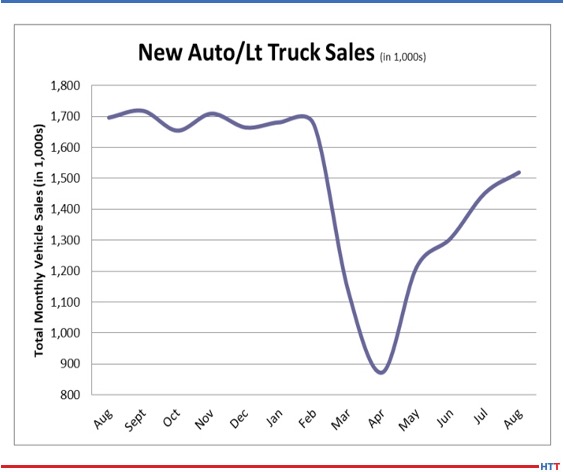
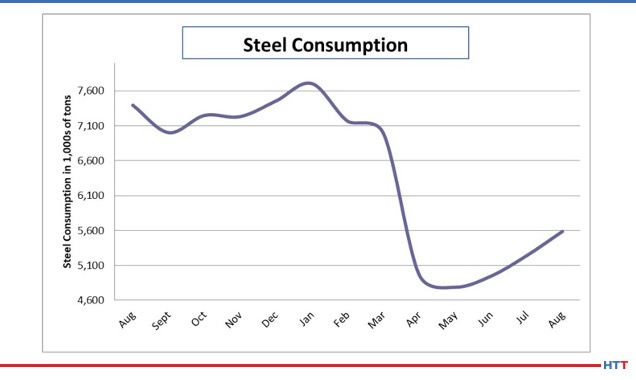
The report continues, “In many respects the economy now seems in better shape than it was just a few months ago and far better than many had expected at this point. That is reflected in the indicators that showed improvement this month.” The gains were in the new automobile/light truck sales, steel consumption, industrial capacity utilization, metal prices, and factory orders.

Vehicle sales are sensitive to the performance of the economy. Demand is slowly coming back.

New home starts, capital expenditure, PMI new orders, credit, durable goods and transportation experienced a decline last month, however, in “many of these readings the changes from last month were minor and the numbers remain far stronger than they were even as recently as July and August. The economy is changing and that has meant decline for some and progress for others.”

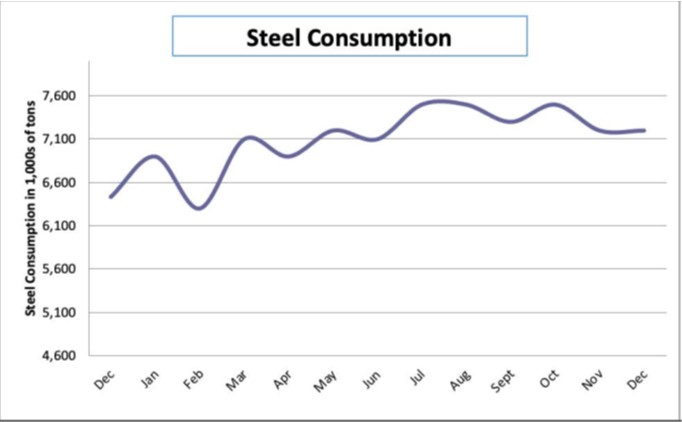
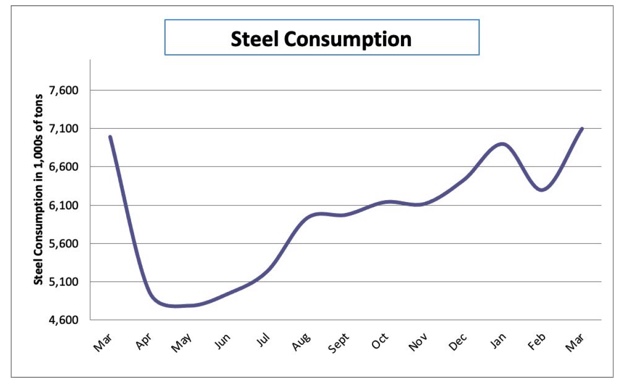
The level of steel consumption has been rising steadily since falling into the doldrums.

While the upcoming election may bring changes, the summary states, “The reality is that the focus of the next year will be the same regardless of who wins the White House and/or Congress. The pandemic may dominate the economy as it has through 2020.” The projections for 2021 fall into two categories. The first scenario is one in which “the recovery will start picking up speed as this year ends and will continue to gain traction into the first half of next year before slowing down slightly.” The second scenario is the more cautious assumption based on an expected spread of the virus through the colder months. The good news is that in both scenarios the end of 2021 will see growth numbers that will look a lot like the numbers at the start of 2020.

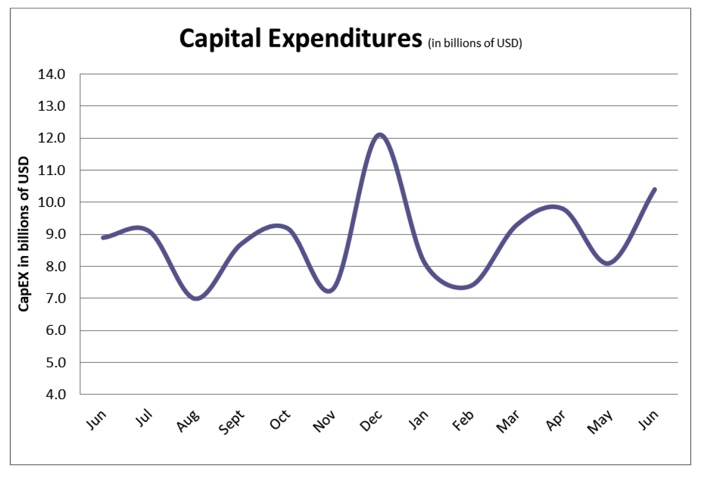
Finally, given all the uncertainty, what should be on the watch list for business and manufacturers specifically? The summary concludes, “The key factors to watch will be those that reflect month to month changes and that will include the Purchasing Managers’ Index as well as the Credit Managers’ Index. Both look pretty solid right now but have shown some signs of concern as the growth spurt in the PMI has faded and the CMI is starting to show issues with the unfavorable factors. Two other indices to focus on will be capital expenditure and capacity utilization. If the manufacturers are worried about the future, they will be reducing their levels of capital investment (both in terms of machine purchasing as well as physical plant).” The only other early warning sign to look for is in transportation. Parcel activity is going to grow as the holiday spending season ramps up, which means paying closer attention to rail and truck volumes.

Check out the full report to see specific index growth and analysis which is available to IHEA member companies. For membership information, and a full copy of  the 12-page report, contact Anne Goyer, executive director of the Industrial Heating Equipment Association (IHEA). Email Anne by clicking here.

Anne Goyer, Executive Director of IHEA


IHEA Monthly Economic Report: “Who’s on First?” Read More »

IHEA Monthly Economic Report: Remarkable Recovery- Consumers Remain Cautiously Optimistic

Growth takes time, but celebrating the small steps and progress is good for the heart and soul– of people and country. “There has been a remarkable level of economic turnaround taking place in the last couple of months. Of the eleven indicators we watch there has been a recovery in every one of them,” so begins August’s Industrial Heating Equipment Association’s (IHEA) Executive Economic Summary.

Yes, the gains have come off record losses and numbers haven’t climbed back to where they were at the beginning of the year, however, as the report conveys, “Given the data that was showing up just a few months ago, the situation now could be far worse at this point and if there is a continuation of these recent trends there could be a recovery of that first quarter momentum by the beginning of the fourth quarter.

The report asks this question: With every index reading trending positive there is not much to contrast so the key issue is why. What is the prime motivation for the comeback and where might the weak points be?” Three factors are suggested for  the gains. The first is the elements of the lockdown have been lifted. “Where there has been a relaxation of the restrictions, there has been economic growth.” The second reason for the economic growth is a resumption of consumer demand. “It was hoped that consumers would be eager to resume their old habits but there was no guarantee, and there was some hesitation as far as consumption was concerned. That largely vanished by the middle of the summer.” The third growth factor was the producers’ willingness to meet the recovering demand. “Production levels have been increasing through the last few months and there has been little indication that activity was being slowed deliberately as a means by which to boost prices through manufactured shortages.”

What is a potential weak area that could adversely affect the economy? The short answer– the election. “Perhaps the most potent unknown surrounds the election. There is always a concern when the possibility exists for a change in leadership. That concern ramps up when there is more at stake than just the White House. The business community is affected more by [who] holds power in Congress as this is where those fiscal decisions are made.

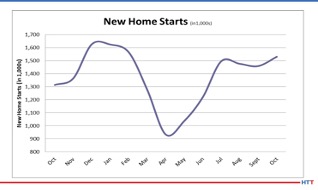
To highlight just two indices, first, take a look at the New Home Starts where the housing market “is booming in almost every respect. The analysis states, “The surge has been seen primarily in the single-family home category as there has been an exodus of people from urban areas to the suburbs and exurbs.” Why? Because due to the lockdown restrictions, people are tired of cramped living conditions, and many are craving more space in the suburbs. “The majority of the factors that stimulate home buying are trending in a positive direction. Mortgage rates remain at very low levels and lenders are still willing to do these home loans.”

There have been people leaving cities they no longer feel safe living in and perhaps the most salient factor is the desire to end their long commutes. (Source: IHEA)

The second index that highlights a viable and healthy rebound is the Factory Order index. “The gearing up for the holiday season is well underway as the retailers have clearly signaled that they are expecting a very early buying season. They will be entering the period with an ‘inventory light’ strategy and will be turning the entire month into ‘Blackvember’ with early sales and discounts designed to capture the attention of the early shopper.”

The recovery of the factory order segment is perhaps better news than the rebound in durable goods and some of the other industrial indicators as it is coming at an ideal time. The gearing up for the holiday season is well underway… (Source: IHEA)

Resilient has often described Americans throughout our history, and this period in time is no different. Challenges make us stronger, and hopefully, wiser. Here’s looking to a continued growing economy and wisdom in decision-making.

Check out the full report to see specific index growth and analysis which is available to IHEA member companies. For membership information, and a full copy of  the 12-page report, contact Anne Goyer, Executive Director of the Industrial Heating Equipment Association (IHEA). Email Anne by clicking here.

Anne Goyer, Executive Director of IHEA


IHEA Monthly Economic Report: Remarkable Recovery- Consumers Remain Cautiously Optimistic Read More »

Skip to content