



aluminum

Heat Treat Fringe Friday: Metal-Air Scavenging Robot “Eats” Aluminum

Heat Treat Fringe Friday

Sometimes our editors find items that are not exactly “heat treat” but do deal with interesting developments in one of our key markets: aerospace, automotive, medical, energy, or general manufacturing. As we approach the weekend, today’s Heat Treat Fringe Friday Best of the Web post focuses on an interesting development in the world of manufacturing robotics.


Batteries have served us well for decades, but they are becoming too heavy and inefficient for some uses as devices continue to shrink. Researchers at the University of Pennsylvania have now developed a new type of robot that powers itself by “eating” metal from its environment.

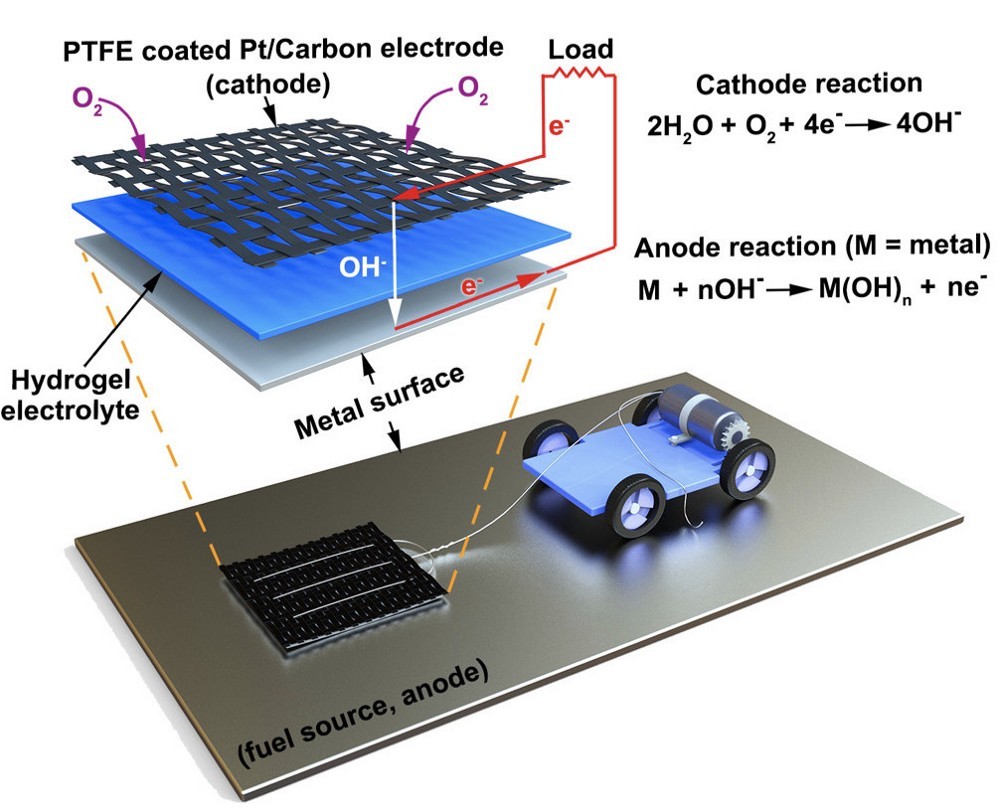
The metal-air scavenger (MAS) design would still have the basic layout of a battery, including a cathode, anode, and electrolyte. But the clever part is that the anode isn’t built into the device – any metallic surface that the MAS passes over will provide the function.

James Pikul, Assistant Professor of Mechanical Engineering and Applied Mechanics, University of Pennsylvania (source: U Penn)

“Our MAS has a power density that’s 10 times better than the best harvesters, to the point that we can compete against batteries,” says James Pikul, lead researcher on the study. “It’s using battery chemistry, but doesn’t have the associated weight, because it’s taking those chemicals from the environment.”

An excerpt: “The cathode is made up of carbon, coated in polytetrafluoroethylene (PTFE) and with nanobeads of platinum embedded inside. The electrolyte is a hydrogel containing salty water. When this jelly-like patch is dragged around on top of a metallic surface, it oxidizes the metal below, breaking down chemical bonds to power itself. At the same time, the cathode material is reducing oxygen from the air above it.”

To read more about this story, click here.
Heat Treat Fringe Friday: Metal-Air Scavenging Robot “Eats” Aluminum Read More »

Melting Furnaces and Twin Chamber Furnace to be Installed

Significant milestones have been obtained with the construction and installation of two 70 mt melting furnaces and the installation of a 105 mt twin chamber furnace. Air pollution control equipment is currently being installed and the pit is being prepared to accept all of the casting equipment which will be installed in 2017. This is all part of GARMCO’s remelt expansion project.

GARMCO designed the plant to meet stringent Bahraini safety and environmental regulations. The new plant will provide GARMCO with the capability to cast an additional 120,000 tonnes of aluminium slab products. Once the slabs are rolled, the finished products will exceed customer quality requirements, improve operational safety, and reduce production costs. The plant is to be fully operational by December 2017.

Fives, the turnkey construction contractor,achieved over 600,000 man hours without any lost time injuries. 2017 will be a challenging year for all personnel on this fast track project that commenced in March 2016 Commissioning of equipment is scheduled for April and the plant should be fully operational by December 2017.


Melting Furnaces and Twin Chamber Furnace to be Installed Read More »

AMAG Orders Plants for Production of Aluminum Strip and Sheet

BOTW  Source: Heat Processing
AMAG rolling GmbH, Austria, has placed an order with SMS group for the supply of a cold rolling mill, a heat treatment line with a connected passivation section, a high-bay warehouse and a packaging line. Thus, numerous key assets of the AMAG 2020 investment project, dedicated to the set-up of production facilities for cold rolled premium aluminum strips and sheets, will all be supplied by SMS group. Commissioning of the new facilities is scheduled for 2017.

The six-high cold rolling mill with CVC plus technology (Continuously Variable Crown) supplied by SMS group will provide the high degree of flexibility required to handle the extensive range of products, including strip in widths of more than two meters. The rolling mill will come with actuators that ensure production to the required, extremely tight product tolerances, and it will be equipped with X-Pact control systems. An Airwash system will provide most efficient purification of the exhaust air from the rolling process. In a highly eco-friendly process, the recovered rolling oil will be fed back to the process cycle. The technological highlights of the heat treatment line and the connected passivation section are the water-cooled floater furnace, the resource-saving process technology and the compact layout. During the heat treatment in the puller furnace, the strip receives the mechanical properties specified by the customer. The final chemical coating process (passivation) gives the strip the perfect condition for the downstream processing steps. Passivated strips are requested primarily by customers from the automotive industry.

An integral element of the new rolling complex will be the central coil handling system which consists of a fully automatic high-bay warehouse with links to the rolling and processing lines. All material flows will be controlled by a warehouse management system which will be connected to the higher-level production control system. The warehouse technology will include an innovative cooling system which will be able to flexibly switch between air circulation and forced cooling in the various warehouse areas depending on the material grades of the coils and the type of downstream processing.SMS group’s scope of supply also includes a semi-automatic packaging line, which will weigh the finished coils and securely tie, pack and label them for their transport to customers all over the world. The warehouse and the packaging line will be provided by SMS Logistiksysteme.With this investment project, AMAG will increase its production capacity as a supplier of special sheet for automotive body applications (exposed and structural parts) and for use in modern passenger aircrafts. The newly added production capacity will also be used to make the other strip products of AMAG’s portfolio, e.g. packaging material. The new facilities will make the works in Ranshofen, Austria, a top location of the aluminum industry and one of the most efficient and modern production plants for lightweight engineering sheets in the world.


AMAG Orders Plants for Production of Aluminum Strip and Sheet Read More »

Skip to content