



AK Steel

Decarburized Steel Critical for Induction Hardening Rotary Blades

For in-house heat treat operations, the number one goal is to produce a reliable product with consistent in-service performance. Yet supply chain and specialized processes can cause consistency stressors. In this article, Heat Treat Today underlines the importance of consistent feedstock for in-house induction heat treater, National Steel Rule, and how the essential mill process of controlled decarburization can be actualized.

This informative piece was first released in Heat Treat Today’s April 2026 Annual Induction Heating & Melting print edition.

If you have any comments or queries, on this article, let us know at editor@heattreattoday.com.

Para leer el artículo en español, haga clic aquí.


Introduction: Steel Rule that Bends

National Steel Rule manufactures rotary cutting rule for the corrugated box industry. Located in Linden, New Jersey, the company supplies products to the die making and die cutting industries globally. They have established a high standard of sourcing, researching, and testing material for their rule, in addition to a complete testing laboratory with both rotary and flat die cutting equipment.

Their steel rule is purchased from a mill that performs a controlled decarburization on the entire feedstock. When National receives the steel feedstock, they work the steel to create teeth, employing induction hardening as part of the process. The finished cutting rule is then sold to steel rule die makers who mount these blades and an ejection rubber on laser cut wooden boards. The manufacturer must ensure their rule blades are sound, as even microscopic cracks will open during the die cutting process.
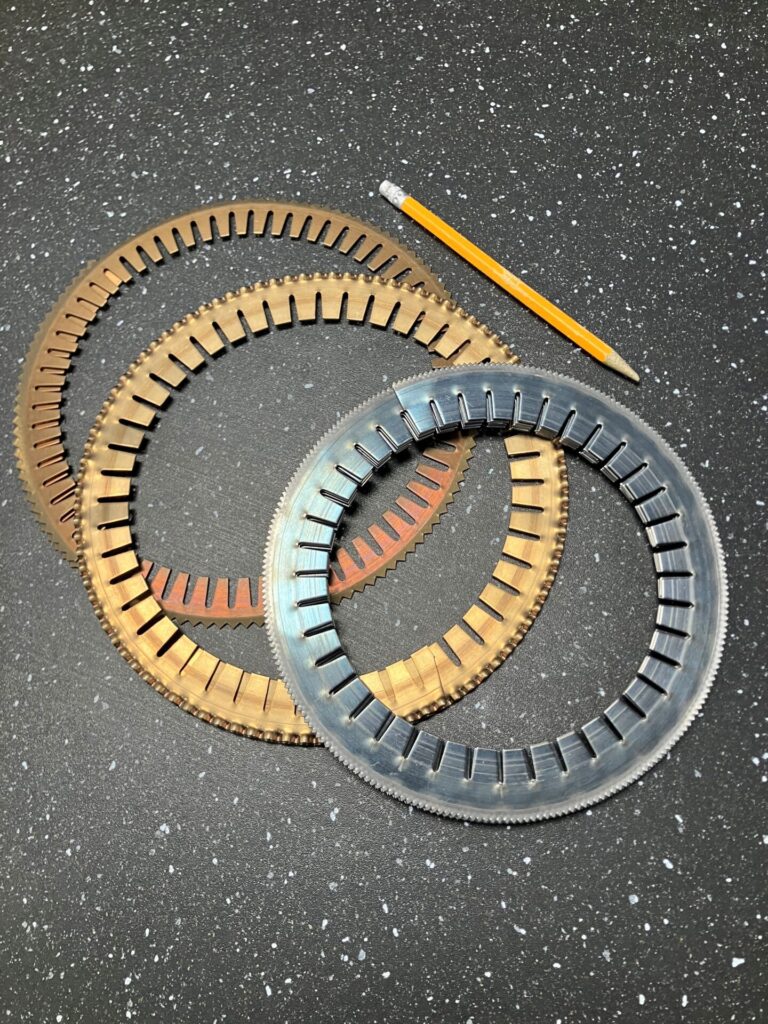
Figure 1. Small diameter bent rule | Image Credit: National Steel Rule

National’s rotary blades and other products rely on purchasing decarburized steel. “Flexibility and formability are paramount,” states Ed Mucci, president of the company, and Alexander Heucke, chief engineer. Cutting rule must be bent to form a circular blade; in service, that blade rotates to cut into the corrugated material. The curve geometry can be extreme, often bending up to a 7-inch interior diameter. As such, the purchase of decarburized steel is critical for the manufacturer’s business. At present, National sources the material internationally. Mucci explains, “Manufacturers aren’t using large quantities of decarburized steel, making it challenging to source, at least domestically.”

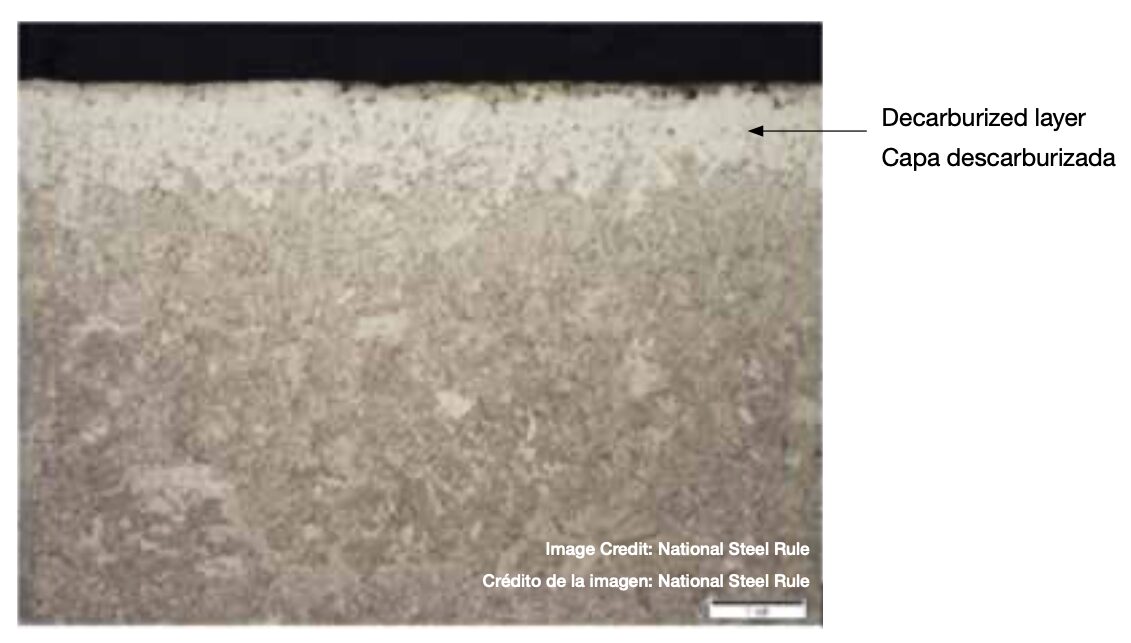
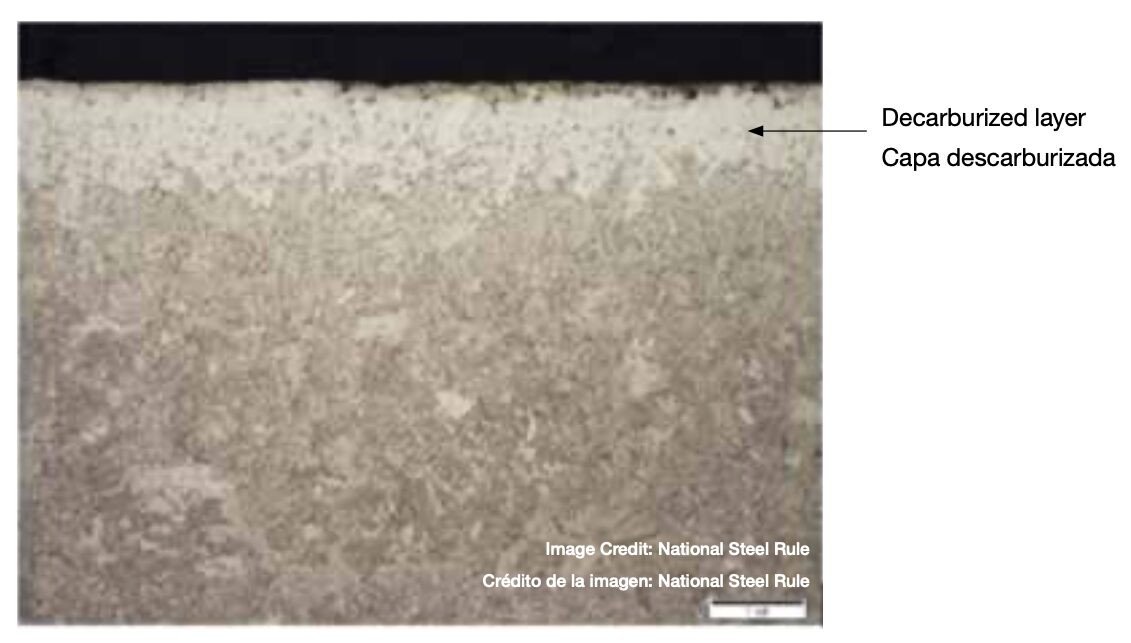
Rotary rule feedstock typically involves C36 (SAE 1036) to C50 (SAE 1050) carbon steel with a hardness range of 32–34 HRC. Mucci and Heucke note that their steel of choice has a total decarburization layer to a depth of 0.0005” depth, with partial decarburization of at least another 0.0005–0.00075”. This ensures that when the rule is bent, the surface stretches versus cracks. Bending the rule is itself a test of whether it has been properly decarburized, with metallurgical testing serving as a quality control verification that suppliers are producing the appropriate decarburization levels.

Precise Induction Hardening Teeth

While bending is essential to forming the appropriate curve, the teeth must be resistant to wear and breakage. National’s rotary cutting rule has performance expectations of at least 750,000 impressions on paper, itself a highly abrasive material. To do this, their in-house heat treat operations induction harden the edge of the rule to ensure a long die life.

There are two methods used to harden the teeth. The primary method is to shave a profile into the strip steel and then induction harden this edge. Serrated teeth are then ground in. “This gives us better control of hardening depth,” according to Mucci and Heuke. The second method is to induction harden after the serrated teeth are ground in. “We have to make sure we don’t harden the teeth too deeply, or we can affect the bendability.”

Induction hardening involves short cycles, and as such requires careful process control to guarantee consistent results; temperature-indicating crayons that melt at a specific temperature are used as one of the process control methods. Hardness testing is performed as well.
Screenshot

Decarburization Revisited

“Usually, one tries to prevent decarburization or even add carbon,” states Mark Hemsath, executive consultant at WINGENS CONSULTANTS and longtime expert and innovator in the thermal processing industry. “Decarb often occurs by accident in poorly designed annealing systems, especially in continuous-type furnaces.”
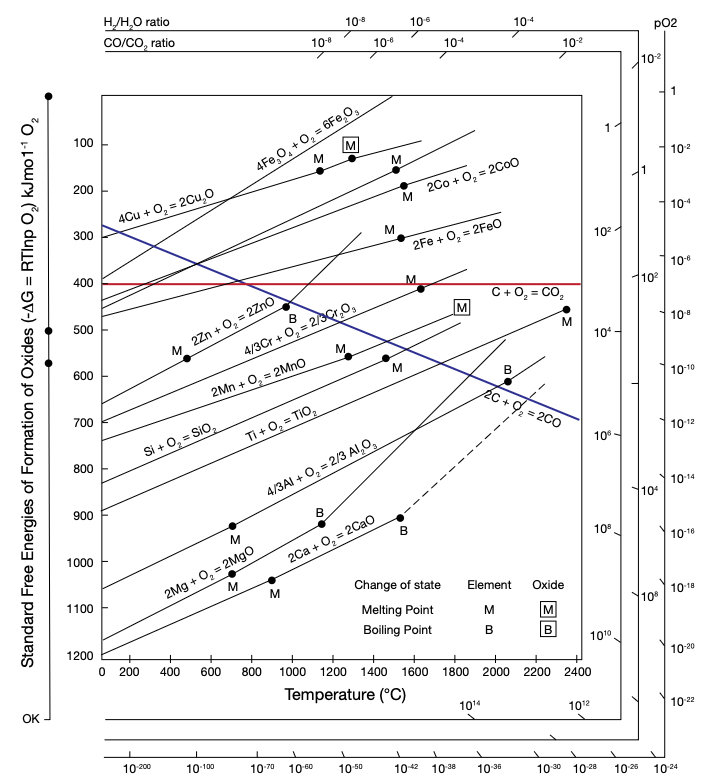
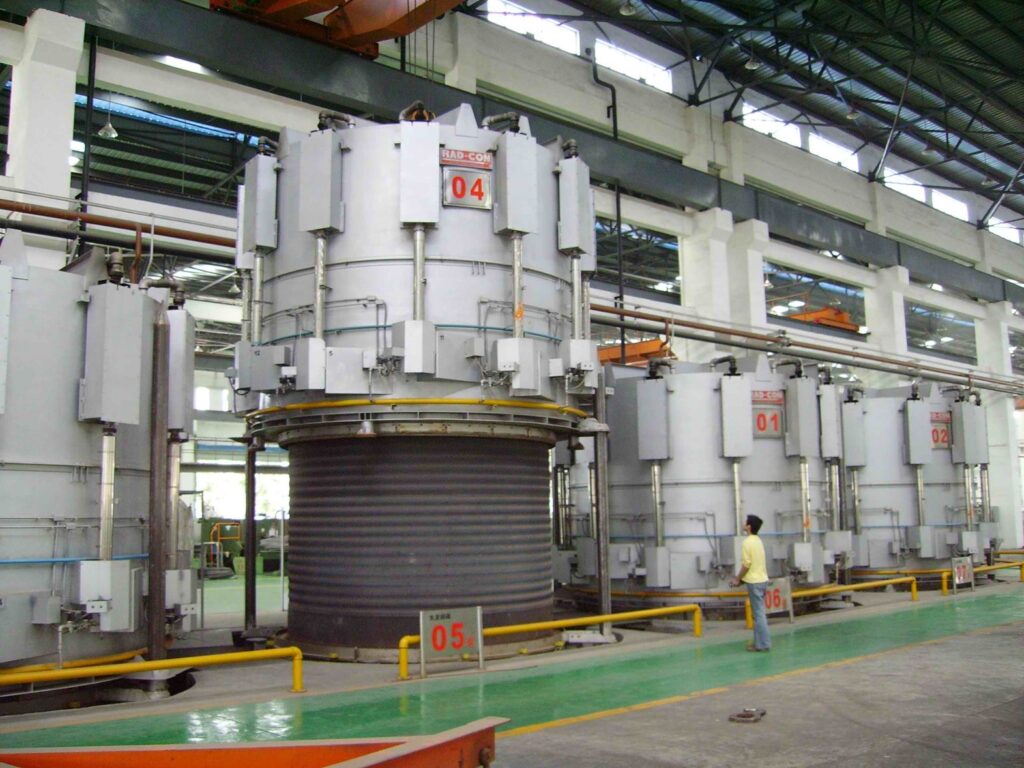
Figure 3. Ellingham Diagram depicting that hydrogen-to-water vapor relationship, the key to a successful, controlled decarburization.
Figure 4. Typical bell-annealing furnace | Image Credit: RAD-CON

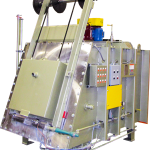
Oxygen, in the form of air or water vapor, is key to the decarburizing process. Less carbon on the surface means a softer, more malleable steel, and while the art of a controlled decarburization process is well known, it can be challenging. Decarburization is a process usually performed below 1500°F. “The preferred method is to use water vapor or steam as a source of the oxygen,” notes Hemsath, pointing to the stability of hydrogen-to-water vapor (H₂/H₂O ratio) derived from the Ellingham diagram. These H₂/H₂O ratios indicate the non-oxidizing qualities of the gaseous mixture, which will allow it to be the carbon reducing agent in the atmosphere. Most furnace companies can provide the necessary equipment and customize size specifications to make it suitable for this special process, and these furnaces are typically retort-based bell or pit type.

Two Methods to Control the Decarb

There are two ways that a decarburization process can be intentionally completed. The first is decarburizing the entire product. In this method, even decarburization is applied to the entire coil sheet surface. “This cold rolled steel, typically with lower carbon, is used for appliances that need enamel adhesion,” Hemsath explained, noting U.S. Steel and AK Steel, now a part of Cleveland-Cliffs, have used this form of controlled decarburization.

Another form of decarburization is selective surface decarburization. Hemsath shared, “If selective decarburizing is required only on the edges, then you could keep the coils tightly wound and the decarburization would affect mainly the coil edges. There would be ingress of carbon loss, reducing towards the center of the wound coil surfaces.”

Conclusion

“Decarburized steel just isn’t in high demand,” according to Mucci, as “most industries are looking to harden and temper the steels they use.” In fact, preventative steel decarburization is more typical and often emphasized in trade shows, technical presentations, and in thermal processing publications. Yet there are products that rely on intentional decarburization to be successful.

Controlled decarburization at the mill brings challenges, in part because successful, consistent decarburization is not often cost effective for the North American thermal processing market. These challenges encompass regional access issues, niche market access, equipment selection needs, and technical process execution.

National’s experience underlines the challenges North American mills face in providing local, in-house heat treaters with reliably, well-controlled decarburized steel that will maintain service life.

Acknowledgements: Heat Treat Todayextends thanks to Dan Herring, The Heat Treat Doctor® at The HERRING GROUP, Inc., who was instrumental in the development of this article.

For more information: Contact Heat Treat Today’s Editorial Team at editor@heattreattoday.com.

Main image: RP8 rotary rule edge hardened | Image Credit: National Steel Rule

Decarburized Steel Critical for Induction Hardening Rotary Blades Read More »

Acero Descarburizado: Crítico para el Endurecimiento por inducción de Cuchillas Rotativas

Para las operaciones de tratamiento térmico internas (in house), el objetivo principal es producir un producto confiable con un desempeño consistente en servicio. Sin embargo, la cadena de suministro y los procesos especializados pueden generar factores que comprometen la consistencia. En este artículo, Heat Treat Today destaca la importancia de contar con material base consistente para el tratamiento térmico por inducción interno de National Steel Rule, y cómo se puede implementar el proceso esencial de descarburización controlada en la planta proveedora de acero.

Este artículo informativo se publicó por primera vez en Heat Treat Today’s April 2026 Annual Induction Heating & Melting print edition. Traducido por Ana Laura Hernández Sustaita.

Si tiene comentarios o preguntas sobre este artículo, háganoslo saber en: editor@heattreattoday.com.

To read this article in English, click here.


Introducción: Regla de Acero que se Dobla

La empresa National Steel Rule produce reglas de corte rotativas para la industria del cartón corrugado. Ubicada en Linden, Nueva Jersey, la empresa suministra productos a las industrias de troquelado a nivel mundial. La compañía ha establecido altos estándares de abastecimiento, investigación y pruebas de material para sus reglas de corte, además de contar con un completo laboratorio con equipos de troquelado rotativo y plano.

Su regla de acero se adquiere de una planta proveedora de acero que realiza una descarburización controlada en todo el material. Cuando National recibe el material, procesa el acero para generar los dientes, empleando endurecimiento por inducción como parte del proceso (ver la imagen principal al inicio de este artículo). La regla de corte terminada se vende posteriormente a fabricantes de troqueles de regla de acero, quienes montan estas cuchillas junto con una goma de expulsión sobre tableros de madera cortados con láser. El fabricante debe asegurarse de que las cuchillas de las reglas estén libres de defectos, ya que incluso grietas microscópicas se abrirán durante el troquelado.


Figura 1. Regla de acero doblada de diámetro pequeño | Crédito de la imagen: National Steel Rule

Las cuchillas rotativas y otros productos de National dependen de la compra de acero descarburizado. “La flexibilidad y la conformabilidad son fundamentales”, afirma Ed Mucci, presidente de la empresa, y Alexander Heucke, ingeniero en jefe. La regla de corte debe doblarse para formar una cuchilla circular; durante el servicio, la cuchilla rota para cortar el material corrugado. La geometría de la curvatura puede ser extrema, llegando a doblarse hasta un diámetro interior de 7 pulgadas. Por lo tanto, la compra de acero descarburizado es crítica para el negocio del fabricante. Actualmente, National obtiene el material a nivel internacional. Mucci explica: “Los fabricantes no utilizan grandes cantidades de acero descarburizado, lo que dificulta su abastecimiento, al menos a nivel nacional”.

El material para las reglas rotativas suele ser acero al carbono C36 (SAE 1036) a C50 (SAE 1050) con un rango de dureza de 32–34 HRC. Mucci y Heucke señalan que el acero que utilizan presenta una capa de descarburización total de 0.0005” de profundidad, con una descarburización parcial adicional de al menos 0.0005”–0.00075”. Esto garantiza que cuando una regla se dobla, la superficie se elongue en lugar de agrietarse. Doblar la regla es, en sí mismo, una prueba para comprobar si se ha descarburado correctamente, y las pruebas metalúrgicas sirven como verificación de control de calidad para garantizar que los proveedores estén produciendo los niveles adecuados de descarburización.

Endurecimiento Preciso por Inducción de los Dientes

Si bien el doblado es esencial para formar la curvatura apropiada, los dientes deben ser resistentes al desgaste y la rotura. La regla de corte rotativa de National tiene una expectativa de desempeño de al menos 750,000 impresiones en papel, que es en sí mismo un material altamente abrasivo. Para lograrlo, las operaciones de tratamiento térmico internas endurecen por inducción el borde de la regla, garantizando una larga vida útil del troquel.

Existen dos métodos usados para endurecer los dientes. El método principal es maquinar el perfil de la tira de acero y posteriormente endurecer por inducción el borde. Posteriormente los dientes son rectificados. “Esto nos da un mejor control sobre la profundidad de endurecimiento”, comenta Mucci y Heuke. El segundo método consiste en endurecer por inducción después de rectificar los dientes. “Debemos asegurarnos de que el endurecimiento de los dientes no sea muy profundo, ya que esto puede afectar la capacidad de doblado”. El endurecimiento por inducción implica ciclos muy cortos, y por lo tanto requiere un control minucioso del proceso para garantizar resultados consistentes. Entre los métodos de control del proceso se utilizan crayones indicadores de temperatura, que se funden a una temperatura específica. También se realizan pruebas de dureza.


Figura 2. Detalle de la capa descarburizada | Crédito de la imagen: National Steel Rule

Revisitando la Descarburización

“Generalmente se intenta prevenir la descarburización o incluso agregar carbono a la superficie”, comenta Mark Hemsath, consultor ejecutivo en WINGENS CONSULTANTS y reconocido experto e innovador en la industria del tratamiento térmico. “La descarburización a menudo ocurre accidentalmente en sistemas de recocido mal diseñados, especialmente en hornos de tratamiento continuo.”


Figura 3. Diagrama de Ellingham que muestra la relación hidrógeno-vapor de agua, clave para una descarburización controlada exitosa.

Figura 4. Horno típico de recocido tipo campana. | Crédito de la imagen: RAD-CON

El oxígeno en forma de aire o de vapor es la clave del proceso de descarburización. Menor porcentaje de carbono en la superficie indica un acero más blando y maleable, y si bien el arte de un proceso de descarburización controlada es bien conocido, puede resultar un desafío. El proceso de descarburización suele realizarse por debajo de 1500°F (815°C). “El método preferido es usar vapor de agua o vapor como fuente de oxígeno”, señala Hemsath. Esto se basa en la estabilidad de la relación hidrógeno-vapor de agua (H2/H2O) derivada del diagrama de Ellingham. Estas relaciones H2/H2O indican las propiedades no oxidantes de la mezcla gaseosa, lo que permite que actúe como agente reductor de carbono en la atmósfera del horno. La mayoría de las empresas fabricantes de hornos pueden proporcionar el equipo necesario y personalizar las dimensiones para hacerlos adecuados para este proceso especial. Estos hornos suelen ser de tipo campana o tipo foso con retorta.

Dos Métodos para Controlar la Descarburización

Existen dos formas de realizar intencionalmente un proceso de descarburización. La primera consiste en descarburar todo el producto. En este método, la descarburización se aplica de manera uniforme en toda la superficie de la lámina o bobina. “Este acero laminado en frío generalmente con menor contenido de carbono, se utiliza en electrodomésticos que requieren una buena adherencia del esmalte”, explica Hemsath. Empresas como U.S. Steel y AK Steel (ahora parte de Cleveland-Cliffs) han utilizado esta forma de descarburización controlada.

Otra forma es la descarburización selectiva en la superficie. Hemsath explica: “Si la descarburización solo se requiere en los bordes, se podrían mantener las bobinas enrolladas firmemente, por lo tanto, la descarburización afectaría principalmente a los bordes. Se produciría una pérdida de carbono que disminuiría hacia el centro de las superficies enrolladas”.

Conclusión

“El acero descarburizado tiene mucha demanda, ya que la mayoría de las industrias buscan endurecer y templar los aceros que utilizan”, indica Mucci. De hecho, la prevención de la descarburización del acero es más común y suele destacar en ferias industriales, presentaciones técnicas y publicaciones de procesamiento térmico. Sin embargo, existen productos que dependen de la descarburización intencional para funcionar correctamente.

La descarburización controlada en la planta proveedora de acero presenta desafíos, en parte porque lograr una descarburización exitosa y consistente no suele ser económicamente viable para el mercado norteamericano de tratamiento térmico. Estos desafíos abarcan problemas de acceso regional, acceso a nichos de mercado, necesidades de selección de equipos y ejecución de procesos técnicos.

La experiencia de National destaca los desafíos que enfrentan las plantas proveedoras de acero de América del Norte para proveer a las empresas de tratamiento térmico interno, acero descarburizado de forma fiable y bien controlada que mantenga su vida útil.


Agradecimientos:
Heat Treat Today
agradece a Dan Herring, The Heat Treat Doctor®, The HERRING GROUP, Inc., quien fue fundamental en el desarrollo de este artículo.


Para más información:
Contacte con Heat Treat Today’s Editorial Team en editor@heattreattoday.com.

La imagen principal: Regla rotativa RP8 con borde endurecido | Crédito de la imagen: National Steel Rule

Acero Descarburizado: Crítico para el Endurecimiento por inducción de Cuchillas Rotativas Read More »

Cleveland-Cliffs Acquires AK Steel, Integrating Steel & Iron Ore Production

AK Steel, a leading producer of flat-rolled carbon, stainless, and electrical steel products was recently acquired by Cleveland-Cliffs Inc., an iron ore company, with a definitive merger agreement to position the new company to create a vertically integrated producer of value-added iron ore and steel products.

Lourenco Goncalves, chairman of the board, president, and CEO of Cleveland-Cliffs

Under the terms of the merger, Cleveland-Cliffs will acquire all of AK Steel’s common stock, and expand their capabilities across the entire manufacturing process, from mining to pelletizing to the development and production of finished high-value steel products, including next-generation advanced high strength steels for automotive and other industries.

“By combining the best-in-class quality of AK Steel’s assets and its enviable product mix with Cliffs’ debt profile and proven management team, we are creating a premier North American company, self-sufficient in iron ore pellets and geared toward high value-added steel products,” said Lourenco Goncalves, chairman of the board, president, and CEO of Cleveland-Cliffs, who will lead the expanded organization. He added that the new company “is well-positioned to serve both the blast furnace and electric arc furnace segments.”

Roger K. Newport, CEO of AK Steel

“The combination of Cliffs’ iron ore pellet capabilities and our innovative, high-quality steel product development and production is strategically compelling,” said Roger K. Newport, CEO of AK Steel. “Together, we expect to be able to take advantage of growth opportunities faster and more fully than either company could on its own. With AK Steel’s 120-year heritage, which began in Ohio, and expertise in steelmaking, AK Steel and Cliffs make an excellent combination, which we expect will facilitate a smooth integration process.”

Cleveland-Cliffs Acquires AK Steel, Integrating Steel & Iron Ore Production Read More »

A Baker’s Dozen Quick Heat Treat News Items to Keep You Current

A Baker’s Dozen Quick Heat Treat News Items to Keep You Current

Heat Treat Today offers News Chatter, a feature highlighting representative moves, transactions, and kudos from around the industry.

Personnel and Company Chatter

  • James Herald has been appointed the president and CEO of EVRAZ North America, Chicago. He will replace Conrad Winkler, who is leaving the group to pursue other opportunities. Herald joins EVRAZ from AXIP Energy, where he served as CEO. He has more than 35 years of experience in the oil and gas and energy pipe industries.
  • Advanced Heat Treat Corp. (AHT) recently announced the addition of three new sales and metallurgy employees: Tim Zemaitis, Shane Seevell, and Katie Herron. Zemaitis, regional sales manager for AHT’s Michigan facility, joins the team with over 30 years of experience in heat treatment, metallurgy, and engineering. Seevell, regional sales manager in the corporate office located in Iowa, brings over 15 years of sales experience plus past heat treat experience working at AHT; and Herron, materials engineer & quality specialist in Alabama, rounds out the growing AHT team. Herron is a recent materials engineering graduate from the University of Alabama – Birmingham.
  • Meggitt, which specializes in high-performance components and subsystems for the aerospace, defense, and selected energy markets, has opened its newly expanded aerospace services and support center of excellence in Miami, Florida.
  • Virginia-based aluminum extruder Service Center Metals has been acquired by The Riverstone Group through its investment entity SCM Industries, LLC in Richmond.
  • L&T Technology Services, a leading global pure-play engineering services company has been selected as a strategic partner by United Technologies Corporation (UTC) for Collins Aerospace, a subsidiary of UTC. Collins Aerospace comprises of the former UTC Aerospace Systems, Rockwell Collins, and BE Aerospace, and is one of the leading providers of intelligent solutions for the global aerospace and defense industries.

  • A 2000°F (1093°C), gas-fired heavy-duty furnace from Grieve (No. 1042), is currently being used for heat treating at a customer’s facility. In addition, the No. 1047, a 350°F (177°C), bench oven, has been purchased from Grieve for curing plugs on the ends of cords at the customer’s facility.
  • A factory with multiple lines of (fixed) heat treating ovens recently purchased a temperature data logging solution from CAS DataLoggers for the purpose of automatically monitoring the oven temperatures with precise accuracy while also handling data transmission and enabling remote access.
  • A manufacturer of electronic components purchased a Blue M inert gas batch oven, with a temperature range of 59°F (15°C) above ambient to 1099°F (593°C), from Thermal Product Solutions.
  • A manufacturer in the oil and gas industry recently received a shipment of an electrically heated four-zone conveyor oven from Wisconsin Oven Corporation. Each chamber in this oven has a maximum temperature rating of 752°F (400°C). The oven has a guaranteed oven temperature uniformity of ±10.8°F at 590°F (±6°C at 310°C)) for a minimum of 6 minutes per heating chamber. In addition, Wisconsin Oven Corporation announced the shipment of an indirect natural gas-fired batch oven to a leading manufacturer in the aerospace industry. The batch oven will be used to cure composite materials and has a maximum oven operating temperature of 500°F.

  • Onex, Inc., recently received the 2018 Pinnacle Award from Vesuvius. Only two contractor installer distributors were presented this award in 2018.
  • AK Steel has accepted an award from the U.S. Department of Energy (DOE) High-Performance Computing for Materials (HPC4Mtls) Program. Researchers from AK Steel plan to work in collaboration with DOE’s Oak Ridge National Laboratory to develop microstructure-based transformation models to predict austenite stability in high strength steels in a project titled “Thermo-Mechanical Forming Process Development to Produce Tailored Strength Automotive Structural Components.”
  • Specitubes has received Nadcap accreditation for demonstrating its ongoing commitment to quality by satisfying customer requirements and industry specifications. The scope of this accreditation covers the heat-treating of seamless precision metallic tubes made in Samer (northern France) of Nickel and Cobalt Alloys, Austenitic Stainless Steels and Titanium Alloys. Typical applications include hydraulic and pneumatic ducting systems for aircraft.
  • thyssenkrupp has announced plans to build the world’s most advanced forging line in Homburg/Saarland, a new facility to produce forged front axles for trucks.  This production expansion represents the biggest single investment ever made at thyssenkrupp’s Homburg site.


Heat Treat Today is pleased to join in the announcements of growth and achievement throughout the industry by highlighting them here on our News Chatter page. Please send any information you feel may be of interest to manufacturers with in-house heat treat departments especially in the aerospace, automotive, medical, and energy sectors to the editor at editor@heattreattoday.com


Onex is proud to receive the 2018 Pinnacle Award from Vesuvius. Only two contractor installer distributors were presented this award.

A Baker’s Dozen Quick Heat Treat News Items to Keep You Current Read More »

10 Quick Heat Treat News Items to Keep You Current

10 Quick Heat Treat News Items to Keep You Current

Heat Treat Today offers News Chatter, a feature highlighting representative moves, transactions, and kudos from around the industry.

Personnel and Company Chatter

  • Julien Noel has been named Vice President / General Manager of the Buehler worldwide division. ITW Test and Measurement Group President, Yahya Gharagozlou, made the announcement. Buehler is an ITW Company which manufactures scientific equipment and consumables for materials analysis.
  • A fourth vacuum aluminum brazing (VAB) furnace has been purchased by California Brazing, a Newark, California, heat treating company in order to expand the capability to service the aerospace sector.
  • Solar Atmospheres recently awarded the title of CEO Emeritus to Roger A. Jones, FASM. The honorary title was conferred by the company and announces his semi-retirement as Solar Atmospheres’ CEO, the culmination of 45 years of leadership and service to the vacuum heat treating industry.
  • A refractories supplier’s recently established partnership will result in the full-service distribution of the company’s products and services throughout several European countries. The Plibrico Company and Pli Group Europe GmbH, a highly experienced refractory distributor contractor based in Vienna, Austria, have entered into a new value-added distribution partnership will cover Austria, France, Germany, Switzerland, Italy, Hungary, Czech Republic, Slovakia, Slovenia, Croatia, Serbia, and Bulgaria.
  • The world’s largest aerospace company, the Boeing Company recently acquired Embraer SA, the commercial aircraft arm of a Brazilian aircraft manufacturer, in a new $4.75 billion joint venture.

Equipment Chatter

  • Seven Gruenberg Glassware drying ovens were recently shipped to a university in the U.S. Midwest by Thermal Product Solutions, a manufacturer of thermal-processing equipment based in New Columbia, Pennsylvania.
  • A furnace equipment company based in Erie, Pennsylvania, recently designed and manufactured a front-loading forge furnace for a leading North American forging company. The furnace built by Onex, Inc., is one of the largest of its kind in North America with workspace dimensions measuring 26ft (W) x 20ft (D) x 14ft (H).
  • A heat treating services provider in the U.S. Northwest recently purchased a Meg-HIP hot isostatic press for heat treating and metal processing. Västerås, Sweden-based, Quintus Technologies installed the system at Stack Metallurgical Group in Albany, Oregon.

Kudos Chatter

  • Thermal-Vac Technology, Inc. has been awarded a 2018 Top Workplaces honor by The Orange County Register. The list is based solely on employee feedback gathered through a third-party survey administered by research partner. The anonymous survey measures several aspects of workplace culture, including alignment, execution, and connection, just to name a few.
  • AK Steel recently announced that it has accepted an award of up to $1.2 million from U.S. Department of Energy (DOE) under the Office of Energy Efficiency and Renewable Energy’s (EERE) Advanced Manufacturing Office program to investigate novel low-density steels in the laboratory, which could ultimately be used in automotive structural applications. The three-year project will be conducted in collaboration with DOE, Oak Ridge National Laboratory Materials Science and Technology Division, and the Advanced Steel Processing and Products Research Center in the Department of Metallurgical & Materials Engineering at the Colorado School of Mines.  The objective of the project is to conduct alloy design, laboratory validation, and testing of low-density steels that are alternatives to currently available advanced high strength steels and other lightweight metals.

Heat Treat Today is pleased to join in the announcements of growth and achievement throughout the industry by highlighting them here on our News Chatter page. Please send any information you feel may be of interest to manufacturers with in-house heat treat departments especially in the aerospace, automotive, medical, and energy sectors to the editor at editor@heattreattoday.com.

10 Quick Heat Treat News Items to Keep You Current Read More »

10 Quick Heat Treat News Items to Keep You Current

10 Quick Heat Treat News Items to Keep You Current

You don't want to miss out on the latest news from your fellow heat treaters, suppliers, or specialists! That's whereHeat Treat Today's News Chatter feature can come in handy, highlighting representative moves, transactions, and kudos from around the industry.

Personnel and Company Chatter

  • Edwards Vacuum, a leading manufacturer of vacuum and abatement solutions which offers heat treating, recently broke ground on a new 75,000 square foot Technology Innovation Center in Hillsboro, Oregon, to serve as the U.K.-based company's North American semiconductor headquarters.
  • A joint project between global steel producer The SMS Group and Arkansas Northeastern College will result in the opening of the Arkansas Steelmaking Academy (ASA), to be housed in the College's Center for Allied Technology, which is slated to open in August 2018 with ASA offerings to begin in 2019.
  • Mariya Trickett, who serves as senior vice president of Human Resources for Dana Corporation was recently honored as one of the Top 15 Business Women by the Ohio Diversity Council, recognizing outstanding women in leadership who are respected, successful leaders within their organization.

Equipment Chatter

  • A Tier 1 automotive supplier recently purchased batch ovens custom engineered for aging aluminum structural components. Epcon Industrial Systems manufactures indirect gas-fired aluminum aging oven systems for the automotive and aerospace parts manufacturers and supplied the units.
  • Lindberg/MPH announced the recent shipment of an electrically heated rod overbend atmosphere box furnace to the aerospace industry. The box furnace has a maximum temperature rating of 2000°F and work chamber dimensions of 24" wide x 36" deep x 24ʺ high and will perform a heat treatment on parts within the work chamber under a reducing atmosphere generated from a nitrogen methanol panel.
  • A Midwest U.S. titanium manufacturer and fabricator recently received shipment of a large horizontal front loading vacuum furnace designed for processing titanium alloys for the aerospace, medical, and other industries. Fully compliant to aerospace specification AMS2750E, the furnace, supplied by Solar Manufacturing, includes a molybdenum shielded hot zone and heating elements, with a work zone size of 54" (1.37m) wide x 54" (1.37m) high x 144" (3.66m) deep and a weight capacity of 7,500 pounds (3,400 kg), and is capable of precise temperature control up to 2400° F (1316° C).
  • A special universal air flow oven from Grieve Corporation, the No. 1043, a 500°F (260°C), has been delivered to a customer to be used to post-cure hose lengths. Workspace dimensions measure 12” W x 30” D x 12” H.

Kudos Chatter

  • Hitchiner Manufacturing Co., Inc. was named the 2018 Powertrain Supplier of the Year at the FCA US LLC Supplier of the Year awards at MotorCity Casino Hotel in Detroit last month. Hitchiner was one of 16 companies recognized by Fiat Chrysler Automobiles at the annual awards for quality and excellence.
  • AK Steel Research and Innovation employees Yu-Wei Wang, Feng Zhu, Wei Wu, Panagiotis Makrygiannis, and Chao Pu were recognized with the Team Award by the Auto/Steel Partnership for their innovation and collaboration in developing pre-competitive solutions enabling steel execution in future vehicles. The award selections were based on project work completed in 2017 and were unanimously chosen by the Auto/Steel Partnership’s Joint Policy Council. Through the Auto/Steel Partnership, automakers and steel companies collaborate to drive improvements through projects focused on new steels, manufacturing processes and design challenges, including steel lightweighting solutions.
  • Advanced Heat Treat Corp. (AHT) announce that all four of its facilities (both Waterloo, Iowa locations, Monroe, MI, and Cullman, AL ) have recently gone through the International Automotive Task Force (IATF) 16949 automotive transition audit and have become IATF 16949 certified. IATF 16949 is the automotive Quality Management System developed by the “Big Three” automotive companies. It was recently updated from ISO/TS 16949 due to a change in the ISO 9001 Standard.


10 Quick Heat Treat News Items to Keep You Current Read More »