

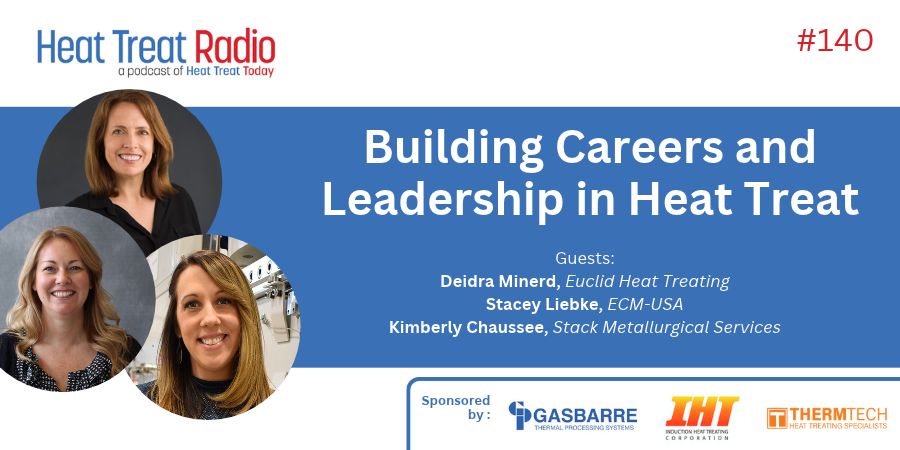
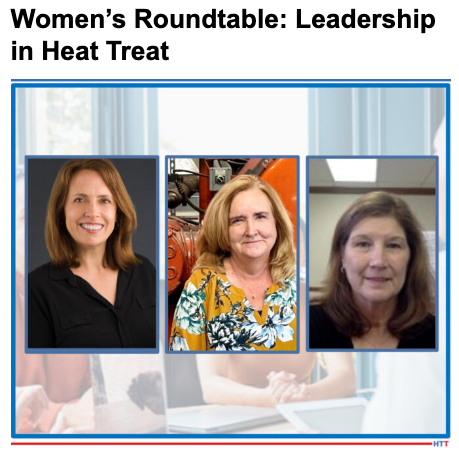
What does it take to build a successful career in the heat treating industry, and how can companies create more opportunities for the next generation of professionals? In this special episode of Heat Treat Radio, host Heather Falcone leads a panel discussion at the inaugural Women in Heat Treat event, joined by Kimberly Chaussee of Stack Metallurgical Services, Stacey Liebke of ECM-USA, and Deidra Minerd of Euclid Heat Treating. The conversation explores leadership development, mentorship, workforce recruitment, and the importance of creating opportunities for women across all areas of heat treating.
Below, you can watch the video, listen to the podcast by clicking on the audio play button, or read an edited transcript.






The following transcript has been edited for your reading enjoyment.
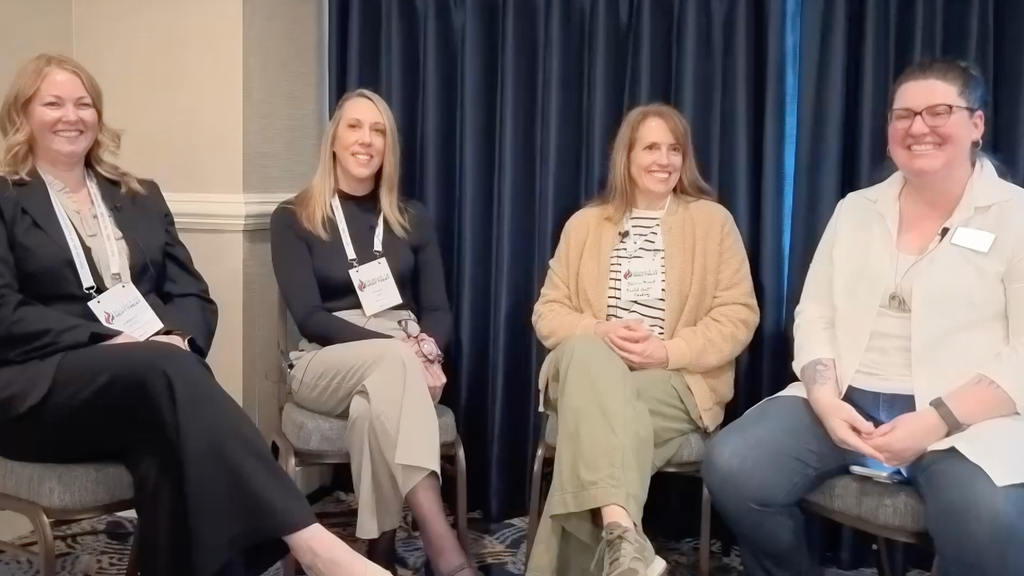
Heather Falcone: Welcome to a special episode live, in studio audience, for Heat Treat Radio. We’ve trained them well, you see? There’s a whole group of 40-plus women and men out there who are here attending our first annual Women in Heat Treat event, and we’ve got a very special panel that we’re going to be talking to about a wide variety of topics, and basically what it takes to work in one of the hardest industries in the world.
I’m Heather Falcone, I’m your host and the producer of Heat Treat Radio, and I’m going to let these ladies take a minute and introduce themselves so that you know just how amazing they are. I consider them all dear friends. I’m so excited that we’re filming this live. We’re going to have questions and answers.
These ladies have got some tough questions coming from me, and in the end, you’re going to be able to watch this and understand just how amazing they all are. So, Kim, we’re going to start with you first. What is it? ASL. No, that’s— We’re old. AOL. Give me the name, give me where you’ve worked, what brought you into the industry. Just give me the elevator pitch. Start us off.
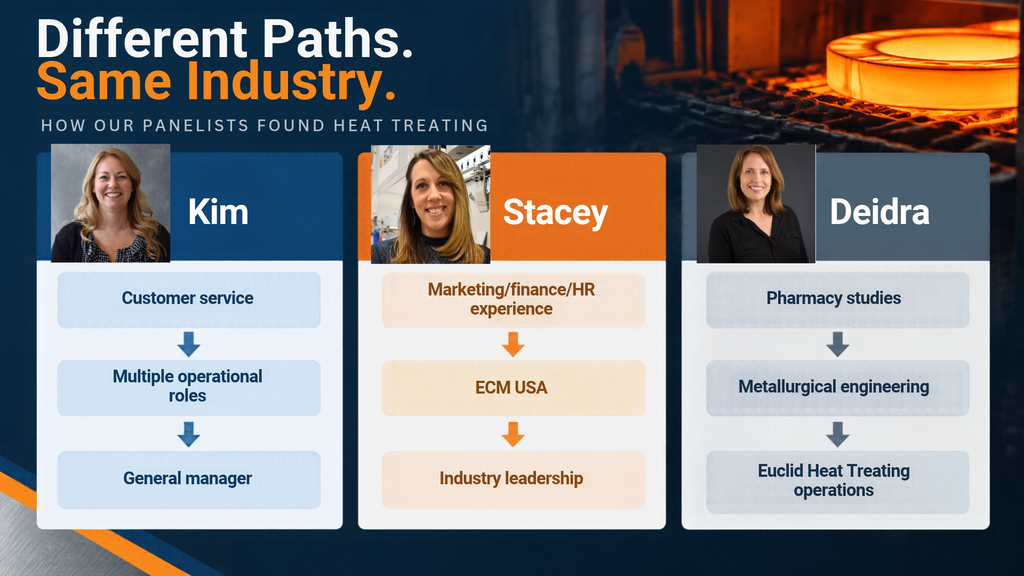
Kim Chaussee: Okay. Well, who am I? First and foremost, I am the mother of three amazing children. I am a part-time Brazilian jujitsu coach, and I am the general manager of Stack Metallurgical Services, located in Portland, Oregon. So between raising three kids, teaching people how to choke each other out, and running a heat treat shop, you can say I’m good at managing chaos.
I started in this industry about 14 years ago. At that time, I had just become a single mom, and I had 15 years of experience helping to run a martial arts studio. I needed to make a change in my career to provide a stable schedule for my kids, and a friend of mine introduced me to Stack. Stack was a heat treat facility.
I had no clue what I was getting into. I had no clue what metallurgy even was. But when you help run a small business, you do a lot of things, from teaching classes on the floor to HR, payroll, accounting, sales, advertising. You run the gamut of everything. And so they had a customer service position, and I took that on.
I had done some customer service, and over the next 10 years, I spent my time taking on new roles and new positions at Stack. If you ever come and visit our facility and stop by my office, I have four computer screens, and I like to say that with every new position I got, they gave me a new screen so that I could take on more duties.
I think I knew I had finally found my calling when we hired a new metallurgist and I was explaining to him how he needed to run his heat treat process in our furnaces. At that point, I knew I wasn’t turning back. About 2021, 10 years in, our CEO came into my office, and the general manager position had opened up.
He leaned on the desk, I’ll never forget it, and he said, “Kim, what do you think about taking this general manager role?” And I laughed and looked at him with a blank stare, because this isn’t something I had in mind. In my mind, they would bring in another metallurgist who would take over that role.
But that’s not what they needed, and he finally just looked at me and said, “You’re doing the job, just take the role.” So I did. I’m very thankful for that opportunity. The last four years have been amazing. I now work with an amazing team of 86 employees, and we’ve done some really neat things in the shop.
We’ve been awarded by our suppliers—Benchmade Knife Company awarded us Supplier of the Year. This last year I received Woman of the Year from the Pacific Northwest Aerospace Alliance. And most recently, they’ve asked me to be on the board of trustees with MTI, which is a huge honor, and I’m really excited to serve the industry that’s given so much to me and my family.
I’m really happy to be here with you all today, and my name is Kimberly Chausse.
Heather Falcone: I just now realized that all of the women here are on the board for the Metal Treating Institute. It took me till today years old to figure that out. This was totally unintentional. These are just my party posse, and I was like, “Who’s loud and obnoxious and wouldn’t mind sitting up in front of a bunch of people?” All of us. And it’s all of us. So that’s pretty funny.
Deidra Minerd: It’s a record.
Heather Falcone: It is a record. If you want to know how many women are on the board, there are four. That’s awesome. Stacey, tell us about it.
Stacey Liebke: Sure. Nice to meet everybody. My story is going to follow a lot of Kim’s story, minus the jujitsu, because I haven’t tackled that yet. But I’ve been in the industry for 16 years. I love that you started off with your family, so I’m also a mother. I have two older daughters and three grandchildren, so they’re the light of my life, of course, and why I do everything that I do.
My career has shaped who I am. I work for ECM-USA. We’re a vacuum furnace manufacturer. It’s a French company, so I work for the US subsidiary. Sixteen years ago, I was working in downtown Milwaukee at a marketing firm for a really terrible boss, if you’ve ever had one of those.
A headhunter called me and said, “I have this French company that’s looking for somebody that has your background,” and my background is in everything. I’m in finance, I was in marketing, I was in HR, so I was the jack-of-all-trades in any business. And I said, “Yes, I’m interested.” I went in, and they were coming off of a bankruptcy.
This is when the auto industry went down. That was a huge industry for us. But they were trucking along and building momentum back. They had about five employees at that moment, and I joined the team, and it’s been a great trajectory since then. ECM is also a family-owned company.
The Pelissier family owns ECM Technologies in France, so it’s a great company to work for. They make everybody feel like they’re part of the team. You’re part of something bigger. Worldwide, I think we’re about 700 employees. At ECM-USA, we’re just about 25. And it’s been a real pleasure to be part of the industry.
I think that every single one of the women up here is my mentor, and even all of you out in the audience. It’s been a real pleasure to get to know all of you, and I’m really pleased to be a part of this group.
Heather Falcone: And for those of you that don’t know, this is the president of MTI from 2026. Just in case that was news to you. So adopt that.
Deidra Minerd: Immediate past.
Heather Falcone: Yes. So, yeah. She—
Kim Chaussee: Graduated, or—
Heather Falcone: You’ve been paroled.
Deidra Minerd: Why, thank you. I appreciate that. I have to say that being president of the Metal Treating Institute that year was what I describe as an epic year for me. It was wonderful, and I’m still glad to be immediate past president with these lovely ladies on the board of the Metal Treating Institute.
To get me there, I’ve been in the industry for about 28 years. I started out with no intention whatsoever of going into the family business. My grandfather started the company in 1933 in the garage of a house on 222nd with salt pot heat treating. He started it because he worked for a tool company, and they needed some heat treating done.
So apparently, he had molten salt in the garage of the house. And then my grandmother at one point said, “No more.” And I’m like, “Why would you care about this cyanide that’s boiling in your garage? Come on.” This is fine. What could go wrong? It’s all right. The kids can play. They’ll just keep them away. So they bought a building next to the house, and then continued buying buildings, and Euclid Heat Treating was born.
My father was also voluntold that that was what he was going to do, so my father was in the business. I distinctly remember… I did not go to school for anything related to it at first. I went to the University of Toledo for pharmacy, and then one summer I was sitting in my dad’s office and I said, “Dad, who’s going to run this when you retire?” And he just looked at me and said, “Do you want to do it?” I’m like, “Sure. Why not?” I mean, that’s how happenstance this decision was. So I transferred schools to metallurgical engineering, and I figured if I didn’t like it or wasn’t good at it, I’d just go back to pharmacy at Ohio State.
But it stuck, and I loved it, and the rest was history. The plan was to go back and work at the family business, so I took a couple of jobs before that to get some experience and ended up back there. I’ve taken a lot of roles to get to where I am right now. Someone else mentioned how lucky they are to be at a company that’s supportive of women, and I realize my sister and I were trailblazers a little bit. She started working there in finance, and I was working there, and we both had kids, so guess what? Euclid Heat Treating has to figure out how to have a part-time employee with kids. And then we were both nursing. Guess what? Euclid Heat Treating has to figure out how to have a nursing room.
You just made it work, right? You just figured it out. And in hindsight, I’m glad that we went through those steps so we could offer that for other women. I’ve been working there for 28 years. I’m operations manager now, and I have a great team there. I have two adult children, who could probably be mad at me now that I didn’t start with them, but they’re out in the world making their way, which I feel is the mark of success, hopefully, that they’re successful individuals. And a wonderful, supportive spouse who helps me out every chance I get and listens to all my woes every day when I come home. All the good stories and the bad stories.
And so I’m really excited to be part of this inaugural group and to be up here with you guys. So thanks.
Heather Falcone: Scott was an excellent first husband, by the way. For those of you who don’t know me, my name is Heather Falcone, and I’ve been in the industry for about 23 years. My dad started a business in 1985. I was born in 1982, so it was baptism by fire, osmosis. I’m a heat treater. There was no escaping it. You hear that story over and over. It’s really common. There’s nothing special about it except everything. Working for your family and with your family is either the hardest thing, the worst thing, the best thing, or all three at the same time. We used to call Thanksgiving and Christmas “Clampsgiving” and “Clampsmas” because we used to do these little clamps that were silicone bake-out, and we had to put yellow Dykem dots on them.
And right before every major holiday, we would get about 20,000 of them to process. And rather than go out to our team and say, “Oh, man, you have to work Thanksgiving. That Black Friday, we really need you to come in,” no. We took the clamps home, sat around the table, and dotted clamps for every holiday for the last however many years.
So I’m so excited to be part of this industry, and I got to graduate from owning a company in 2024. And now I’m a little butterfly that goes around and just talks to other heat treaters and helps out. Part of that is being blessed by Doug Glenn, our founder and publisher, to take over the podcast, which is over 100 episodes. This is episode 140. Kind of crazy, right?
So I’m going to throw the gauntlet, because these ladies can handle tough questions. The first one I want to ask, because I know there are unique stories for each one of you, is: what career choice made the biggest trajectory change or impact for you? And this isn’t, like, a one, two, three. Whoever responds to this, go for it.
Stacey Liebke: I can go first. I think right after college, I went to school for microcomputers. I was thinking, “I’m going to be in the technology business.” That was the big boom when I went to college. And one of my professors was a sailor, and after I graduated, he asked—he was going to be planning an event for our city. It was a tall ship event where they bring all of the tall ships in, which had nothing to do with my degree or what I was going to do for a living. But I was like, “It’s one summer. Why not? Let’s just do something out of my comfort zone.” And I did. I planned this event, and what that did was give me an opportunity.
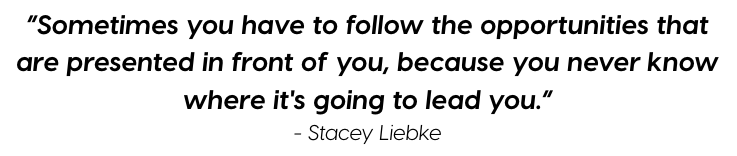
Somebody I met through the city hired me, and then I got into finance, and I got into marketing, and it gave me all of these opportunities that I probably wouldn’t have had if I had just gone into technology. It probably wouldn’t have led me to where I’m at today if not for taking on this tall ship event. That was so random. I did that for so many years, and I think that really was a big learning lesson for me. I tell my girls that all the time, and even my staff: sometimes you have to follow the opportunities that are presented in front of you, because you never know where it’s going to lead you. You never know who you’re going to meet, and I think that’s such an important part of your career and where you’re going to go.
Heather Falcone: What’s interesting, and I’m going to make you answer this now, is that whenever I see Deidra at any major event, she usually has three to five students trailing behind her. She’s introducing them to people, she’s showing them booths. She opened up her shop, and she’s changing these students’ lives. So what changed yours?
Deidra Minerd: That’s a good question. There was one particular mentor of mine, Roger Fabian, who was a giant in the heat treat industry. He was the one who pointed out to my dad that I would be the one to run the company, because I still had kids at home, and it was not even… I was doing quoting and pricing, and that was kind of it. He just opened my eyes to that. I don’t know that I’m in a position to say that to another kid, maybe in our company for sure, but I try, for our own purposes, to get younger people into the industry too and mentor them.
But then I see, probably more as a mom, how beneficial it is to have a younger person ask a question, introduce themselves, shake a hand, make a phone call. So I’ve basically forced my kids’ friends to come to trade shows with me and introduce themselves and have a conversation, just because for that same reason, you never know who needs somebody, and who’s going to ask for somebody, and who was impressed with your poise or your presence or something like that. I honestly wish more people had done that for me. I remember going to a trade show when I was in college. The ASM student chapter sent us to probably the ASM national meeting in Orlando that year, and talk about a fish out of water. The five of us showed up with no concept of what an industry association was, no concept of really what ASM was, and we walked in, and man, would it have made such a huge difference to have an adult come up to me. I mean, legally we were adults, but we still had no clue. To have an adult come up to me and say, “Let me show you around. Let me introduce you to people.”
So I think because that didn’t happen for me, I look for the opportunities to make it happen for younger people, and selfishly I want them to come and work at Euclid Heat Treating. But if they decide Cleveland’s not for them, they could find a job in an ancillary or supportive industry. Who knows? So that’s why I do it.
Heather Falcone: For sure. It brings up a topic that we have all had to confront during our long and tenured careers. Sometimes things don’t go right. As Annia (Amosa, Quality and Continuous Improvement Manager at Ipsen USA) brought up in the previous session, the most time quality people spend their life living in the wrong. There’s not a lot of good or right for quality folks. So what did you have to learn the hard way, Kim?
Kim Chaussee: I think the biggest thing for me was learning that I can’t do it all. I’m one who likes to take on new projects and new things, learn it all and do it all. But at some point, you just can’t. And so learning to delegate, learning to bring up those around you, has been a process for me that I’m still working on to this day. But it has actually brought me a lot of joy, because as I’m forcing myself to pass things off and bring the people around me into new positions and promote them, it’s been really wonderful to see them take off in those positions and support them the way that somebody had also supported me. So, yeah. Who else has a school of hard knocks?
Stacey Liebke: Well, if I’m being completely honest, I’m a very type A personality, and for me it’s control. Giving up the control. Very similar, I hold on to the job. I can do it best. It’s just easier if I do it, versus putting the time into training somebody else and passing on the tribal knowledge and trusting that your staff, your employees, are going to take it on and maybe even do it better, you know?
Heather Falcone: Heaven forbid.
Stacey Liebke: And sometimes they do. That’s not okay. I have lots of staff who will take my idea and make it so much better than I would have ever done. Letting go of the control and trusting that process is something I had to learn how to do, for sure.
Heather Falcone: It’s hard. Once you aren’t the one that does everything, you move from that individual contributor role into that leader role, and you have to accomplish things through others. That’s one of the hardest things I had to learn. How did you guys handle that? When you first were like, “Dang, I’m in charge of people now. They can make me look good or bad. How’s this going to go?”
I’ll tell you, the first time I sat in a meeting where I wasn’t in charge, the person thought I was the secretary. I was there to negotiate a contract. It was about $3 million, no big deal. We were in the final phases. It had taken 18 months. There were 12 people in the room. I brought in the team, and I had recently become CEO, so I was really trying to practice not controlling everything. So I sat there physically on my hands. Physically. And every time the group would direct a question to me, I would have to turn to someone else and say, “John, what’s your answer on this?”
So I finally got so stressed out I got up and started getting coffee for everybody. I couldn’t sit still. The nervous energy of not being able to accomplish something myself was so distracting. And then as everybody was leaving, one of the gentlemen commented to my then quality director, “Was that the secretary? Was that the office assistant?” And he said, “That was the CEO.” But it’s tough turning it off, right?
What’s kept us in this industry this long? We have so many stories that we’ve heard so far, and not all of them are pleasant. Some of them have been stressful. We know the pain that comes from long hours, weekend work, trying to make sure payroll comes in the door, trying to make sure the electricity doesn’t go out, our salt pot doesn’t freeze, somebody doesn’t get hurt. What keeps you excited about continuing to build a heat treat career?
Deidra Minerd: I think it… I’m looking for the future. I think about my job, and it’s kind of a trite answer, but it’s servant leadership: trying to make it so everybody else can do their job well. What obstacles can I take out of your way? And I think of the people that work for us. We have 67 employees, and when I have to make a decision, I think, that’s 67 mouths to feed, and it’s more than that. That’s heavy. So any decisions that we make, it’s for… You can’t currently heat treat without people. They’re the biggest resource that we have, so anything that we do, I try to think through the lens of our employees. Our HR manager and our team want to be an employer of choice. We provide jobs that are not just a job but a career, that people can grow as much as they want, work hard, and go home safely to their families.

That’s where I see my role right now: how do I keep Euclid Heat Treating going and maintain that level of longevity and continuity and just make it a better and better place to work. You have to be in business and be doing successfully as a business, but yes, it’s to heat treat parts, and it’s also to make it a good place to work. That’s the way I see it.
Heather Falcone: Humans. We’re in charge of humans. Really great answer. What else keeps you guys excited?
Stacey Liebke: For me, my staff—we’re a true team. We’re a really strong team. Everybody really respects everybody else, and it makes going to work easier. It makes the painful days get by when you can suffer with everybody around you, but also celebrate the wins. But also, heat treating is a secret society. I’m sure you guys get it all the time. You tell people what you do, and nobody knows this exists. The general consensus is, “You do what?” And I’m like, “It touches everybody’s life.” We’re the silent part of that, but it’s making the world go around, and I think there’s something so grand and exciting about that. It never gets old. It’s just always exciting.
Heather Falcone: Anything to throw in there in the mix?
Kim Chaussee: I’m on the same level. For me, it’s the people that keep me going. I think we were talking earlier today about what energizes you, and it’s the people. We are also a family-owned business. I’m not one of the family, but I feel like I am. And—
Heather Falcone: We have to unpack that in its own episode, by the way. Being the non-family leader of a family-owned business.
Kim Chaussee: Yes. And everybody there is family to me, and so seeing them succeed is what energizes me every day.
Heather Falcone: And you have an awesome, supportive owner, and I know him quite well, and we’ve got relatives in the audience and all of that. The heat treating industry is collectively secret society-ish, but also kind of this weird family. I say it all the time. Every time we go to a trade show or an event, it feels like a family reunion. I’m seeing the same faces. I’m really happy to see everybody. I really appreciate that about it.
I don’t know if I’ve ever told you this story, but at my very first MTI meeting, I showed up with my husband, and we walked into the reception on the opening night, whatever it was. It was a spring meeting, so it was a smaller meeting. And the people were introducing themselves to my husband because they made the assumption that he was the heat treater, not me. So the first people to acknowledge me were Doug and Jackie Peters, and they came up to me and specifically spoke to me first. And they said, “Wait a minute. We know your dad.” And I was like, “Okay, that’s fine. Dad’s the, you know.” But we have this secret society that is so male-dominated, just by, you know, we work with our hands. We work with heat. We work with aerospace, defense. That largely has been male-dominated. So what does our industry need to do to attract the next generation of women? Because we’re all suckers. Family, family. We’re defaulted into it.
Deidra Minerd: When you tell that story, I think of a time, I forget what meeting it was, but I grew up going to MTI meetings. Those were our family vacations when I was a kid. I didn’t know that other people took regular family vacations that didn’t have to do with business. I thought everyone went where Dad knows all these other people. I just thought that was a thing. But to your point, I went, and I’ve always known my dad’s cronies, right? They’re always wonderful and kind to me, and that’s who I would talk to, my dad and his buddies. And I remember leaving one meeting thinking, and I don’t know why it hit me, “I’ve got to make my own friends.” I need to make my own group, and I set out to do that.
I know this doesn’t answer your question about getting other women in, but it hit a nerve when you said that. Everybody was wonderful, but I said, “I need to go find my own people.” So I made it an effort to go find and talk to new people, and that’s really what it comes down to once they’re in the industry: making them, man or woman, feel comfortable. MTI has this plan where the new people have a blue dot on their name tag, so we call them the blue dots. Affectionately. We love the blue dots. We try to go out and welcome them and make them want to come back another time. So once they’re there, we can make them feel welcome, but there might be some other ideas on how to get them in.
Stacey Liebke: I don’t know. I think what you’re doing with your company is a really great idea, and maybe more people can model that for their companies, to have internships and have people come in and see what it is. Even at some of the trade shows, I see that they bring in groups of students, and they walk them through, and they stop at the booths. And sure, they’re getting all of the trinkets that we’re giving away, but they’re also having a conversation and being introduced to something that they didn’t know existed before. So I think we’re doing all of the right things. We just have to do it more often. I think it’s a long game, too.
Deidra Minerd: If you think that one student is going to come right out of school and work for you and work there forever, it might not happen, but you’ve planted a seed with those kids. They might take that glamorous job that looks great on paper that moves them to another part of the country they don’t want to be in, and then some job comes up in heat treating, and they go, “Oh, I know what that is.” You know? Exactly.
Understanding that you don’t have to be born into heat treating to come into heat treating, I think that’s one of the biggest barriers that we have: not knowing anything about it, and oh man, this looks hot and heavy and, like, no fun.
Heather Falcone: So how do we break down those barriers? Who knew about this industry before they started working in it? There are four people, just FYI, on camera. There are four people that just raised their hands. So that means you all accidentally lucked into this. And I mean lucked and accidentally, because nobody chooses this on purpose, typically. I needed a job. I had to pay my bills. It was who was hiring. My friend referred me. Whatever it is, how can we collectively come together to make sure that we make opportunities for women to join in with us? Well, you guys do something.
Kim Chaussee: Yeah, so I think it’s not just one thing across the board. I think we all have our own strengths and ways that we can get the word out there and get people into our shop. For us, we use a lot of temp help, and my high schooler, if you know me, then you know they play sports, football and wrestling. You’ve probably heard all about it from me. We found that these kids were struggling to find summer jobs or work because of their sports schedule and school schedule, so we started offering them the jobs that the temps were doing. I’d much rather help them out than bring in a temp who’s going to show up and probably not make it through their shift.
It gives them an opportunity to come in and get a taste of what having a job is like. We know they’re going to have a different schedule because of their sports and their school. So just like we would pick up the phone and say, “Hey, temp agency, we need five people tomorrow,” they call us and say, “Hey, we can work tomorrow,” and we order fewer people from the temp agency. We’ve had some kids come in and end up staying. We’ve had some who realize that this is not what they want to do and go on to do other things. But I’ve gotten a lot of good feedback. They’ve come back and said, “If it wasn’t for this, I wouldn’t have learned A, B, or C.” So I think we can each offer different things. We’re able to reach out in that way. Deidra’s got her interns. So there are lots of ways to get the word out there.
Heather Falcone: For sure. Last question before I open it up, because we have, like, 30 other people that want to ask these ladies questions. What is a piece of advice that’s given to women in this industry that is just flat out wrong? Wish you had never heard it, it is just not true.
Stacey Liebke: I think one of the things that we’re told is, if you work hard, nose to the grindstone, someone will eventually notice. And I don’t think that’s always the case. I think that if you’re not surrounded by people that are going to give you opportunities, it says a lot about that company, and you’re probably in the wrong spot.
Deidra Minerd: That’s a good point. Very good.
Heather Falcone: What else is wrong?
Kim Chaussee: So I think we talk about it being a very male-dominated industry, but that doesn’t mean that it’s negative toward females working in the industry. We need to get away from that misconception. Most of the people who supported me in my career were male. They’re the ones that allotted me the opportunities and gave me the support. So I think we need to break through that misconception. While there might be fewer females on the shop floor, that doesn’t mean that we’re any less.
Deidra Minerd: It’s just a little lagging behind some other industries, but it’s not because they don’t belong there.
Heather Falcone: In 28 years, what’s the worst advice you’ve gotten?
Deidra Minerd: Ooh. The worst advice I’ve gotten. I don’t know. I’ll have to think about that one. Maybe it’s a lesson I figured out myself the hard way, and it’s more from a management standpoint, and this applies to a lot. I’ve had to remind myself almost daily that there’s another side to every story. No matter what, if you hear one side of something, whether it’s an event, an opinion, something about a person, that is the one thing that sticks with me: I have to go see, hear the other side. That has helped me a lot, and all the times that I’ve gotten bitten, it’s because I believed the first thing and didn’t go investigate myself. I didn’t go ask the question. So from a management standpoint, and even from a customer email or something like that, if you hear one version of it, you have to investigate.
Heather Falcone: Match it up.
Deidra Minerd: That’s one of the things I’ve learned the hard way.
Heather Falcone: I mean, that’s just from being a mom, too. Never trust the kid that’s telling.
Deidra Minerd: Yes. Very true.
Heather Falcone: Maybe that’s where I learned it. Running a heat treat is remarkably similar to parenting. It really is. The parallels are just there. One of the funnier stories: I lucked into the position that I had before CEO, and I’m saying “lucked” because I have so much trauma repressed that I have to continually affirm myself that it was luck. In 2012, I was getting ready to take on leadership at our company, and my dad wanted to basically retire and go off and putz around in his motor home. So there were, at that point, three different leadership positions at the company: sales, engineering, and quality, and I ran HR. I had never run the shop floor. I mean, I’d worked during the summers, right? I’ve done induction. I’ve done all the dirty jobs that nobody wants to do. I filed manual timecards that went into a machine that went choo-choo. I did faxes. I did carbon copy paper. Yes, that old.
But then I met with the then-president of our company, and he said, “I’m going to put you in charge of quality.” And I was like, “Sir, I don’t know anything about quality, never have. Never read a work order. Never been on the shop floor. Nobody’s going to take me seriously. I know nothing about quality.” And he said, “Yeah, it’s easy. No, you’re fine.” “You’re fine.” What he neglected to tell me was we had a Nadcap audit in 42 days. So January 1st, I became the director of quality, and 42 days after that, I had my first Nadcap audit. That was the worst advice I ever got. “Oh, it’s easy. No problem. You can be director of quality.” So that one hurt.
Deidra Minerd: I bet.
Heather Falcone: What I think is kind of interesting, though, is, let’s do a quick show of hands. How many ladies today, or gentlemen, work in quality here? All right, how many of you are operations? Okay, what do the rest of you do? So we have, like, three people in quality and two people in ops.
Audience: Shipping and receiving.
Heather Falcone: That’s operations, babe. What else?
Audience: Sales.
Heather Falcone: Oh, how many sales do we have? Okay, there are some sales. Sales is, like, two-thirds. All right, got it. So the—
Audience: Finance.
Heather Falcone: I’m sorry? Finance. Finance, yes. We’ve got our finance pros. All of us get stuck with finance, so it’s extra fun. But I think it’s so interesting because in a heat treater, the most common place you’re going to find a woman most likely is finance, sales, HR, admin, quality, but they’re not technicians, pyrometry, operations leaders, right? How do you guys feel about that?
Take it over. Take it over, Annia says. We’re going to take it over, yes. Who’s got a question out there for our lovely panel? Shout it out. Yes.
Audience: How is getting involved with—
Heather Falcone: How has getting involved in MTI impacted your careers?
Kim Chaussee: So I’m going to say for me it’s been a really amazing experience. I was nervous about showing up to my first MTI meeting. I actually had somebody tell me, “They’re not going to accept you,” and quite a few things like that. But I was lucky enough to show up, and they accepted me with open arms. Steven Christopher (of SSI), who had been on our site, took me around and introduced me to everybody, and it’s been a wonderful, wonderful experience to be able to talk with other heat treat owners, people running the heat treat shops, and share ideas and get some insight into what’s going on across the country.
I started off with Stack, and I’ve been there 14 years, so what I know is Stack. Seeing what’s going on in other places opens my eyes to different things. So it’s been a wonderful experience for me.
Heather Falcone: What about you? You’re a lifer.
Deidra Minerd: I am. Wait, there was a time before MTI once?
Stacey Liebke: For me, I think it was my second year with the company, and our general manager, Dennis Beauchesne, said, “I hear about this Metal Treating Institute. We should look into it.” So we looked into it. We became a sponsor, and we never looked back. Everything has been so impactful for our company. The relationships that we’ve built with all of the other suppliers, the customers, everybody, it’s really a sharing of knowledge, which can’t be replaced, and there’s a camaraderie and real friendship that just happens amongst everybody. And the leadership of Tom (Morrison, CEO of Metal Treating Institute) and his team, and Amanda, I mean, he’s so charismatic and welcoming, and the show has been so great to us.
We’ve been exhibiting there for the past 14 years, and it’s really great support, and like I said, it’s a real pleasure to sit on the board with you guys. It’s filled with men that are supportive, and I never feel like my voice isn’t heard in a room full of MTI members.
Deidra Minerd: Yeah. Very true.
Heather Falcone: Although, I’ll tell you a story. Ryan Fussell was president when I really started getting involved in things, and I somehow got the impression that Ryan Fussell was a cool kid, and he was this unapproachable guy who had a whole coffee klatch of dudes that would just hang out. And I manifested this whole ostracized thing where I was off on my own and these cool kids were over here, and then Ryan comes up and says, “Hello.” And I don’t do a good Ryan Fussell, but there’s a twang. There’s a Texas drawl. “Hello.” You know, like it’s real… And he just slid right up to me and said, “Now, who are you?” And off to the races we were, and I had to tell him this story years later. I was like, “Ryan, I was so afraid of you. You were so cool, and I was so not cool.” And we somehow create these perceptions for ourselves, and that’s so weird. Why do we do that to ourselves?
Stacey Liebke: Because we think that things are going to be intimidating, but they’re really not. Everyone’s just a person. Everyone has the same issues, and they’re going through the same things. And everyone is so friendly. Honestly, everybody. It’s a very welcoming crew.
Deidra Minerd: And I sat next to some big names at my first MTI meeting, and I was overwhelmed and didn’t even want to open my mouth. It was one of those times where you learn in life to just ask the question. There are no dumb questions. Once you say the question out loud, you see the other heads nod around the table because nobody wanted to ask the question. We had Bob Ferry, who would go on about specs, and I thought, “You’re like the god of specifications. How do you know all these things?” I learned the most I’ve ever learned about heat treat specs from him at the MTI board meetings. But they are wonderful. Mike Mouilleseaux was sitting next to me, and he, again, is just a wealth of knowledge. But to your point, they’re so welcoming, and they want to share with you. You can take them aside and say, “Hey, I know this is a dumb question, but…” And you ask the question, and those are just the best kind of people. I’ve learned so much, from managing a company to the technical side, from some of these people, men and women, that are on the board in MTI. It’s a good group. It’s a smart group.
Heather Falcone: Absolutely.
Deidra Minerd: Present company included.
Heather Falcone: Great question. Yes?
Audience: Feels awesome.
Heather Falcone: So, Barbie’s (Salerno) question, aside from saying very nice things about me that are blatantly untrue. I used to have a blue hair Mohawk, and that’s how most people knew me. So the blue’s making a comeback, slowly but surely. The lowest point for me was finding out people are afraid of me, and I’m looking right back there at Mr. Andrew Bassett. It took him years to come up to me, and he finally did, and we talked for hours. He just turned out to be an incredible dude. And he looked at me and said, “I was so afraid of you. You are so scary.” Like, you are too smart. You’re going to eat me. You just open your mouth and just wah. That was really hard because I felt like I had to adapt more of a dragon lady presence because I was trying to match male-dominated energy. As leaders, men lead differently than women. So I thought copy man equals success. Turns out that just kind of gives you cancer.
True story. Got cancer. Changed my entire outlook. In 2018, I got colorectal cancer at age 36, stage 2B adenocarcinoma. I sat in a hospital bed getting chemo and said, “This is not my life. I am not a dragon lady. I am not a mean person. I am not the one that scares people.” And that took a lot.
Deidra Minerd: Aw. You are not a dragon lady.
Heather Falcone: I am not a dragon lady. I’m going to get a little tag that says that I’m not a dragon lady. And people automatically assume that because I’m now a big persona, I was always this way. I was not. I was a small, scared woman who didn’t know anything about anything, and I felt continually reinforced that I was small, and a lot of that was my own doing. So once death was right here, I was like, “Okay, we’re done. Moving on. Let’s do something different.” So the coming back was really a discovery and unpacking. And talking about Katie’s presentation, God, I’m crying on Heat Treat Radio. It’s powerful.
Coming back from that and getting to decide what my future was going to be created a whole different possibility, a world that people didn’t know me in, and I just changed who I hung out with entirely. I started showing up to MTI, and that’s when that person was born. And I’ll tell Barbie’s story that she won’t tell. The first time I met Barbie was with Tony when he showed up to his first board meeting, and we go around and introduce all the spouses and the new board members. And Barbie introduced herself as, “I’m the wife of the guy that does the stuff.” And I was like, “We need T-shirts.” Because the women behind the man at a heat treater are the ones doing the stuff alongside, and it’s so important. And we look at the past MTI presidents that were women, and I’m pretty sure a lot of them were spouses. I mean, Judy Rudy’s, she’s just a force of nature all on her own. But Doug and Jackie were both presidents. Who else? I can’t— Mary Springer. I mean, there are just some dominant powerhouse women, but we forget that attached to a lot of these men are also amazing women.
So that, I guess, is the comeback story, or the story from that low. Very long-winded, but there’s a lot of history there, and I think a lot of people have a similar story where you just got fed up, you got tired of being who you were and it stopped working for you, so you change, right? And I got to be friends with all my friends up here. Great question. Thank you. Any other questions? What’s next? Yes, either one.
Audience: Male saturated.
Heather Falcone: Ooh. Male saturated.
Audience: Implies, like, dominance, whereas saturated just means there’s more of them.
Heather Falcone: Right. Okay.
Audience: That was just… It’s been a topic—

Heather Falcone: I love that. I like that. So changing the terminology up to “male saturated.” That means there’s too many, and as Annia said, we’re taking over. No. We are blessed with a bunch of allies, and to even have an event like this where we’re all together in one room, that’s super cool. Go ahead. So for people that are looking for mentors, how do they find one?
Stacey Liebke: Well, I think even this event is a great place to find a mentor. Find somebody that you connect with, share information, and let that person be your mentor. I’m sure every woman in this room would be happy and proud to be able to connect with anybody else here and be that pillar of support for you.
Deidra Minerd: I think a lot of people that you might ask, and I would just speak for myself, you might gain mentorship from somebody, but they might not walk around feeling like they’re a mentor. You know what I mean? I don’t think there are a lot of people who would… maybe the fellows of ASM might, or a retired CEO might say, “Yeah, I’d absolutely be a mentor.” But if you recognize something in somebody that you like or admire, maybe just telling them, “I feel like I could learn something from you,” might be a spark that they never even considered, that they have something to offer. Because we all just go about our day doing our job and don’t realize what we’re learning and the impact that we’re making. So if you connect with somebody online or what have you, tell them that, and they might be just as surprised as you are that you want to learn something from them.
I got lucky, actually. When you do the YES program at MTI, one of the things they say is to go find a mentor. Roger Fabian was one of mine, and I was on the phone with him and he just said, “I heard you need a mentor for YES. I’ll be your mentor. Tell Tom that I’m your mentor,” and hung up the phone. I’m like, “That was fantastic.” I didn’t have to ask a single thing. But that’s few and far between. So I think if you recognize that in somebody, it’s a compliment to them if you ask them to be your mentor.
Heather Falcone: I think, adding to that, you’re going to hear this afternoon in the session with Sarah and Andrew, there are other places to be involved besides MTI. You’ve got Nadcap, that’s for aerospace and defense contractors. You’ve got AMEC, which writes specifications. You’ve got ASTM, which also writes specifications. You’ve got AWS, which writes specifications. So you can find mentorship by showing up to these industry events, and I refuse to steal all their thunder, but that’s a session that I would go to if you’re looking to get more involved in the technical side of the industry. And then there are so many other places you can show up. Trade shows are a great place to find mentorship because, typically, companies are sending some of their most knowledgeable people to either be in that booth or walk the floor.
Kim Chaussee: And I’ll add to that. There are local associations. For us in the Pacific Northwest, we’re in this corridor of aerospace and space work, and so we have associations like PNAA, which is the Pacific Northwest Aerospace Alliance, and PNDC, which is the Pacific Northwest Defense Coalition. By joining some of those groups, you’re going to meet a lot of people. They might not be heat treaters, but they’re in the industry of making aerospace parts or parts for defense and things of that nature. There are a lot of contacts to be made there, and really great people that can offer mentorship.
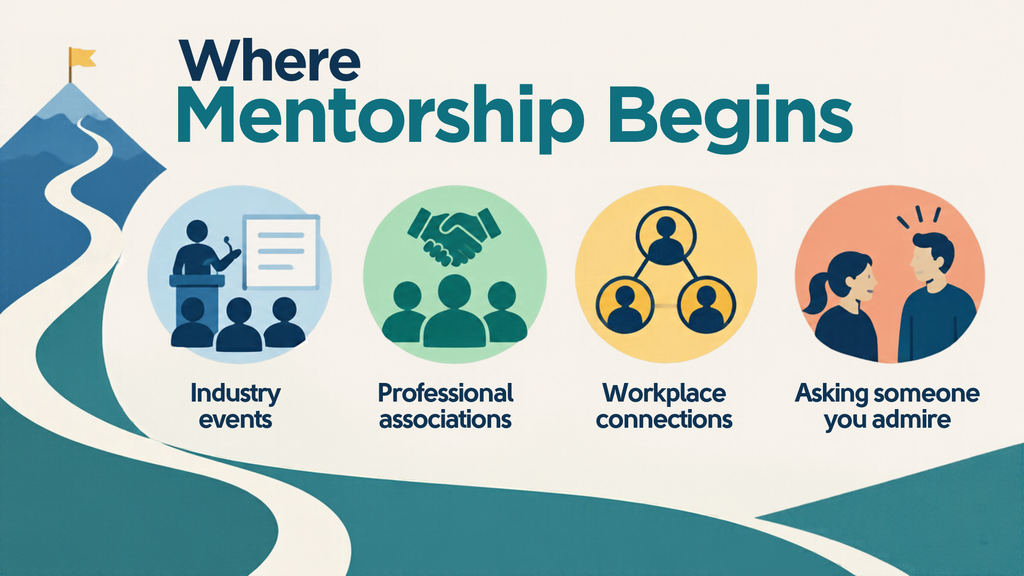
Heather Falcone: Good old-fashioned networking is still a thing that we have to do, and it’s a lost and dying art, because it’s very uncomfortable. It’s not a lot of fun to put yourself out there and get rejected or try to make a new friend. But find somebody who looks friendly and sit at their table, and that’s the best start for a mentor. Really good question.
Any others out there? We’re getting toward the end of our time, but I think we need to take at least one or two more.
Audience: This is for—
Heather Falcone: What’s your biggest goal in your company?
Kim Chaussee: For me, it’s to see the company succeeding. When I took over this position, things were, I will say, very tight at that point in time. So being able to spend the last four years, going on five years, seeing the company expand and succeed, that’s my end goal. And seeing the employees there being able to benefit from that is probably what gives me the most energy.
Stacey Liebke: Yeah, I think the same for me. I’m a business manager, finance, so of course the growth and success of the company is my biggest goal. When you go through the MTI YES training, you set goals, and I set them very high, and I’ve achieved all of them, except for one.
Heather Falcone: Of course you did.
Stacey Liebke: Yes. Except for one. I work for a French company, and I said, “Oh, I’m going to learn French,” and that’s probably going to be the easiest one. I can order a glass of wine, and that’s probably about it. So really, I’ll set that as my main goal now, because that’s the one thing that I still have to do.
Deidra Minerd: I mentioned before, I think mine is to have a company that runs… I have it all listed, actually, on a big whiteboard in my office. I want a company that’s successful in that it has longevity, but also that everybody has a role where they are or can reach their highest potential, make a comfortable living, and that we have backup for every role so that if somebody wants to move up, there’s somebody to take their place and move up. And selfishly, that if someone goes on vacation, I don’t have to fill in for that role. Again, that’s a selfish thing. I call it one- and two-deep leadership, that there’s a backup for every role. People can fill in and take a vacation without feeling like all your work is waiting for you when you get back. And if I can set it all up like that and take a vacation now and then, all is well.
Heather Falcone: A vacation that’s not MTI.
Deidra Minerd: Yeah. There are those things?
Heather Falcone: Is that on the whiteboard? I think it should be.
Deidra Minerd: It is. It says trip. Well, it does say MTI travel. So we’ll have to change that part.
Heather Falcone: Awesome. Great question. I saw another hand. Yes?
Audience: How do you see a woman’s role in this industry in the next five to 10 years?
Kim Chaussee: So I’ll say, I attend a lot of different associations locally, and the word that keeps getting sent down is that there are not going to be enough men to fill all the roles that are going to need to be filled. So the women are going to have to fill them. I don’t think we need to have a specific role. I think that we can do anything we want. I have women in our shipping department. I have one running our quality lab. There doesn’t need to be a woman’s role, necessarily, in my mind. I look at who’s the best person for this job and who my applicants are. Male, female.
Stacey Liebke: Right.
Kim Chaussee: It doesn’t matter.
Stacey Liebke: Very well said. We need further saturation of those roles.
Heather Falcone: What do you think about our role in the next five to 10?
Deidra Minerd: So there was a gentleman that worked for us for 40-something years, and he became our resident curmudgeon, I affectionately called him. I remember having people come in and interview for the roles, and this was a particular role where the person fixturing the rods had to move them and everything. Well, we have a weight limit. We’re not asking someone to move 80 pounds or anything. We only need someone who’s qualified to do up to, say, 40 or what have you. And bless him, a woman applied or something, and he said something to the effect of, “Well, that role’s too tough. We can’t have a woman do it.”
And I just remember in my head going, “I could do it with heels on.” There is nothing there that a woman can’t do, and no, she’s not wearing heels. But I just remember thinking that there is no role that a woman can’t do. Now, is it hard to find a woman who wants to crawl in a quench tank and clean it out? Yes, but it’s hard to find a person who wants to crawl in a quench tank and clean it out. So there’s really nothing that can’t be done. It’s about being welcoming and making it so that… We had a woman welder, same kind of thing. In all walks of life, we’re just not there yet, but we will be, because there’s nothing, male or female, that can’t be done in a heat treat. You just have to get them in there, you know?

Heather Falcone: I think we do have an opportunity. If there is a responsibility for us in the room, we have to be an advocate. We have to invite somebody to play who might not want to play. I talk to Starbucks baristas all the time. I try to take them and put them in heat treaters all the time. I feel like a Starbucks barista is the most qualified person to go into heat treating of anybody. McDonald’s, any fast food or service industry people, they have dealt with a whole bunch of mean people on their worst day, because their coffee is not to their liking and their food isn’t hot enough. So we are responsible for advocating to bring others with us, pulling, because we weren’t necessarily handed what we got here. None of us were handed anything. But it’s now our responsibility to reach back, grab someone else’s hand, and pull them with us so that we can keep providing opportunities for someone to even think that they could be that.
I think our role is that we have to make sure that we create a space for the possibility of a woman to think that she could be a furnace operator, pyrometry technician, induction operator, maintenance technician, whatever it is. And to someone’s point, and I think it was yours, evaluate the candidates on their merit. There are stigmas, and in the hiring process, I highly encourage blind hiring. Don’t look at the names. Take the names off of your resumes before you give them to the guys to read and let them tell you who they want to see without knowing if that’s a man or a woman, because that takes out that bias. And now we’re hiring based on merit. I think that’s a really big responsibility for us, to keep dispelling and breaking down those myths of, “Oh, I don’t think a woman could lift a furnace basket.” Well, all of these women could lift a furnace basket, let me tell you.
So I think that’s probably the one piece we would all agree on: we have to make the space and make sure that we keep crushing those old things that still stick in our minds now and then.
Deidra Minerd: Very true.
Heather Falcone: All right, one more. Yes, ma’am.
Audience: How do you know when it’s time to take on a new challenge?
Heather Falcone: How do you know when it’s time to take on a challenge or make a change in your career? Oh, that’s a hard one.
Stacey Liebke: That is a hard one. I feel like you know when you’re ready. And for women, I think my number one thing would be to ask for it. Ask for the opportunity. If you’re ready for growth and you’re ready to take on more, speak to your management and let them know that you’re open to taking on more responsibility. Or you also know when you are burnt out and you’ve taken on too much, so set the boundary. But if you feel like you’re ready for it, then all the time is a good time to ask for that.
Heather Falcone: All the time is a good time.
Kim Chaussee: And I’ll add to that. I think as women, we always want to check all the boxes before we ask for that next step. There’s a different mindset with males, where they’re like, “I’ve got this. I’m going to take this on.” And you don’t have to check all the boxes. It’s okay to check most of them and ask for that next step.

Heather Falcone: I think there’s a LinkedIn study on that, actually.
Kim Chaussee: You probably read the same one that I did.
Heather Falcone: Probably. So in any job posting, the average man will apply to a job if they have three or less of the characteristics they need. They’re like, “Yeah, heck yeah, that’s me.” Women will not hit apply until they have eight or more.
Kim Chaussee: And I’m like that case study. I was running the business, but I didn’t go to school for metallurgy. In my mind, I had to have that metallurgical degree before I was able to take on that next step, so I’m thinking the next thing I’m going to do is go back to school, right? I was lucky enough to have somebody who noticed the situation and promoted me along. But had he not done that, I wouldn’t be where I am today. I’d still be doing the same thing and somebody would be my boss, you know? Not that that would be a terrible thing, but I would have missed out on a lot of really cool things the last four years. Try to take that next step.
Heather Falcone: I think your question is speaking a little bit to work-life balance.
Kim Chaussee: Yeah.
Heather Falcone: And that doesn’t exist. I don’t know if you knew that or not. Sorry. But in case that’s new, everyone tries to convince women that we should have it all: work, life, family, spouse, keep a beautiful home, be the room mom, be on the PTA, take snacks to soccer. I totally always forgot the snacks. My husband always had to bring them. But that’s not real. Life has chapters. So talk to us about that.
Deidra Minerd: Yes. When I started, I was completely oblivious to the goings-on of everything. All I was doing was pricing, quoting and pricing, quoting and pricing, and I had babies at home, and I brought babies to work, and I wasn’t paying attention. Or not paying attention, but I cared only about this job. But that chapter changes, and somebody noticed that I should do some more. And as family business goes, as soon as there’s some other job that needs to get done, you just start doing that job. There’s no pronouncement or anything. You’re like, “Oh, I guess Deidra’s in charge of that now.” That’s just kind of how it works. But definitely chapters. And when you’re with one company, it’s maybe a little bit hard to decipher when one ended and one began. Being in a family business is a little bit less applying for the next role versus just being granted the next role. So it’s a little bit different there.
But now that I have an empty nest, I spend way too much time at work. But I also get joy from that. And I don’t feel guilty about it because there’s nobody at home waiting for dinner.
Heather Falcone: And I think that misconception of a balance where all things have to be equal is one of the most damaging things.
Stacey Liebke: Yes. Well, I think that it changes. Sometimes you’re at 50/50, and then sometimes you’re 70/30. And also, I think in that same conversation, it’s important to have a supportive partner. When you want to go for your goals and you need to take more time to maybe get there, the other person picks up the slack to make sure that you can achieve that. And if you can’t achieve it at the moment, then you have to pick and choose. It can still happen. It just maybe has to be later.
Heather Falcone: And for those of us who are deciding not to have partners, there are plenty of other choices that now enable us to do a lot. The United States doesn’t do a super great job of helping women stay in the workforce, and it does create a very large wage gap. Everybody’s aware of this. It’s a truth. It’s a thing that’s been published for decades, as long as the study’s been out. But I think when you’re saying, “When do I know I’m ready,” it’s whenever you allow yourself to change. Because no matter what, it’s going to be hard, and it’s not going to go how you thought it was going to go. And it’s probably, honestly, going to be not very much fun for some period of time until, like Katie was talking about, you go from that beginner status, which is the scariest part, jumping off the cliff into beginner status, and then building your way back up. So I think the knowing comes from knowing yourself, as opposed to knowing some magic indicator of readiness. Right?
We’re going to close it out, so I’m going to give all of our ladies a chance. Any other burning questions, by the way? If it’s not burning, we’re moving on. Okay, cool. Each one of you is going to have a chance to give one parting, “Make everybody write this down on their notepad because it’s amazing.” No. I’m putting too much— If there’s one takeaway that you wanted this room to have from the last hour that we spent together, what would it be?
Kim Chaussee: I think this has been the theme of the day: push yourself. I call it doing things outside the box. I think that our speakers had a different verbiage for it, but keep pushing yourself to do things outside the box, and it’s going to take you to some really neat places and, you know, have a lot of fun.
Stacey Liebke: I think for me it’s going to be to take the risk, and it’s never going to feel like the right time. You’re always going to talk yourself out of it, but you can do it, and it’s probably going to be great, and if it’s not, you shift. So just take the risk.

Deidra Minerd: I think two things. Number one, ask questions. Just assume everybody has something to teach you about their job. In this room, you’ll learn something from somebody about their job, so just constantly be learning. Read books, watch podcasts. It doesn’t have to be formal education, but read a book about something that interests you, ask questions of people, and that asking the question just opens the door to the next thing. You never would have said yes to, like, the Tall Ships thing, and it just leads to the next thing. And there’s no dumb question. That’s the other thing. Just say, “I have no idea what your job is. Tell me about it.” People love to talk about themselves, and that’s how we all learn and find commonality. What’s your parting wisdom?
Heather Falcone: I have no wisdom whatsoever.
Deidra Minerd: Yes, you do. You always have wisdom.
Heather Falcone: No, there’s nothing profound. From sitting here for an hour, I just feel blessed. This is a room of 43-plus, I don’t actually know the final number, and every single person that registered showed up. When’s the last time you went to an event where every single person that registered showed up? I don’t even know. So I’m inspired, I’m motivated by being in this room and feeling all the energy, and all these questions, and the networking, and getting to know each other, and next year we’re having tattoos and book club. There’s just so much. Inspiration comes from community, and motivation comes from taking a bath in it as often as you can, because it’s like showering, you don’t just do it once. So we have to reimmerse ourselves in the motivation and inspiration of others as much as we can, and we’re freaking darn lucky. And I am so grateful to all of you for showing up and taking two days out of your time. We all know that we have 1,000 emails unread in our inboxes right now. You have six voicemails, you have 73 texts, and yet you’re here listening to us talk, and I just want to say how grateful I am for that.
So thank you all for being here. Thank you to my lovely panel. Thanks to all my ladies for today, and thank you so much for listening to this episode of Heat Treat Radio, brought to you by Heat Treat Today. If you want to know more, please go onto the website, heattreatoday.com. If you would like to be a guest or a sponsor, or you have an idea for a future episode, please email me at heather@heattreatoday.com.
I’m going to add all the legalese in at post to make sure that we let you know not to reproduce any part of this. We own it. But please go on and give us five stars, all the likes, and subscribe, because that’s how we bring our message to all of you. That’s how you probably found us. Help us find others that are interested in this industry.
Thank you so much, and I’m Heather Falcone. Take care.
About the Guests
General Manager
Stack Metallurgical Group
Kimberly Chaussee has spent 14 years at Stack Metallurgical Group, moving from customer service to production control and then to general manager in 2021. She was recently appointed to the MTI Board of Trustees.
Business Manager
ECM USA
Stacey Liebke has been with vacuum furnace builder ECM-USA since 2010. She runs finance, HR, operations and marketing.
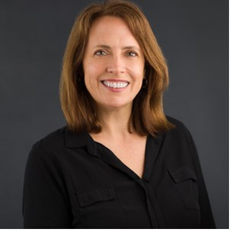
Operations Manager
Euclid Heat Treating
Deidra Minerd grew up in the family business her grandfather started in 1946. She is an Ohio State metallurgical engineer, the operations manager at Euclid Heat Treating, and the 2026 president of the Metal Treating Institute (MTI).