

AUTOMOTIVE HEAT TREAT NEWS

StrikoWestofen Furnace Systems to be Installed in the USA for the First Time

For its new project in Michigan (USA), the Chinese automotive wheel manufacturer CITIC Dicastal has decided on StrikoMelter melting furnaces built by StrikoWestofen Asia (Taicang). The highly global orientation of the Gummersbach subsidiary had a crucial role to play in this decision: the interaction of modern technology from Germany, efficient production in China and reliable on-site service in the USA was a convincing proposition for the leading manufacturer worldwide of aluminium wheels. With this large-scale contract, StrikoWestofen was able to assert itself against the Japanese, Chinese and American competition. It means that StrikoWestofen systems manufactured in China will be taken into operation in the USA for the first time in 2016.

International call for tenders: in its search for modern thermal process technology, the Chinese wheel manufacturer CITIC Dicastal made high technical demands on the bidders. The leading manufacturer worldwide of aluminium wheels was in search of especially energy-efficient melting systems with low metal loss for a new project in Michigan (USA). Here StrikoWestofen Asia (Taicang) was able to assert itself against the Japanese, Chinese and American competition.

Melting and recycling efficiently

CITIC Dicastal Wheel Manufacturing supplies companies from the automotive sector such as Mercedes-Benz, BMW, Audi, Ford and Toyota, making it one of the leading suppliers of cast aluminium components worldwide. Since as early as 2013, the company has based production at its site in Ningbo (Zhèjiāng Province) on the reliable performance of six StrikoMelter melting furnaces built by StrikoWestofen Asia. In the current call for tenders, too, the high-quality systems and the comprehensive range of services offered by the Asian subsidiary of StrikoWestofen (Gummersbach) were a convincing proposition for the Chinese supplier: the three new StrikoMelter which CITIC Dicastal is ordering for the USA provide the option of chip recycling. “The main factors influencing the decision were the efficient use of energy, the minimal metal loss and the extremely low emission values,” explains Rainer Erdmann, Managing Director of StrikoWestofen Asia. The high system availability convinced the wheel manufacturer too. Also, the option of independently recycling aluminium chips additionally provides for maximum metal yield and a highly economical mode of operation.

Global all-round service

However, the international orientation of the StrikoWestofen Group also had a special role to play in the investment decision of CITIC Dicastal. The optimum cooperation between the various locations – StrikoWestofen (Germany), StrikoWestofen Asia (China) and StrikoDynarad (Michigan, USA) – combines the best from three continents: modern technology from Germany, efficient production in China and reliable installation and on-site service in the USA. Thanks to the company’s local presence in Michigan, Dicastal permanently benefits from the extended service and spare parts program in OEM quality offered by StrikoWestofen. Original spare parts and the company’s own technicians are available at short notice at all times. The new StrikoMelter are to be delivered in summer 2016. “Then StrikoWestofen furnace systems manufactured in China will be put to work in the USA for the first time,” Erdmann adds. This intercontinental cooperation of one manufacturer therefore has an especially pioneering role for the entire automotive supply industry.

StrikoWestofen Furnace Systems to be Installed in the USA for the First Time Read More »
Brazing and High Vacuum Heat Treat Furnace Delivered to Southwest USA

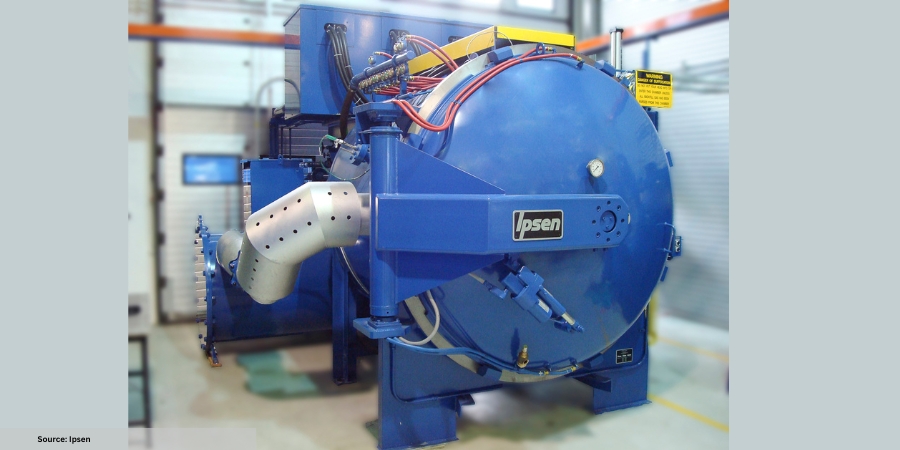
CHERRY VALLEY, IL – Ipsen recently shipped a horizontal-loading MetalMaster® vacuum furnace with 2-bar gas quenching to a company in the Southwest U.S. for use in manufacturing catalytic converter products, which are then used by such industries as Aerospace, Automotive and Power Generation. Ideal for brazing and other high vacuum applications, this vacuum furnace line performs well with thin section parts and lighter pieces.

This customized furnace features a 36″ x 36″ x 72″ (914 mm x 914 mm x 1,829 mm) graphite work zone with a carbon steel gas distribution plenum and graphite heating elements, as well as a 3,000-pound (1,361 kg) load capacity. It operates at temperatures of 1,000 °F to 2,400 °F (538 °C to 1,316 °C) with ±5 °F (±3 °C) temperature uniformity.

The furnace is also equipped with a 35-inch diffusion pump and Ipsen’s CompuVac® controls system. In addition, this MetalMaster furnace is capable of meeting applicable AMS 2750E requirements and providing tight temperature tolerances with DigiTrim® controls settings. It also features an open heating element detection system, as well as offers a specially engineered heat exchanger and turbine blower that are designed to optimize gas flow for more efficient cooling.

MetalMaster furnaces can also include several high-productivity options, including specialized instrumentation, increased pumping capability and material handling systems.

Brazing and High Vacuum Heat Treat Furnace Delivered to Southwest USA Read More »

Magnesium and silicon carbide recipe results in lightweight metal with record strength

BOTW-50w Source: GizMag

Magnesium has a number of potential advantages when it comes to engineering. It is considered the lightest of structural metals (those capable of bearing loads in buildings and cars) and it is the eighth most abundant element in the Earth’s crust. On the flipside, however, it is not as strong and durable as some of its counterparts. Scientists are now reporting to have overcome its main limitations by infusing it with silicon carbide nanoparticles to form a new type of super-strong composite material, which they claim may lead to lighter and more efficient airplanes, spacecraft and cars.

Read more about how silicon carbide nanparticles increase strength and stiffness-to-weight ratios.

Magnesium and silicon carbide recipe results in lightweight metal with record strength Read More »

Revolutionary steel treatment paves the way for radically lighter, stronger, cheaper cars

featured flash-bainite-automotive-hyundai-11[Best of the Web] Source: GizMag

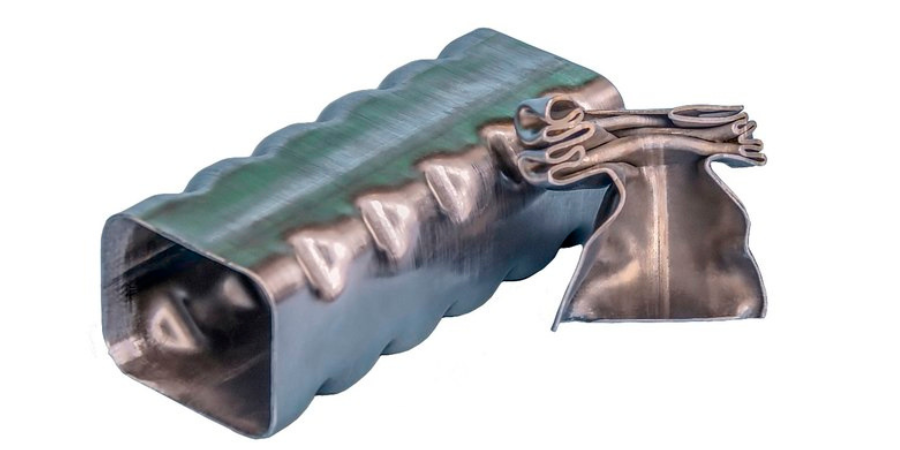
Back in 2011, we wrote about a fascinating new way to heat-treat regular, cheap steel to endow it with an almost miraculous blend of characteristics. Radically cheaper, quicker and less energy-intensive to produce, Flash Bainite is stronger than titanium by weight, and ductile enough to be pressed into shape while cold without thinning or cracking. It’s now being tested by three of the world’s five largest car manufacturers, who are finding they can produce thinner structural car components that are between 30-50 percent lighter and cheaper than the steel they’ve been using, while maintaining the same performance is crash tests. Those are revolutionary numbers in the auto space.

Darren Quick did a good job explaining exactly how Flash Bainite is produced in our original story, but in basic terms, you take regular, off-the-shelf AISI1020 carbon steel, and instead of heat treating it for 10 minutes like costly alloyed steel, you put it through a roller-driven system that induction-heats and liquid-cools the steel in a matter of 10 seconds or so.


Read more about Flash Banite and its potential and growing use in the automotive industry.

Revolutionary steel treatment paves the way for radically lighter, stronger, cheaper cars Read More »

Skip to content