A full-service heat treating company serving a broad range of industries recently announced the capability to offer aerospace accredited aluminum heat treating.
Nevada Heat Treating (NHT), baesd in Carson City, Nevada, added a drop bottom furnace to its thermal processing lines to treat aerospace and commercial jobs to the latest AMS aluminum heat treating specifications. The aluminum drop bottom furnace is certified as a Class 2 furnace, meeting AMS2750 standards, and is equipped with multiple state-of-the-art quenching systems for the needs of a broad range of industries including aerospace, semiconductor, military, nuclear, and machine shops.
A French tier 1 aerospace and defense supplier recently signed a framework agreement with a Russian aircraft engine manufacturer to re-engine a groundbreaking, multi-role fire-fighting aircraft, with mission capabilities including maritime surveillance, wildfire-fighting, passenger transport and humanitarian relief.
Safran Aircraft Engines of France and UEC Saturn of Russia signed the agreement concerning a re-engined version of the Beriev Be-200 fire-fighting aircraft using the SaM146 engine. The SaM146 turbofan engine was developed and is produced by the two aero-engine manufacturers through their 50/50 joint company, PowerJet.
The Beriev Be-200 is the first aircraft of this type to be fitted with two jet engines located over the wings to reduce the risks of water projection.
“We are delighted to contribute to this project, clearly reflecting our ongoing commitment to bolstering collaboration with the Russian aviation industry, a collaboration that started some twenty years ago,” said Olivier Andriès, CEO of Safran Aircraft Engines. “Safran Aircraft Engines produces the SaM146 core, and this engine symbolizes the full value of our industrial partnership, one that we are very pleased to further develop with this new agreement on the Beriev Be-200.”
“This partnership is a new opportunity to develop our synergies with Safran Aircraft Engines,” said Alexander Artyukhov, Director General of UEC. “Along with our French partner, we have defined a very clear roadmap, allowing us to start the development of a new version of the SaM146 that will meet the requirements of the Beriev-200.”
When designing for manufacturability (DFM) for aerospace applications, should a design team commission a comprehensive feasibility study? In this article from Precipart, which designs and manufactures high precision custom gears and mechanical components for the medical technology, aerospace and industrial sectors, read about application-specific requirements, concerns with production tooling, and tolerance of materials for post-fabrication processes, including heat treatment:
key specifications of a gear or motion control system
potential design issues that may occur throughout the life of a device; for example, how heat treatment, among other post-fabrication processes,
recommendations to address performance issues in various environments and conditions
A group of aerospace firms or suppliers from the UK’s Midlands, including a heat treating company, recently traveled to Rzeszow, Poland, which has the largest aerospace cluster within the country, on a trade mission to tour local factories and explore potential partnerships.
A global aerospace company that provides complex assemblies and systems solutions to aircraft and engine manufacturers and defense and space agencies worldwide recently announced that a number of major contract extensions and new awards have been made by world’s largest aerospace company and leading manufacturer of commercial jetliners and defense, space and security systems.
Magellan Aerospace, based in Toronto, Ontario, reported that multi-year contract renewals were agreed to for the manufacture of titanium wing fittings for the Boeing 787 Dreamliner and the detail manufacture and assembly of the tanker door for the Boeing 767-2C aircraft. In addition, Magellan was also awarded a new multi-year contract to manufacture winglet components for the Boeing 737 MAX.
The components and assemblies associated with these multiple contracts will be delivered from Magellan’s facilities in New York, New York, and Middletown, Ohio.
Haydn Martin, vice president New Business Development for Magellan
“These awards reflect Magellan’s commitment to continue to provide value solutions to Boeing in meeting their market challenges. Magellan will continue to innovate and optimize its performance to meet the expectations of Boeing and our customer base,” said Haydn Martin, vice president New Business Development for Magellan.
Here’s a great article by Bob Hadley at AVWeb that explains the differences between aluminum alloys and how heat treating can make a crucial difference in the final properties.
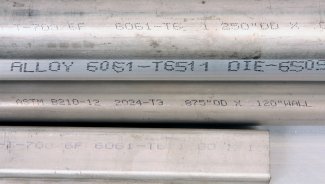
Aluminum is usually marked by the manufacturer to indicate the alloy and temper. The markings may also include the lot number and the born-on date. (PC and caption: AVWeb)
An excerpt:
“Heat treatment can dramatically alter the working characteristics of an alloy. 6061 is a great example. In the non-heat-treated state (6061-TO), it is quite bendable. But it is so soft, if you try to machine it, it will gum up the gullets of your saw and clog the flutes of your drill bits and end mills. It’s like trying to drill taffy. But when heat-treated to T4 or higher (such as 6061-T6 or 6061-T651…T651 being T6 temper plus stress-relived), it responds fine to any machining operation.”
Plus more, including
the range of temper/heat-treat designations denoting the specific process used to treat the material
the higher the number of alloy doesn’t necessarily indicate a stronger and harder alloy
which aluminum stock ought to be considered “mystery” material
Whether the OEM manufactures truck frames, aircraft components, or soda cans, applying the right heat treatment process to the right alloy produces the just the right weldability, machinability, and bendability.
A Swedish high-tech engineering company that supplies to the heat treat industry, offering tooling systems, advanced stainless steels and special alloys, recently announced intentions to broaden its reach in digital manufacturing through the planned acquisition of French software company, Metrologic Group, headquartered in Meylan.
Björn Rosengren, president and CEO of Sandvik Group
Björn Rosengren, president and CEO of Sandvik Group, based in Sandviken, Sweden, noted that this announcement is a “first material step towards an increased offering in digital manufacturing in Sandvik Machining Solutions.”
A market leader in agnostic metrology software, Metrologic Group would form a new business unit within a new product area in Sandvik Machining Solutions and would maintain brand independence, in line with Sandvik’s decentralized business model.
Klas Forsström, president of Sandvik Machining Solutions
Metrologic Group develops 3D inspection software and electronics which run measurement machines used for dimensional control notably in the automotive, aeronautics, transport, and medical sectors.The company’s offering includes agnostic software for metrology, automation and robotics control as well as services for calibration and 3D-measuring. Products are used globally in most industries, including automotive, aerospace, energy, general engineering and consumer goods, all similar to that of Sandvik Machining Solutions.
“By merging Sandvik Machining Solutions’ know-how about materials, customer applications and machining processes with Metrologic’s deep understanding of measurement technology, we would be able to further expand the offering of increased productivity. I am convinced that this step towards increased digital manufacturing will be key for continued success for Sandvik Machining Solutions,” said Klas Forsström, president of Sandvik Machining Solutions.
A contract valued at approximately $116 million to deliver 16 additional UH-72A Lakotas for the United States Army has been received by a leading aeronautics, space, and related services provider, the company’s second request this year to supply the U.S. Army’s Lakota program.
Chris Emerson, president and CEO of Airbus Helicopters, Inc. and head of the North America Region
Airbus Helicopters Inc announces the new contract includes the UH-72A production aircraft, associated technical and flight operator manuals and program management in training configuration for the Initial Entry Rotary Wing mission at Ft. Rucker. The UH-72A is a twin-engine utility helicopter used for a wide range of military operations including troop and light cargo transport, MEDEVAC, VIP transport, border security, and Homeland Defense.
“We are proud of our partnership with the U.S. Army. As the world’s best Helicopter Trainer provider, we recognize how important an asset the Lakota is for Army Aviation and our nation. Our employees at Airbus are committed to delivering every aircraft on-cost and on-schedule, without exception,” said Chris Emerson, president and CEO of Airbus Helicopters, Inc. and head of the North America Region. “Our mission of providing this vital national asset is crucial to the protection of our country and the closure of the pilot shortage gap.”
The Lakota is a key component of the Army’s Aviation Restructuring Initiative (ARI) and the primary rotary-wing trainer for the U.S. Army Aviation Center of Excellence at Fort Rucker, Ala. The UH 72A Lakota is fielded in and out of the Continental United States in several different configurations, performing a number of essential missions for the U.S. Army, U.S. Navy, and the National Guard.
A new high-tensile, highly shock-resistant prepreg that incorporates carbon fiber has recently been developed by a high-performance fiber company in Germany for aerospace applications and specialized carbon nanotubes (CNT).
Toho Tenax Co., Lt., the core company of the Teijin Group, announced the hybrid prepreg has been adopted by Mizuno Corporation in a new golf club shaft that weighs nearly 30 percent less than conventional shafts of the same thickness. A prepreg is a carbon fiber sheet pre-impregnated with matrix resin and used as an intermediate material for carbon fiber reinforced plastics (CFRP). The high-tensile prepreg enables the shaft to bend suitably as the ball is impacted and then cuts the shock of impact by more than 10 percent to reduce club movement on the follow-through swing.
The surface of the CNT is specially treated and its structural elements disperse equally when Toho Tenax’s carbon fiber is impregnated with matrix resin containing the CNT. The hybrid combination of carbon fiber and CNT realizes a superior CFRP that offers improved tensile strength and shock resistance. The CFRP is more durable because the carbon fiber and matrix resin do not peel away from each other thanks to the CNT’s balanced dispersion.
The Teijin Group is accelerating its development of its new high-tensile, highly shock-resistant prepreg for high-end applications in the sports and leisure fields, then eventually in aircraft fields, where weight reduction and high functionality are especially critical. Teijin also is strengthening its capabilities to provide solutions for diverse global businesses, from upstream to downstream.
Henry Canady of Aviation Week interviews Mark Meyer of GEAdditive to gain insight on how additive metal manufacturing will disrupt the manufacturing landscape, particularly the aerospace sector, as techniques are refined for metal additive. Meyer speculates that additive will compete with metal forging and further enhance forging processes.
An excerpt:
“Just as taxi service often improves when Uber and Lyft move into town, metal casting is being enhanced as additive competes with casting.”