
Ask The Heat Treat Doctor® has returned to bring sage advice to Heat Treat Today readers and to answer your questions about heat treating, brazing, sintering, and other types of thermal treatments as well as questions on metallurgy, equipment, and process-related issues. In this Technical Tuesday installment, Dan Herring explores practical guidelines for getting heat treatment right the first time, every time, in the first part of a series inspired by the work of Jon L. Dossett. He outlines seven keys to success in heat treating and the two questions design engineers must answer about what a component must endure in service and how it will be made. He then examines the most common specification mistakes, including unrealistic hardness, case depth, and tolerance requirements, and shows how carbon content, section size, mass effect, and commercially achievable tolerances determine whether a steel can be hardened to specification.
This informative piece was first released in Heat Treat Today’s September 2026 People of Heat Treat print edition.

If you have any comments or queries, on this article, let us know at editor@heattreattoday.com.
Para leer el artículo en español, haga clic aquí.
In our day-to-day work, most of us face the challenge of meeting production demands while navigating tight manufacturing deadlines in an ever-changing materials and manufacturing landscape. Heat treatment can be defined as the controlled application of time, temperature, and atmosphere to produce a predictable change in the internal structure (i.e., microstructure) of a material, resulting in the desired metallurgical, mechanical, physical, and other properties we desire. There is, however, an alternate and equally important definition of heat treating: getting the job done right the first time — every time.
In this short series, we will examine practical guidelines to help make that objective a reality. Let’s learn more.
7 Keys to Success in Heat Treating
To accomplish this goal, we must be able to meet the seven key considerations in heat treating to ensure both our success and survival (Herring 2014a, 2014b, 2015):
- To know, metallurgically, what you want to accomplish.
- To be able to predict the outcome of a heat treatment operation.
- To have repeatability built into the process.
- To get the most out of the equipment you have and to use state-of-the-art heat treating equipment whenever possible.
- To be aware of how changes to our manufacturing operations influence the outcome of a given heat treatment process or series of processes.
- To not compromise on quality.
- To know our costs and understand our profitability.
Challenges Faced by Today’s Engineers
In the design of any engineered component, it is necessary to fully understand and address two key questions that design engineers working with metallurgists are often best qualified to answer (Herring 2014a, 2015, 2017):
- What must the component endure during service (i.e., what are the product requirements)? To answer this question, consider the following: What are the rigors of the application, and what is the design life? Must the component part provide premier service, or is there an adequate design life involved (i.e., will other factors end its service long before its useful life is expended)? What loading, lubricants, temperature, and contaminants are involved? What other service and performance aspects specific to the product must also be factored into the selection process?
- How will the component part be made (i.e., what are the process requirements)? Consider the following: How will its basic form be generated, and how will it be heat treated — if at all? Will it be important to introduce particular mechanical properties? If so, how (i.e., by heat treatment or by mechanical means)? Is geometry or surface finishes important? Will special coatings be used? Is dimensional control (including stability at temperature) an issue? What other processing aspects specific to the product must be considered?
How We Achieve Our Goals
Experienced heat treaters often point to the most common mistakes made by design engineers and/or their clients, that is, selecting materials, defining and understanding the limitations of the requested heat treatment processes, and specifying realistic outcomes from heat treating.
These include, for example, the desired hardness, case depth, and dimensional tolerances. These issues generally result from a failure to recognize the differences in the material’s chemical composition and form (e.g., wrought or powder metallurgy, castings, forgings). The design engineer should also understand the mill processing methods used to produce the material.
Often, the tolerances for the specified heat treatment properties are either too aggressive, too ambiguous, or too restrictive from a real-world standpoint. Here are a few basic metallurgical guidelines that can, from a practical standpoint, help avoid these problems (Herring 2014a, 2015; Dossett 2007, 2026).
Steel Selection
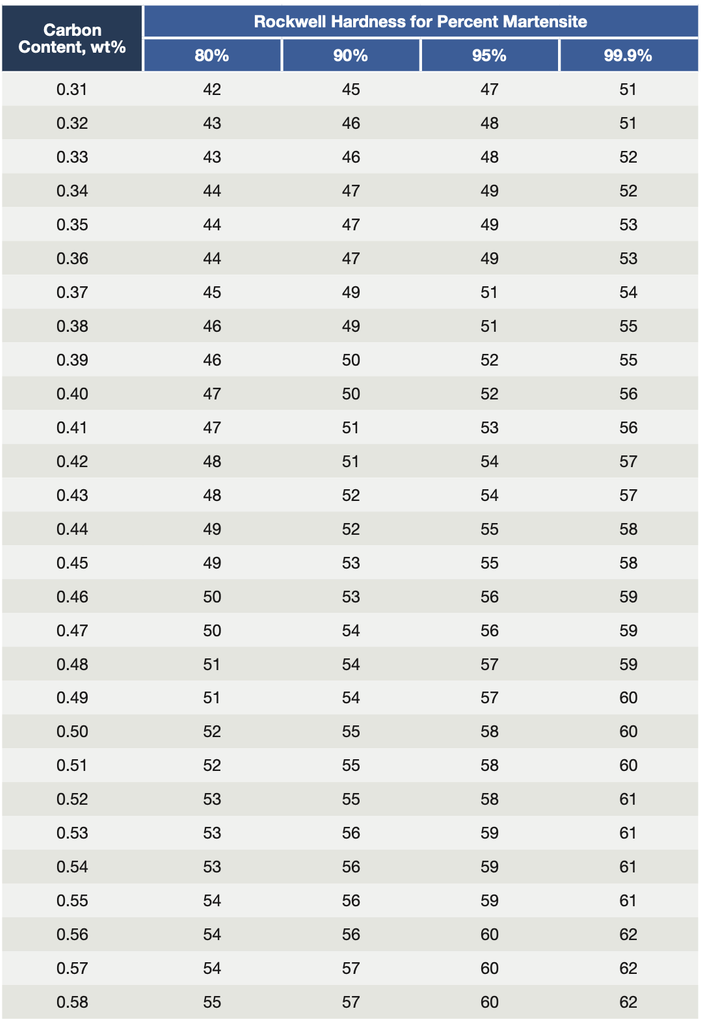
Problems in specifying the proper steel grade for a particular application generally involve choosing a steel grade that cannot be hardened to the specification and/or specifying a surface or core hardness range that is too restrictive. For example, Table A provides a guideline for the maximum surface hardness achievable using induction or flame hardening treatments. The maximum obtainable hardness is a function of the carbon content of the steel being used.
If the material selected is 4140H with a carbon range of 0.37–0.44%, we would expect the surface to be approximately 99.9% martensite after quenching. Thus, the expected as-quenched hardness would fall in the range of 54–58 HRC for all the heats of this steel. However, the ability to achieve this hardness depends on the severity of quenching, the quenchant used, the quench tank design, and the adequate removal of surface decarburization that might be present on the wrought steel itself.
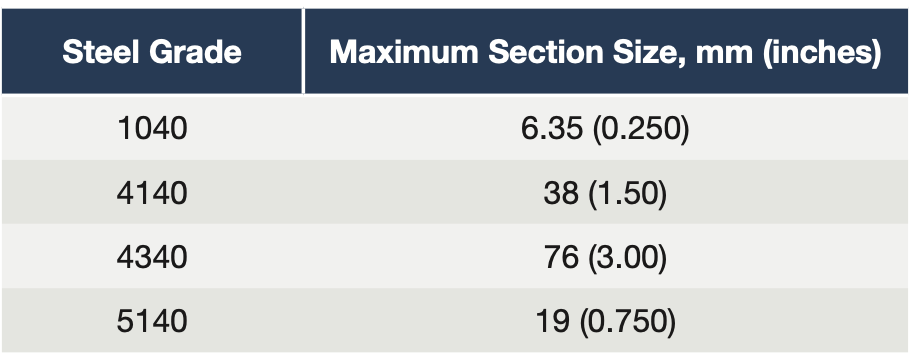
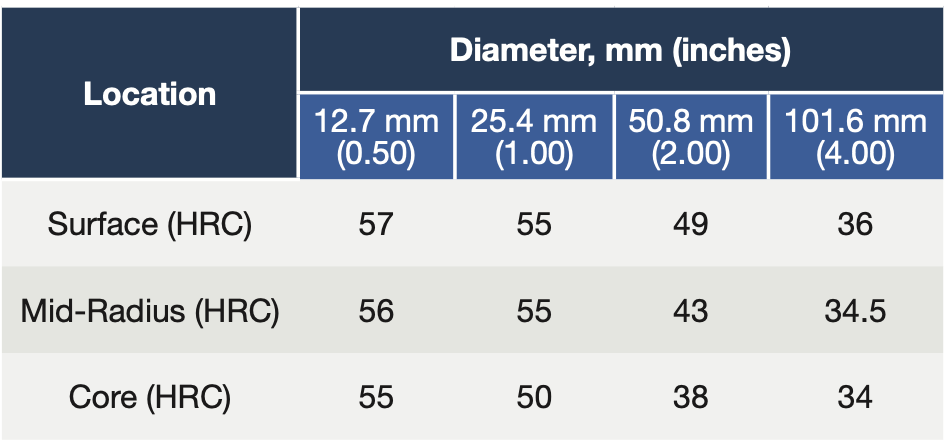
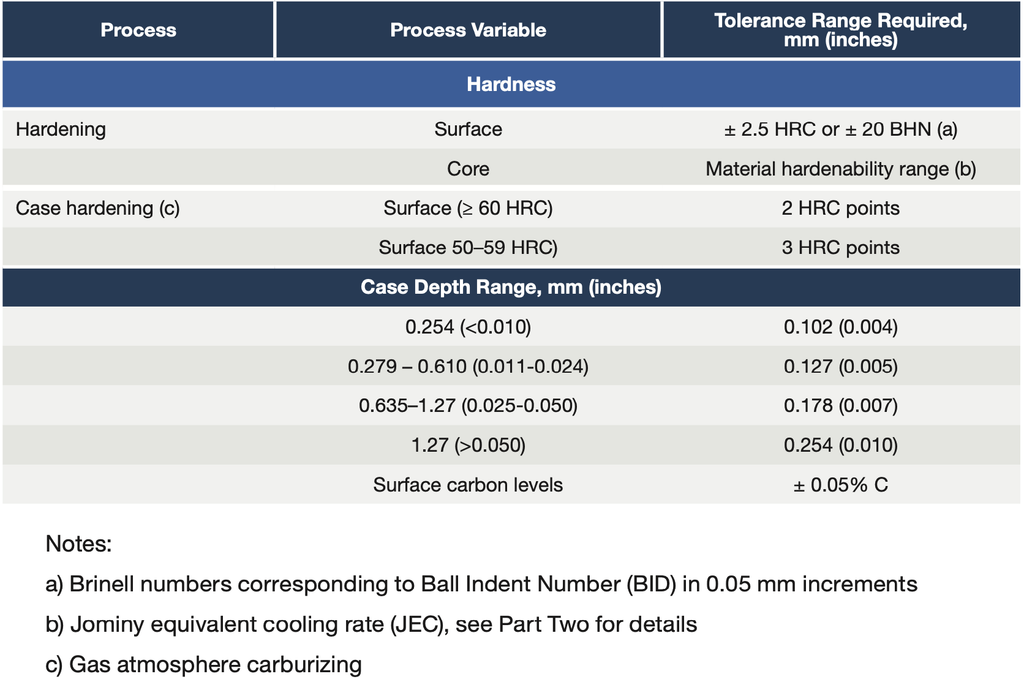
By contrast, in the case of furnace heat treatment, the maximum attainable surface hardness depends both on steel’s carbon content and its hardenability. The maximum section size (Table B) and effect of mass (Table C) are shown for several steel grades based on oil quenching. The commercially accepted range for surface hardness after tempering is ± 2.5 HRC points or ± 20 BHN points (Table D).
Next month we will review steel hardenability and how to determine the expected core hardness range.
This series was motivated by and contains insightful content from Jon L. Dossett who has granted permission. Jon’s distinguished career includes commercial heat treating involvement, extensive teaching career at ASM, and his work as editor of several volumes of the ASM Handbook series.
References
Bethlehem Steel Company. 1949. Modern Steels and Their Properties. Handbook 268. Bethlehem, PA: Bethlehem Steel Company.
Chandlar, Harry, ed. 1995. Heat Treater’s Guide: Practices and Procedures for Irons and Steels. Materials Park, OH: ASM International.
Dossett, Jon. 2007. “Make Sure Your Specified Heat Treatment Is Achievable.” Heat Treating Progress (March/April).
Dossett, Jon. 2025. Private conversation.
Herring, Daniel H. 2014a. Atmosphere Heat Treatment. Vol. 1. Troy, MI: BNP Media Group II.
Herring, Daniel H. 2014b. “Industry 4.0 and the 7 Key Considerations in Heat Treating.” Industrial Heating (September).
Herring, Daniel H. 2015. Atmosphere Heat Treatment. Vol. 2. Troy, MI: BNP Media Group II.
Herring, Daniel H. 2017. “The Relevance of Metallurgy in Engineering and Manufacturing.” Industrial Heating (November).
About the Author

“The Heat Treat Doctor®”
The HERRING GROUP, Inc.
Dan Herring has been in the industry for over 50 years and has gained vast experience in fields that include materials science, engineering, metallurgy, new product research, and many other areas. He is the author of six books and over 700 technical articles.
For more information: Contact Dan at dherring@heat-treat-doctor.com.
For more information about Dan’s books: see his page at the Heat Treat Store.