


Ask The Heat Treat Doctor® has returned to bring sage advice to Heat Treat Today readers and to answer your questions about heat treating, brazing, sintering, and other types of thermal treatments as well as questions on metallurgy, equipment, and process-related issues. In this Technical Tuesday installment, Dan Herring explores the fundamentals of vacuum oil quenching — the three stages of oil quenching, the properties that make oil an effective quenching medium, and the ways pressure control, oil circulation, and temperature can be used to minimize part distortion — and offers step-by-step guidance on properly conditioning and degassing vacuum quench oil to ensure consistent, repeatable results.
This informative piece was first released in Heat Treat Today’s August 2026 Annual Automotive Heat Treating print edition.
Oil quenching in vacuum furnaces is a technology that has been around for over 65 years. The popularity of oil as a quench medium is due to its excellent performance and stability over a broad range of operating conditions. Proper application, testing, and conditioning of the oil are necessary to ensure its effectiveness. Let’s learn more.
For many, the choice of oil is not only due to metallurgical transformation and resultant properties it can achieve, but also to a number of other factors, including:
- Economics/cost (initial investment, maintenance, upkeep, life)
- Performance (cooling rate/quench severity)
- Minimization of part distortion (agitation/baffling)
- Controllability (variable cooling rates/changes to the pressure over the oil)
- Environmental impact (recycling/waste disposal/dragout)
Properties of an Idea Quenching Medium
The first criterion that any quenchant must meet is its ability to approach an ideal quenching medium.
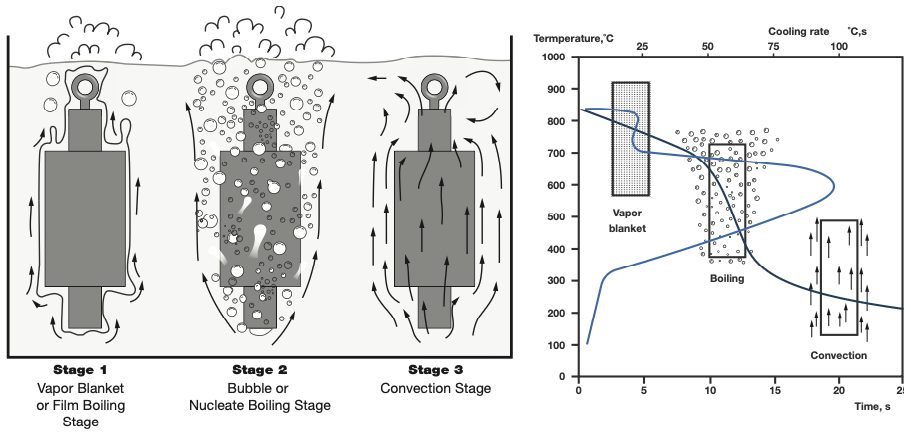
Regardless of the type of liquid (brine, water, polymer, oil, molten salt, or air mist), the ideal quenching medium (Figure 1) is one that would exhibit high initial quenching speed in the critical hardening range (Stages 1 and 2) and a slow final quenching speed through the lower temperature range (Stage 3). Thus, the ideal quenchant is one that exhibits little or no vapor blanket stage, a rapid but controlled nucleated boiling stage, and a slow cooling rate during convective cooling.
The high initial cooling rates allow for the development of full hardness by ensuring the steel misses the “nose” of the time-temperature-transformation diagram (i.e., quenching faster than the so-called critical transformation rate). This is followed by cooling at a slower rate beginning at the time the steel is forming martensite, which allows for better stress equalization so that the potential for distortion and cracking is reduced.
When conventional quenching oils are used, the duration of Stage 1 is longer, the cooling rate in Stage 2 is considerably slower, and the duration of Stage 3 is shorter. As such, the “quenching power” of oil is far less drastic than other quenchants. Water and water-based quenchants exhibit high initial cooling rates. Unfortunately, because of water’s low boiling point, this fast cooling persists until the steel is cooled to below 300°F (150°C). As most steels have formed or are forming martensite by this point, stresses are given little time to equalize. Thus, water is typically limited to low hardenability materials and relatively simple geometries.
Oil has a major advantage over water or polymer due to its higher boiling range. A typical oil has a boiling range between 450°F (230°C) and 900°F (480°C). This causes the slower convective cooling stage to start sooner, enabling the release of transformation stresses. Oil, therefore, is able to quench intricate shapes and high hardenability alloys successfully.
As it is heated, oil has a proportional drop in viscosity. This allows the quenchant to move more freely, increasing, in general, the tendency to break the vapor blanket layer. The nucleate boiling stage is not drastically altered by changes in bath temperature. The cooling rate in the convection stage, however, will slow as the bath temperature increases. This is advantageous for obtaining a slower rate of cooling through the austenite-to-martensite transformation range.
In general, as the temperature of a quenching oil increases, the overall quenching rate increases. Practical heat transfer coefficient (α) values are in the 1,000 to 2,500 W/m²K range depending on oil characteristics and degree of agitation. Peak α values are in the order of 4000 to 6000 W/m²K, or a cooling rate greater than 100°C/sec (180°F/sec).
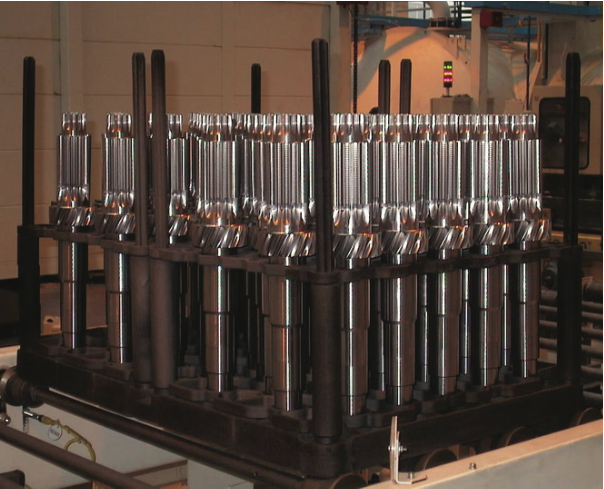
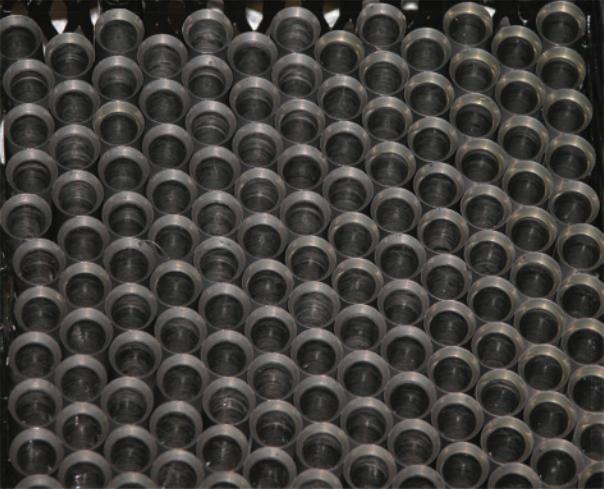
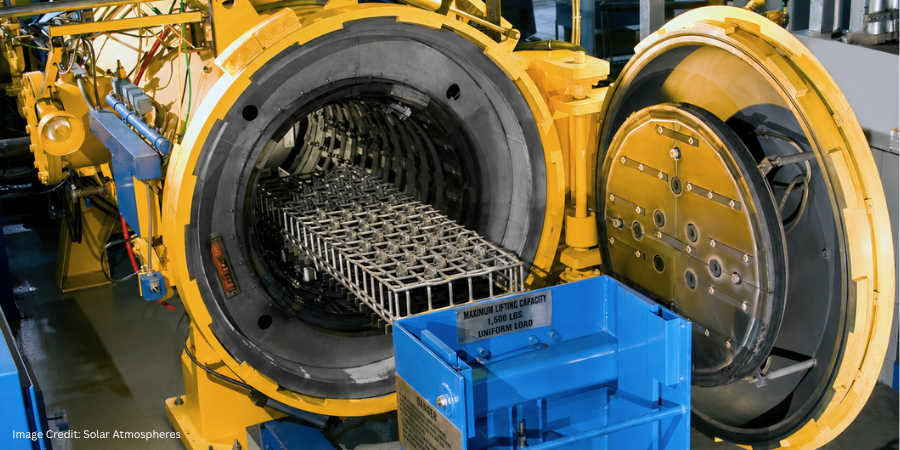
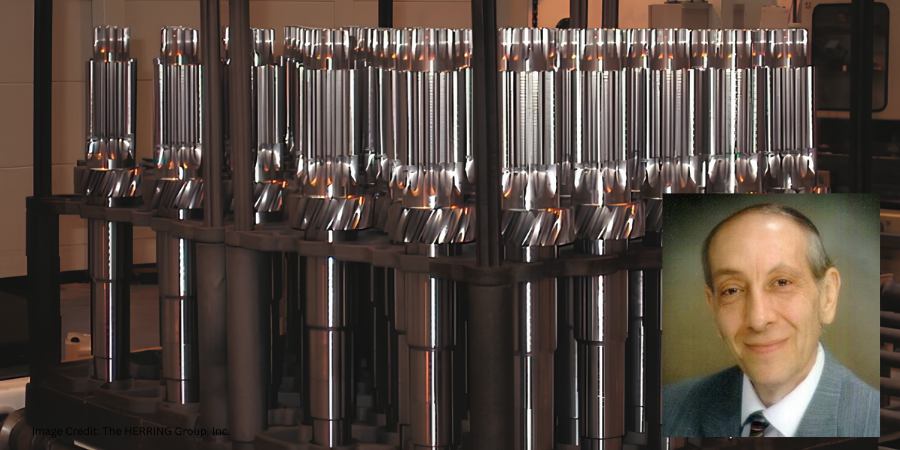
The use of vacuum oil quenching has been found to reduce distortion in many components including gears, pinions, and shafts (Figure 2). Oil quench vacuum systems also offer an attractive alternative to conventional atmosphere oil quenching, given their ability to vary a quench related variable not otherwise possible, namely controlling the pressure over the oil (Figure 3). This technique can be used to extend the range of part cross sections and materials that can be successfully hardened (Herring 1987, Sugiyama and Uchigaito 1987).
Pressure control along with oil temperature and oil circulation improves the predictability of distortion. The lower pressure allows for longer “vapor blanket” stages and a somewhat long “vapor transfer” stage, due to the reduced boiling point of the oil. This may reduce distortion and provide the desired hardness if the material’s transformation ranges are accommodating.
Distortion minimization methods have been used in combination with changes to flow characteristics. Some manufacturers pull oil down through the workload as opposed to pushing it upward. Also, oils formulated for vacuum service typically have a low vapor pressure, allowing them to be easily degassed.
Finally, vacuum systems do not permit the buildup of water in the quench tanks. In a vacuum furnace system, where vacuum is used to process the work or purge the quench environment, moisture will be removed as the system is evacuated and the oil circulated. Circulating the oil carries any moisture to the oil surface, where it vaporizes and is removed by the vacuum pumping system.
Maintaining Your Vacuum Quench Oil
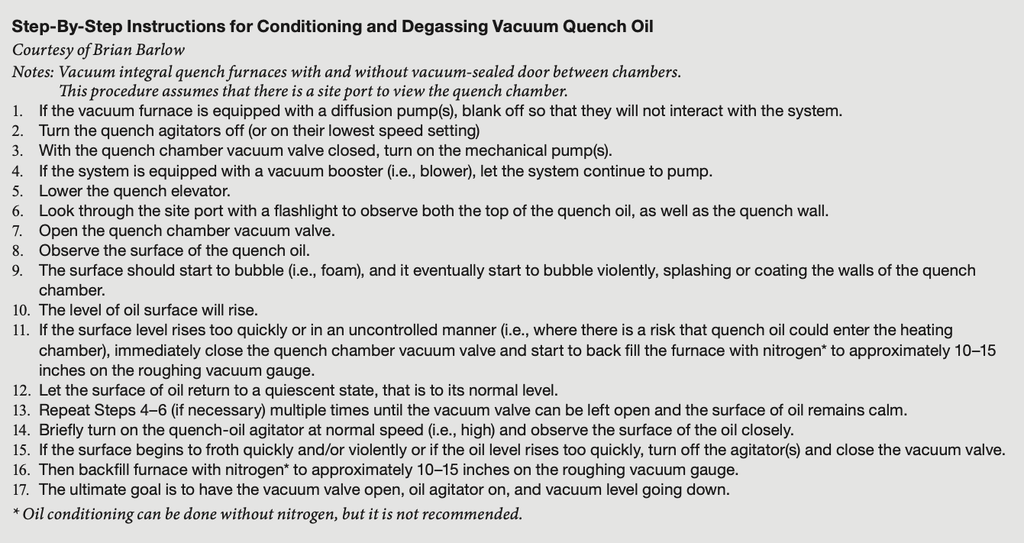
One of the aspects of vacuum oil quenching that is seldom documented is how to condition the quench oil. See “Step-By-Step Instructions for Conditioning and Degassing Vacuum Quench Oil” below.
Final Thoughts
As with all quenching, the key is to understand and control the key process variables. Proper selection of the type and use of oil under ideal conditions in a well-designed and well-maintained quench tank will ensure consistent and repeatable results.
Oil quenching should be applied in applications where its advantages outweigh its disadvantages and, as with all technologies, should be as completely understood as possible with respect to the performance requirements of the product so as to meet the application end use.
References
Brian Barlow. 2025. Private correspondence. Gasbarre Thermal Processing Solutions.
Herring, Daniel. H. 2002. “A Review of Factors Affecting Distortion in Quenching.” Heat Treating Progress Magazine. December. 2012. Vacuum Heat Treatment, Volumes I. BNP Media Group.
Herring, Daniel H. 2016. Vacuum Heat Treatment, Volume II. BNP Media Group.
Herring, Daniel H., Steven D. Balme. 2007. “Oil Quenching Technologies for Gears.” Gear Solutions. July.
Herring, D. H., Sugiyama, M., Uchigaito, M. 1986. “Vacuum Furnace Oil Quenching – Influence of Oil Surface Pressure on Steel Hardness and Distortion.” Industrial Heating Magazine. June.
Sugiyama, M., Uchigaito, M. 1987. “Controlling Oil Surface Pressure in Vacuum Oil Quenching.” Heat Treating Magazine. July.
About the Author

“The Heat Treat Doctor®”
The HERRING GROUP, Inc.
Dan Herring has been in the industry for over 50 years and has gained vast experience in fields that include materials science, engineering, metallurgy, new product research, and many other areas. He is the author of six books and over 700 technical articles.
For more information: Contact Dan at dherring@heat-treat-doctor.com.
For more information about Dan’s books: see his page at the Heat Treat Store.