

Reliable induction heat treating depends on more than metallurgy — it requires precise, repeatable performance from every part of the induction system. In this Technical Tuesday installment, Aaron Goodwin, business development engineer for Inductoheat, explores how induction coils, power supplies, quench systems, and real-time process monitoring work together to consistently achieve the hardness, case depth, and microstructure demanded by today’s automotive components. Learn how equipment reliability, preventive maintenance, and process control help manufacturers reduce variability, improve quality, and keep production running efficiently.
This informative piece was first released in Heat Treat Today’s August 2026 Annual Automotive Heat Treating print edition.

If you have any comments or queries, on this article, let us know at editor@heattreattoday.com.
Para leer el artículo en español, haga clic aquí.
There is a critical partnership between an automotive component’s design and its heat treat requirement. In modern vehicle manufacturing — whether trucks, SUVs, or crossovers — the margin for error is very small. Components like axles, gears, shafts, and other engine/drivetrain elements are subjected to demanding loads, high torque, and complex operating conditions. These vehicles must balance durability, efficiency, quiet operation, and performance. They also need to successfully handle a wide range of driving scenarios, from stop-and-go urban traffic to towing, off-road use, and long-distance travel.
Across these vehicle platforms, one reality remains constant. While material selection and engineering design are critical, consistency and reliability of the heat treating process determine whether components perform as intended in real-world conditions. Induction heating for case hardening of automotive components is a common choice among design engineers, and reliable induction heating equipment is key.
From the induction coil to the power supply and the quench system, each must operate with precision and repeatability for every cycle. Induction case hardening depends on tightly controlled variables working in harmony. When performance is stable, quality heat treated components follow. When it is not, variability is introduced and with it risk.
The Link Between Induction Equipment and Metallurgy
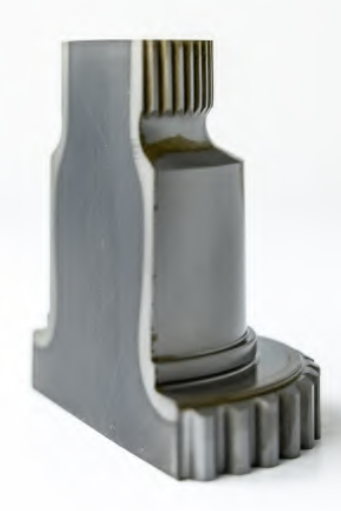
Heat treated components are evaluated based on hardness, case depth, and microstructure of the steel after processing. Each component has a heat treat specification that defines these metrics. Some components require shallow case depths while others have very deep case. Shallow case is needed for surface wear resistance, while deep case is specified for strength under high torsional loads, and there are scenarios in between.
Induction heat treatment equipment reliably executes several tightly controlled variables to produce the required metallurgical properties. Key variables include power output and frequency, heating time, coil geometry and position, quench timing, and flow rates.
Each variable plays a critical role: even small deviations can significantly alter results. A slight fluctuation in power delivery, for example, may reduce case depth or create uneven hardness profiles. In truck components, this could result in reduced fatigue life under high loads. In a crossover or SUV, it may show up as premature wear or component failure. Reliable equipment ensures that these variables remain tightly controlled cycle after cycle, part after part. It transforms heat treating from a “variable process” into a repeatable, engineered system.
The Role of Induction Coil
The induction coil is where the energy meets the automotive component. Its design and condition directly influence heating and resulting hardness case patterns. A well-designed and properly maintained coil provides consistent electromagnetic coupling, uniform heat distribution along the surface, and sufficient penetration sub-surface for creating required case depths and hardness profiles.
When energized, the induction coil produces a magnetic field. From this, the automotive component begins to experience Joule heating from induced current, known as eddy currents. Heat times vary but are often only a few seconds in duration to reach the temperature required for the formation of austenite (range of 750–850°C [1382–1562°F], depending on chemical composition of steel).
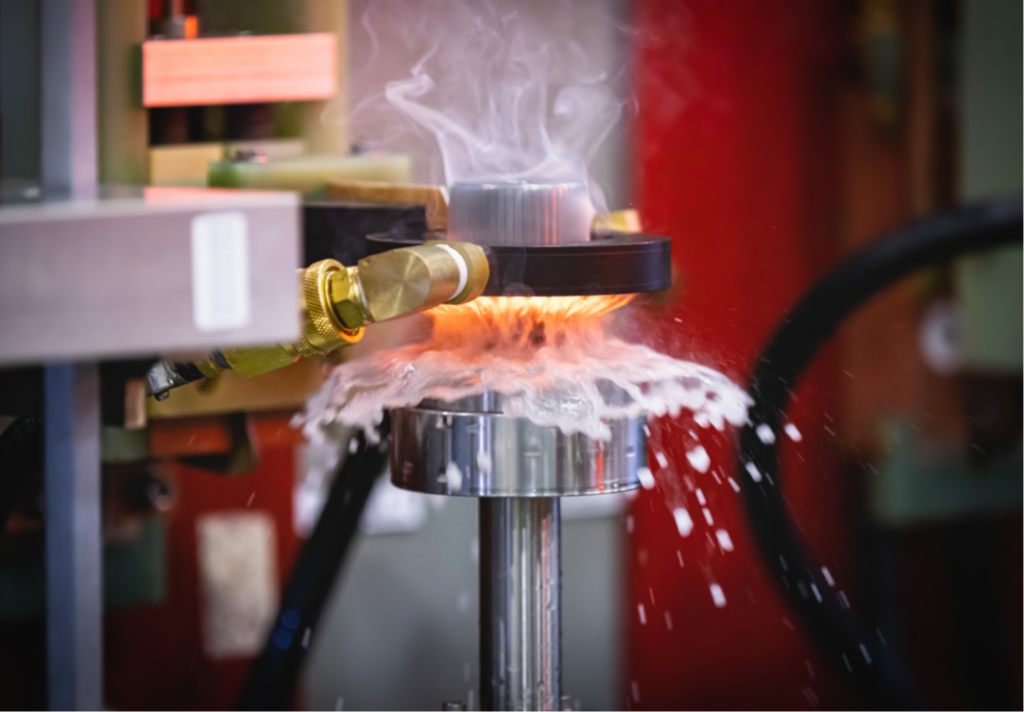
Induction coils are perishable tooling components. Over time, thermal cycling, surface oxidation, and degradation, along with mechanical fatigue can reduce performance. Minor changes in coil geometry, alignment, or surface conditions can alter the electromagnetic field and introduce variability. What makes this especially challenging is that these changes are often gradual and not immediately visible. A coil may continue operating while quietly affecting heat distribution. Routine inspection, cleaning, and scheduled replacement are essential. In high-volume automotive manufacturing, proactive coil management is critical to maintaining process stability and reliably heat treated components.
Power Supply Stability
The induction power supply governs how energy is delivered to the coil and thus the component being heat treated. A stable output of power is critical for repeatable heating and consistent metallurgical results. Selection of the proper output frequency is important to balance the required depth of heating and the surface temperature of the component. For case hardening, the most common frequencies utilized fall in the range of 1,000 Hz up to 200 kHz. While a single power supply cannot cover this entire frequency range, most will provide some range of frequency flexibility.
Power supplies have precise and programable energy delivery at a stable frequency. They provide rapid response to variations in load as the temperature of the automotive component increases, passes through the curie point, and reaches the target temperature. This power supply gives reliable performance across long production runs. This is important when thousands of components must meet specifications in a narrow margin of variability. If a power supply introduces fluctuations, these will affect the heating rates and final hardened properties. For manufacturers, this leads to scrap parts and reduced profitability.
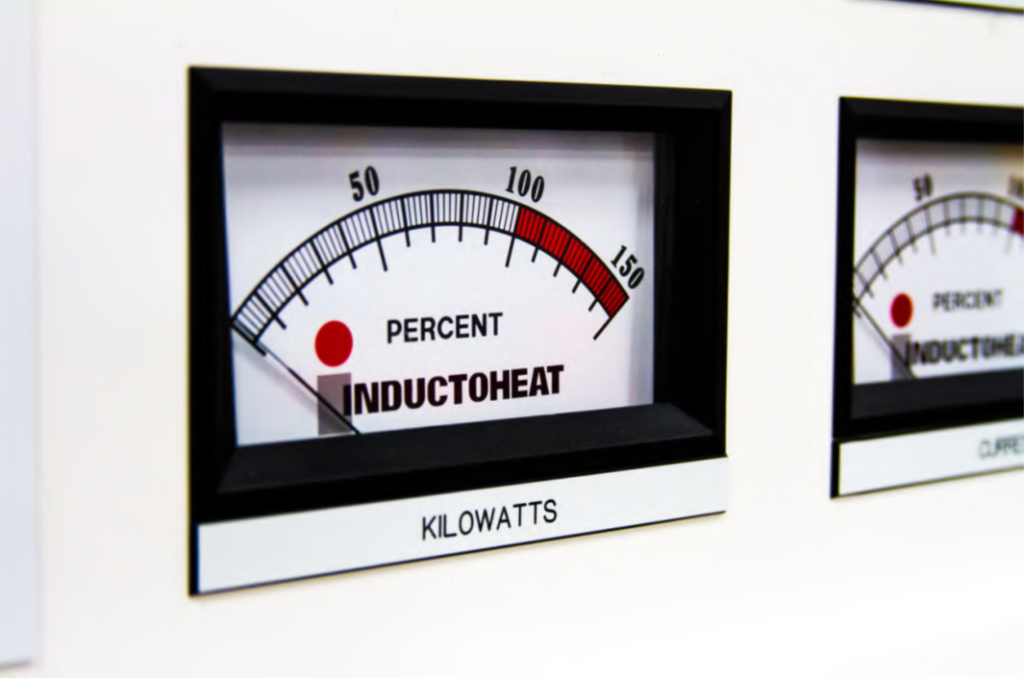
These work horses need scheduled maintenance. After all, reliable power delivery directly supports both quality and productivity. Personnel must:
- Periodically check the power supply for tight electrical connections on bus work and wire terminals.
- Check all cooling water hosing connections for tightness as the hoses age.
- Verify that all protection switches are working.
- Ensure that the cooling system’s water is clean and check its conductivity monthly.
- Refer to the manufacturer’s manual for more information.
Quenching: Completing the Process
Heating is only half of the equation. The quenching process is initiated after the component has reached its austenitizing temperature at the desired depth. Quench fluid is sprayed uniformly onto the surface of the component, which removes heat in a rapid and controlled manner. This produces the formation of martensite giving the automotive component a case-hardened surface layer. All of this is done within proper limit set points to produce repeatable heat treated components.
Quench fluid is typically water with polymer additive. It needs to be maintained at the appropriate temperature and with the required percentage of polymer quench additive. The quench system delivers it with precise timing relative to heating. The pump and valves must provide consistent flow rates and pressures. The heat exchanger in the quench system will remove excess heat from the quench fluid. Otherwise, the temperature of the fluid will continue rising after each cycle.
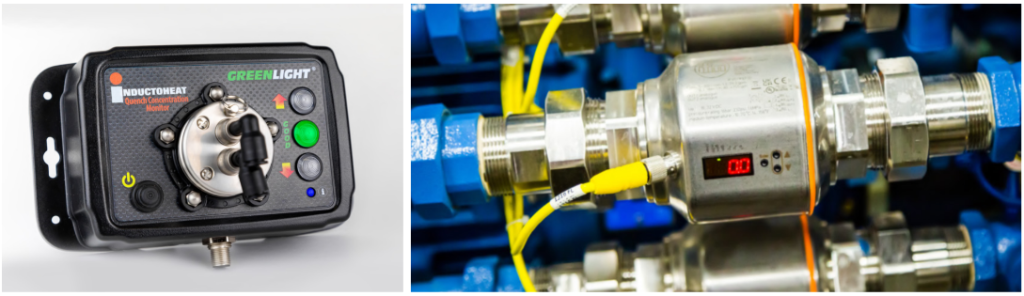
Over time, quench water evaporates raising the concentration of polymer quench. It also becomes contaminated with oily residue, metal chips, and more. Quench system bag filters become full, and the many orifices of quench spray devices get clogged with scale and debris. The quench system needs to be maintained to ensure that cooling is controlled and repeatable. This completes the heat treating process with consistency and reliability.
Data-Driven Reliability
Induction equipment must function with precision to achieve the required heat treatment. When this equipment includes real-time monitoring and data collection during the process, further confidence is provided. Signature monitoring measures the many aspects of induction heat treatment for every cycle. This “signature” can record electrical parameters like inverter power, current, voltage, and frequency over the process time. It can also include quench fluid temperature, flow, and pressure, along with machine scan speed and spindle rotation speed. Each of these is given a percentage of permitted variation, graphed over time. Any deviation outside of these boundaries during the cycle, and the machine will initiate a process fault.
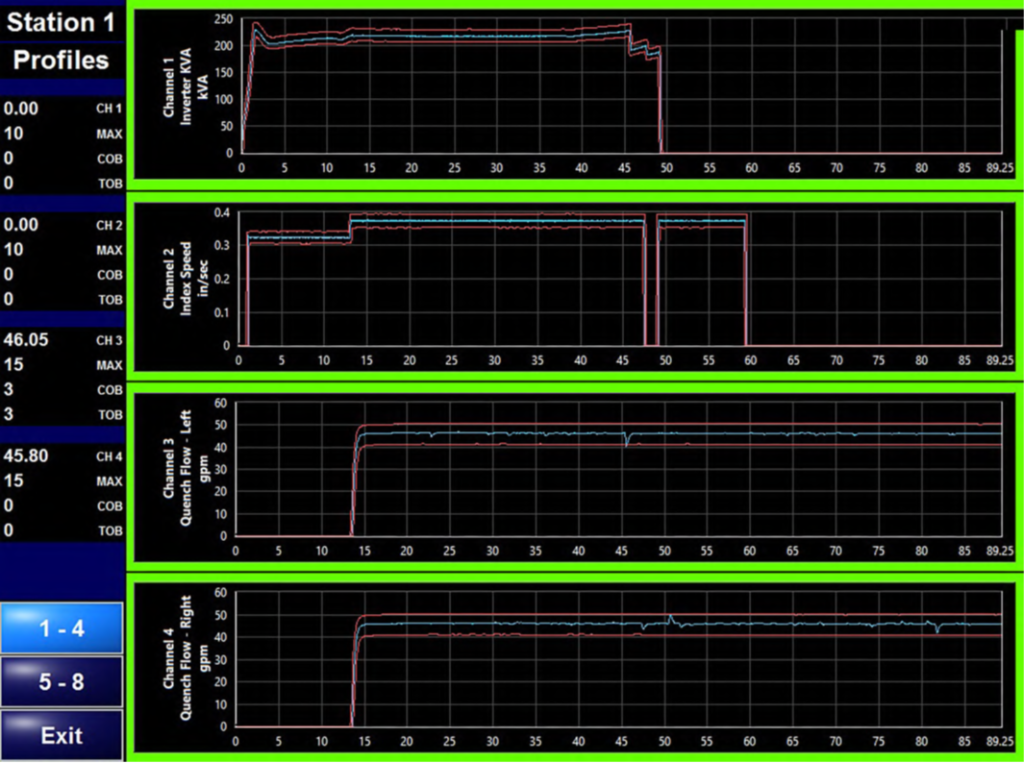
This can be an important part of a quality assurance system (QAS) and ensure confidence during each production shift. For automotive components with barcodes or other unique markings, traceability becomes possible, saving the process signature from the machine and assigning it to the heat treated component. This step can provide critical data to isolate a batch of parts should the need arise, avoiding the tendency to quarantine more pieces than necessary.
Reliable Equipment. Better Parts. Stronger Vehicles.
Across the full spectrum of vehicle manufacturing, from heavy-duty trucks to everyday SUVs and crossovers, performance is built layer by layer. As vehicle platforms continue to evolve, heat treating processes must keep pace with increasingly complex component designs and performance requirements. Reliable induction equipment is essential to meet these challenges. Each aspect must operate with precision and consistency. Routine maintenance, including the replacement of wear items such as induction coils, helps ensure process stability, consistent results, and dependable production.
For many manufacturers, maintaining reliability also means modernizing existing equipment. Aging induction systems can often be rebuilt with updated controls, power supplies, and critical components, extending service life while improving performance and uptime. They can also be re-tooled for new heat treat programs.
By investing in induction equipment, manufacturers can continue producing high-quality components that support the demands of today’s vehicles.
About The Author:

Business Development Engineer
Inductoheat
Aaron Goodwin has over 32 years of experience in the induction heating industry, having held a variety of technical positions with Inductoheat in Madison Heights, Michigan. In his current role as business development engineer, Aaron provides technical support to both sales and engineering, with responsibilities that include leading the finite element analysis (FEA) simulation team for coil and process design. Aaron also collaborates with global sister companies throughout the Inductotherm Group, supporting technology development, knowledge sharing, and customer-focused solutions worldwide.
For more information: Contact Aaron Goodwin at agoodwin@inductoheat.com.