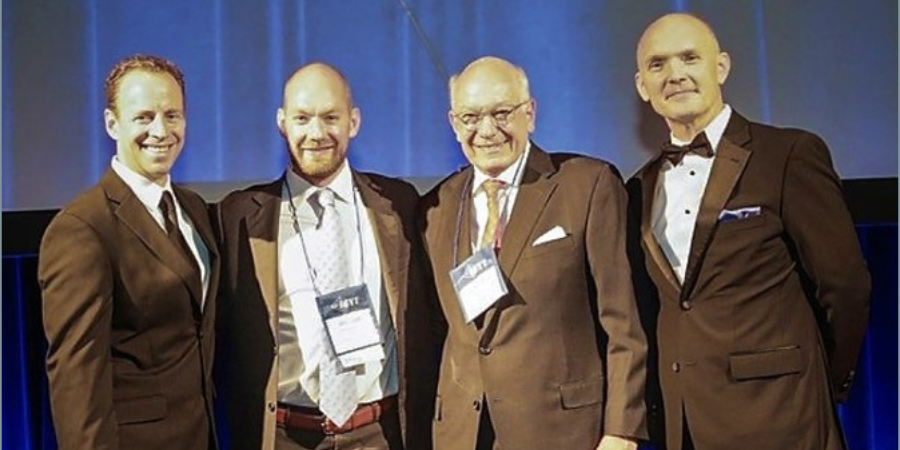
Paulo Products was the recipient of the Commercial Heat Treater of the Year award presented by Heat Treat Today, in cooperation with The Metal Treating Institute (MTI). The award was initially decided and presented virtually in 2020, and was formally awarded in person on October 6, 2021 during the MTI Annual Fall Meeting awards banquet in San Antonio, Texas.
MTI awards the Commercial Heat Treater of the Year to the company that demonstrates they are making a positive impact in the community and the industry. The award is judged by a panel of previous recipients based on quality programs, pollution and hazardous waste control, community involvement, and leadership.
The award consists of a plaque and a $1,500 donation to the MTI Educational Foundation by Heat Treat Today in the name of the winning company. The donation was matched by MTI’s Educational Foundation. Paulo Products will award this $3,000 as a scholarship to a high school or college student pursuing an education towards heat treat.
Photo: Paulo Products being recognized as 2020 Commercial Heat Treater of the Year. (L-R) Jim Oakes, Super Systems, Inc. & MTI President; Will and Ben Rassieur Paulo Products; Doug Glenn, Heat Treat Today
Metallurgists need accurate specifications in order to correctly perform the necessary heat treatment of parts. This helpful guide, written by William Rassieur, Sales Leader at Paulo Heat Treating, is a useful tool to identify what details ought to be communicated to the heat treating expert. Read below to understand the terms to pass along.
William Rassieur, Sales Leader, Paulo Heat Treating
Too often, metallurgists receive inadequate heat treatment specifications. Some specs contain too little information. Some are unclear. Some are just plain wrong.
In any case, inadequate specs mean heat treaters don’t have the information they need to deliver finished parts that can stand up to the applications intended by their manufacturers. Avoiding the confusion and delays that follow comes down to understanding what heat treaters need to see in heat treatment specifications so that the right treatment is applied.
Make certain your parts get the appropriate treatment by including the following information:
Clearly identified materials
The chemical makeup of a part is one of the most critical determinants of how it is heat treated. It’s not enough to state on the spec that a piece is steel alloy. Consult materials standards and use the correct material designation on the spec.
For example, if you want to treat a carbon steel or an engineering alloy, using those terms (or known trade names for a specific material) isn’t adequate. Good heat treatment specifications include the material as expressed in the standards—AISI 1040 for a carbon steel, for example, or SAE 4140 for an engineering alloy.
Specific process required
It’s not enough to tell a heat treater you’d like a harder part because there are many ways to do that. Does it need to be through hardened? Case hardened? Does it require stress relief via annealing?
Specs that dictate which process is to be used help heat treaters shape the rest of the heat treatment steps that follow.
Hardness tolerance
For through hardened parts, a prescribed hardness should be included on the spec and expressed as a range. Tolerances are always more useful than uniform hardness levels because parts can have different hardness values in different regions due to material thickness or closeness to an edge.
Engineers should note that the materials and dimensions of a part affect how well it hardens out. As these variables change, so does the acceptable hardness tolerance that should appear on a spec.
Case depth tolerance
For case hardened materials (i.e., those that are carburized or carbonitrided), specs should indicate whether the desired hardness is expressed as effective case depth or total case depth.
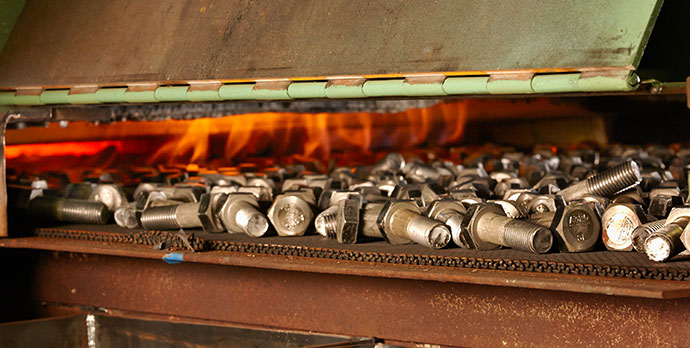
Case Hardening (photo source: Paulo.com)
Total case depth refers to the distance carbon has diffused into the part. This is usually specified for parts that have thinner case depths after treatment. Effective case depth applies to parts with generally thicker cases. This is measured as the distance from the surface through the case to a specific hardness level. Usually, that hardness is effective based from 50 or 52 HRC. This should always be stated on specs.
Heat treatment specifications should also identify the case tolerance, or the range of depths the prescribed hardness should reach. For example, a good spec for the heat treatment of a theoretical gear might state the effective case depth should be between 0.007 and 0.012 inches at the prescribed hardness.
As with through hardening, it’s more useful and realistic to specify minimum and maximum case depths rather than to write specs with a single case depth. Specs that include only minimum or maximum case depths still leave too much to interpretation and should be avoided.
Avoid too much information
Sometimes, though, too much specificity can lead to trouble. Specs that include too much process information can paint metallurgists into a corner, forcing them to abide by strict requirements that can end up thwarting their efforts to deliver improved parts.
For example, if a tempering spec includes both a specified temperature and a specified hardness, the hardness may not be possible to achieve due to differences in equipment. In such a scenario, metallurgists advise that specs be amended to call for a minimum temper as long as the part’s configuration and material hardenability are capable of achieving it.
Correct hardness scales
The scale on which a part’s hardness is determined depends on the heat treatment applied to the part. In the U.S., we typically use the following four hardness scales: Rockwell Hardness, Brinell Hardness, Microhardness, and Leeb Hardness. Become familiar with each scale and which parts and processes should be tested with each.
Also note that conversions between hardness scales should be avoided unless it’s absolutely necessary. That’s because hardness values are approximate; converting from one approximation to another compounds variation and could lead heat treaters and owners to incorrectly assume the prescribed hardness has been achieved.
Inspection points
Heat treatments are carefully designed to achieve specific results on specific areas of parts, so owners need to clearly identify those areas on which hardness tests are to be conducted.
For example, the critical part of the theoretical gear mentioned above is its teeth; case hardening is designed to strengthen that part of the gear while leaving other areas relatively soft and ductile. Applying a hardness test anywhere else but the teeth won’t inform heat treaters of whether the treatment was successful.
Be prescriptive with heat treatment specifications
Problems with heat treatment specifications are one of the biggest —and perhaps the most avoidable— pain points in the relationship between a manufacturer and heat treater. Manufacturers need finished parts that perform as promised. Armed with accurate and descriptive heat treatment specifications, heat treaters can deliver that performance.
For more information, contact the quoting team at Paulo or download Paulo's guide for in-house versus out-source handling of heat treatment needs.
The privilege of unveiling the Heat Treat Today 40 Under 40 Class of 2019 comes with the disappointment that not every one of the nominees could be included in the final count, even though each young, up-and-coming, talented heat treating professional whose name was submitted is making a significant difference in their field. We will be back next year looking for candidates for the 40 Under 40 Class of 2020, and in fact, you can begin the process right now. Click here to nominate the young professional you have in mind who is not listed among the finalists or honorable mentions.
Consider this list a preview:
The 2019 Honorable Mentions
Andy Muto,
Paulo Heat Treating
Hiram Martinez,
Inductotherm HWM
Judith Levermann,
SMS Elotherm GmbH
Mitchell Kaltenbaugh,
Peters’ Heat Treating, Inc.
Ryan McLaughlin,
McLaughlin Furnace Group
Tee Rassieur,
Paulo Heat Treating
William Rassieur,
Sales Leader,
Paulo Heat Treating
Vadims Geza,
Chief Product Officer,
CENOS LLC
The individuals pictured are those we acknowledge in 2019 with an Honorable Mention for their contribution to their company, their dedication of service to their customers, their commitment to pursue skills and knowledge about their field. You should know that we at Heat Treat Today are rooting for you and have already rolled the names of any qualified Honorable Mentions into the nominations for the Class of 2020.
Heat Treat Today encourages the rest of you to keep your eyes open for young professionals you encounter within your heat treating sphere, especially in the captive heat treatment industry, who deserve recognition and encouragement to stick to the path that will take the industry to greater heights of technology, quality control, standards, and leadership.