



Considerations for Base Metal Thermocouple Wire Diameters


Thermocouple Specialist
Pelican Wire

Business Development Manager
Pelican Wire
“What size wire should I use in my thermocouple assembly?” While this is a pretty direct question, the answer is more complex. In this fascinating Technical Tuesday article, learn how both the type of thermal processing as well as the stability and performance of the thermocouple contribute to selecting the right size wire. Read more in this Heat Treat Today Original Content article by John Niggle, Business Development Manager, and Ed Valykeo, Thermocouple Specialist, at Pelican Wire, Naples, FL.
This article will discuss influences that should be considered when choosing the wire diameter in a base metal thermocouple circuit. It is important to keep in mind each thermal process will dictate the type and size of thermocouple. It is also important to understand there are several factors which influence the life expectancy of a thermocouple circuit.
We often get asked, “What size wire should I use in my thermocouple assembly?” The quick and simple answer is, “Use the largest practical size.” While this may be true, the individual thermal process should dictate the proper wire size.
The selection of a specific wire size for a given thermal process is related to the question of “expendability.” A thermocouple not exposed to harsh environments or excessive temperatures should have a long and useful life. Thermocouples exposed to corrosive atmospheres and elevated temperatures should be considered expendable. In general, if a thermocouple wire is deemed expendable then the wire should be no larger than necessary. If the thermocouple wire is exposed to excessive temperatures, or harsh environments, a larger diameter wire may be required.
There are several factors that affect the stability of thermocouple alloys:
- Evaporation – Especially at higher temperatures certain elements evaporate more readily than others.
- Diffusion – Alloying elements from one leg to the other.
- Oxidation – In most cases oxidation in clean air is beneficial for thermocouple performance. As oxide film thickens with time and temperature, the overall composition of the thermoelement changes.
- Contamination – Changes in wire composition can affect thermocouple drift. Contamination from sulfur, iron, and furnace refractories can be sources of contamination.
Each of the above factors can induce EMF (electromotive force) drift, caused by a change in alloy composition. EMF drift is the potential for the thermocouple to lose its accuracy over time. Typically, this change takes place on the surface of the wires. Since smaller diameter wire has increasing ratios of surface to volume exposure, they are more rapidly affected by surface effects. The rate at which this phenomenon progresses accelerates as the temperature increases.
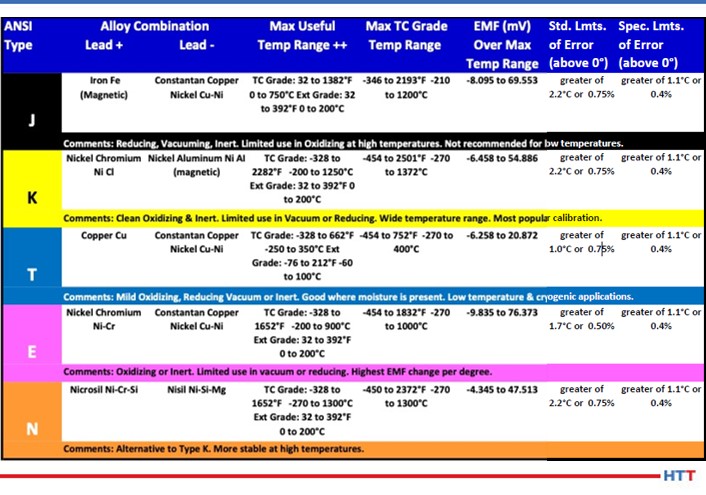
It is important to keep in mind each base metal thermocouple type has its advantages and disadvantages. The environment and temperature range contribute to the overall thermocouple performance. Using a thermocouple in the wrong environment or incorrect temperature range could increase the opportunity for adverse surface effects, regardless of the wire size.
There are other considerations when choosing a wire size in a thermocouple circuit:
- Stem Loss – Stem conduction is heat conduction along the length of a wire. When the heat source end and the cold junction end of the wire are at different temperatures, stem conduction occurs. This temperature discrepancy produces a reading different from the actual heat source temperature. Using a larger gauge conductor could produce an error due to stem loss conduction.
- Resistance – The industry standard is to keep total loop resistance of your circuit under 100 ohms. Loop resistance is determined by multiplying the length in feet by the resistance per double feet. Double feet is the resistance per foot of each thermocouple element. Decreasing the wire size results in the increase of resistivity of each thermoelement, which affects total circuit resistance.
- Flexibility – Some thermocouple assemblies are run through conduit or inserted in protection tubes. As you increase the wire diameter you lose some flexibility.
Useful thermocouple life is difficult to predict, even when most of the details of an application are known. The best test for any application is to install, use, and evaluate the performance of a design that is thought likely to succeed. Thermocouple type descriptions are good source for determining recommendations, and prohibitions for thermocouple use.
Keeping in mind these recommendations, as well as having a better understanding on what affects thermocouple performance, should help you select the proper wire diameter for your specific application.
About the Authors: John Niggle has been the business development manager at Pelican Wire since 2013 and has prior sales experience in process instrumentation. Ed Valykeo, a 40-year veteran in the wire industry, many with Hoskins, is a thermocouple specialist who has worked with Pelican for 10 years.
Considerations for Base Metal Thermocouple Wire Diameters Read More »