Toyota Invests in eVTOL Air Taxi Development
Joby Aviation has spent the last 10 years hammering out the designs and flight dynamics of its tilt-rotor eVTOL (electric vertical take-off and landing) aircraft . Thanks to an investment round led by Toyota, they now have substantial funding to continue development.
Toyota's share of the US$590 million series C finance round was $394 million, and it comes with a commitment to bring its manufacturing, quality, and cost control approaches to the table as Joby prepares to move closer to FAA certification and commercialization of its five-seat electric VTOL air taxis.
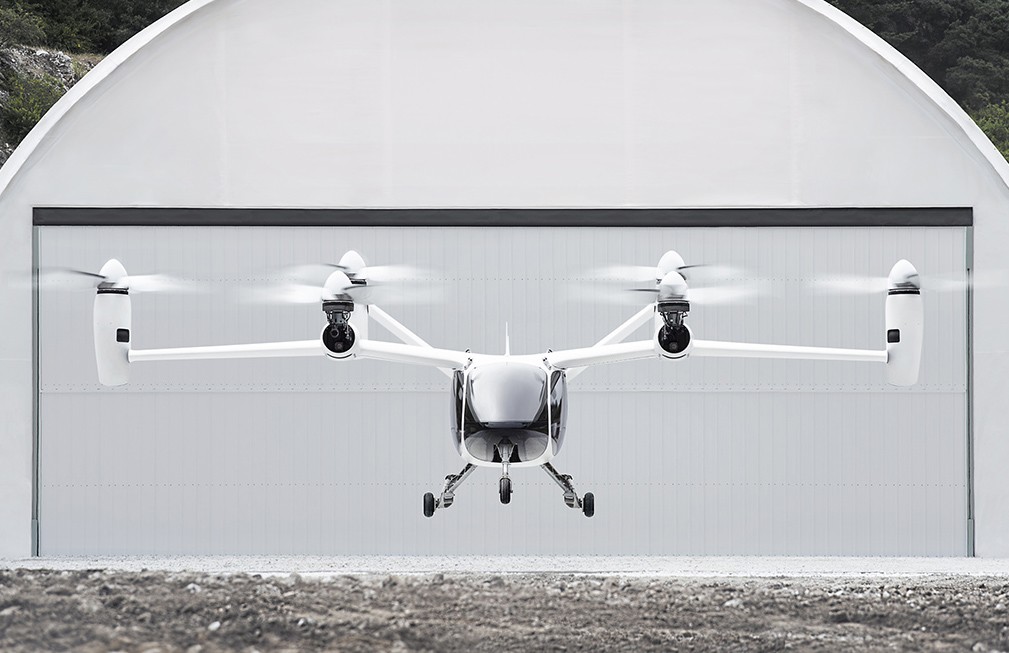
Joby's full-scale prototype features thin wings supporting four tilting prop units, the outer ones on swivel mounts and the inner two extending out and upward on short arms. A V-shaped tail unit carries two more swivel units for a total of six rotors, each about six feet (1.8 m) in diameter with five uniquely shaped blades.
The idea is to have an electric aircraft capable of taking off and landing vertically on a helipad or similar that can then transition to winged forward flight once it's airborne for efficient cruising at high speeds. Joby claims its vehicle is capable of 200-mph (322-km/h) flight, and that its small rotors produce about 1 percent of the noise of a regular aircraft on takeoff. In winged cruise mode, the company says it will be virtually silent on the ground.
Toyota may also bring hydrogen powertrain to the table. Toyota and Hyundai/Kia are more or less the only companies still forging ahead with hydrogen powertrains for cars, but Japan and Korea are investing in hydrogen in a massive way, envisioning a transport future largely running on fuel cells, using imported energy from overseas to move some of their emissions out of their choked megacities and into the skies of countries like Australia, which is gearing up to become an energy exporter in the form of liquid hydrogen.
Moving to a hydrogen powertrain solves the problem of energy density for eVTOLs in a single stroke. Liquid hydrogen might be a pain to handle and deal with (and explosive in an accident), but its energy density is superb. Running a hydrogen eVTOL air taxi service would enable super-quick refueling and ultra-long-range flight, maybe 10 times the range of what current battery technology can deliver.
A common topic regarding eVTOL is safety, a problem that still needs an answer. The Joby aircraft, like the vast majority of other designs, offers a certain degree of redundancy in case of rotor failures. The problem nobody seems to be able to deal with yet is what happens in case of total catastrophic failure below a height of about 120 ft (37 m). Ballistic parachutes remain troubling, and while helicopters have the ability to autorotate safely to land without power, multirotor eVTOLs do not.
Joby is right at the forefront of eVTOL development right now, alongside other well-funded companies. It has recently signed a deal with Uber to supply and operate these aircraft under an Uber Elevate service. Uber is promising to build and run the skyports and support services for these air taxis as well as managing last-mile connection transport at either end of a journey. Uber is targeting 2023 as a launch date.
Photo Credit: Joby Aviation
Toyota Invests in eVTOL Air Taxi Development Read More »