Today’s Motor Vehicles – May/June 2016
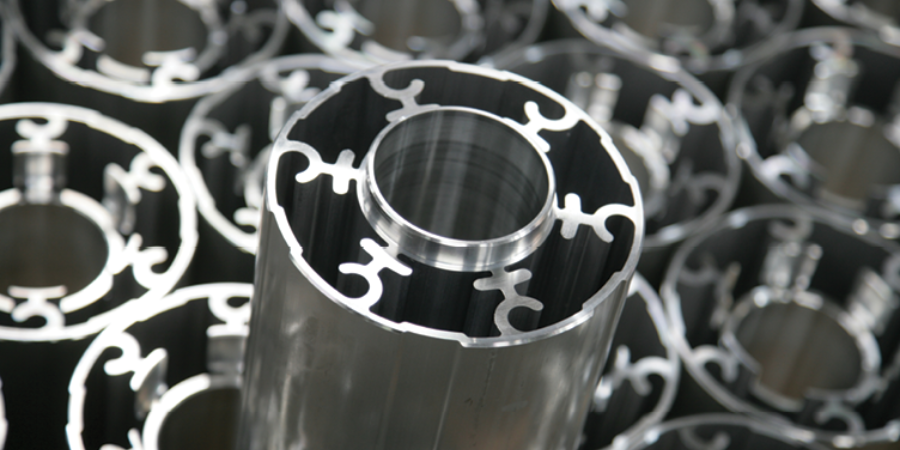
Making Aluminum Extrusions
Dave Lukasak, director of metallurgy at Sapa Group, explains the process used to create extruded aluminum parts.
Cast logs – A furnace melts primary aluminum, aluminum scrap, and alloying elements to create the alloy. Workers then transfer the molten metal to a casting table where logs are cast in vertical, semi-continuous process. The end result are logs 200″ to 300″ in length.
Homogenize – Ingot casting is a non-equilibrium process, so solidification results in a non-uniform structure that could lead to micro-scale, non-uniform properties in the final product. To counter this, the cast logs are heated to approximately 570°C, depending on the alloy. The resultant metal has a more uniform structure better suited for extrusion and creation of the final product. After homogenization the logs are cooled quickly to lock the uniform structure in place.
Extrusion – Billets and the tool-steel die are heated to between 490°C and 520°C. An extrusion press then forces the billet through the small opening in the die using about 90,000psi. Temperature control is critical as deformation from squeezing material through the die opening increases the temperature of the aluminum significantly. If the temperature of the ingot is too hot, the heat of deformation can take the aluminum to a temperature where tearing occurs as the profile emerges from the die. If the temperature is too low, the physical strength of the final extrusion can be compromised. Employees use two-dimensional dies to create flat profiles or three-dimensional ones to create more complex shapes such as boxed beams. Cathleen Rutsey, an automotive applications engineer at Sapa, says she keeps an old Play-Doh press in her office to demonstrate the basics of controlling extrusion shapes.
Quench – Parts are air-cooled or water-cooled, upon exiting the press, depending on the shape, alloy, and intended use. Quenching locks elements in solid solution critical for developing the final strength of those extrusions that are heat treatable, such as 6000 series alloys.
Age – Finished parts are heated from 175°C to 230°C for up to 12 hours. Following aging, material strength will continue to increase for about a week, so Lukasak says it’s important to use a first-in-first-out (FIFO) inventory management system.
Precipitation aging – Heat-treatable aluminum alloys require artificial aging to achieve the required mechanical properties for the intended application. For 6000 series alloys, extrusions are heated to approximately 175°C to for up to eight hours – specific practices are alloy dependent. If a customer needs to form extrusions, doing so in the precipitation-aged condition can result in cracking, so some customers purchase unaged extrusions to have softer material that has better forming properties. Lukasak adds that even at room temperature, heat-treatable extrusion alloys continue to gain strength through what is termed natural aging. The initial increase is rapid with a 25% to 30% increase in strength in 2 to 10 days, so first-in-first-out inventory management helps create a more consistent forming operation.
Read More: Automotive Aluminum Extrusion Market Grows