
Tiffany Ward

Our People

Heat Treat Today publishes twelve print magazines a year and included in each is a letter from the editor. This letter is from the September 2025 Annual People of Heat Treat print edition. In today’s letter, Bethany Leone, managing editor at Heat Treat Today, shares about the value of people in the heat treatment publication industry, highlighting individuals in the Heat Treat Today family.


We’re in business because people matter. Heat treating just happens to be our industry — which means we like making things hot (and then cold). But at our core, our business is people.

The Business of People

When I ask someone their favorite thing about the heat treating industry, most of the time, the answer is “the people.” Engineers, operations managers, sales reps, and operators all echo the theme.

Why is that? Maybe it’s the strong family values found in many family-founded, family-run operations. Or maybe the behind-the-scenes nature of the discipline draws a more people-focused crowd. It could be that the slower-paced, deliberate innovation attracts people motivated by collaboration more than competition. I’m not sure.

For whatever reason, it is a hallmark to our industry that those from various backgrounds and experiences can come to feel like family.

Welcome to the Family

Over the past year, we’ve welcomed several new individuals to the Heat Treat Today family. Each of them provides essential skills and abilities to making this publication helpful to you.

Jake Romano joined us in the summer of 2024. He embodies so many of our core values that it feels like he’s been here longer than just a year. Jake’s detailed eye for creative problem-solving has allowed our Heat Treat Radio podcast to reach new heights, funneling robust interviews to you seamlessly every month. He never fails to step up to the plate if time is of the essence and does so with the utmost professionalism and an ear for a good story: “My favorite thing that I’ve learned about the industry is just how diverse it is. There are so many people with fascinating backgrounds and reasons for joining the industry and I’ve been enjoying hearing their stories!”

Kelsha Wells has been the mastermind behind social media since fall of 2024 and recently coordinated the 40 Under 40 nomination process. The fruits of her labors are seen daily, connecting industry news and technical updates to you via social media. “From day one, I was struck by how incredible everyone is, not just in their talents, but in their willingness to support one another, celebrate wins, and work together seamlessly. That impression has only grown stronger over the past year.” This magazine edition is particularly special as she gets to see the many worthy young people featured on pages 36 to 71. She also supports various marketing campaigns for Heat Treat Today.

Michele Shaller found us through our legendary Laura Miller (now retired… we think). Michele assumed her position as editorial specialist in late-winter 2025. Every article you see in the print edition, every Heat Treat Radio transcript, and every, “hey, could you look at…?” piece of material gets an eagle-eye review by this whirlwind editor. Additionally, she is the editorial caretaker of several platforms, including the monthly e-newsletters.

Tiffany Ward connected with us in early spring 2025 and has been generating and formatting timely technical content for our website and Heat Treat Daily readers ever since. If you’ve ever had to scrap a heat treat plan and pivot fast under pressure, you have an idea of what Tiffany’s workday looks like every day. Can you say “pivot”?

Hamilton Pearman stumbled across the heat treat industry in 2014 and took a hiatus for a few years. Recently, he has returned, and in late-spring 2025, Hamilton assumed a sales role for Heat Treat Today’s European connections. Hamilton observed that the heat treat industry is like a large friendly family, “and that’s such a relief in the world we live today… Heat Treat Today is one the best examples of what I mean. Family, technical, focused, and yet still friendly.”

Mariah Roth, stepping into the critical role of administrative assistant as of this summer 2025, addresses the immediate challenges that our team faces. Fittingly, she commented the following: “Since joining the team, [I’ve been] realizing and affirming just how small the world is — this is something my grandpa had always said. The older I get, the more I understand this phrase. At the same time, I’m always learning how much I don’t know about the world. Coming from a metallurgy background to a heat treat industry, and now to a heat treat magazine company has really brought me full circle.”


Bethany Leone
Managing Editor
Heat Treat Today
Contact: Bethany Leone at bethany@heattreattoday.com


Our People Read More »

From Furnace To Your Front Door: A Morning in Heat Treatment

Heat treatment impacts almost every facet of our lives, yet few people are aware of how important this practice is to a modern way of living. Heat treatment is a process which changes the microstructure of a metal, such as hardening, carburizing, tempering, and many others.

When a metal is formed, it undergoes heat treatment in order to make it longer lasting, change its structure so that it becomes harder or softer, or reduce the tendancy toward cracking which can form during manufacturing. To help us appreciate the impact of heat treatment on our daily lives, Tiffany Ward, daily editor for Heat Treat Today, has prepared this illustrative post.


Breakfast of Champions

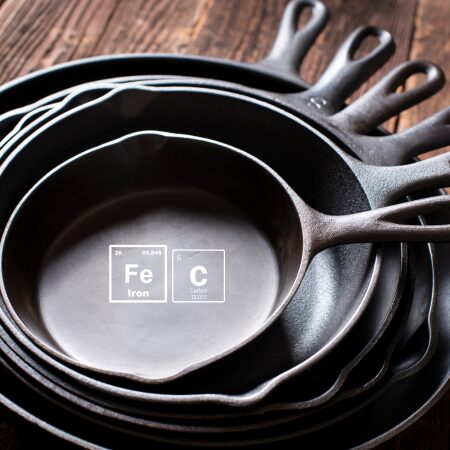
You wake up in the morning and roll yourself out of bed, greeting a foggy sunrise through the window. You stumble to the kitchen to fire up your cast iron skillet.

Cast iron contains a minimum of 2% carbon

At one time, that same cast iron skillet lived a provincial life, known as simply: iron. Cast iron is made from iron with greater than 2% carbon, which is in the form of graphite. When that iron was “cast,” it was melted at a high temperature, and once cooled, it transformed into a very stable material that heats and cools uniformly. Perfect for your sunny-side-up eggs.

At the foundry, someone poured the molten metal into a mold to form the exact shape your pan is in today, and then it underwent numerous heat treat processes: annealing, normalizing, tempering, and even graphitizing (a process of converting carbon into graphite). The particular processes the skillet underwent depend upon the chemistry of the cast iron.

Almost all cast iron has carbon and nitrogen added to its surface in a process called ferritic nitrocarburizing plus post-oxidation. This heat treatment gives a shallow surface layer to the pan for better wear resistance. The skillet is heated up between around 1550°F and 1650°F inside a protective atmosphere of Endothermic gas. Endothermic gas is a generated heat treat atmosphere. It is made up of approximately 40% hydrogen, 40% nitrogen, and 20% carbon monoxide. The Endothermic gas is enriched with both a hydrocarbon gas (i.e., natural gas or propane) and ammonia so that carbon and nitrogen can be added to the iron.

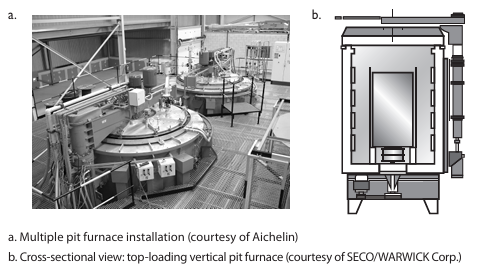
There are a variety of different furnaces that can be used for ferritic nitrocarburizing. Box, pit, and tip-up furnaces are used due to their large capacity. For cast iron skillets, one common choice is the pit furnace a cylindrical furnace typically located in the floor of a factory. Pit furnaces can hold a lot of heavyweight items, making them a good fit for the cookware now resting on your stove.

Figure Source: Herring, Daniel H., Atmosphere Heat Treatment Volume 1, BNP Media II, LLC, 2014. 

Technical Resource: An Overview of Case Hardening: Which Is Best for Your Operations?

Technical Resource: Nitriding and Nitrocarburizing: The Benefits for Surface Treatment


It Cuts Like a Knife

You pull a knife out of your drawer and begin slicing an apple. The blade reflects a beam of sun from the window, but it isn’t your best knife. You’ve noticed that some of your knives are sharper and can resharpen more easily than others; this is because of the quality of the original material used and the heat treatment process employed in manufacturing the knife.

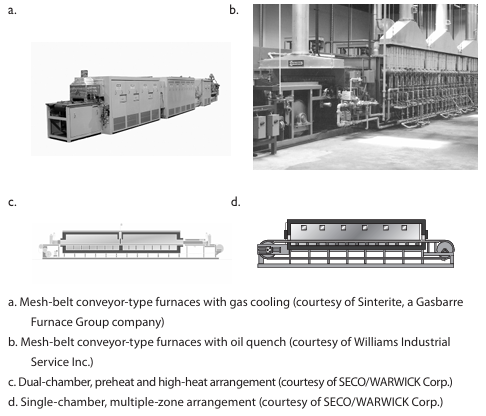
Perhaps the knife you chose to use today was made from high carbon steel such as 1095. The blade was heat treated using a process of hardening, quenching, and tempering. After the blade was formed, it entered a continuous mesh-belt furnace and was quenched in either oil (in the case of a 1095 steel), or in the case of stainless steel or tool steel, cooled in still air.

Source: Dan Herring, The HERRING GROUP, Inc.
Figure: Batch integral-quench furnace system installation (courtesy of AFC-Holcroft). Dan Herring, The HERRING GROUP, Inc.

At the same time of hardening and quenching, the handle was joined to the blade in a process called brazing. The entire knife was heated up to an austenitizing temperature and rapidly cooled in the quenching process, giving it a particular hardness level.

The hardening process can be performed in a vacuum furnace or an atmosphere furnace. The atmosphere is typically nitrogen or, more commonly, a nitrogen/hydrogen mixture. Another option is nitrogen plus dissociated ammonia (dissociated ammonia is 75% hydrogen, 25% nitrogen).

A typical temperature for the heat treatment of high carbon 1095 steel knives is 1475ºF. Stainless steels are run at higher temperatures, typically in the range of 1800º/1950ºF and tool steels even higher, to around 2200ºF.


Technical resources: Ask the Heat Treat Doctor®: How Does One Determine Which Quench Medium To Use?

Technical Resource: Heat Treat Radio #105: Lunch and Learn: Batch IQ Vs. Continuous Pusher, Part 2


Time to Look Pretty

After breakfast you head to the bathroom. You are anxious to rid yourself of unshaven scruff, carefully running a razor over your face. The razor blades were hardened and tempered for sharpness, so that you get a smooth, clean shave. 

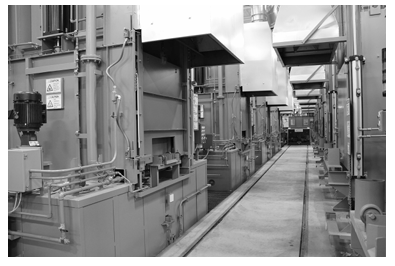
Like knives, razor blades are hardened and are made of a medium to high carbon steel. Unlike knives, they are hardened in a continuous strip form. Envision all of your razor blades as a single, thin strip, run continuously through a furnace to heat and cool them. The blade is heated in a protective atmosphere as it runs through the furnace. On one end of the furnace is a reel that coils the strip and at the other end is an un-coiler.

Continuous style furnaces have alloy tubes inside of them that are very small in diameter, typically one inch, which run the entire length of the furnace. As the razor strip is run through the tube it is exposed to an atmosphere of nitrogen and hydrogen, typically with 3% hydrogen, to protect the razor blade surface from oxidation. Once heated, the blade enters cooling either by surrounding the tube with water or by blowing forced air on the tubes.

A process called tempering follows hardening and quenching. When you harden a material you make it stronger, but less ductile, so there is a concern that the razor blade might break. The tempering process improves ductility, removing some of the hardness but improving flexibility.

Dan Herring, The Heat Treat Doctor®, describes the balancing act this way: “On one end of the teeter totter, metallurgically, are strength properties and on the other side of the teeter-totter are ductility properties. It’s always a challenge to properly balance the teeter-totter. If you get the hardness too high, what happens to the ductility? It’s very low. As a result, the material is super hard but may crack easier. On the other hand, if ductility is too high, the material is super flexible so that it can bend like a branch of a tree in the wind, but it has little strength. You need a balance of strength and ductility in all heat treated products, which is accomplished in part by proper tempering.” 


Technical Resources: Tempering: 4 Perspectives — Which makes sense for you?

Technical Resources: Ask The Heat Treat Doctor®: What Are the Differences Between Intergranular Oxidation (IGO) and Intergranular Attack (IGA)? 


Wake Up and Smell The Heat treatment

Our lives are touched by heat treatment at every turn. Highly technical processes play their role in the formation of even the most common household items. While heat treatment may seem to some a niche industry, its impact on everyday life is ubiquitous.

A special note of thanks to Dan Herring, The Heat Treat Doctor®, for his insights and contributions which informed this post.


From Furnace To Your Front Door: A Morning in Heat Treatment Read More »

Skip to content