


Publisher’s Page

4 Unrelated Items

Heat Treat Today publishes eight print magazines a year, and included in each is a letter from the publisher, Doug Glenn. This letter first appeared in the November 2024 People of Vacuum print edition.

Feel free to contact Doug at doug@heattreattoday.com if you have a question or comment. 


Don’t try and weave a common thread between the four items below; there really isn’t one.

Act of Kindness in the Vacuum Industry

One of North America’s leading vacuum heat treat-related companies lost one of its key leaders to a battle with cancer recently. My wife and I were fortunate to attend a very Christ-centered funeral service which, in its own way, was encouraging even as it recognized the pain and sting of death. One of the most touching and thoughtful things happened when my wife and I came to the front of the viewing line to extend our condolences to family members. The father of the deceased pulled us aside and showed us a beautiful bouquet of flowers sent by a competitor. In my eyes, this was a classy and thoughtful gesture, and it was deeply appreciated by the family. It just goes to show that North American heat treating is a rare industry full of kind and thoughtful people. Kudos to the competitor for their thoughtfulness.

Signs that Our Industry Is “Younging Up”

Over the past several weeks, I have been more and more impressed with how the North American heat treat industry is attracting and maintaining excellent young talent. If you read any of the content we put out in September, you’ll know that we honored another 40 young individuals who are rising leaders in the North American heat treat market. In fact, we’ve honored 240 such individuals since 2018. Many of these recipients continue to contribute to the industry in significant ways.

I also had the pleasure of attending the Industrial Heating Equipment Association’s (IHEA) annual Combustion Seminar and Safety Seminar. The number of young people taking these two courses this year was very impressive. Well over half of the attendees were easily under the age of 40 with a large number appearing to be in their 20s or 30s.

Thanks for Rating Us Highly

Results from a recent industry study proved to be very positive for Heat Treat Today, The study focused on heat treat media brands in the North American market and Heat Treat Today ranked #1 in all categories. Our team was humbled and thankful to all of our readers for the faith you put in us to bring you the latest and most helpful technical and news content. We believe people are happier and make better decisions when they are well informed. If you’re a supplier to the industry and are looking to reach end-users of heat treat equipment, especially manufacturers who have their own in-house heat treat operations, please know that we’d be honored to help. To all of our readers, viewers, and listeners, thanks for ranking us so highly. We appreciate your faith in us.

Print Is the Most Preferred Media

Doug Glenn
Pubisher
Heat Treat Today

Somewhat counterintuitively, the above media study revealed that respondents vastly preferred the print version of a magazine over a) the digital edition of the magazine, b) websites, c) e-newsletters, d) podcasts, and e) social media — in that order. The survey was sent out by email, so it was not skewed by sending it only to those who currently receive print copies. The survey was sent to a mixture of print magazine recipients, website visitors, e-newsletter recipients, and podcast listeners and STILL a preference for a copy of the print magazine far outpaced all the other options — across ALL recipients regardless of age. Interesting results which might help inform your future marketing plans if you’re a supplier to this industry.

Contact Doug Glenn at doug@heattreattoday.com.


Find Heat Treating Products And Services When You Search On Heat Treat Buyers Guide.Com

4 Unrelated Items Read More »

Letter from the Publisher: Heat Treat Green Is Coming

Heat Treat Today publishes eight print magazines a year and included in each is a letter from the publisher, Doug Glenn. This letter first appeared in Heat Treat Today's March 2023 Aerospace Heat Treating print edition.


Doug Glenn
Publisher and Founder
Heat Treat Today

Depending on where you live, “green” started to appear outside in March.

Contact us with your Reader Feedback!

Such was the case this March with Heat Treat Today. Our efforts were “greening up” around here as well. With the push for sustainability and environmental corporate responsibility, we decided to start the industry’s first and only “green” heat treat annual magazine edition and quarterly e newsletter. The Heat Treat Today team has been working on these items for several months now, but we are officially announcing them this month and encouraging you to watch for them both in May.

Whether you’ve been mandated to make your in-house heat treat operation more sustainable, or you want to do it simply because it’s the right thing to do, we’re here to help.

NEW Green Technologies in Heat Treat Annual Print Edition

Heat Treat Today's May print magazine will be the inaugural yearly focus on Green Technologies in North American heat treat. We’ll have articles and special editorial sections focused on sustainable technologies currently or soon-to-be available in the North American heat treat industry. This highly-focused issue will give industry suppliers a chance to shout loud and far about the technologies they have that will help you make your in-house heat treat operation more sustainable and productive. We anticipate topics such as:

  • Induction heating equipment
  • Electrical furnaces and ovens, including vacuum furnaces
  • High-efficiency gas-fired equipment
  • High-efficiency burners
  • Efficiency-maximizing control systems
  • Energy-saving insulating materials
  • Emission control or capture
  • Eco-friendly quench media
  •  Economizing cooling systems
  • Industrial gas economizing systems
  • High-efficiency radiant tubes
  • High-efficiency heating elements

Potentially, there will be many other topics added to this list. There should be something for everyone who is interested in making their in-house heat treat operations, or commercial heat treat shop, more sustainable. I hope you look forward to receiving your copy and enjoying the content . . . in May!

NEW Quarterly Heat Treat Green E-Newsletter

Sustainable technologies come into the market more than once a year, so, Heat Treat Today is launching a new quarterly e-newsletter this May that focuses on sustainable heat treat technologies for the North American marketplace. This e-newsletter, aptly named Heat Treat Green, will also focus on emerging and currently available sustainable technologies and products that will help your heat treat operations reduce environmental waste in a responsible manner. We anticipate that this e-newsletter will be deployed in the months of February, May, August, and November each year.

Do You Have a Green Story To Tell?

In both the annual magazine edition and the quarterly e-newsletter, we’d be interested in publishing your in-house heat treat sustainability story if you have one to tell. Our readers benefit from hearing what other manufacturers are doing to make their heat treat operations more sustainable. Many chief compliance officers or others in your organization responsible for promoting sustainable practices are typically quite interested in telling their sustainability stories. If that’s you or your company, we’d like to help you get the word out to the North American heat treat industry. Please contact our editors at editor@heattreattoday.com, and we’ll be sure to be in touch

Finally, if you’re a supplier to the North American heat treat industry and your product has a sustainability story to tell, you also should contact our editors: editor@heattreattoday.com.

Keep your eyes peeled for Heat Treat Green!


Find heat treating products and services when you search on Heat Treat Buyers Guide.com


Letter from the Publisher: Heat Treat Green Is Coming Read More »

Letter From the Publisher: Keto & Carbon

Heat Treat Today publishes eight print magazines a year and included in each is a letter from the publisher, Doug Glenn. This letter first appeared in the Heat Treat Buyers Guide print edition.


Doug Glenn
Publisher and Founder
Heat Treat Today

In the world of dieting and food, it is pretty much commonly accepted that today’s diet or medical advice will be proven wrong tomorrow. For example, it used to be that coffee was good for you; then it became bad for you; then good again. The Atkins Diet, heavy on protein and light on carbs and fats, was once considered the best way to lose weight — today, not so much.

Contact us with your Reader Feedback!

Just this week, I was visiting with a heat treat industry legend in Brighton, Michigan. He and his wife own a building in downtown Brighton where their son runs a successful microbrewery business. On the wall near the bar area, there is an old, 1900s-vintage newspaper advertisement for a miracle elixir that was purported to cure any ill. The ingredients in the elixir were ingredients that one would be arrested for possessing in today’s world — think cocaine, etc. — and are known to be poisonous today. But back in the day when the ad for this elixir was published, the contents were widely accepted as a miracle cure for many ailments.

The point being that yesterday’s “truth” quite frequently is shown to be untrue over time.

Enter the “carbon” debate.

This last week I also attended three trade shows: AISTech in Pittsburgh, Fastener Fair USA, and Rapid+TCT (both in Detroit). Especially at AISTech, but also at the other two events, the discussion of carbon neutrality and green technologies was rampant. It is safe to say that carbon is today’s bad boy element. According to the prevailing science of the day, carbon is the source of many of our societal problems. Carbon dioxide (the stuff we exhale until we die) is considered to be the single most dangerous compound in the universe — one that will be responsible for the extinction of man if it goes unchecked.

What if we’re wrong about carbon in the same way that we’ve been wrong about a myriad of other things? What if carbon really is good? What if increased levels of carbon dioxide result in more vegetation growth (because green things LOVE carbon dioxide), resulting in a natural stabilization of the environment? What if we fi nd out that our concern about the badness of carbon has been misguided? What if we fi nd out that we’re actually doing more harm to the earth by minimizing the amount of carbon dioxide?

I know it sounds crazy, but if we can learn anything from history, it is this: We are often wrong about those things that we feel so strongly about and those things we once thought were right are wrong, and those things we once thought were wrong are right.

Based on history, approaching the carbon problem with a degree of humility and caution seems appropriate. Much like the Keto Diet has recently been all the rage but may well be yesterday’s diet fad, we should also remember, although on a much longer timeframe, that carbon and carbon dioxide may one day be our friend.

It could happen!


Find heat treating products and services when you search on Heat Treat Buyers Guide.com


Letter From the Publisher: Keto & Carbon Read More »

Letter From the Publisher: Energy Supply Is Not the Problem

Heat Treat Today publishes eight print magazines a year and included in each is a letter from the publisher, Doug Glenn. This letter first appeared in Heat Treat Today's May 2022 Induction Heat Treating print edition.


Doug Glenn
Publisher and Founder
Heat Treat Today

With the war in Ukraine, the availability of energy resources has taken centerstage. Readily available energy is nowhere more important than in the heat treat industry where roughly 80% of the processes being performed are still carbon based. Granted, over the past several decades there has been a slow and steady move away from oil and gas to electric-based heating processes — especially with advances in both vacuum and induction technologies — but the vast majority of heat treat processes are still fueled by natural gas.

Heat Treat Today's regular energy/combustion columnist, John Clarke, often has interesting and insightful things to say about the heat treat industry’s energy needs and consumption. I recommend his column to you on page 8. Here are a few less technical thoughts about our current energy situation.

Technology Is a Problem

Mark Mills, from the Manhattan Institute, is one of the most articulate and informed individuals I know whenit comes to energy. Mark and I met in 2017 in Düsseldorf, Germany, at the International Thermprocess Summit where he was a keynote speaker. You’ll be hearing and seeing more from Mark in future issues of Heat Treat Today. Mark says a lot of things that make sense when it comes to energy. One point that resonated with me is his assertion that we do not have an energy shortage problem; we have a technology problem. His point is this: We have essentially an endless supply of energy, especially if we’re able to derive energy from the hydrogen found in water, which is abundant. But even if not from water, there is an abundance of energy under, on, and above the earth that could keep the world warm, clean, and productive for thousands of years into the future. The issue is not the presence of those energy resources; the issue is developing technologies to extract those energy sources in an affordable and socially acceptable way.

Take for example the recent shale gas revolution. That energy resource has always been there — even back in the 1970s when most people believed that there was only so much oil in the world, and we would soon run out and all freeze to death. Because of technology advances, we are now able to extract that resource and the future has never looked brighter for an abundant supply of clean, inexpensive energy.

Imagine what will happen when we figure out how to tap the heat from the center of the earth or burn the hydrogen
straight out of water. Seems unthinkable today, but who in the 1970s would have predicted that we could drill down, take a 90-degree turn and drill horizontally? With advances in technology, we’ll have more energy than we need.

Geopolitics Is a Problem

Getting oil and gas from anywhere on the globe is physically possible and relatively affordable. The challenge is not finding the energy, extracting the energy, or transporting the energy. The obstacle is the presence of free markets, open markets, or unrestricted trade among world players — a geopolitical issue. We’re not importing oil from Russia because they’ve invaded Ukraine — a geopolitical problem. Others in the world are not buying liquified natural gas from the United States because the political bent in the U.S. right now is leaning heavily “green,” which significantly restricts the amount of gas U.S. companies can extract — a geopolitical problem.

Bottom line, adequate energy resources are NOT the issue. The real issue lies with other impediments — technology and geopolitical concerns to name just two. We live in an energy-rich world, so be encouraged North American heat treater.
All we need to do now is remove all the other obstacles.


Find heat treating products and services when you search on Heat Treat Buyers Guide.com


Letter From the Publisher: Energy Supply Is Not the Problem Read More »

Letter from the Publisher: Cryptocurrency In Your Future

Heat Treat Today publishes eight print magazines a year and included in each is a letter from the publisher, Doug Glenn. This letter first appeared in Heat Treat Today's March 2022 Aerospace Heat Treating print edition.


Doug Glenn
Publisher and Founder
Heat Treat Today

What does cryptocurrency (crypto) have to do with the heat treating industry? Within the past two weeks, I spoke with two suppliers in our industry who are making equipment to help cool crypto mining equipment, both of whom are diverting a portion of their manufacturing capacity to fulfill crypto demand. To that extent, the crypto craze is affecting the North American heat treat market in some capacity. So, let’s talk about cryptocurrencies because it’s a hot topic — and we deal with heat in this industry!

The question I’d like to mull over publicly is whether crypto has what it takes to be legitimate money.

Money — a widely accepted medium of exchange — has the following characteristics:

  • It is relatively scarce.
  • It is easily divisible.
  • It is easily portable.
  • It is durable.
  • It is uniform/fungible.
  • It is widely recognized/accepted.

I suggest we add one more characteristic to this list: It needs to be understandable.

Crypto’s Success or Failure

Something becomes money when people come to recognize it as a commonly accepted item which maintains its value over time. It is something widely and commonly valued and nearly everyone will accept it in exchange for another item or service. There must be a “perceived value” — both today and in the future.

This is where crypto has a few hurdles to clear before it can become real money. While there is a relatively small (but growing) number of people currently using cryptocurrencies, it is certainly far from being widely accepted, primarily because it is not widely understood — and some would say it is not understandable.

Source: Aliaksandr Marko/Adobe Stock

For example: Where does it come from? How is it made? Who makes it? Where is it kept? How do I trade it for other goods and services? What am I trading? Why is it valuable? Where do I keep it? What does it look like? Can I withdraw it and keep some at home? Can I carry it around? Can I see, touch, and feel it? Does it still exist if the electricity goes out? If it fell in the woods when no one was around, would it make a noise?

If cryptocurrencies are going to succeed in becoming money, they are going to have to be understandable to the common man. The common man is going to have to “believe” in it. They’re going to have to understand what it is, where it comes from, why it is valuable, and why it will continue to be valuable into his/her retirement years and beyond.

The Good of Crypto — Limited Supply

Cryptocurrencies do have (purportedly!) one thing going for them that our current currency lacks — limited supply. If the claim is true that there is a limited supply of cryptocurrency, then that is a clear and very important advantage it has over the U.S. dollar, because it can be endlessly printed if those in charge so desire. There is nothing physically stopping the Federal Reserve Banking System — those in charge of the currency — from printing and printing and printing. Cryptocurrencies, on the other hand, if we are to believe those in charge of their creation, have a limited supply (at least some of them). At least that’s what we’ve been told.

The reason the U.S. dollar is in such trouble now is because those in charge of the currency in the past have created way too many dollars. It’s just paper (or credit) and there is essentially NO LIMIT to how many dollars can be created. When too many dollars are created, the value of each dollar shrinks and the money itself becomes less and less valuable because it can buy fewer and fewer items. If crypto is going to succeed, the supply is going to have to be understandably and believably finite. Unfortunately, it’s not obvious to the common man that this is the case.

Beyond Governments

Money will come into existence without the help of government. Cryptocurrencies are a great reminder of that economic fact! Individuals, acting freely, will sooner or later settle on a widely accepted medium of exchange which is relatively scarce, divisible, portable, durable, uniform/fungible, widely recognizable/accepted, and understandable. If governments step in and make any currency, crypto or otherwise, “legal tender” or insist that only they can create money (what has historically been called “monopoly of the mint”), then I suggest we run from that money. Free people acting freely will settle on the best medium of exchange without government help. Whether or  not crypto will be that next medium of exchange remains to be seen.


Find heat treating products and services when you search on Heat Treat Buyers Guide.com


Letter from the Publisher: Cryptocurrency In Your Future Read More »

Letter from the Publisher: The Upside of Failure

Heat Treat Today publishes eight print magazines a year and included in each is a letter from the publisher, Doug Glenn. This letter first appeared in Heat Treat Today's February 2022 Air and Atmosphere print edition.


Doug Glenn
Publisher and Founder
Heat Treat Today

I failed my Ham Radio Technicians test today. It was publicly humiliating and embarrassing.

It wasn’t that public — there were only four test takers and three proctors — but it was genuinely embarrassing and humiliating. I was ashamed. It is remarkable the impact this minor life failure has had on my mind and emotions all day!

The experience set me thinking about the upside of failing — the silver linings that are worth mentioning and might be helpful to someone reading.

Empathy

For those who have not failed frequently, it is important to remember that others experience it more frequently and that it is not fun. Failing isn’t enjoyable and when someone fails, we shouldn’t ignore the fact that it hurts emotionally, psychologically, mentally, and sometimes physically and financially. Depending on the failure, the pain can be intense and long-lasting or minor and transient. Nonetheless, it hurts, embarrasses, humiliates, and often brings shame.

A good, solid failure now and again reminders us of this fact and helps us be more empathetic.

Reality

Secondly, a good failure will remind us that life doesn’t always go as planned. It reminds us that we are not in control. Just as importantly, it reminds us that others’ lives don’t always go the way that they’ve planned. Failures happens to everyone — no exceptions.

Most of us have experienced relative ease. Our lives have been mostly successful with few failures. It is a reality unique to 20th- and 21st-century America that so many people have been so successful for so long — what Francis Schaeffer refers to as “personal peace and prosperity” in his classic video series and book How Should We Then Live? (available on YouTube). We should thank God for that, but failure is a reality, and we should not be surprised when we fail or when others fail. Best to remember that none of us are in control of our lives.

Initiative 

Thirdly, people don’t tend to run toward situations where failure is probable. We tend to hightail it in the opposite direction. There is, however, a certain goodness in failing, especially when that failure comes from trying new things, stepping into new territory, or purposefully pushing ourselves beyond our comfort zones. In one sense, if we’re not failing, we’re not really trying. We’re coasting — and hopefully none of us are comfortable with coasting.

In the early days as the publisher of Industrial Heating magazine, back in the early 1990s, the CEO of BNP Media at that time, Jim Henderson, sent out a memo with a simple and impactful message. The memo — yes, a memo, not an email — essentially said (my paraphrase), “We’re not failing enough.” His point was simple — if we’re not failing, then we’re not trying new things and we need to be trying new things.

Failing can be painful, but there is no better indicator of initiative than failure. As Babe Ruth said, “Every strike brings me closer to the next home run.” Keep swinging!

Forgiveness

This last thought is a bit “Christian,” so if you’re not comfortable with some Christian talk, abandon ship now. (Not encouraging it; just giving fair warning!) There were three gentlemen administering the Ham Radio test that I failed today. It was striking to me how uncomfortable I felt when the three of them were openly grading the 35-question exam. I was surprised at how uncomfortable it was to have them judging my work and knowing that these three men were going to render a verdict on my performance. I was actually squirming in my chair — both figuratively and literally!

As a struggling Christian, my thoughts quickly turned to how much more uncomfortable it would be if there were Three other Persons (think “Trinity”: Father, Son, and Holy Spirit) evaluating my performance. In a small yet powerful way, it was one of the most tangible examples of the Judgment we’ll all experience . . . and, boy, am I super thankful for forgiveness. I can’t imagine having to answer for all my life failures before God without the reality of God’s forgiveness.

Our failures are forgivable, for which I’m extremely thankful.

Letter from the Publisher: The Upside of Failure Read More »

Publisher’s Page: Fracking

Doug Glenn
Publisher
Heat Treat Today

Heat Treat Today publishes four print magazines a year, and included in each is a letter from the publisher, Doug Glenn. This letter first appeared in Heat Treat Today‘s Medical and Energy Heat Treating magazine, December 2020.


Home heating oil is going for $1.49 per gallon. 525.4 gallons was just pumped into the two, 275-gallon fuel oil tanks in the basement of my 1900’s-era farmhouse. Eleven months ago, when I last filled those tanks, fuel oil was selling for $2.35 per gallon. $1.49 is the lowest price I’ve paid in the 10 years I’ve lived in this drafty old house, and it represents a 36% drop in price.

Let’s put the blame on fracking for the price drop. We can’t really blame COVID – although we can and should blame COVID for nearly everything else that went wrong in 2020, but not the drop in fuel oil prices specifically, and energy prices in general.

My acquaintance and friend, Dr. Mark W. Hendrickson, retired  adjunct faculty member, economist, and fellow for economics and social policy with the Institute for Faith and Freedom (www.faithandfreedom.com) at Grove City College (www.gcc.edu), my alma mater, in western Pennsylvania, recently published a short and thought-provoking article about fracking. You can read Dr. Hendrickson’s entire blog post by clicking here (if you’re reading this in digital format – which apparently only roughly 30% of you are), or if you’re reading this in the “old-fashioned” print edition (roughly 70% of you!), I’ll summarize a few of the more salient points below, or you can jump on your computer and Bing or Google “mark hendrickson faith freedom why fracking is a big issue.” It will pop up as one of the first search results. More on this article in just one moment. But first …

Since this issue covers heat treatments in the energy and medical industries, please notice the article in this issue that deals with heat treating a fracking pump valve seat. The article is an edited version of one of four Heat Treat Radio interviews conducted with Integrated Heat Treating Solutions CEO, Joe Powell. If you’re involved in the oil and gas industry or any other energy related industry, this fracking article will be of interest to you. Joe explains how his company more than doubles the life of a mission-critical valve seat in a down-hole fracking pump by introducing some very, very unique heat treating and quenching processes. (Spoiler: the secret is in the quenching!) Read and enjoy – or if you’d prefer to listen, click here.

Now, back to Dr. Mark Hendrickson’s blog post on fracking, Why Fracking is a Big Issue. Dr. Hendrickson points out “the strange tendency of many people who have benefited from economic advances to denounce and vilify the source of their prosperity, a sort of ‘bite-the-hand-that-feeds-you’ phenomenon.” The “denouncing and vilifying” of fracking is one good example of this strange psychosis.

Hendrickson continues, “The enormous boost that cheap natural gas gives to the American economy is reason enough to continue with fracking, but there are also important geopolitical, health, and environmental benefits to natural gas.” Geopolitically, fracking has made the US energy independent. In terms of human health and safety, natural gas is “far safer for workers to extract than coal, and burning it causes much less pollution than coal.”

Much more could be said; much more is said in Hendrickson’s short article. I recommend his article to you.

I like paying $1.49 per gallon for my fuel oil, but I’m not in favor of that price if there is an obvious harm being done to a specific person. Dealing with legitimate environmental, health, and safety issues verifiably caused by fracking is reasonable and good; completely eliminating fracking seems extreme. Long live $1.49 (or less) fuel oil prices for all!

Publisher’s Page: Fracking Read More »

Publisher’s Page: The Bright Side of COVID-19

Heat Treat Today publishes four print magazines a year, and included in each is a letter from the publisher, Doug Glenn. This letter first appeared in Heat Treat Today‘s Automotive Heat Treating magazine, June 2020.


Doug Glenn, Publisher, Heat Treat Today

For the record, the 2020 North American heat treat industry has been severely impacted by COVID-19. Everyone I’ve talked to agrees that the reality of 2020 will pale in comparison to the hopes and dreams for 2020 back in January and February of this year. March and April usually bring spring-like optimism, but this year those two months were marked by a grinding of the US economy to a nearly complete standstill, the heat treat industry included. As one of our Latvian foreign exchange visitors said in his broken English, “NOT GOOD.” Thus, it has been; and thus, it is even as of this writing.

Every situation, however, is 20% situation and 80% what you make of it, so let me suggest four positive things that will come out of this historic economic tragedy.

#1 “Sheltering at home” for 6-8 weeks might help us all slow down. For the vast majority, we’ve all been slowly heated in the waters of busyness to the point where we think it is normal. During my recent conversation with the executive director of an industry association, this person said, “I’m in favor of anything that will help us all slow down.” This person was fully convinced that our “normal” pace is not healthy. Perhaps this person was right. One other individual I spoke to was “forced” to ignore work for two weeks. His company furloughed individuals and sternly warned them NOT to check emails while furloughed because the company could be sued if furloughed workers were actually working. The national market manager that told me this story did so from his personal cell phone while preparing to paint a room in his house. No work for him. Like many of us, he had to slow down.

#2 Interacting face-to-face with other human beings is important. I know that many of you introverts are loving the forced isolation, but even you must admit that after a week or more seeing no one, it would be nice to be able to at least go somewhere where you can actually see and talk to other human beings besides those with whom you are confined to quarters. My favorite example of this are all of the technologically savvy young people who live on their phones. As long as they have their phones, they’re content. Come to find out, many of these now homebound young ones are now MISSING SCHOOL, not so much for the academics, but more for the interaction with their peers – even if it is sitting next to each other with their heads in their phones! People matter. COVID is helping us remember.

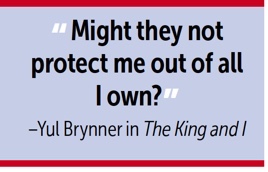
#3 COVID, or more accurately, the RESPONSE to COVID, is helping us all remember just how quickly we can lose our freedoms. For many of us, we lost the freedom to go to work, we lost the freedom to freely assemble, we lost the freedom to travel where and when we like, we lost the freedom to walk around without a mask, we lost the freedom to walk up a grocery store aisle in either direction, and we’ve even lost the freedom to worship where and when we like. Some even argue that we’ve lost our freedom of speech! Try asserting the opinion that the actual COVID virus is not significantly more dangerous than a normal flu. Try it once; you’ll not do it again! Of course, most of these freedoms will be lost only temporarily and for a good cause – our safety. But please remember what King Mongkut (Yul Brynner in The King and I) said about finding safety from others, “Might they not protect me out of all I own?” Or take it from Ben Franklin – “Those who would give up essential liberty, to purchase a little temporary safety, deserve neither liberty nor safety.” 

#4 And finally, COVID is helping us all see just how quickly life can change … and this is a good thing … because it is true. We think we are safe, we think we are secure, we think that life will always be this way, we think we are in control. We are wrong. There’s only One in control – assuming you believe in God – and we are not Him. This might be a scary thought for some – to not be in control. But, it is better to live in an unpleasant reality than a dangerous fantasy. COVID is helping us deal with reality.

So, there’s a lot of good coming from this pandemic. Here’s to a more modestly paced life, here’s to time with friends and family, here’s to liberty, here’s to remembering Who’s in charge … and here’s to your health and safety and a return to a more “normal” North American heat treat market.

Publisher’s Page: The Bright Side of COVID-19 Read More »

Publisher’s Page: The Most Interesting Non-Heat Treat, Heat Treat Story You’ll Ever Watch

Doug Glenn, Publisher, Heat Treat Today

Heat Treat Today publishes four print magazines a year, and included in each is a letter from the publisher, Doug Glenn. This letter first appeared in Heat Treat Today‘s Aerospace Heat Treating magazine, March 2020. 


The first time I heard the name “Rodriguez” was at the 2015 ASM International Heat Treat Show during the “The Heat Is On” networking reception held at The Waterview Loft at Port Detroit – the same location it was held this last year (2019). I was standing beside a to-remain-nameless president of a furnace manufacturing company who had traveled extensively in his pre-heat treat days. While we were chatting at one of the outdoor cocktail tables on a lovely Detroit night, a middle-aged couple (and by that I mean a couple who were roughly my age, 54 at the time) came up and stood with us. Striking up a conversation with them, as I’m known to do with complete strangers, it became clear to us, both by their accent and by the content of the conversation itself, that they were from South Africa. They were here in the States to attend the Heat Treat Show.

When the “to-remain-nameless” furnace manufacturing president found out that this middle-aged couple was from South Africa, his eyes lit up. With enthusiasm somewhat uncharacteristic of his personality, he asked them – with great anticipation – “Do you know Rodriguez?” They looked at him as if he had two heads and after a short glance at each other replied, “Of course!” The to-remain-nameless president then looked at me, a man of roughly the same age as these two middle-aged individuals, and said, “Do YOU know Rodriguez?” Feeling a bit in the dark, I answered honestly, “No; who is Rodriquez?”

Suffice it to say, I did a lot of listening from that point forward in the conversation. It was fascinating and, to be frank, somewhat unbelievable.

As with any good story, it is best not to say too much, especially about how the story ends, but the story of Rodriguez is a fascinating story that you will NOT believe. And it is heat treat related – kind of.

I’ll tell you a bit more about Rodriguez here, but you must PROMISE to search for and watch the documentary about Rodriguez, Searching for Sugar Man. You can watch it on Netflix, and you may be able to find it other places as well. Trust me, it will be a worthwhile investment of time and, if you’re like most people who I’ve steered in that direction, your response will be something like, “No way! Not possible.”

In fact, Rodriguez was a heat treater. If you listen carefully at roughly the 1-hour mark in the documentary, you’ll find out that Rodriguez worked in the heat treat department for Chrysler, its Lynch Road Assembly plant in, interestingly enough, Detroit! According to Wikipedia, the “Lynch Road Assembly [Plant] was a Chrysler assembly plant located… near Coleman A. Young International Airport. It is now the location of The Crown Group, a powdered coatings manufacturer which supports the automotive manufacturing industry.”

That is as “heat treat” as the documentary gets, so don’t expect any more.

You need to watch this documentary, you and your entire family. My four kids were all in their teen years when we first watched Searching for Sugar Man. They were mesmerized once we got into it. Suffice it to say that Rodriguez was a musician besides being a heat treater, and what happened to him is, well… unbelievable.

If, nay, WHEN you watch it, please drop me an email (doug@heattreattoday.com) and tell me what you thought. Also, if you know of any other non-heat treat, heat treat stories, or simply movies where heat treat is mentioned, please let me know. I’m trying to compile a list of movies where at least heat treat gets a mention.

Publisher’s Page: The Most Interesting Non-Heat Treat, Heat Treat Story You’ll Ever Watch Read More »

Publisher’s Page: Infinite Energy from the Earth

Heat Treat Today publishes four print magazines a year, and included in each is a letter from the publisher, Doug Glenn. This letter first appeared in Heat Treat Today‘s Medical & Energy Heat Treating magazine, December 2019


Doug Glenn, Publisher, Heat Treat Today

The fingers of heat treat reach into nearly every area of our life. Some of the effects of heat treating are obvious, like the landing gear on an airplane that is able to take repeated high-impact landings without snapping in two. There are other effects of heat treating that are not as obvious but are no less important. Take for example the amazing things that go on inside that same airplane’s jet engines at super-high temperatures and super high stress and strain levels. The jet engine is a modern marvel usually taken for granted by millions of travelers each day.

Graphene has the potential of being able to transport heat from the core of the
earth to the surface with essentially zero losses.

Some of the effects of heat treating are mundane. One of my favorite examples of a very practical and understandable heat treatment is the annealing process for aluminum foil. “Why is it,” I ask, “that you are able to bend this thin sheet of metal and yet it doesn’t shatter, break, or even crack?” Answer: heat treat–specifically, foil annealing.

In this issue, we take a look as some rather fascinating heat treatments in the medical and energy industries. It’s not that these two industries have anything to do with each other; they really don’t. In fact, much of what is done in the medical industry is done in vacuum furnaces in cleanroom settings. Energy heat treatments, on the other hand, can be done in a vacuum, especially when stainless steels or other more exotic materials are used (think nuclear reactors), or they can be done in the down and dirty atmosphere furnaces and oil quench tanks. But they are both heat treat-intense industries and both worthy of some attention–thus we’ve combined them into one issue.

Pulling Energy from the Earth’s Core

One of the more fascinating “heat treat” applications is the emerging possibility of being able to extract what appears to be an infinite supply of energy from the earth’s core using a material that will transfer the energy from the core to the surface with essentially zero losses. The material capable of doing this is graphene, and the graphene is currently made in vacuum furnaces. In fact, there are a number of vacuum furnace companies in the heat treat industry that are dabbling in this field.

The ability to extract energy from the core of the earth with essentially zero losses is the focus of the Limitless Energy Graphene Project headed by Manoj Bhargava and Ravi Sajwan. These gentlemen propose to transfer energy from roughly 4.5+ miles below our feet to the surface by using graphene, which is 100-times better at conducting than copper, lighter than air, and stronger than steel.

It transfers heat ultra-efficiently. According to Mr. Sajwan, if you apply 100°F to one end of a graphene pathway, you’ll instantly get 100°F heat at the other end of the pathway, but the middle of the pathway will remain perfectly cool. What they’re describing is 100% heat transfer with zero transmission losses. And according to Mr. Bhargava, you can go 10 feet or 10 miles, and the result is the same.

The temperature 4.5 miles below our feet ranges anywhere from 1,000°F to 7,000°F. Imagine being able to dig just deep enough to reach temperatures capable of boiling water and bring those temperature to the surface to fuel electricity-creating, steam-powered turbines.

Graphene is an atomic-scale hexagonal lattice made of carbon atoms.

If you’re not familiar with graphene, go to “The Google” and search for “What is graphene?” You’ll have no problem finding many explanations. I suggest looking for a short video from the University of Manchester.

CLICK HERE to be taken to an amazing YouTube video entitled, “5 Amazing Renewable Energy Ideas & Solutions for the Future.” HTT

Publisher’s Page: Infinite Energy from the Earth Read More »

Skip to content