



Publisher’s Page

Industry-Academia Partnerships

Heat Treat Today publishes twelve print magazines annually and included in each is a letter from the publisher, Doug Glenn. This letter is from the August 2025 Automotive Heat Treat print edition.

Feel free to contact Doug at doug@heattreattoday.com if you have a question or comment. 


The relationship between industry and higher-level educational institutions in North America is an interesting and evolving relationship. Unlike in Europe and Asia, the relationship is quite a bit less formal and far more scarce here. It is almost a foregone conclusion that leading industrial companies will have tight relationships with academic research institutions across Europe. The same is true in Asia, especially China, where many of the research institutes are government funded and are expected to assist with industry research projects. Of course, in both Europe and Asia, many companies are heavily subsidized by the government to conduct research. All in all, the relationships are more plentiful and tighter.

While there are thriving industry-academic relationships in North America, they are far less common, and they take a more practical, business-first approach. There are, however, a good number of strong relationships between educational institutions and the North American thermal processing industry. I’d like to mention three here in some depth and a few others briefly.

Illinois Institute of Technology Thermal Processing Technology Center (TPTC)

Without doing any thorough research, TPTC was perhaps one of the oldest industry-academic partnerships around. I was introduced to this partnership when Dr. Phil Nash, a professor at IIT, was the director of TPTC. That was back in the 1990s. I also know that our very own Dan Herring, the Heat Treat Doctor®, was supportive of the organization. TPTC reportedly shut down 10 years ago, but a webpage, which was not easy to find, indicates that it is now under the direction of Dr. Leon Shaw. After a quick review, there is a good bit about the academicians (professors and students) online, but I could not find any reference to industry partnerships or members. Nevertheless, TPTC was one of the go-to sources for industry for those who were interested in conducting ground-level research.

Worcester Polytechnic Institute (WPI) Center for Heat Treat Excellence (CHTE)

The WPI CHTE remains quite active. Their website does not indicate the exact date that it was established, but I’m guessing the late 1990s or early 2000s. I remember its inception and the efforts of Diran Apelian, their first executive director. I recall that membership dues were steep, but there was a good bit of industry buy-in, including Surface Combustion, Houghton International (now Quaker Houghton), and ASM International.

Current industry partners include Bodycote, Aalberts, Thermatool, Dante, Arcelor Mittal, Pilot Precision Products, GKN Sintered Metals, Pratt & Whitney, DevCom, and Sikorsky. There are also many active industry-focused research projects. CHTE is led by Dr. Thomas Christiansen with the able assistance of Maureen Plunkett. More information about CHTE can be found at https://wp.wpi.edu/chte/.

Purdue University Purdue Heat Treat Consortium (PHTC)

Purdue is a relative newcomer but quite active. Under the leadership of Dr. Mark Grunninger and Dr. Mike Titus with assistance by Maddison DeLaney Walsh, PHTC has gained an impressive number of thermal processing end-user and supplier members, including Amsted Rail, California Pellet Mill (CPM), Caterpillar, Cummins, ECM USA Inc., Howmet Aerospace, Inductoheat, Inc., John Deere, Nucor, and Rolls-Royce. I believe that Quaker Houghton has also recently joined. The number of projects being conducted by this industry-focused consortium is also impressive. More details on PHTC are at https://engineering.purdue.edu/MSE/PHTC.

Others

Of course, there are many other universities around the country that cooperate with the industry to help advance real-world research. Many Heat Treat Today 40 Under 40 honorees are graduates of these educational institutions. Here is a short — and I’m sure incomplete — list of other universities that have a proven relationships with the thermal processing industry:

  • Carnegie Mellon University
  • Colorado School of Mines
  • Michigan Technological University
  • New York State College of Ceramics at Alfred University
  • Pennsylvania State University
  • Rensselaer Polytechnic Institute
  • San Diego State University
  • South Dakota School of Mines
  • The Ohio State University
  • University of Akron

Conclusion

Although the relationship between industry and education is less formal here in North America compared to Europe and Asia, the relationship does exist and can be tapped for the benefit of any company interested in using the great minds of up-and-coming engineers to help solve tomorrow’s challenges. If you’d like to contact any of the organizations listed above, please email me.

Doug Glenn
Publisher
Heat Treat Today
For more information: Contact Doug at doug@heattreattoday.com


Industry-Academia Partnerships Read More »

Tracking the Heat Treat Economy

Heat Treat Today publishes twelve print magazines annually and included in each is a letter from the publisher, Doug Glenn. This letter is from the September 2025 Annual People of Heat Treat print edition.

Feel free to contact Doug at doug@heattreattoday.com if you have a question or comment. 


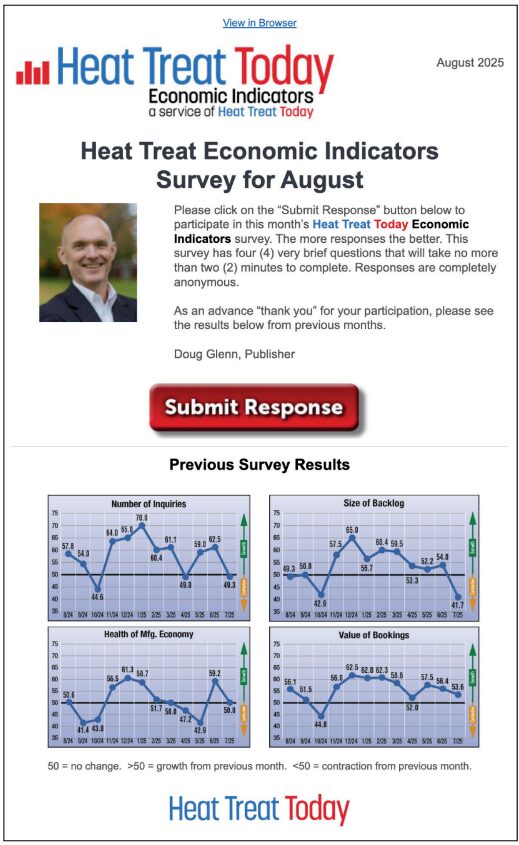
Knowing whether the North American thermal processing economy is up or down compared to last month or last year is a question that many want to know. And, as you may already know, there are essentially ZERO industry-specific economic indicators measuring our market. Except for one — Heat Treat Today’s Economic Indicators, or the heat treat economic indicators (HTEI).

A Little History

A little history and then let’s discuss Heat Treat Today’s HTEI. Back in the mid-1990s or early 2000s, I and the team at Industrial Heating established the first industry-specific economic indicators. Those indices survived for roughly 20 years before passing into oblivion when Industrial Heating shut their doors in 2023.

The data for the indicators were not saved…to the best of my knowledge. During those 20 years, many, many companies in the thermal processing industry relied on the data from those indices to help plan their business. I recall specifically speaking to one of the top-level guys at Bodycote who confessed that they used the economic indicators together with some other macro-economic data to help with their annual strategic planning. There were many others as well who either called or emailed asking questions about the indicators or asking for permission to use them in reports.

After Industrial Heating shuttered the indices, Heat Treat Today picked them up and has been collecting and reporting industry-specific economic data since that time.

The 4 Indices

There are four indices. All four are forward looking and none require a company to report any numbers back to us. Here’s how they work.

On the first business day of each month, Heat Treat Today sends an email survey to over 800 supplier contacts in the North American heat treat market. Recipients are asked four simple opinion questions. All four questions ask essentially the same thing: Do you think the next 30 days will be better or worse or the same as the past 30 days? We ask this question for four specific areas:

  1. The number and/or value of inquiries
  2. The number and/or value of bookings
  3. The size of the company’s backlog
  4. The general health of the manufacturing economy

Respondents pick a number between −10 and +10 for each of the four questions with −10 being much, much worse and +10 being much, much better. Respondents can also skip one or more questions if they have no opinion or do not want to share.

The responses are aggregated and converted into an index very similar to the Purchasing Managers Index where the index number 50 represents no change, numbers above 50 represent growth, and numbers below 50 represent contraction.

More Responses Are Better

As with any statistical analysis, the larger the sample set, the more reliable the data. This is true for HTEI as well. With over 800 solicitations going out each month, we’re getting a pretty decent response, but more responses would be better. Responding to the survey takes less than two minutes, so time is not really an issue. No numbers need to be compiled or calculated to respond, which keeps it simple. The questions are all “opinion” questions about whether you anticipate the next 30 days will be better than the past 30 days.

We would love to have you join the ranks of people that respond regularly to the HTEI monthly emails. If you would like to receive the monthly survey on the first business day of each month, please send your email address to me and I’ll add you to the list. You can email me at doug@heattreattoday.com.

Thanks for participating. 

Doug Glenn
Publisher
Heat Treat Today
For more information: Contact Doug at
doug@heattreattoday.com


Tracking the Heat Treat Economy Read More »

The Value of a Good [Brand] Name

Heat Treat Today publishes twelve print magazines annually and included in each is a letter from the publisher, Doug Glenn. This letter is from the July 2025 Heat Treat Super Brands print edition.

Feel free to contact Doug at doug@heattreattoday.com if you have a question or comment. 


The Good Book, the Bible, upon which our nation was founded, is chock full of wisdom. Here’s one: A good name is to be more desired than great wealth; favor is better than silver and gold. That’s from Proverbs 22:1, and the first part of that verse hits at the heart of what the Heat Treat Today team is trying to accomplish this month with the inaugural edition of “Heat Treat Super Brands.” We are taking a moment to recognize the brand names that are prevalent in the North American heat treat and thermal processing market — giving a voice to the many companies in this industry who have invested endless hours building and maintaining the good name and good reputation that they’ve so diligently worked to establish. 

Building a Good Name 

Building a reputable brand is a long, painstaking process that is not easily accomplished but can be undone in seconds. Building and maintaining that good name is a huge investment of both time and money, and companies have a right to insist that their brand names be respected and used correctly.

Our publication tries to do that very thing, but sometimes we have slip ups for which we feel bad and do all we can to correct. I recall an instance years ago when we used the phrase “trident tube” when referring to a radiant tube. Either BJ or Ben Bernard from Surface Combustion called us and very politely reminded us that Trident™ is a trademark of Surface Combustion. We apologized and quickly corrected ourselves. Their defense of their brand name was well founded. 

Countless other companies in the North American heat treat and thermal processing market have also invested blood, sweat, and tears establishing reputable brand names, trade names, and patents, all of which deserve protecting. 

Spreading the Word 

In the Letter from the Publisher of the April 2025 publication, I wrote, “You Can’t Sell If You Don’t Tell.” The point of that column was to remind our industry suppliers that they can have the best product, technology, or service in the industry, but if they don’t make it known, if they don’t “tell,” it will be nearly impossible to sell. The same is true when it comes to brand names.  ere are hundreds of brand names in the North American heat treat market, but not all of them are well known. The only way for these names to become well known is for them to be publicized widely and frequently. The goal, of course, is to become a household name like Kleenex or Coke. In an industrial setting like ours, it is essentially impossible to become a household name, but we can shoot to become well known within the industry. 

Heat Treat Today has become a relatively well-known brand in the industry. Why is that? The answer is rather straightforward — Heat Treat Today is consistently in front of thousands of in-house heat treat department personnel, as well as in commercial heat treat shops. We’re there every month with a hardcopy print magazine. We’re there every weekday with our Heat Treat Daily e-newsletter. We’re there 24/7, 365 days a year with the industry’s leading heat treating and thermal processing website, as well as industry e-newsletters and our monthly podcast, Heat Treat Radio. We’re not exactly a household name, but thanks to all of you, people have become comfortable with us because we are seen widely and frequently. That’s what it takes to be a super brand, and we’re here to help the suppliers in our industry reach that status. 

This edition of Heat Treat Today that you hold in your hands is our attempt to help those industry suppliers build awareness of their brand names. Please take a minute to flip through this edition and read about some of the Super Brands included. If you are a supplier and are not included in this edition, you can be included in next year’s July edition, which we anticipate will have the same Super Brand focus.  

Contact Michelle Ritenour (michelle@heattreattoday.com) if you’d like to be included.  

Doug Glenn
Publisher
Heat Treat Today

For more information: Contact Doug at doug@heattreattoday.com


The Value of a Good [Brand] Name Read More »

Sustainability vs. Stewardship

Heat Treat Today publishes twelve print magazines annually and included in each is a letter from the publisher, Doug Glenn. This letter is from the May 2025 Sustainable Heat Treat Technologies print edition.

Feel free to contact Doug at doug@heattreattoday.com if you have a question or comment. 


This month’s magazine focuses on green and sustainable technologies. I love this topic, and I’ve been thinking about what motivates us to care for the planet. 

Our presuppositions about the environment significantly affect the thoughts we have and actions we take. The presuppositional glasses we wear affect the way we see the world. If we have proverbial rose-tinted glasses, the world always looks “rosy.” And if the world looks rosy, we won’t do much to fix it. 

In this column, I’m suggesting that “stewardship” has different and better presuppositions than “sustainability.” I don’t expect everyone to wear the same presuppositional glasses, but I hope the following discussion will stimulate thought. 

Stewardship vs. Sustainability

Stewardship, as mentioned above, has a variety of premises. It is a distinctively Judeo-Christian concept derived largely from Genesis 1:28 in the Bible, which states that God said, “Be fruitful and multiply, and fill the earth, and subdue it; and rule over the fish of the sea and over the birds of the sky and over every living thing that moves on the earth.” The “subdue it” part of this verse is also referred to as the “Dominion Mandate.” After making the world, God explicitly assigns mankind as stewards of what He made and commands them to take care of it. 

If this is true, then our thinking about climate change, sustainability, and our environmental responsibilities will change.  

Here are some examples. 

Ownership of Earth

Stewardship changes the idea of how we think about ownership. Who really owns the planet? Sustainability says that 1) mankind owns it, 2) no one owns it, or 3) animals own it. In all cases, mankind is not responsible to anyone higher than himself for how he treats the planet. 

Stewardship, on the other hand, puts a whole new spin on how man interacts with the planet. If God made the earth and gave man responsibility to care for it, then man is accountable to Him for how we care for it. The compelling driver behind caring for the environment is significantly different and eternal with stewardship mentality. Answering to ourselves, our children, the earth itself, or the animals for the way we care for the earth is less motivational than answering directly to God.  

Eternality of Earth 

The stewardship mentality also changes the timeline. Sustainability assumes that the planet will go on forever in varying conditions of well-being depending on our care — it has a never-ending timeline. The stewardship mentality has a fixed end date. More importantly, that end date has accountability associated with it. One day, the world will cease to exist as we know it and God will hold mankind responsible, both individually and corporately, for how well we’ve handled it. 

Man Is the Problem 

One final presupposition that changes if we switch from a sustainability to stewardship mindset is our view of man. Sustainability often comes with the assumption that man is the problem — a scourge on the earth. Most of us have heard the concept that the world would be a better place if it weren’t for man mucking it up. Stewardship is the opposite. It claims that the earth has been given to man to rule over it, subdue it, and care for it. Man, instead of being the scourge of the earth, becomes the most important and most valuable creature. 

Conclusion 

There are a lot of reasons why people love and care for the environment. Lord willing, stewardship will play a bigger role in the future. In the meantime, please enjoy the technical content in this month’s stewardship, I mean, sustainability edition. 

Doug Glenn
Publisher
Heat Treat Today

For more information: Contact Doug at doug@heattreattoday.com


Sustainability vs. Stewardship Read More »

You Can’t Sell If You Don’t Tell

Heat Treat Today publishes twelve print magazines a year and included in each is a letter from the publisher, Doug Glenn. This letter is from the April 2025 Annual Induction Heating & Melting print edition.

Feel free to contact Doug at doug@heattreattoday.com if you have a question or comment. 


This magazine has been a blessing to publish. The industry is niche, yes, but it is far-reaching and impactful on nearly every aspect of life. There isn’t a place where I can go where heat treating and thermal processing have not made life better and/or possible. The people are by and large good people, fun to work with, and interesting to talk to. The content written in these pages is a good mix of challenging technical content, as well as general interest information.  

Our target audience, the 15,000–20,000+ engineers and managers that make purchasing decisions for the vast number of manufacturers who have their own in-house thermal processing operations, is highly engaged with Heat Treat Today. While it is impossible to gauge the engagement of our monthly print editions, when readers respond, it is usually because of something they read in one of our print editions.  

Granted, it’s easier to see if/when someone opens or clicks on any of our e-newsletters, but it is surprising the number of people who email us about something they’ve seen in the print editions. 

The bottom line is: All of our audience (whether print or digital) is an engaged bunch.  

Suppliers who want the attention of these manufacturers with in-house heat treat departments would do well to remember the reach of Heat Treat Today. Whether you use Heat Treat Today or some other format to tell your story, you can’t sell if you don’t tell

This may seem to be an abundantly obvious statement to many, but you would be shocked at the number of engineering-based companies who believe, “If we build it, they will come.” Thank you, Kevin Costner — that may be true in a field of your dreams, but it is untrue in the real world. Your selling story needs to be told.  

Just having a great product — even the best product of its kind — is not a guarantee of success. Sooner or later, you must let people know, somehow, you exist and your product is unparalleled. 

Here are a few of the ways that companies typically spread the news: 

  1. E-blasts: While e-blasts are low cost and convenient, there are a few challenges: 1. Reaching new people, and 2. People will look at your in-house e-blast as a purely promotional effort, and because of that, will not give it the full attention it might deserve.  
  2. Advertising in magazines or on a website: A decent way to tell since they boast a targeted audience, however, magazines do not offer metrics, and websites, while able to provide numbers, typically reach far fewer people than a print version of a magazine and are not consumed for as long as print. 
  3. Word of mouth: This method is typically slower and dependent on others talking about you. If your product is that good and it causes a buzz in the industry, then word of mouth may be all you need. It is, however, a passive form of telling, which you do not control and depends on others. 
  4. Representatives: Assuming your reps are giving you a large enough portion of their time and are knowledgeable in your capabilities, this is a good way to tell your story. The downside is the rep’s reach. Even if a rep were making four calls a day every weekday of the year, that totals up to just over 1,000 visits a year. And let’s be honest, most companies would be thrilled if a rep made 500 calls a year.  
  5. Internal sales teams: Assuming they’re on the phone consistently and not fulfilling orders or being distracted by other internal demands, an in-house sales team, although potentially expensive to maintain, is one of the better options a company has for telling their story. Nearly everyone I know has an internal sales staff. It is pretty much a must. 
  6. Website: Websites are not as good at getting the message out as many think, but they are still absolutely necessary. Websites are the most misunderstood marketing tool in the marketing toolbox. Most people think if they have a website, they’re good. Please remember, website “advertising” is passive marketing. Once a website is built, it just sits there until someone decides to come look at it. 
  7. Marketing materials: Similar to a website, literature sits there until someone decides to look at it. It’s a passive form of marketing. The bottom line here is this — as you plan for the success of your business, don’t forget it is not just about product quality. You must also remember that “telling” is just as important, if not more so, than building the best product out there.  

Our audience of in-house heat treaters is interested in hearing your story. Remember, you can’t sell if you don’t tell.  

Doug Glenn
Publisher
Heat Treat Today

For more information: Contact Doug at doug@heattreattoday.com


You Can’t Sell If You Don’t Tell Read More »

Time for Company Leaders To Refocus on Profits

Heat Treat Today publishes twelve print magazines a year and included in each is a letter from the publisher, Doug Glenn. This letter first appeared in March 2025 Aerospace Heat Treating print edition.

Feel free to contact Doug at doug@heattreattoday.com if you have a question or comment. 


The world is a better place when people know what their job is and then stick to that job. When the carpenter knows that their job is working with wood and then works with wood, things go well. When the pipefitter doesn’t try to be an electrician but sticks to pipefitting, things go well. It’s only when we forget (or never knew) who we are or why we’re here that things begin to go terribly wrong.

This is just as true in the C-suite as it is on the shop floor when it comes to running a business. CEO, CFO, COO, presidents, and VPs all benefit the business by sticking to their huckleberry bush just as the welder, the electrician, and the plant operations guys prosper the business when they do what they’re called to do.

In the C-suites, however, there seems to be more confusion about what it is they are there to do and company leaders more frequently get distracted from their huckleberry bush than do the guys in the shop. Here are some good, yet ultimately unhelpful things that have kept company leadership from focusing on profits — which ought to be their huckleberry bush.

Environmental Concerns

If ever there was a worthy cause, caring for the planet should be toward the top of the list, coming in second only behind caring for people. Business leaders proceed at their own risk if they completely ignore environmental issues. But elevating “saving the planet” over profits is a common mistake made by well-meaning leaders. The driving question that should underlie all business questions is whether or not profits will increase, not only what impact the decision will have on the environment. The EV craze, which has petered out significantly since this time last year, is a great example of company leaders losing sight of profits in favor of the environment. The number of car manufacturers who boldly announced electric-only or significantly enhanced EV fleets in 2024 only to have the two-by-four of company profits hit them squarely upside the head is astounding. Most of them have backtracked or are in financial hardship for not backtracking.

Well-meaning environmentalism should never come at the expense of profits.

Diversity, Equity, Inclusion (DEI)

Another distraction from focusing on profits has been, while to a lesser degree now as compared to this time last year, the DEI movement. DEI, to its credit, is people-focused and, undoubtedly, was well-motivated by many. Nonetheless, kowtowing to externally imposed social norms in order to avoid becoming a corporate pariah carries with it the seeds of failure, because profits and overall corporate health will suffer. Such was the case for countless large and small companies, including McDonalds and Harley Davidson, that elevated DEI above profits. The primary (though not the only) factor that should drive hiring and promotional concerns within a company should be competency and effectiveness. Will the individual help enhance company profits or not?

“Profit” Is NOT a Four-Letter Word

In her classic work, Atlas Shrugged, Ayn Rand makes this very point. When we vilify “profits,” we do not do ourselves or our fellow man any good. One might say, “It is not profitable to vilify the word ‘profit.’” Profit is good, and it is enormously comforting to see company leaders of all stripes returning to a good, healthy embrace of the profit motive.

Obviously, the ill-founded desire for profits at all costs regardless of the impact on the freedoms and liberties of others is not good and is the exact reason why we have courts of law. Profit cannot and ought not be at the expense of others’ freedoms. Further, the profit motive should not go right up to the line of violating personal freedoms. A true and good profit motive is not devoid of compassion and long-term thinking. It values human life and liberty and tempers its decisions based on what is good in the long run for human flourishing. Sound, profit-motivated decisions are often not easy black and white decisions. There are countless intricacies and complexities. Nonetheless, our default position ought not to be the disparaging of profits. Quite the opposite.

Company leader, stand strong as you do all that you can to build your company profits and don’t be ashamed to say so.

Doug Glenn
Publisher
Heat Treat Today

Contact Doug Glenn at doug@heattreattoday.com.


Find Heat Treating Products And Services When You Search On Heat Treat Buyers Guide.Com

Time for Company Leaders To Refocus on Profits Read More »

Survey Says …

Heat Treat Today publishes twelve print magazines a year and included in each is a letter from the publisher, Doug Glenn. This letter first appeared in February 2025 Air & Atmosphere Heat Treating print edition.

Feel free to contact Doug at doug@heattreattoday.com if you have a question or comment. 


In July of last year (2024), one of the industry’s leading consultants, Dan Herring, The Heat Treat Doctor®, conducted an amazing comprehensive survey. Here’s how it started:

As many of you know, I’ve surveyed the industry numerous times over the years to check on the latest technology trends and overall health of the heat treating and thermal processing industry. With the rapidly changing print and electronic media landscape, I am curious as to how these changes will impact our industry. As many of you are painfully aware, some magazines, websites, e-newsletters, and webinars/podcasts have gone away; while precious few others have come into being.

The consultant went on to ask the near 10,000 email recipients to complete an eight-question survey about that “rapidly changing print and electronic media landscape.”

#1 The Respondents

The respondents were a good mix of manufacturers with in-house heat treat departments, commercial heat treaters and industry suppliers. From what we know about our own magazine’s circulation, which is predominantly to manufacturers with in-house heat treat departments, the responses were a good sampling of the North American heat treat market.

#2 Awareness of Media Brands

We were very pleased to see that Heat Treat Today ranked highest in awareness. A whopping 93% of respondents were aware of our existence. The three other media brands all ranked significantly lower: The next highest came in more than 13 percentage points lower, and the lowest ranking media brand had a score of only 28% awareness.

#3 Most Helpful Media Brand

Heat Treat Today also scored exceptionally high when asked which media brand was “most helpful to your business.” Respondents were asked to rank the publications from 1 to 4 with 1 being most helpful and 4 being least helpful. 59% of the respondents ranked Heat Treat Today as #1, the most helpful media brand. The media brand ranked second as most helpful came in with only 23% of respondents.

#4 Voice of the Industry

When asked which media brand the respondents considered to be the “voice of the industry,” Heat Treat Today again ranked #1 with over 63% selecting us. The other three media brands pulled only 19%, 16% and 2%, respectively.

#5 Most Important Information

The consultant next asked this question: What is the most important information you get from heat treatment/thermal processing media? Technical content ranked #1 at 46.4%. Industry news came in at #2 with 45.5%, followed by helpful resources at #3 with 5%. Finally, supplier content and lead generation came in at 2% and 1%, respectively.

#6 Media Brands that Deliver the Most Important Information

Then respondents were asked which media brand best delivered technical content and industry news. Heat Treat Today again ranked extremely well with nearly 6 of 10 (58%) ranking us at #1. The next closest media brand came in with just a tad over 2 in every 10 respondents indicating that they delivered the important information desired.

#7 How You Consume Media

One of the more enlightening questions had to do with what types of media the respondents used to consume their information — meaning, do they read print or digital magazines, visit websites, receive e-newsletters, listen to podcasts or flip through social media posts? Remember, the survey was sent out by email, which could have skewed the results.

The surprising #1 response was print magazines! Print came in with 32% of respondents ranking it as their most preferred method of consuming content. If you were to combine those who ranked either of the magazine options (print or digital), the number increases to 56%, well ahead of the next closest option which was website. Websites came in at 23%. E-newsletters, social media, and podcasts/videos all ranked in single digits — 9%, 5% and 5% respectively.

#8 Type of Device

Answers to the final question will also be surprising to many: “On what type of device do you prefer to access your heat treatment digital media?” This question does not take into consideration that the #1 preferred method for consuming media is the print magazine, just if and when they consume digital media. “Phone” ranked nearly dead last (believe it or not), second only to “None of the above.” Readers are not accessing thermal processing information much on their phones. This is confirmed by the low social media and video numbers in #7 above. The big winners, both with roughly half of the responses (both at 47%) were desktop computers and laptop computers.

Lessons Learned

The data was encouraging, proving that providing helpful, timely content is what the thermal processing industry needs. Please continue to communicate with us and tell us what you’d like to know.

Doug Glenn
Publisher
Heat Treat Today

Contact Doug Glenn at doug@heattreattoday.com.


Find Heat Treating Products And Services When You Search On Heat Treat Buyers Guide.Com

Survey Says … Read More »

Reader Feedback: ‘Settled’ Science or an Agenda?

Readers are checking out Heat Treat Today’s magazine, and the January 2025 Technologies To Watch print edition has a piece that sparked comments from readers. The letter from publisher Doug Glenn entitled “What If We’re Wrong About CO2 & Global Warming? challenges the “assumption that global warming, and specifically man-induced global warming, is a real and settled science.

Would you like to weigh in on the topic? Submit your question, comments, thoughts, or queries here or email Bethany Leone at editor@heattreattoday.com.


Here is an excerpt from the publisher’s page:

“I’d like to challenge that assumption. Firstly, legacy media, the federal government, academia, and the scientists who deliver the science we’re called to follow — i.e. “follow the science” — are all strong proponents of man-made global warming and the evil of CO2. This grouping of authorities, in and of itself, causes many to be suspicious, given this group’s historic record of dishonesty and deception. If this group has been so wrong in the past on macro-social economic issues (e.g., Covid) would it not be reasonable to question their claims about climate change?

Secondly, the science doesn’t seem to be as settled as claimed.”


This publisher’s page prompted this feedback from loyal reader Roger Hird of W.H. Kay Company:

“Thank you for your column in the recent HTT issue.  As a longtime climate skeptic, articles like yours are exactly what’s needed to push back on continued efforts to use climate change as a tool for massive government interference in all phases of life.

Sadly, the EU is much further down the road in their Climate zealotry, and we’re reading how these efforts are even pushing some European landowners to close down their farms to avoid crippling penalties in the decree of decarbonization. 

This past election puts the proverbial ‘finger back in the dike’ of climate-based government intrusion in our economy and daily lives, and thank God for that! 

Keep up the great work Doug.” 

Doug’s reply:

“The well-meaning folks in our government will continually find ways of expanding their scope and power. Let’s assume 90% of them mean well. The fact is, the government should NOT be in 90% of the stuff they’re currently in. It is our responsibility to reign them in, politely if possible.

Keep fighting the good fight when and where you’re able. The publisher’s page is one place I’ve been blessed to use in my little corner of the world.  Not everyone agrees, but that’s the way it ought to be.”

From reader Kevin O’Brien, Birmingham, Michigan:

“Quick note to thank you for your editorial. Yes, agree on the idea that we are re-shaping and re-orienting too many aspects of our economy and society because there is an agenda being pushed by a group. Even more so when you consider that many of the people pushing the agenda stand to gain from massive government spending in this arena. All too often, the environmental ‘movement’ seems to be acting on and reacting to published material that seems more like the flavor of the month rather than solid, steady scientific findings…. The result is that large numbers of people experience a negative outcome (higher prices, more regulations) with no means for redress.”

Doug’s reply:

“Very much agree with your assessment of ‘flavor of the month.’ My content is that we should trust the market and not well-meaning individuals in positions of power to determine the direction of the world’s environmental movement. If everyone in the world were genuinely concerned about global warming, they would demonstrate that sincere concern by spending money in that direction. That in turn would encourage companies to follow the consumer’s lead. We don’t have enough faith in the market … or as Adam Smith would say, the Invisible Hand!”

From reader Steve Maus:

“I have followed this issue with great interest for decades, and so I am familiar with the work and comments of the prominent figures you have referenced. My studies toward a metallurgical engineering degree included significant coursework in organic chemistry and thermodynamics, and in my career, I’ve done extensive hands-on work with CO2 and its many reactions. With that in mind, I tend to agree with the skeptics because the chemistry simply does not support the claims of those who predict catastrophic global effects due to small changes in atmospheric CO2.

It seems to me that our industry ought to encourage frank debate of the issue, and that we should demand that it be based on a critical look at the entire chain of generating process heating, and on the genuine effects of CO2 emissions.  Simply moving the generation of CO2 away from the point of natural gas-based heating and transferring it to the source of generating electricity with fossil fuels or ‘renewable’ sources that have issues of their own or using fuels that require electric power to generate them, is not accurately addressing the situation.  Otherwise, it appears to be a situation of doing something just to do something, for reasons that may not well-considered.  And as we have seen with other attempts like EVs, solar panels and wind turbines, the solutions often come with problems of their own, so we ought to learn the lessons and apply them here.

But I digress. Doug, I applaud you for raising the question, and I look forward to the healthy discussions that will be provoked by it.”

Doug’s reply:

“Thanks for the encouragement, Steve. I hope you’re doing well. By the way, if you haven’t read the article I referenced from The Epoch Times, I highly recommend it. If what they are saying in that article is true (regarding ‘saturation’ of CO2), then the whole issue becomes moot … IMHO! It is worth the read.”

From reader Dean Keal of IGE Fans:

“I think you are spot on.  Aside from all the science debunking this, history has shown the planet has been warmer in the past than it is currently. Heck, in the medieval warming period, the Vikings were grain farmers on Greenland. I think this whole fiasco is about power and control, not science. Unfortunately, there are so many people making money from this issue it has become entrenched. Perhaps President Trump will interject some common sense.”

Doug’s reply:

“Thanks, Dean. Appreciate the encouraging words. Not everyone agrees, but most everyone that has taken the time to respond has been respectful and MOSTLY in agreement. There was one who vehemently disagreed but we’re still on speaking terms!”

We welcome your inquiries to and feedback on Heat Treat Today articles. Submit your questions/comments to editor@heattreattoday.com.

Reader Feedback: ‘Settled’ Science or an Agenda? Read More »

What If We’re Wrong About CO2 & Global Warming?

Heat Treat Today publishes twelve print magazines a year, and included in each is a letter from the publisher, Doug Glenn. This letter first appeared in January 2025 Technologies To Watch print edition.

Feel free to contact Doug at doug@heattreattoday.com if you have a question or comment. 


I recently attended the Industrial Heating Equipment Association Decarbonization SUMMIT in Indianapolis at the Conrad Hotel. Roughly 100 thermal processing industry professionals participated in this two-day long event. As I listened to all presentations over those two days and going back even further to the planning of the event — which, by the way, I’d like to commend Jeff Rafter of Selas Heat Technology for his leadership, Mike Stowe of Advanced Energy for his technical contributions, and Goyer Management for their diligent work to produce this SUMMIT — I noticed that nearly everything being discussed was predicated on the assumption that global warming, and specifically man-induced global warming, is a real and settled science.

I’d like to challenge that assumption.

Firstly, legacy media, the federal government, academia, and the scientists who deliver the science we’re called to follow — i.e. “follow the science” — are all strong proponents of man-made global warming and the evil of CO2. This grouping of authorities, in and of itself, causes many to be suspicious, given this group’s historic record of dishonesty and deception. If this group has been so wrong in the past on macro-social economic issues (e.g., Covid) would it not be reasonable to question their claims about climate change?

Secondly, the science doesn’t seem to be as settled as claimed.

John F. Clauser, a Nobel laureate in Physics, has been articulate in his doubts about the climate crisis.

  • “The popular narrative about climate change reflects a dangerous corruption of science that threatens the world’s economy and the well being of billions of people.”
  • “I don’t believe there is a climate crisis. The world we live in today is filled with misinformation. It is up to each of you to serve as judges, distinguish truth from falsehood based on accurate observations of the phenomena.”
  • “Great news! There is no climate crisis! Much as it may upset many people, my message is that the planet is not in peril.”

Ivar Giaever, another Nobel laureate in Physics, has been clear in his skepticism about global warming.

  • “Global warming has become a new religion. We frequently hear about the number of scientists who support it. But the number is not important: only whether they are correct is important.”
  • “It is amazing how stable temperature has been over the last 150 years.”
  • “I am a skeptic. Global warming has become a new religion.”
  • “We don’t really know what the actual effect [of CO2] on the global temperature is. There are better ways to spend the money.”

Richard Lindzen, professor emeritus of Earth, Atmospheric, and Planetary Sciences at MIT, has been a vocal critic of the consensus on human-caused global warming.

Willie Soon, an astrophysicist, geoscientist, and aerospace engineer at Harvard’s Smithsonian Center for Astrophysics, questions the extent of the human impact on climate change.

Frederick Seitz, former president of the U.S. National Academy of Sciences, has expressed doubts about the severity of global warming.

Ian Plimer, an Australian geologist and professor emeritus at the University of Melbourne, is a prominent climate skeptic.

Peter Ridd, a former professor at James Cook University in Australia, has been a vocal critic of climate change science.

Jim Mason, PhD in Experimental Nuclear Physics from McMaster University, Hamilton, Ontario, Canada, recently published an excellent article in The Epoch Times entitled, “A Physicist’s View of Greenhouse Gas Emissions and the Impact on Climate,” which seriously calls into question whether or not the concentration of CO2 gas in our atmosphere has the physical ability to produce global warming. Mason quotes the work done by two other physicists, William A. Van Wijngaarden and William Happer. Mason says, “The duo postulate that long-wavelength radiation (LWR) absorption does not increase in a linear fashion as CO2 increases but does so in an exponentially DECREASING fashion. Additional amounts of CO2 added to the [atmosphere] absorb ever-decreasing amounts of additional LWR, until at some point the CO2 is absorbing effectively all of the LWR in the [atmosphere] that CO2 can absorb. Absorption is saturated” (emphasis is mine).

The implication is that adding more CO2 to the atmosphere may have essentially no impact on global temperatures if CO2 is absorbing all that it can absorb. I highly recommend Mr. Mason’s article.

Given the above, I have a few questions:

  • What if we are wrong about decarbonization and these gentlemen are right?
  • Is there any wisdom in approaching this topic with a bit more caution?
  • Do any of you have doubts about the need to decarbonize, and if so, how do you reconcile those doubts with continued efforts to decarbonize and/or take Department of Energy grants and subsidies?
  • Is anyone concerned about the amount of money that we are throwing at this potentially non-problem and the enormous and devastating impact on our children’s financial future?
Doug Glenn
Publisher
Heat Treat Today

Contact Doug Glenn at doug@heattreattoday.com.


Find Heat Treating Products And Services When You Search On Heat Treat Buyers Guide.Com

What If We’re Wrong About CO2 & Global Warming? Read More »

Resounding Success: Heat Treat Boot Camp 2024

Heat Treat Today publishes eight print magazines a year and included in each is a letter from the publisher, Doug Glenn. This letter first appeared in the December 2024 Medical & Energy Heat Treat print edition.

Feel free to contact Doug at doug@heattreattoday.com if you have a question or comment. 


If you’ve been thinking of sending someone, including yourself, to Heat Treat Boot Camp, this column should help motivate you to pull the trigger for 2025.

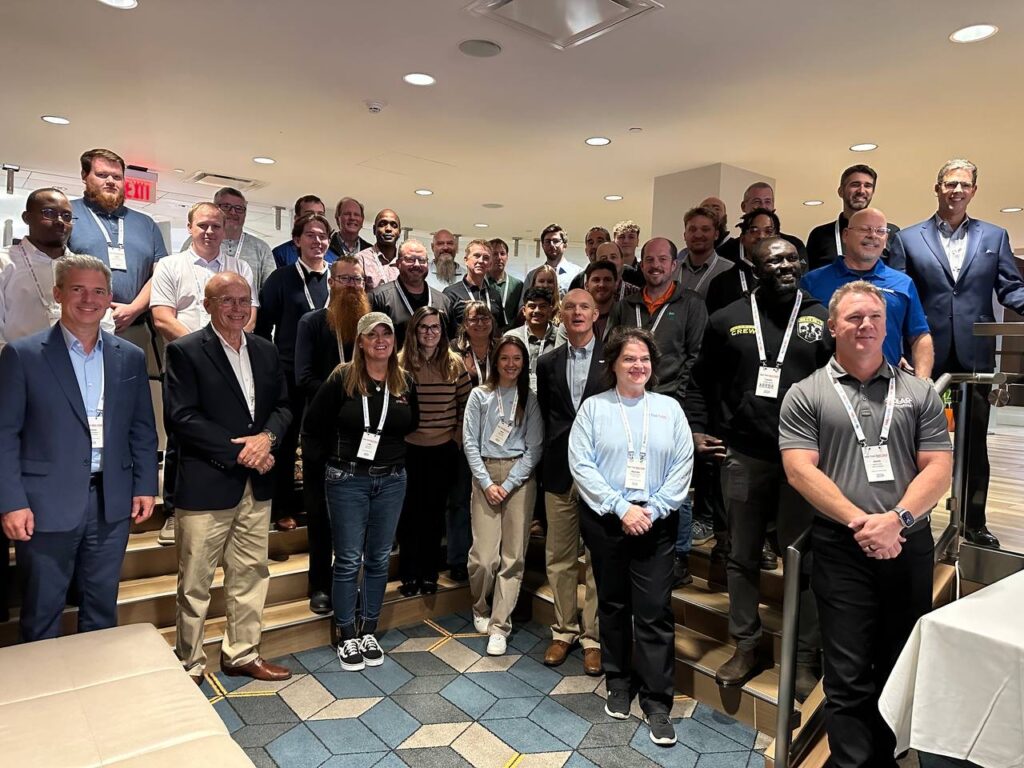
On September 23–25 of this year (2024), 40+ individuals gathered at the DoubleTree Hilton Pittsburgh Downtown and experienced the 3rd Annual Heat Treat Boot Camp together. By all measures, it was a resounding success. Here’s why.

The Content

The foundation of the event’s success is the information provided in seven different and intensive presentations by Thomas Wingens, of WINGENS CONSULTANTS — Material and Thermal Processes, and me. The presentations cover the following in language intended for newcomers to the industry:

  • Heat, Markets, and End Products
  • Heat Treat Processes & Materials, Part 1
  • Heat Treat Products (e.g., furnaces, induction equipment, etc.)
  • Heat Treat Processes & Materials, Part 2
  • Heat Treat Players (the companies that make the products)
  • Heat Treat Latest Developments
  • Heat Treat Resources (for continual and continuing education)

These seven presentations are presented classroom style for a full 1.5 days and really serve as the core of the boot camp’s success. Each attendee goes home with a handy resource manual which I’ve been told by several of the attendees stays on or near their desks and is referenced weekly.

Given the fact that Heat Treat Today publishes believes people are happier and make better decisions when they are well informed, it is no surprise one of the primary reasons that the boot camp is successful is the content provided. While nearly all of Heat Treat Today’s publishes content is targeted at professionals working for in-house heat treat operations, Heat Treat Boot Camp content is one exception where the content is more specifically targeted at industry suppliers. The content is intended to help newbies to the industry gain 2+ years of industry knowledge in two days.

But it’s not just about the content.

The People, Networking & Relationships

Speaking for myself, one of the most satisfying parts of the boot camp is seeing the personal relationships that are developed and grown during the two-day event. There is a lovely mix of eager learners including a spattering of captive heat treaters (individuals from companies that do their own in-house heat treating), commercial heaters, and suppliers to the industry. The interaction between these three groups of attendees and the Heat Treat Today staff and speakers is remarkable, and according to numerous comments in the largely positive feedback forms received at the end of the event, it is one of the most beneficial aspects of the event.

Knowing that people talking to people is one of the most important things that will take place at this event, we’ve made a point to provide plenty of time for these interactions … mostly around food! Boot camp starts on a Monday evening with an opening reception with some excellent heavy hors d’oeuvres and drinks. The atmosphere is casual and engaging and there are ample opportunities to meet fellow attendees.

There is also a good bit of relationship development going on during our “field trip” at the end of the first full day (Tuesday) when we jump on a school bus (yes, an actual yellow school bus!) and make our way over to one of Pittsburgh’s iconic sites, the Duquesne Incline, where we all ride the Incline to the top of Mt. Washington and literally look down on the city of Pittsburgh — one of the most spectacular sights of any city in the U.S.A.

At the end of the 1.5 days of classroom instruction, there is an optional commercial heat treat plant tour where additional networking and relationship developing takes place.

This year we did something new that also proved to be great for networking. Roughly a dozen supplier companies opted to help sponsor the event. These sponsors had small tabletop displays and the conversations around those tables during breaktimes were energetic, and from feedback comments, very productive and beneficial to both sponsor and attendee.

Boot Camp 2025

The dates and location of the 2025 event have not been nailed down as of this writing, but please keep your eyes open for the announcement of that information and please feel free to visit heattreatbootcamp.com. Sincerely hope to see you at the 2025 event.

Doug Glenn
Publisher
Heat Treat Today

Contact Doug Glenn at doug@heattreattoday.com.


Find Heat Treating Products And Services When You Search On Heat Treat Buyers Guide.Com

Resounding Success: Heat Treat Boot Camp 2024 Read More »

Skip to content