

linde

Answers in the Atmosphere: Argon Part 2 — Market Perspectives

In this installment of Answers in the Atmosphere, David (Dave) Wolff, an independent expert focusing on industrial atmospheres for heat treat applications, examines the market realities shaping argon supply and demand.

This informative piece on argon’s sourcing and distribution landscape, safety considerations, and emerging growth drivers — from U.S. titanium refining and powder metallurgy to the reshoring of domestic steel production — was first released in Heat Treat Today’s March 2026 Annual Aerospace Heat Treating print edition.


Akin Malas
Business Development Manager / Metallurgist
Linde

If you are just beginning to read this column, welcome. I encourage you to read the February 2026 installment to have a better understanding of the attributes of argon as an industrial gas for the thermal processing industry. Akin Malas, business development manager and metallurgist at Linde, joins me in this foray into argon, and we’re exploring market realities in this installment.

Though many companies compete for market share in the supply of gases such as nitrogen, oxygen, and hydrogen because they are relatively less expensive to source and process, the number of companies that have sufficient scale and expertise to produce and market argon is generally considered to be limited to the top tier of industrial gas companies like Linde, Air Liquide/Airgas, Air Products, Matheson, and Messer. Many other companies operate ASUs; however, very few of the plants are large enough to separate and purify argon. In the case of some ASUs owned and operated by very large steel mills, they generally sell their crude argon to industrial gas suppliers for purification and subsequent marketing and sales.
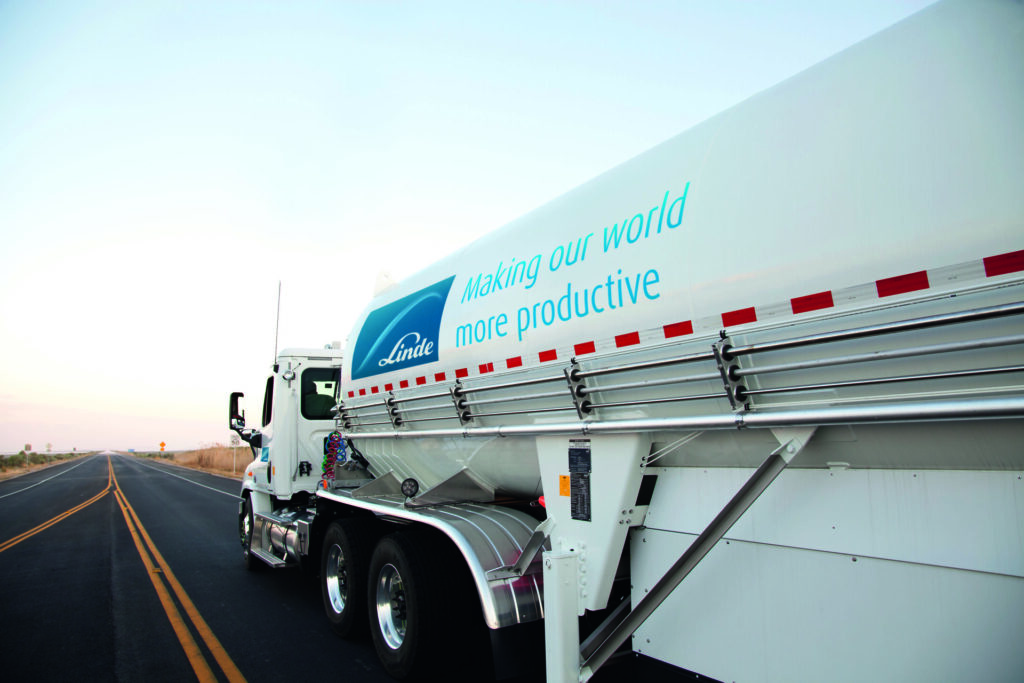
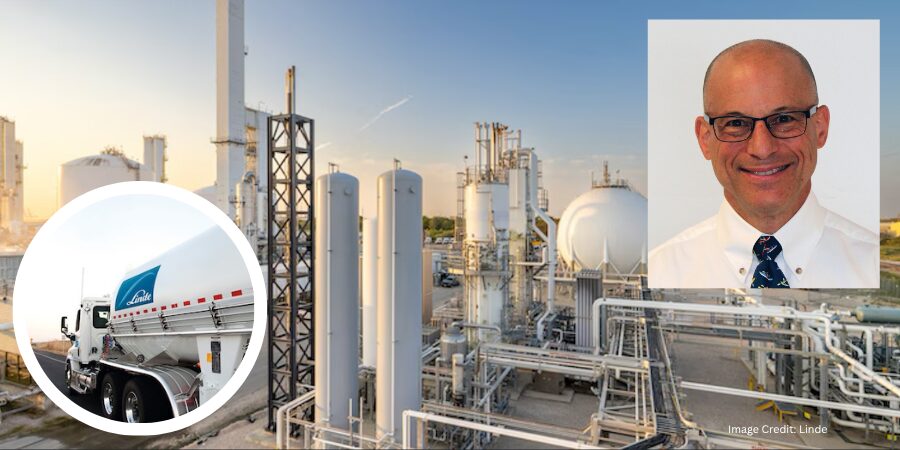
Linde gas delivery truck | Image Credit: Linde

Argon is delivered as a liquid cryogenic product (LAR), like liquid nitrogen (LIN), or liquid oxygen (LOX), but there may be differences in the storage and dispensing equipment installed at a client’s site due to the variety of uses for argon. Certain high-volume applications, such as ladle stirring and metals atomization, may require substantially higher pressure than normal cryogenic tanks are set up to store, making the use of boosters or cryogenic pumps necessary. If your application requires argon pressure to be above 100 psig, make sure that you are talking to a supplier that is experienced in providing and maintaining the equipment needed for your process.

From an NFPA codes standpoint, argon storage is comparable to nitrogen storage, and the clearances in NFPA 55 are the same for argon and nitrogen. But there are some key points to consider as far as safety in use:

  • While all cryogenic gases will create a vapor cloud that hugs the ground if there is a release, the clouds from nitrogen and oxygen will disperse and rise relatively rapidly as the gas warms. But because argon has much higher density than oxygen and nitrogen, a release will tend to hug the ground and can create a serious oxygen deficient atmosphere issue in low spots. Users of pit furnaces with argon need to be particularly aware of the unique characteristics of argon.
  • Because argon is generally shipped much longer distances than oxygen or nitrogen, tanks tend to be larger sized so that more can be delivered in a single visit. Since the transportation element of the price is considerable, keep in mind that your tank size (and NFPA clearance calculations) may be different than is typical for nitrogen.

While argon cannot be cost-effectively produced from air by non-cryogenic generation techniques (like membrane and PSA techniques used for nitrogen and oxygen), argon recovery/recycling is possible from argon-based industrial streams. A few of the larger industrial gas providers can provide recycling equipment that uses cryogenic separation technology to re-create very high purity argon from argon-rich offgas streams. Note that these installations are relatively expensive and specialized and are generally only of interest to the largest argon consumers.

After many years of relatively modest growth in the consumption of argon, several market segments are driving potentially important growth in argon use:

  • Several companies are developing U.S.-based titanium refining capabilities. Argon is required for processing and refining titanium metal, and the U.S. titanium production may become an important consumption driver.
  • Virtually all atomization of the special metals for powder metallurgical applications currently is done with argon used as the atomization gas. Though cheaper water-based atomization is being developed, it is not yet suitable for high quality powders. The metals powder industry has experienced strong growth and continues to grow.
  • The U.S. is reshoring iron and steel production, meaning that argon use for ladle stirring will rise. This means that overall argon use will rise, and that some new argon-capable ASU capacity will be built to serve the needs of new and refurbished steel plants.

Akin and I hope that these last two column installments have helped readers understand the factors in the market for argon that make it different in several ways from the more familiar nitrogen/oxygen marketplace.

About The Author:

David (Dave) Wolff
Industrial Gas Professional
Wolff Engineering

Dave Wolff has over 40 years of project engineering, industrial gas generation and application engineering, marketing, and sales experience. Dave holds a degree in engineering science from Dartmouth College. Currently, he consults in the areas of industrial gas and chemical new product development and commercial introduction, as well as market development and selling practices.

For more information: Contact Dave Wolff at Wolff-eng@icloud.com.

Answers in the Atmosphere: Argon Part 2 — Market Perspectives Read More »
Answers in the Atmosphere: Argon Part 1 — An Inert Alternative

In this installment of Answers in the Atmosphere, David (Dave) Wolff, an independent expert focusing on industrial atmospheres for heat treat applications, explores the practical role of argon as a truly inert alternative to nitrogen in thermal processing.

This informative piece on argon’s unique properties, production challenges, and applications — from vacuum heat treating of titanium to powder metallurgy and additive manufacturing — was first released in Heat Treat Today’s February 2026 Annual Air & Atmosphere Heat Treating print edition.


Akin Malas
Business Development Manager / Metallurgist
Linde

In this column, I’ve invited Akin Malas, business development manager and metallurgist at Linde, to bring his deep expertise in the subject of argon gas. What follows is the fruit of our discussion and continued conversations about this specialized yet indispensable industrial gas in thermal processing applications.

Compared to nitrogen (the industrial gas this column last covered), argon exhibits actual inertness, enabling its use in high-temperature environments and for processing metals that cannot tolerate nitrogen atmospheres, such as titanium and certain high-performance stainless steels. While argon is significantly higher cost than nitrogen, it remains far more economical than helium, another highly inert alternative.

Argon plays a vital role across multiple stages of metal processing, including:

  • Primary metallurgy: ladle stirring
  • Powder metallurgy: atomization of metal powders
  • Additive manufacturing: laser and electron-beam processes requiring inert chamber atmospheres
  • Vacuum heat treating: backfill gas for titanium and specialty alloys

Argon is used differently than nitrogen in most cases. Inexpensive nitrogen is often used as a utility pressurization gas, for scavenging, and blended with other gases (such as hydrogen); however, argon is most often used in pure form. Nitrogen is considered inert for heat treatment applications except in extraordinarily high temperatures or heat treatment of reactive metals, such as titanium and stainless steels. In this case, using an actual inert gas like argon or helium is necessary. Also, while nitrogen is virtually the same density as air and thus will diffuse throughout a vessel, argon is much denser than air and can be used to form a stratified inert layer.

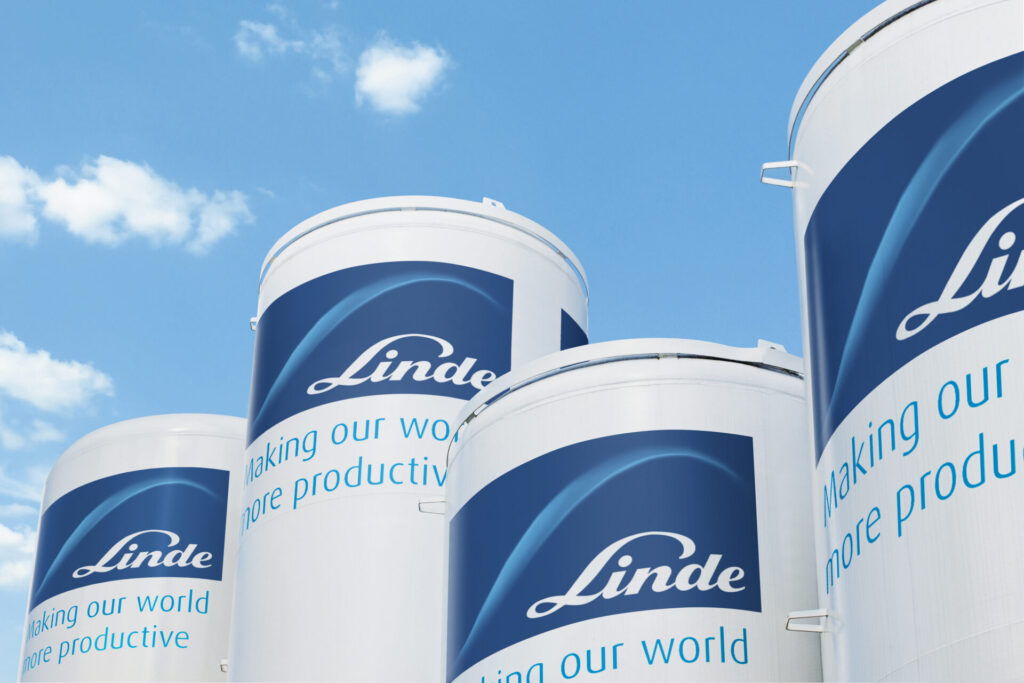
Linde gas storage tanks | Image Credit: Linde

Both argon and nitrogen are separated from air in a cryogenic air separation unit (ASU), but there are three main factors that make argon much harder to make than nitrogen and thus much more expensive:

  • Argon is only 1% of air while nitrogen is 78% of air. Argon boils at nearly the same temperature as oxygen, making a separate purification process necessary. Those two factors mean that only the largest ASUs make enough argon to make it worth purifying.
  • Argon cannot economically be separated from air non-cryogenically (primarily because the percentage in air is so low), so there is no low-cost competition to cryogenic argon. Also, because argon is prized for its inertness, there is much less interest in argon that might be lower purity.
  • Because argon is made in only the largest ASUs (typically those serving very large steel mills) and because those plants tend to be geographically grouped, shipping distances for argon tend to be much farther than for nitrogen and oxygen, further driving up the costs.

Processors of titanium parts and parts made of some stainless steels, such as the 300 series stainless alloys (SS), cannot be processed in nitrogen-containing atmospheres, because the metals will nitride at heat treating temperatures. Hence these metals may be processed in a pure argon (for Ti) or hydrogen (for SS) atmosphere blends.

We’ll pick up this discussion next month to see what market options are available, particularly in the U.S.

About The Author:

David (Dave) Wolff
Industrial Gas Professional
Wolff Engineering

Dave Wolff has over 40 years of project engineering, industrial gas generation and application engineering, marketing, and sales experience. Dave holds a degree in engineering science from Dartmouth College. Currently, he consults in the areas of industrial gas and chemical new product development and commercial introduction, as well as market development and selling practices.

For more information: Contact Dave Wolff at Wolff-eng@icloud.com.

Answers in the Atmosphere: Argon Part 1 — An Inert Alternative Read More »

Answers in the Atmosphere: The Tremendous Value of Industrial Gas Smartphone Apps

In this installment of Answers in the Atmosphere, David (Dave) Wolff, an independent expert focusing on industrial atmospheres for heat treat applications, highlights the practical value of smartphone apps designed for industrial gas calculations and conversions.

This informative piece on mobile tools that simplify gas property calculations, unit conversions, and storage or flow-rate estimations — drawing attention to apps developed by major gas suppliers and equipment providers that help heat treaters access critical data in the field — was first released in Heat Treat Today’s January 2026 Annual Technologies to Watch print edition.


The field of industrial gases is complicated by the fact that the physical characteristics of gases depend on the temperature and pressure at the time of measurement. Industrial gases may be delivered and stored as cryogenic liquids and highly pressurized gases, though they are generally used in relatively low-pressure gaseous form. Additionally, gases may be used for different purposes; for example, hydrogen may be used as a metallurgical atmosphere or as a burner fuel. As such, users need a ready source of data on various industrial gases to make necessary calculations.

Image Credit: Open Library/Internet Archive

Years ago, industrial gas users had to rely on data tables in publications like the CRC Handbook of Chemistry and Physics — the nearly 8 lb, $195 hardbound handbook that has been published continuously since 1914 and is currently on its 106th edition.

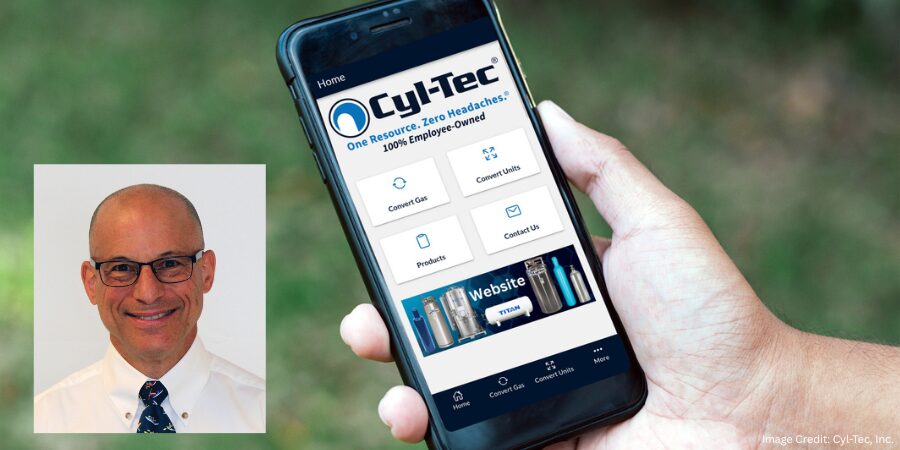
Today, there are many more mobile solutions in the form of smartphone applications. Several of the major gas providers have developed handy apps available for both Apple and Android operating systems to simplify gas conversions and calculations. Equipment providers have also developed apps to help understand the specifics of their equipment. All of these can be helpful to metals thermal processors, including heat treaters at in-house processing operations.

Some examples follow:

  • Air Products and Linde both provide powerful conversion engines that enable users to convert from imperial to metric units, from mass to volume measurements, and from liquid to gaseous volumes for common industrial gases. For example, users can calculate how many hours of atmosphere coverage 6,000 gallons of liquid hydrogen stored in a tank will provide.
  • Cyl-Tec, Inc. has developed an app that focuses on calculations primarily specific to cryogenic and pressurized gas storage. In addition to unit of measure conversions for each common industrial gas, the app provides detailed information on each of the storage vessels that the company makes.
  • WITT-Gasetechnik of Germany has developed an app to support their gas safety and controls business. Their products include gas mixers, gas analyzers, regulators, and other controls. The app provides a variety of gas blending and measurement information, including welding gas blend suggestions, unit conversion, and flow rate calculators.
  • Gasmet of Finland has developed an app that simplifies calculation of dewpoint and combustion products depending on the fuel being combusted.

While these suppliers hope that you will buy their products, be assured that the measurements and conversions performed with their tools, and the recommendations generated, will be equally applicable to products and systems supplied by others.

I suggest you create a folder called “calculations and conversions” on your smartphone and load it up with several of these apps while you are connected to your home or office internet, so that you will have the apps handy when you are away from your standard technical resources.

About The Author:

David (Dave) Wolff
Industrial Gas Professional
Wolff Engineering

Dave Wolff has over 40 years of project engineering, industrial gas generation and application engineering, marketing, and sales experience. Dave holds a degree in engineering science from Dartmouth College. Currently, he consults in the areas of industrial gas and chemical new product development and commercial introduction, as well as market development and selling practices.

For more information: Contact Dave Wolff at Wolff-eng@icloud.com.

Answers in the Atmosphere: The Tremendous Value of Industrial Gas Smartphone Apps Read More »

Name Change for U.S. Subsidiary of Global Industrial Gases and Engineering Supplier

On August 13th, Linde announced that its U.S. subsidiary, Praxair, Inc., will begin operating under the Linde name, effective September 1. This name change follows the merger of Praxair, Inc. and Linde AG. The company, which will operate under the Linde brand, is a global industrial gases and engineering company.

With 80,000 employees in more than 100 countries, the company reiterated its values of safety, integrity, community, inclusion, and accountability, believing in "making our world more productive." 

The primary customer contact for products and services will remain the same. Beginning September 1, information on the U.S. business may be found at www.LindeUS.com. The Customer Call Center will be available either by phone at the new 1.844.44LINDE or the new e-mail address contactus@linde.com.


(photo source: linde.com)


Name Change for U.S. Subsidiary of Global Industrial Gases and Engineering Supplier Read More »

Skip to content