


Jim Combustion Corner

When the Pressure Gets Too Much — And It Helps

Jim Roberts of U.S. Ignition engages readers in a Combustion Corner editorial about the double-edged sword of heat recovery technology — explaining how efforts to reduce fuel consumption inadvertently drove up NOx emissions, and how flue gas recirculation (FGR) emerged as the design solution capable of cutting both fuel use and emissions by up to 50%.

This editorial was first released inHeat Treat Today’s February 2026 Annual Air & Atmosphere Heat Treating print edition.


A furnace guy walks into the heat treating plant and says to the operators standing nearby, “This exhaust system and these burners all have a negative attitude.” The other furnace guys say, “They better be negative, or they would not work well!” As if we don’t have enough negativity swirling around in our world as it is, now we are happy about it?

In the Annual People of Heat Treat (September 2025) we talked about the types of burners that were developed as heat treating and furnace sciences and combustion designs evolved. We also chatted about how the advent of new fuels and government regulations was going to take a chunk of our attention in the coming years — for example, pollution laws coming to the forefront of our industry in the late ‘70s and onwards. Interesting new burner designs sprung up, primarily, as you recall, to address the usage of gas. In other words, how can we reduce fuel usage?

But First, NOx

The cost of gas skyrocketed for a stretch and it led us first to energy reduction plans. But with heat recovery sciences came the phenomenon of higher flame temperatures. When you get higher flame temperatures, you can sometimes (okay… all the time) generate NOx. One of the primary constituents of atmospheric pollution is NOx, and it became a prime target for reduction by the EPA and other governing air quality folks. As it should be.

Just a quick step back to the “remind me again, Jim” world. What do we breathe? Air, right? We have to have oxygen. But what we tend to forget is that air is roughly 79% nitrogen. So, what we breathe is actually nitrogen spiked with oxygen, and the fuel that we generally burn, natural gas, has some nitrogen in it too.

Natural gas can have as much as 5% nitrogen in it, although membrane filtering usually controls pipeline gas content at around 1%. The point is that nitrogen is the dominant gas in our combustible portfolio, and when we make it really hot, it makes NOx. And that is considered bad for all of us. So, NOx from fuel-borne nitrogen can be released at temperatures as low as 1400°F. Sometimes that is referred to as “sudden NOx” because it releases quickly. All of us Furnace Guys know that 1400°F ain’t nothing in our world.

The second form of NOx is referred to as “thermal NOx” and that is the major source of NOx in our world. That is when we heat the air we are combusting in a burner, burning off most of the 21% oxygen. Then, flame temperature climbs, and continues to now superheat and try to burn that remaining 79% of nitrogen. As temperatures approach 2300°F, the magic happens.

Thermal NOx forms significantly at high combustion temperatures, typically starting above 1300°C (2372°F), with formation increasing exponentially as temperatures rise, especially above 2800°F (1538°C), due to atmospheric nitrogen and oxygen reacting at peak flame temperatures. Does anybody remember what happens to flame temperatures when we preheat the combustion air (recuperation, recirculation, etc.)? Flame temp and heat transfer increase and we go up to theoretical flame temperatures of 3200°F without even working at it.

Solving Energy Efficiency Through Design

So, let’s return to the original question: What happened when we tried to only save gas with heat recovery? Answer: We installed energy efficient burners but increased the emissions footprint in doing so. We cut down on energy expenditure but made exhaust an issue with the higher temps.

For most industrial and commercial applications, the optimal range for flue gas recirculation (FGR) is between 10% and 25% as this range offers significant NOx reduction without compromising combustion stability or efficiency. By adjusting the pressures coming into the burner and then balancing the exhaust outlet pressures over the heat exchanger body, normally with an extraction device called an “eductor,” we can dial in the percentage of recirculation the burners are operating under.
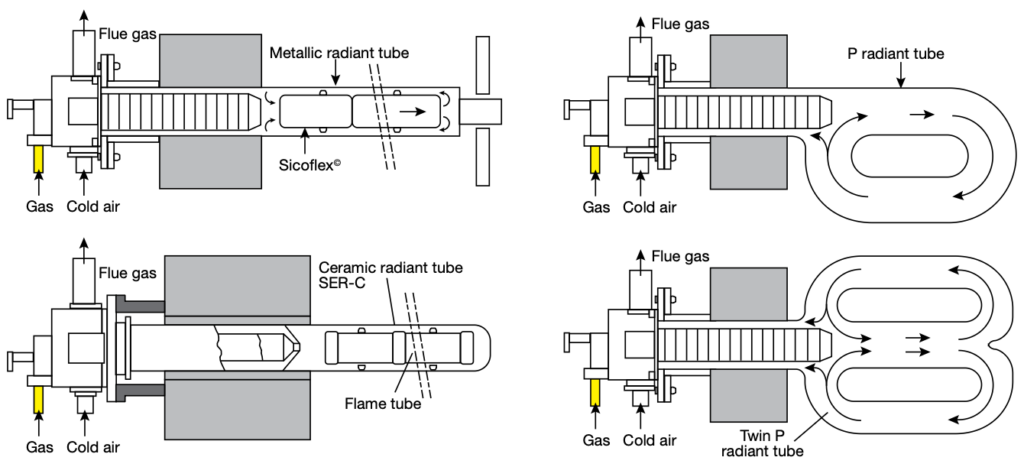
Figure 1. Flow diagrams depicting the basic design for both direct fired and radiant tube style burners | Image Credit: Honeywell

With this design, I have seen fuel and emission reductions of 50% when compared to the existing conventional combustion systems. It really is a testament to what design and research can produce for us (Figure 1).

We’ll look more closely at these designs next time.

About The Author:

Jim Roberts
President
US Ignition

Jim Roberts president at U.S. Ignition, began his 45-year career in the burner and heat recovery industry focused on heat treating specifically in 1979. He worked for and helped start up WB Combustion in Hales Corners, Wisconsin. In 1985 he joined Eclipse Engineering in Rockford, IL, specializing in heat treating-related combustion equipment/burners. Inducted into the American Gas Association’s Hall of Flame for service in training gas company field managers, Jim is a former president of MTI and has contributed to countless seminars on fuel reduction and combustion-related practices.

For more information: Contact Jim Roberts at jim@usignition.com.

When the Pressure Gets Too Much — And It Helps Read More »

Cost of Fuel Drives Change

Jim Roberts of U.S. Ignition engages readers in a Combustion Corner editorial about how rising fuel costs have driven dramatic improvements in furnace efficiency and combustion technology over the past 60 years, transforming heat treat processes from 20% to 70% fuel efficiency.

This editorial was first released in Heat Treat Today’s January 2026 Annual Technologies to Watch print edition.


A furnace guy walks into the shop and sees the cost of gasoline. “This keeps going up, what gives?”

My first car got about 10 MPG — we will not even go near to discussing when that was. Gasoline costs have since driven cars to become more efficient with 30+ MPG vehicles.

Last month’s article highlighted how there are five qualities in our heat treat processes: Quality and Accuracy, the necessary attributes; Efficiency and Performance, the variables; and Profit, which comes whenever we improve the two variables. We have discussed government regulation on emissions and technological breakthroughs that improved combustion technology in earlier articles, but now we turn to the connection of combustion and cost: how gasoline costs drove improvement of the two variable qualities of heat treat processing for combustion, Efficiency and Performance.

Gasoline Costs: A Timeline

Up until about 1960, the world of heat processing was pretty much a level playing field with Efficiency and Performance. We had tons of fuel at our disposal. Pollution was known but not yet a criterion to manage processes. So, burner efficiency and design were very low end. Nobody cared. Fuel was almost free. In doing research for this story, I found records of natural gas being less than $0.50 per million BTUs. Electricity was on par with delivered BTU costs. But then the cost of fuel started to fluctuate. The furnace guys started to notice; if nothing else changed, our friend Profit would weaken.

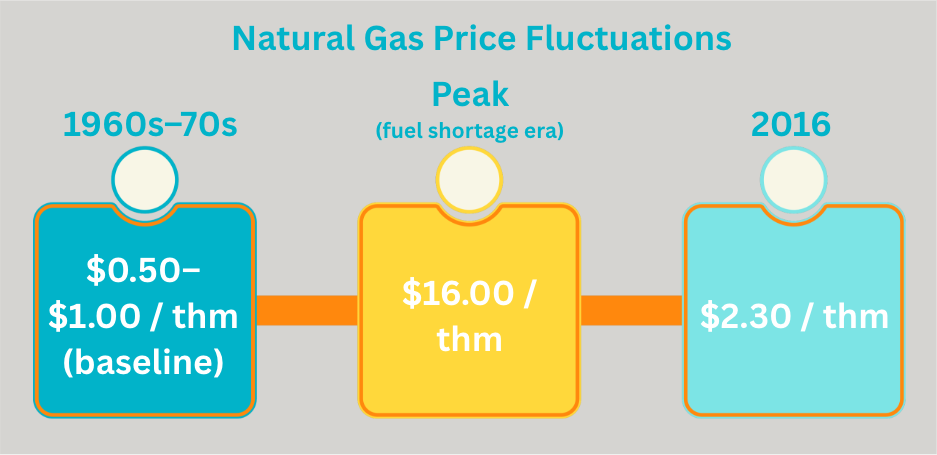
From 1930 to 1980, electricity pricing went up 500%. Natural gas started to bounce around in price. It was less than a $1.00/thm in the ’60s and ’70s, peaking during times of fuel shortage at $16.00/thm. Ten years later, in 2016, it hit $2.30/thm again. Some pretty wild fluctuations. In fact, it should be noted that the industry overseas had already begun to shift technologies — several years ahead of the U.S. — because they had been suffering with high fuel costs in Great Britain, Germany, Western Europe, and in Asian markets.

Furnace guy and the suppliers had to improve the efficiency and performance.

Troubleshooting and Combustion Design Changes

At first, you look at easy fixes to improve Efficiency and Performance. An example would be that insulation and refractory science really improved. If you can keep the heat in the furnace, you need less fuel to hold it at these high temperatures, right? So, improve the insulation.

Next, let’s get the burners from just being the opening in the furnace that you pour gas into, and make the burner more like a carburetor on an engine. Let’s get control of the air and gas ratios.

Next, let’s recover some of the flue gases and pre-heat the air coming into the burner. When you do that, the flame temp goes up, sometimes by as much as 400-500°F. That means higher heat transfer rates to the parts inside a now well-insulated furnace. Huge efficiency gains started happening.

Efficiency and Performance got a huge boost when the burners started to have high velocity discharge rates. In other words, we now had flames that were hotter and going into the furnace at several hundred miles an hour more than before. With that comes circulation improvement inside the furnace. And much like pudding in a blender, the faster the beaters, the smoother the mix. To give you an idea of the scope of these improvements, form 1960 to 1990, a matter of only 30 years, furnace and burner technology improvements went from 20% fuel utilization to estimated 60-70% fuel efficiencies, even higher in some instances. And there it was, super efficiency driven to occur by fuel cost and flucturation of supply.

To really hit home what that meant, let’s look at a 1,000-lb load of steel. Our process temp is 1750°F. Our furnace and combustion efficiency used to be 20%. That would require 1,370,000 BTU to heat up in an hour. Now, with 75% furnace and burner efficiency, that’s 352,000 BTU. You just saved approximately 1,000 ft3 of gas per hour! If we use the average industrial gas price today at $3.80/1,000 ft3, the difference of all this is $24,000/year, and that’s just a 1,000-lb load. Real world, the numbers are significantly higher, as all you furnace guys know. Imagine the dollar savings when fuel was at $16.00/thm?

And so, there it is. The well-known realization that in most markets, the dollar cost of the energy triggers improvement of technology.

Until next time…

About The Author:

Jim Roberts
President
US Ignition

Jim Roberts president at U.S. Ignition, began his 45-year career in the burner and heat recovery industry focused on heat treating specifically in 1979. He worked for and helped start up WB Combustion in Hales Corners, Wisconsin. In 1985 he joined Eclipse Engineering in Rockford, IL, specializing in heat treating-related combustion equipment/burners. Inducted into the American Gas Association’s Hall of Flame for service in training gas company field managers, Jim is a former president of MTI and has contributed to countless seminars on fuel reduction and combustion-related practices.

For more information: Contact Jim Roberts at jim@usignition.com.

Cost of Fuel Drives Change Read More »

Refine Your Process, Get Profits

Jim Roberts of U.S. Ignition engages readers in a Combustion Corner editorial about how focusing on the right priorities in the right order naturally leads to profitability in heat treating.

This editorial was first released in Heat Treat Today’s December 2025 Annual Medical & Energy Heat Treat print edition.


It’s a crisp winter day, and a furnace guy walks into the heat treat plant and says, “Something has changed here, it feels…more modern.” The rest of the furnace guys shrug and continue with the tasks at hand. But the furnace guy is right — something has been changing all along and will continue to do so in the foreseeable future, I’ll wager.

We’ve talked about how certain trends and needs have driven the growth in the industry. My ramblings have included bed posts and pipelines and the flavors of different fuels, and what it all boils down to is change. These changes are attempts to get the following qualities into our processes in the heat treating world:

  1. Quality
  2. Accuracy
  3. Efficiency
  4. Performance
  5. Profit

“But Jim, you listed profit as the last measuring stick! What is wrong with you?” It would be pretty easy to invert this list; turn these guideposts upside down and the world you are in would still work. But if we add longevity in business as an additional goal, then it will not be too long before you begin to realize that the order is listed correctly here. For the most part, in my experience, the heat treating industry has kept the order intact. It is an honorable path, I think.

Quality and Accuracy are the new givens. We do not have to spend time on this. As long as we have been wielding control over metal, those properties are the constant. From hammering out the very first horseshoes, if they did not fit the horse or cracked and broke after a couple of steps, you were not in the horseshoe business very long. These days, standards clearly map out the goal: a client tells us what is demanded, maps it out for us in a specification, and we meet it.

Items 3 and 4 are where we focus today. If we can improve Efficiency and Performance after meeting the Quality and Accuracy targets, then good old item 5 happens — Profit. It just happens. What a concept! Now you may think this is a re-run of every BUS-101 class or seminar you have seen. Maybe you are right, but this is where I veer off as a furnace guy and get back to the business of combustion as it applies to our industry.

We talked earlier about how the natural gas industry expanded and built this fantastic infrastructure to provide fuel to all of us. Electric providers did and are still doing the same thing.

At the end of the transmission line, whether gas pipe or electrical cable, sit the furnaces and ovens that heat treating needs. The buck stops here. Speaking of bucks, in order to get to profit, what must we do? If we really only have Efficiency and Performance in our control (Quality and Accuracy are presumed to be met), then let’s look at how that changed, in furnace guy world…next year [in 2026].

All the best to everyone in the Holiday seasons. May you be blessed with good health and happiness.

About The Author:

Jim Roberts
President
US Ignition

Jim Roberts president at U.S. Ignition, began his 45-year career in the burner and heat recovery industry focused on heat treating specifically in 1979. He worked for and helped start up WB Combustion in Hales Corners, Wisconsin. In 1985 he joined Eclipse Engineering in Rockford, IL, specializing in heat treating-related combustion equipment/burners. Inducted into the American Gas Association’s Hall of Flame for service in training gas company field managers, Jim is a former president of MTI and has contributed to countless seminars on fuel reduction and combustion-related practices.

For more information: Contact Jim Roberts at jim@usignition.com.

Refine Your Process, Get Profits Read More »

Flame and Fire: History of the Industrial Gas Industry

Jim Roberts of U.S. Ignition entertains readers in a Combustion Corner editorial about how the industrial gas industry evolved from its humble beginnings in the early 1900s into a precision-driven force that transformed combustion technology and modern manufacturing.

This editorial was first released in Heat Treat Today’s November 2025 Annual Vacuum Heat Treating print edition.


Let’s think about how young the industrial gas industry really is.

A Short Pipeline in Time

The first real industrial usage was way back in the 1800s somewhere. But there was no infrastructure, no supply other than bottled gas for industrial applications. The gas industry, as far as we recognize it, did not really take off until somewhere around the early 1920s when the first welded pipeline was installed. Then, as usage increased, it became apparent that safety was going to be a concern. The addition of mercaptan (rotten egg smell) was not until the late 1930s.

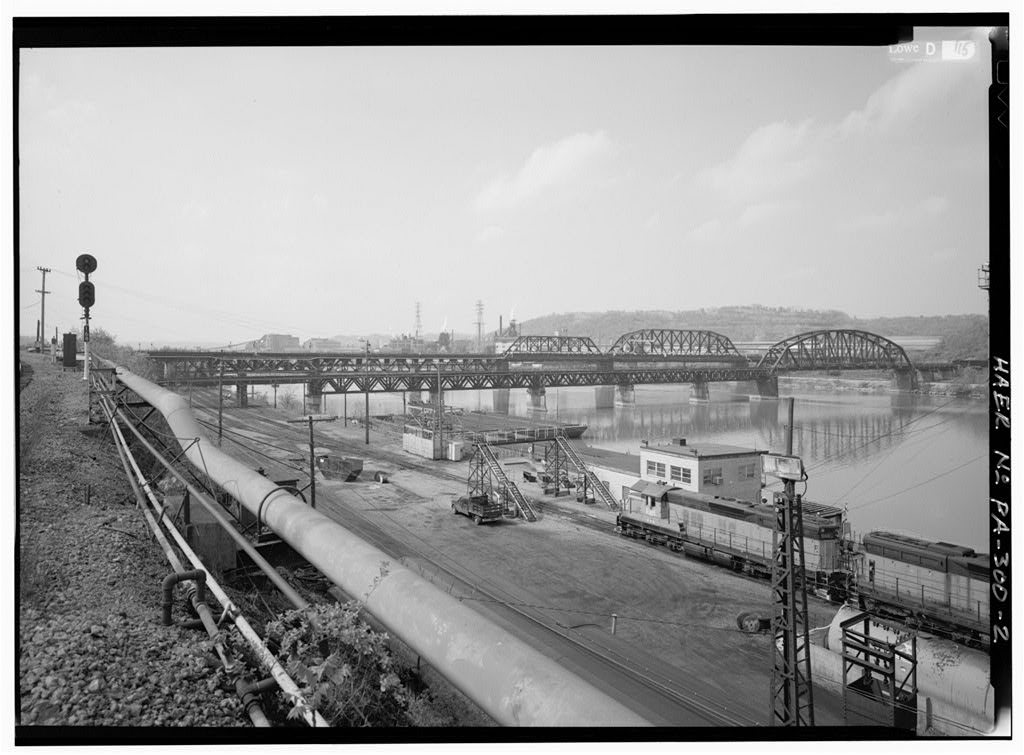
With the growth of commercial and residential usage, the demand for gaseous fuels grew by 50 times the original market size anticipated between 1910 and 1970! What does that demand look like? Today there are over 3 million miles of gas distribution lines connected to 300,000 miles of big transmission pipelines in the U.S. alone. All that growth in a span of 100 years, essentially. That means the transmission pipeline system in the U.S. could stretch around the planet 12 times!

USS coke gas pipeline in the foreground with the Conrail Port Perry Bridge spanning the Monongahela River, Port Perry, Allegheny County, PA (Lowe, 1994)
Source: Library of Congress Prints and Photographs Division

Most of that construction occurred during the post-war 1940s to 1960s timeline. That’s one busy industry! And it dragged all the thermally based markets and industries along with it. Now, we have come to accept the availability of natural gas as so commonplace that we cannot imagine life without it.

Responding with Precision

So, now you ask yourselves, “Why this history lesson, Jim?” Well, because we are supposed to be learning about combustion and the era of major combustion advancements — and if I would quit veering off into side topics we might actually get there. But it is all interconnected.

If you recall the story of the heat treater with the bedpost burners (October 2025 edition), he had no inspiration to improve efficiency or performance because those darn bedposts would burn gas just fine. So, what changed? Firstly, the world had been through a couple of military conflicts during this rise of the gas industry. And sadly, sometimes the best technological advances occur in times of conflict; engineering becomes more precise. All of a sudden, instead of hammering out horseshoes for the cavalry, we were heat treating gun barrels and crankshafts for airplanes. We needed to be more than precise — actually, we had to be perfect. So, we stepped away from the old heat treatment ways and developed systems that we could control to within a couple of degrees.

As a result, burners became specialized. Each process became unique and precise. Instead of pack carburizing components, a company called Surface Combustion developed a piece of equipment called an Endothermic generator. This device made carbon-based atmosphere out of natural gas or propane- and nickel-based catalysts. All of a sudden, we could do very precise non-scale covered heat treating. And the burners from companies like North American Combustion, Eclipse Combustion, Maxon, Hauck, Pyronics, Selas, W.B. Combustion, and on and on, all scrambled to develop the specific types of burners that the heat treaters and iron and steel makers needed.

Another important milestone hit around 1963: the Government got involved (gasp!). The Clean Air Act of 1963 essentially said we needed to burn our fuels cleanly and not spit smoke into the air. Those laws got reviewed again in 1970, 1977, and again in the updated Clean Air Act of 1990 with some of the biggest revisions.

With all of these changes, we had several drivers for innovation in the combustion world. Again, precision became a must. Heat treating became a very standards-driven industry. Metallurgists roamed the planet inventing both new materials and the processes to achieve them. Gas companies themselves became huge drivers of innovation and developed think tanks, like the GRI (Gas Research Institute), where people learned and laboratories hummed with development projects investigated in conjunction with burner and furnace companies. Academia became involved with industry in the form of organizations like The Center for Heat Treating Excellence (CHTE) and the Metal Treating Institute (MTI). Suddenly, the industry was more than just blacksmiths.

We’ll talk about how burner companies became design specialists and system efficiency experts and what that meant to various burner styles in next month’s offering.

References

Lowe, Jet. 1994. Panorama of Industry (Conrail Port Perry Bridge, Spanning Monongahela River, Port Perry, Allegheny County, PA). Historic American Engineering Record, HAER PA,2-POPER,1-2. Library of Congress Prints and Photographs Division.

About The Author:

Jim Roberts
President
US Ignition

Jim Roberts president at U.S. Ignition, began his 45-year career in the burner and heat recovery industry focused on heat treating specifically in 1979. He worked for and helped start up WB Combustion in Hales Corners, Wisconsin. In 1985 he joined Eclipse Engineering in Rockford, IL, specializing in heat treating-related combustion equipment/burners. Inducted into the American Gas Association’s Hall of Flame for service in training gas company field managers, Jim is a former president of MTI and has contributed to countless seminars on fuel reduction and combustion-related practices.

For more information: Contact Jim Roberts at jim@usignition.com.

Flame and Fire: History of the Industrial Gas Industry Read More »

Skip to content