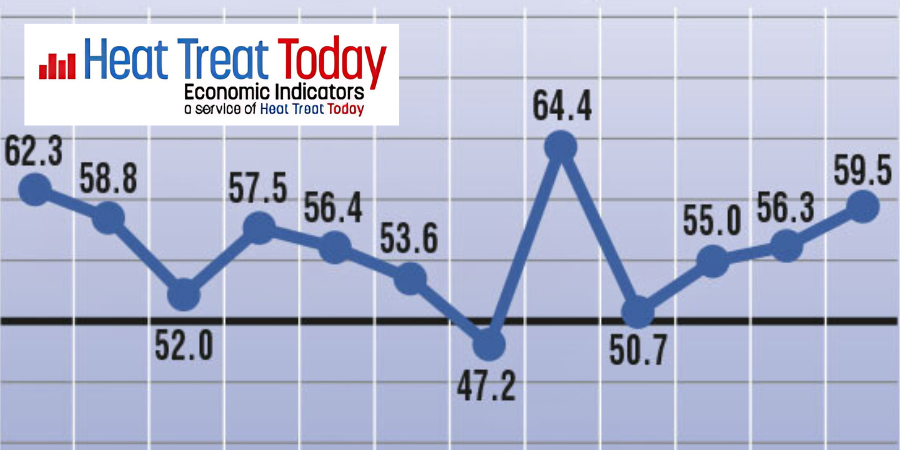
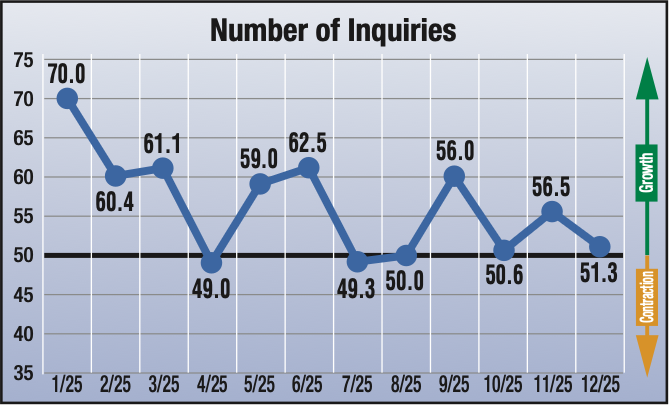
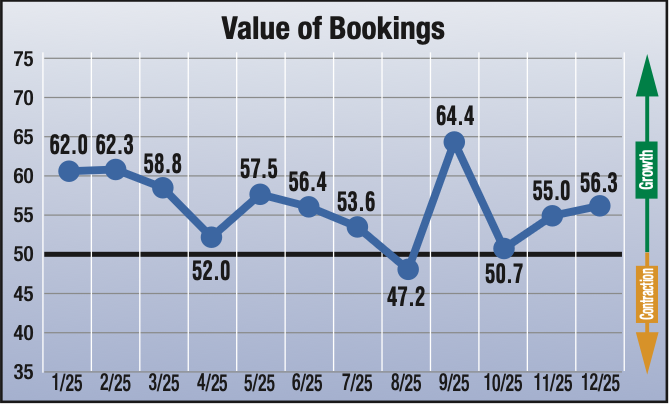
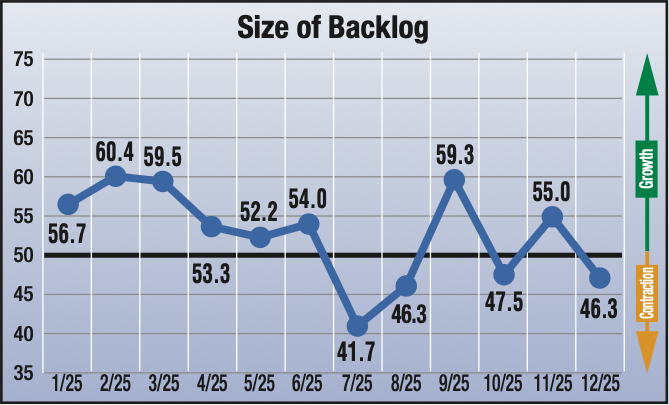
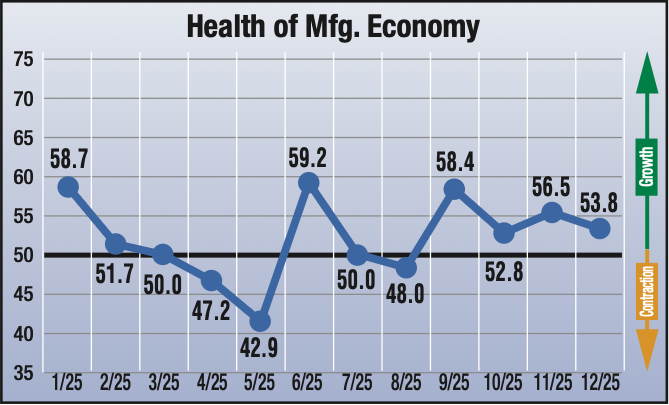
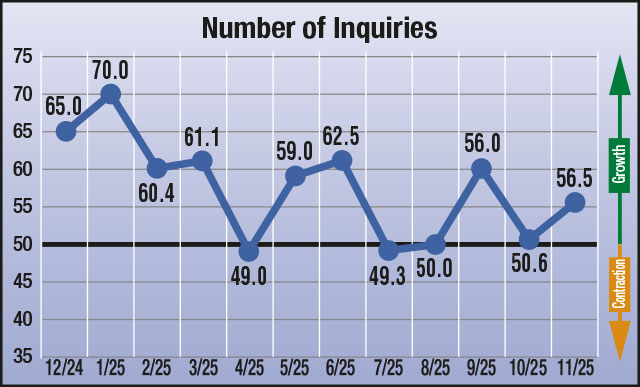
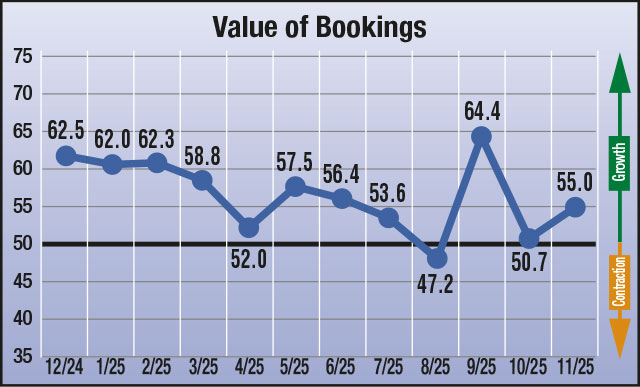
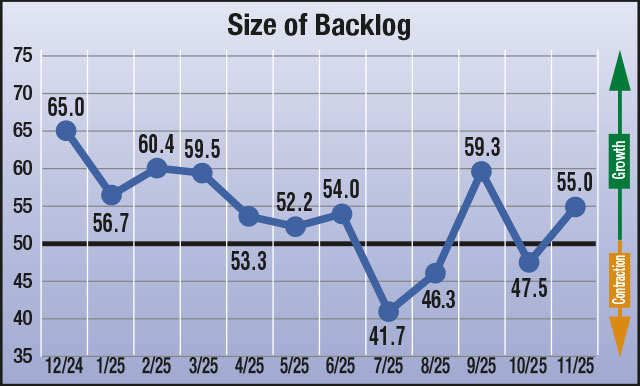
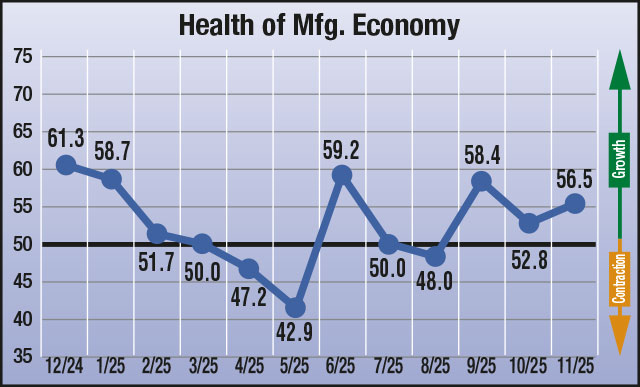
Heat Treat Today has gathered the four heat treat industry-specific economic indicators for January 2026. The January results show encouraging momentum compared to the December 2025 predictions.
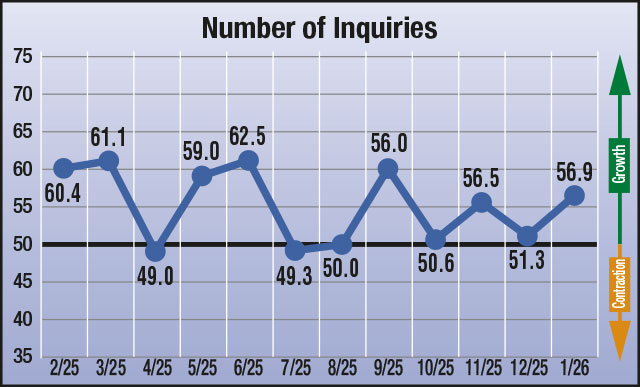
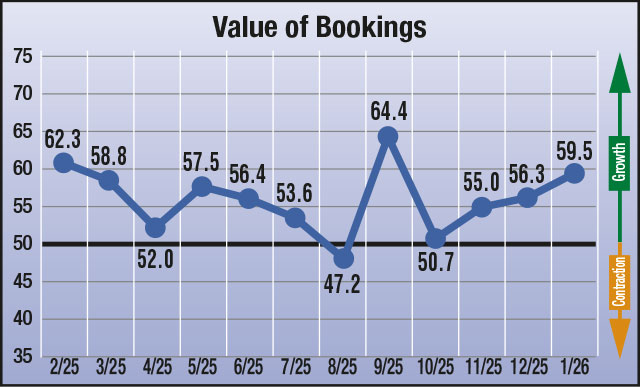
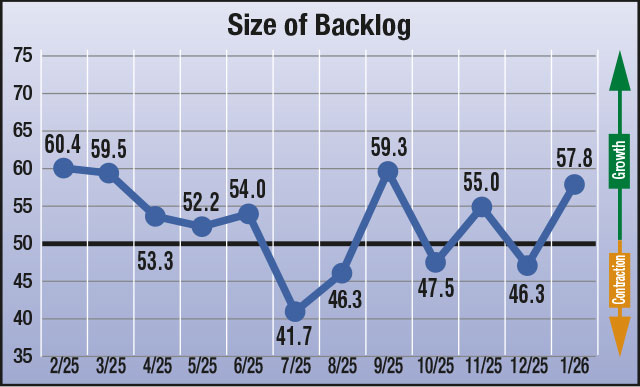
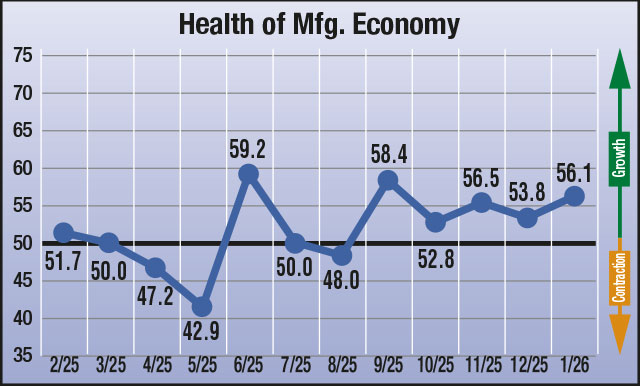
January’s indices show suppliers to the industry anticipate significant growth across all four key metrics. Inquiries had a robust uptick at 56.9 (up from 51.3 in December). Bookings demonstrated a healthy increase at 59.5 (up from 56.3 in December). The Backlog index rebounded dramatically, swinging the metric from contraction back into solid growth territory at 57.8 (up from 46.3 in December). Finally, the Health of the Manufacturing Economy index continues to reflect expectations for an encouraging backdrop for heat treating demand at 56.1 (up from 53.8 in December).
January’s indicators reveal a heat treating industry hitting its stride as we enter 2026. The across-the-board improvements — particularly the dramatic backlog recovery — paint a picture of renewed vitality and momentum. With all four metrics showing solid growth, the industry appears well-positioned for a strong start to the year.
The results from this month’s survey (January) are as follows: numbers above 50 indicate growth, numbers below 50 indicate contraction, and the number 50 indicates no change:
Anticipated change in Number of Inquiries from December to January:56.9
Anticipated change in Value of Bookings from December to January: 59.5
Anticipated change in Size of Backlog from December to January: 57.8
Anticipated change in Health of the Manufacturing Economy from December to January: 56.1
Data for January 2026
The four index numbers are reported monthly by Heat Treat Today and made available on the website.
Heat TreatToday’sEconomic Indicatorsmeasure and report on four heat treat industry indices. Each month, approximately 800 individuals who classify themselves as suppliers to the North American heat treat industry receive the survey. Above are the results. Data collection began in June 2023. If you would like to participate in the monthly survey, please click here to subscribe.
Heat Treat Today publishes twelve print magazines annually and included in each is a letter from the publisher, Doug Glenn. This letter is from theNovember 2025 Annual Vacuum Heat Treating print edition.
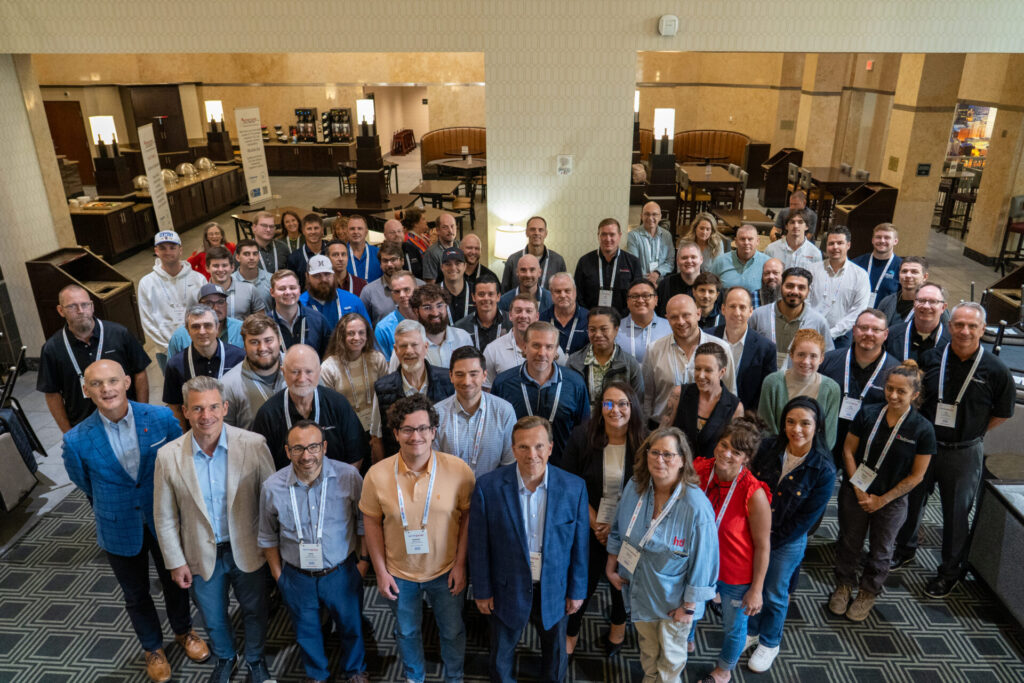
Heat TreatBoot Camp has become a popular gathering place for individuals who are either new to the North American heat treat/thermal processing market or who have been around a good while but would like to learn more. This year, on September 15–17 in Pittsburgh, Pennsylvania, the industry gathered over 60 learners at the 4th annual Heat TreatBoot Camp. By all practical measures, it was an extremely successful event.
Attendance
2025 Heat Treat Boot Camp attendees
The magic number, 63, was more than any previous year by 50% and double the number that we had last year. Of those 60-some, we had roughly:
11 captive heat treaters (18%)
7 commercial heat treaters (12%)
1 investment company (<1%)
44 suppliers (70%)
The number of years that these attendees had been in the industry varied from as little as several weeks or months to over 30 years. The mix was ideal, allowing the newbies to learn from the industry veterans and for industry veterans to be energized by the enthusiasm and energy of the newbies.
It was also good to have multiple companies sending people for the 2nd or 3rd year in a row. Obviously, they like what their employees are learning.
Speakers
As with the previous three events, Thomas Wingens of Wingens Consulting and I were the only two speakers. Between the two of us, we have well over 50 years of industry experience. Thomas covered the technical side of the conversations dealing with both the materials and processes of heat treat, while I covered the markets, products, and players. Thomas also discussed emerging technologies, and I concluded with a short session on resources to help keep current.
Activities
We kicked off the event on Monday evening, September 15, with a reception on the scenic outdoor patio of the Drury Plaza Hotel in downtown Pittsburgh. The hotel had purchased and renovated this historic building, the former location of the Pittsburgh Federal Reserve. In fact, all of the training sessions took place in The Main Vault. It was a “safe place.”
Tuesday was a full day in the classroom. It was grueling, but attendees were rewarded with a school bus ride to the historic Duquesne Incline where we were elevated to the top of Pittsburgh’s Mt. Washington. From there we could overlook the city from well above the tops of the skyscrapers. It was a beautiful evening. We then walked two blocks to LeMont Restaurant where we continued to overlook the city until the evening hours brought out the city lights. Again, beautiful.
Wednesday was a half day of classes and then an optional tour of Penna Flame Heat Treating in Zelienople, Pennsylvania, less than one hour north of Pittsburgh.
Sponsors
A big “thank you” goes to the industry sponsors — many of whom returned from last year — who helped us underwrite the costs of the boot camp. Idemitsu was our sole Title Sponsor. Can-Eng Furnaces was our sole Social Sponsor helping with the expenses of some of our networking functions and the putt-putt contest. Our two lunch sponsors were Cleveland Electric Labs (who have sent at least two people to all four of the boot camps since 2022) and Newton Heat Treating. Other corporate sponsors included ECM USA Vacuum Furnaces, Gasbarre Thermal Processing Systems, Super Systems, Honeywell, Chiz Bros, and I Squared R who had the popular Triple-Dipped Malted Milk Ball sponsorship. All of these companies were super helpful in making Boot Camp a success.
You’re Invited
Next year, we encourage you or someone from your company to attend. To see what past recipients have said and for more information about the 2026 Boot Camp, please visit www.heatttreatbootcamp.com. See you there.
Doug Glenn Publisher Heat TreatToday For more information: Contact Doug at doug@heattreattoday.com
Heat Treat Today has gathered the four heat treat industry-specific economic indicators for December 2025. The December results suggest more limited growth than what was predicted in November of 2025.
December’s indices showed modest expansion with mixed momentum across different indicators. The Inquiries stayed moderately positive at 51.3 (from 56.5 in November). Bookings are encouraging at 56.3 (up from 55 in November). The Backlog index is in contraction territory at 46.3 (from 55 in November). Finally, the Health of the Manufacturing Economy index showed moderate growth at 53.8 (from 56.5 in November).
The data suggests cautious optimism but warrants close monitoring of inquiry trends and backlog levels in coming months.
The results from this month’s survey (December) are as follows: numbers above 50 indicate growth, numbers below 50 indicate contraction, and the number 50 indicates no change:
Anticipated change in Number of Inquiries from November to December:51.3
Anticipated change in Value of Bookings from November to December: 56.3
Anticipated change in Size of Backlog from November to December: 46.3
Anticipated change in Health of the Manufacturing Economy from November to December: 53.8
Data for December 2025
The four index numbers are reported monthly by Heat Treat Today and made available on the website.
Heat TreatToday’sEconomic Indicatorsmeasure and report on four heat treat industry indices. Each month, approximately 800 individuals who classify themselves as suppliers to the North American heat treat industry receive the survey. Above are the results. Data started being collected in June 2023. If you would like to participate in the monthly survey, please click here to subscribe.
Heat Treat Todaypublishes twelve print magazines a year and included in each is a letter from the editor. This letter is a pre-release from the December 2025 Annual Medical and Energy Heat Treat print edition. In today’s letter,Bethany Leone, managing editor at Heat Treat Today, shares about the ASM Heat Treat show of 2025.
Attending the bi-annual Heat Treat show is always a thrill. The ASM Heat Treat Society did not disappoint, bringing a full line up of technical sessions and engaging panels to attend between walking the busy show floor, itself packed with cutting edge research presentations and informative booths of key players. I had the opportunity to attend more sessions than usual this year to hear what concerns in industry were being raised at this event.
On Monday, October 20, ASM President Dr. Navin Manjooran, chaired the first ever Executive Leadership Forum, bridging the concerns and forecasts of industry leaders with the bold training methods of frontline academic leaders. The event was specifically hosted for the IMAT conference attendees at the collocated 33rd Heat Treating Society Conference and Exhibition.
Dr. Manjooran underlined the intent of creating stronger collaborations between these two groups, with the first moderator, Renee Parente, director of Technology and Product Engineering at Advanced Micro Devices (AMD), further emphasizing the goal of accelerating innovation through open discussions like these.
Industry Panel
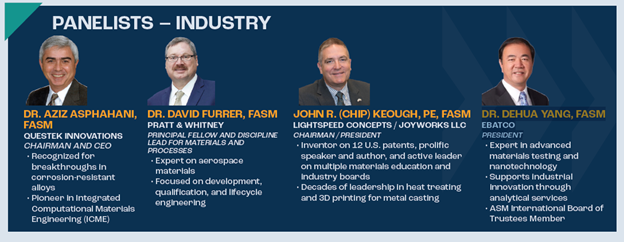
At this forum, the first panel included a Q&A portion moderated by Renee Parente with the following four industry panelists:
Dr. Aziz Asphahani, FASM, chairman and CEO of Questek Innovations
Dr. David Furrer, FASM, principal fellow and discipline lead for materials and processes at Pratt & Whitney
John R. (Chip) Keough, PE, FASM, chairman and president at Lightspeed Concepts/Joyworks LLC
Dr. Dehua Yang, FASM, president at Ebatco
ASMExecutive Leadership Panel Industry Panelists Source: ASM International
From this panel came key thoughts on how research in the business world was being developed to further commercial efforts. First, there was a consensus that corporations were investing in research internally but were instead looking to start-ups to absorb the energies of research and development needs. While academic-industry partnerships were valuable, the concern over IPs was reviewed with Dr. Furrer adding that it is commitment to collaborative internal research efforts and external research industry partnerships that is most meaningful. He also added that the new generation of engineers are entering the workforce with new tools of industry at the ready to implement, and this shift needs to be welcomed to keep pace with the speed of innovation.
Another important thread of discussion in this panel was the need to both accelerate the development of higher performance materials (Dr. Asphahani), as well as implement this development in a connected manner across engineering counterparts, like the quality, manufacturing, and design departments (Dr. Furrer) for effective product development.
Academic Panel
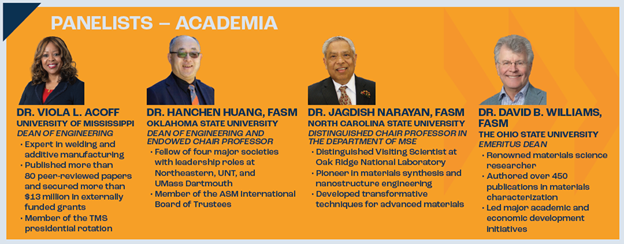
The academic panel revealed specifics on exciting current and developing efforts to train the rising workforce. Dr. Viola L. Acoff, the dean of engineering at the University of Mississippi, passionately shared the success of her breakthrough course design to retain freshmen metallurgy students through a hands one MTE 101 course, which includes access to a fully functioning foundry and efforts to grow already present real-world industry experience through industry-sponsored programs.
ASMExecutive Leadership Panel Academia Panelists Source: ASM International
While the panel acknowledged the ongoing efforts to prepare students to use AI and other technologies of Industry 4.0 (and 5.0), there was a mixture of other emphases, including:
the “plug-and-play” graduate who does not need remediation training at their first job (especially emphasized by Dr. Christopher Berndt, distinguished professor, Surface Science and Engineering at Swinburne University of Technology)
a focus on developing materials engineers who think critically
a close look at the publication system, with some specifically advocating the need to rethink this system as the barometer for engaged students and commercially focused research
The four-person academic panel was completed by Dr. Hanchen Huang, FASM, dean of Engineering and endowed chair professor at Oklahoma State University, and Dr. David B. Williams, FASM, dean emeritus at The Ohio State University. The moderator was Dr. Zi-Kui Liu, FASM, Dorothy Plate Enright Professor in MSE at The Pennsylvania State University.
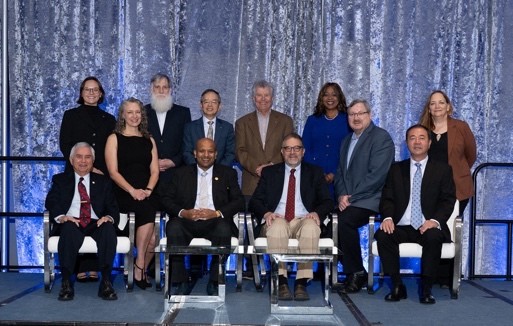
Panelists pose with Dr. Navin Manjooran (front, center right) and Master of Ceremonies Nicole Hudak Nicole Hudak
(back left).
Audience
I sat in a room amidst several dozen heat treat decision makers from both the commercial and teaching ground of heat treat, ranging from student and early career to research veteran and recently retired. Audience members asked their questions after both of the panels and mingled after the session to share a few words amongst ourselves and the generous speakers.
Clearly, concern for the next generation of materials experts to meet industry needs — both in training and in availability of personnel — was of primary importance. Be it the question of how industry was investing in secondary and primary education interventions or a side discussion questioning how the leaders of both panels were driving young people toward entrepreneurial competition, the room buzzed with interest.
Summary
One comment Dr. Furrer shared outside of the panel session was his interest in how the focus of academia was shaping the opportunities available to upcoming industry leaders and engineers.
Despite the government panel being unable to participate in the forum due to the ongoing government shutdown, this forum proved to be emblematic of Dr. Manjooran’s summary of ASM’s most important attribute: the ability through connections — memberships, partnerships, etc. — to advance materials worldwide.
Heat Treat Today has gathered the four heat treat industry-specific economic indicators for November 2025. The November industry-specific economic indicators reinforce the overall trend toward growth that began in September of 2025.
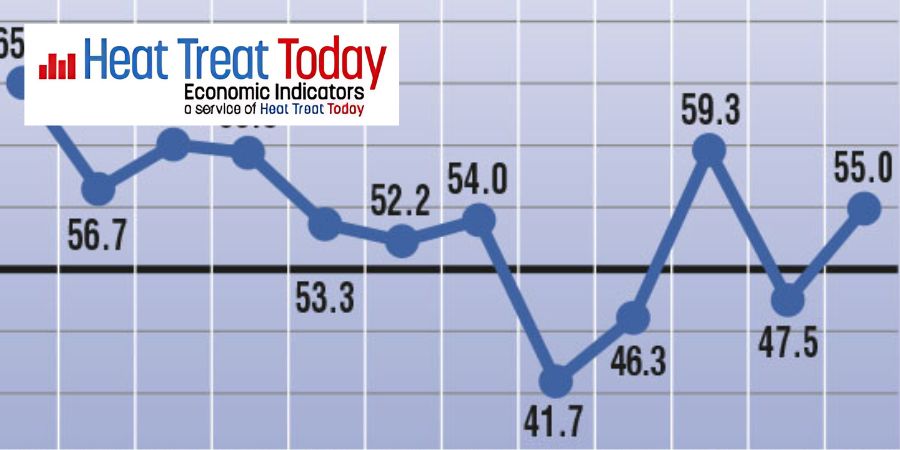
November’s industry-specific economic indicators showed all four indices in growth. The Inquiries stayed in growth, rising to 56.5 (from 50.6 in October). Bookings rose to 55.0 (from 50.7 in October). The Backlog index rose out of contraction to 55.0 (up from 47.5 in October). Finally, the Health of the Manufacturing Economy index remained in growth at 56.5 (up from 52.8 in October).
All of the graphs suggest that the undercurrent of growth, which began in late summer, is continuing to rise as we look to the end of the year.
The results from this month’s survey (November) are as follows: numbers above 50 indicate growth, numbers below 50 indicate contraction, and the number 50 indicates no change:
Anticipated change in Number of Inquiries from October to November:56.5
Anticipated change in Value of Bookings from October to November: 55.0
Anticipated change in Size of Backlog from October to November: 55.0
Anticipated change in Health of the Manufacturing Economy from October to November: 56.5
Data for November 2025
The four index numbers are reported monthly by Heat Treat Today and made available on the website.
Heat TreatToday’sEconomic Indicatorsmeasure and report on four heat treat industry indices. Each month, approximately 800 individuals who classify themselves as suppliers to the North American heat treat industry receive the survey. Above are the results. Data started being collected in June 2023. If you would like to participate in the monthly survey, please click here to subscribe.
Heat Treat Today publishes twelve print magazines annually and included in each is a letter from the publisher, Doug Glenn. This letter is from theOctober 2025 Ferrous & Nonferrous Heat Treatments/Mill Processing print edition.
Karen Gantzer, associate publisher, and I recently visited a manufacturing plant with an extensive, in-house heat treat operation. We don’t often visit captive heat treat operations even though the vast majority of our audience are, in fact, captive heat treaters — manufacturers with their own in-house heat treat capabilities.
The conversation we had with the two heat treat specialists that hosted us was wide-ranging and enlightening. One of the topics was the rationale used for purchasing new thermal processing equipment. They have two mesh belt furnaces and a small number of integral quench furnaces. All the furnaces came from the same supplier.
We asked them straight up, “Why did you buy from this supplier and not from others?” The answer was instructive not only for furnace manufacturers, but for all suppliers in the industry.
What Didn’t Matter
While the three points listed below had some influence, these were not as important to the captive as many furnace manufacturers believe:
Price. In fact, they outright told us that they did not buy the least expensive equipment. When company purchasing agents get involved, the decision-making process is complicated, but with this mid-sized company, the two key decision makers — the two guys who spent time with us — assured us that price was not the main driver behind their decision.
Equipment and controls features. Features were not unimportant, but they were not the driving factor. Each company that bid for the job had slightly different solutions making it difficult to compare features. Our hosts told us that several of the designs would have worked. They chose one, but it was not because they preferred that design over the others.
Quality. What exactly does “quality” mean? If ever there was an overused marketing word, “quality” is it! Quality was not a determining factor in the purchase of the heat treating equipment. All of the equipment was “quality” equipment… whatever that means.
What Mattered
There were two key factors that swayed the decision for this captive heat treater:
1. Responsiveness was the #1 reason why this captive heat treater chose this furnace manufacturer. Responsiveness took several forms. First, during the bidding process, the manufacturer set itself apart by being prompt and creative with design changes. They obviously listened to what the captive heat treater was saying and responded in a timely fashion with alterations/solutions that demonstrated understanding. Second, the ability to reach the “top guy” at the furnace manufacturer day or night brought a level of comfort that heavily tilted the scales in their favor. Both guys indicated that they had the president’s cell number in their phones — not on speed dial, because that’s not necessary — but in their phones just in case. And they’ve used that number multiple times with good results. Finally, the furnace manufacturer continues to be responsive even after the equipment has been installed and commissioned. If there is something new or different the guys want to do, they call the furnace manufacturer, speak to a real person, they are heard, and they get a response in a timely fashion.
2. Location was the second most important reason. Here’s why. First, the buyers were happy to be stimulating the U.S. economy and, more specifically, the regional economy. Second, they felt that a geographically close furnace manufacturer would be more capable of providing speedy service and parts if and when those items became necessary. Third, proximity allowed the buyer to inexpensively visit the furnace builder for manufacturing progress updates. And finally, a domestic manufacturer eliminated tariff concerns.
Obviously, a furnace manufacturer can’t be geographically close to all their clients. However, alleviating concerns about parts and service, accommodating on-site progress visits throughout the furnace manufacturing process, and manufacturing as much as possible in the U.S. would all be steps in the right direction.
All this to say, it is not so much the hard inputs like engineering, manufacturing, and finance that persuade customers to make a purchase. Rather, it is the softer inputs — the human elements — that help furnace buyers become comfortable, giving you a leg up on your competition. Comfort is an emotion… and as we all know and agree, “Everyone always buys emotionally all the time.”
Doug Glenn Publisher Heat TreatToday For more information: Contact Doug at doug@heattreattoday.com
Heat Treat Todaypublishes twelve print magazines a year and included in each is a letter from the editor. This letter is from the September 2025 Annual People of Heat Treatprint edition. In today’s letter,Bethany Leone, managing editor at Heat Treat Today, shares about the value of people in the heat treatment publication industry, highlighting individuals in the Heat Treat Today family.
We’re in business because people matter. Heat treating just happens to be our industry — which means we like making things hot (and then cold). But at our core, our business is people.
The Business of People
When I ask someone their favorite thing about the heat treating industry, most of the time, the answer is “the people.” Engineers, operations managers, sales reps, and operators all echo the theme.
Why is that? Maybe it’s the strong family values found in many family-founded, family-run operations. Or maybe the behind-the-scenes nature of the discipline draws a more people-focused crowd. It could be that the slower-paced, deliberate innovation attracts people motivated by collaboration more than competition. I’m not sure.
For whatever reason, it is a hallmark to our industry that those from various backgrounds and experiences can come to feel like family.
Welcome to the Family
Over the past year, we’ve welcomed several new individuals to the Heat Treat Todayfamily. Each of them provides essential skills and abilities to making this publication helpful to you.
Jake Romano joined us in the summer of 2024. He embodies so many of our core values that it feels like he’s been here longer than just a year. Jake’s detailed eye for creative problem-solving has allowed our Heat Treat Radio podcast to reach new heights, funneling robust interviews to you seamlessly every month. He never fails to step up to the plate if time is of the essence and does so with the utmost professionalism and an ear for a good story: “My favorite thing that I’ve learned about the industry is just how diverse it is. There are so many people with fascinating backgrounds and reasons for joining the industry and I’ve been enjoying hearing their stories!”
Kelsha Wells has been the mastermind behind social media since fall of 2024 and recently coordinated the 40 Under 40 nomination process. The fruits of her labors are seen daily, connecting industry news and technical updates to you via social media. “From day one, I was struck by how incredible everyone is, not just in their talents, but in their willingness to support one another, celebrate wins, and work together seamlessly. That impression has only grown stronger over the past year.” This magazine edition is particularly special as she gets to see the many worthy young people featured on pages 36 to 71. She also supports various marketing campaigns for Heat Treat Today.
Michele Shaller found us through our legendary Laura Miller (now retired… we think). Michele assumed her position as editorial specialist in late-winter 2025. Every article you see in the print edition, every Heat Treat Radio transcript, and every, “hey, could you look at…?” piece of material gets an eagle-eye review by this whirlwind editor. Additionally, she is the editorial caretaker of several platforms, including the monthly e-newsletters.
Tiffany Ward connected with us in early spring 2025 and has been generating and formatting timely technical content for our website and Heat Treat Daily readers ever since. If you’ve ever had to scrap a heat treat plan and pivot fast under pressure, you have an idea of what Tiffany’s workday looks like every day. Can you say “pivot”?
Hamilton Pearman stumbled across the heat treat industry in 2014 and took a hiatus for a few years. Recently, he has returned, and in late-spring 2025, Hamilton assumed a sales role for Heat Treat Today’s European connections. Hamilton observed that the heat treat industry is like a large friendly family, “and that’s such a relief in the world we live today… Heat Treat Today is one the best examples of what I mean. Family, technical, focused, and yet still friendly.”
Mariah Roth, stepping into the critical role of administrative assistant as of this summer 2025, addresses the immediate challenges that our team faces. Fittingly, she commented the following: “Since joining the team, [I’ve been] realizing and affirming just how small the world is — this is something my grandpa had always said. The older I get, the more I understand this phrase. At the same time, I’m always learning how much I don’t know about the world. Coming from a metallurgy background to a heat treat industry, and now to a heat treat magazine company has really brought me full circle.”
Heat Treat Today publishes twelve print magazines annually and included in each is a letter from the publisher, Doug Glenn. This letter is from theAugust 2025 Automotive Heat Treat print edition.
The relationship between industry and higher-level educational institutions in North America is an interesting and evolving relationship. Unlike in Europe and Asia, the relationship is quite a bit less formal and far more scarce here. It is almost a foregone conclusion that leading industrial companies will have tight relationships with academic research institutions across Europe. The same is true in Asia, especially China, where many of the research institutes are government funded and are expected to assist with industry research projects. Of course, in both Europe and Asia, many companies are heavily subsidized by the government to conduct research. All in all, the relationships are more plentiful and tighter.
While there are thriving industry-academic relationships in North America, they are far less common, and they take a more practical, business-first approach. There are, however, a good number of strong relationships between educational institutions and the North American thermal processing industry. I’d like to mention three here in some depth and a few others briefly.
Illinois Institute of Technology Thermal Processing Technology Center (TPTC)
Without doing any thorough research, TPTC was perhaps one of the oldest industry-academic partnerships around. I was introduced to this partnership when Dr. Phil Nash, a professor at IIT, was the director of TPTC. That was back in the 1990s. I also know that our very own Dan Herring, the Heat Treat Doctor®, was supportive of the organization. TPTC reportedly shut down 10 years ago, but a webpage, which was not easy to find, indicates that it is now under the direction of Dr. Leon Shaw. After a quick review, there is a good bit about the academicians (professors and students) online, but I could not find any reference to industry partnerships or members. Nevertheless, TPTC was one of the go-to sources for industry for those who were interested in conducting ground-level research.
Worcester Polytechnic Institute (WPI) Center for Heat Treat Excellence (CHTE)
The WPI CHTE remains quite active. Their website does not indicate the exact date that it was established, but I’m guessing the late 1990s or early 2000s. I remember its inception and the efforts of Diran Apelian, their first executive director. I recall that membership dues were steep, but there was a good bit of industry buy-in, including Surface Combustion, Houghton International (now Quaker Houghton), and ASM International.
Current industry partners include Bodycote, Aalberts, Thermatool, Dante, Arcelor Mittal, Pilot Precision Products, GKN Sintered Metals, Pratt & Whitney, DevCom, and Sikorsky. There are also many active industry-focused research projects. CHTE is led by Dr. Thomas Christiansen with the able assistance of Maureen Plunkett. More information about CHTE can be found at https://wp.wpi.edu/chte/.
Purdue University Purdue Heat Treat Consortium (PHTC)
Purdue is a relative newcomer but quite active. Under the leadership of Dr. Mark Grunninger and Dr. Mike Titus with assistance by Maddison DeLaney Walsh, PHTC has gained an impressive number of thermal processing end-user and supplier members, including Amsted Rail, California Pellet Mill (CPM), Caterpillar, Cummins, ECM USA Inc., Howmet Aerospace, Inductoheat, Inc., John Deere, Nucor, and Rolls-Royce. I believe that Quaker Houghton has also recently joined. The number of projects being conducted by this industry-focused consortium is also impressive. More details on PHTC are at https://engineering.purdue.edu/MSE/PHTC.
Others
Of course, there are many other universities around the country that cooperate with the industry to help advance real-world research. Many Heat Treat Today40 Under 40 honorees are graduates of these educational institutions. Here is a short — and I’m sure incomplete — list of other universities that have a proven relationships with the thermal processing industry:
Carnegie Mellon University
Colorado School of Mines
Michigan Technological University
New York State College of Ceramics at Alfred University
Pennsylvania State University
Rensselaer Polytechnic Institute
San Diego State University
South Dakota School of Mines
The Ohio State University
University of Akron
Conclusion
Although the relationship between industry and education is less formal here in North America compared to Europe and Asia, the relationship does exist and can be tapped for the benefit of any company interested in using the great minds of up-and-coming engineers to help solve tomorrow’s challenges. If you’d like to contact any of the organizations listed above, please email me.
Doug Glenn Publisher Heat TreatToday For more information: Contact Doug at doug@heattreattoday.com
Heat Treat Todaypublishes twelve print magazines a year and included in each is a letter from the editor. This letter is from the June 2025 Buyers Guideprint edition. In today’s letter,Karen Gantzer, editor-in-chief/associate publisher at Heat Treat Todayextols the virtue of continuous learning in the heat treatment industry.
May was a busy month. Much travel was part of the schedule — both business and pleasure. Our business trips, however, were filled with enjoyment in being with others and enrichment experienced through team building competitions and challenges to habits and disciplines. Upon reflection, it’s encouraging and empowering to be a lifelong learner.
As you know, heat treating involves heating and cooling metals under controlled conditions to enhance their strength, durability, and adaptability. Much like this process, learning as we age transforms our minds and perspectives, making us more resilient and capable of facing life’s challenges. Just as a metal alloy becomes tougher through repeated cycles of heating and cooling, our continued pursuit of knowledge — whether through new skills, experiences, or ideas — sharpens our minds and enriches our lives.
One of the opportunities to learn was through attending the Metal Treating Institute (MTI) Spring Meeting in San Juan, Puerto Rico. What a destination for a meeting — sunshine, ocean breezes, warm sand — someone had to go!
HTT Team at OX8 – Left to right: Aubrey Fort, Karen Gantzer, Doug Glenn, Ellen Porter, and Michelle Ritenour Source: OmedaBeach Olympics at MTI Spring Conference 2025 Source: MTI
It’s always a joy to catch up with friends from the industry and meet new folks as we listened to heat treaters share insights from their part of the thermal processing world. We were encouraged by coaches who shared tools to become better leaders and our competitive hunger was satisfied through Beach Olympics. All providing helpful takeaways to employ when we returned to the real world.
More Heat Treat Todaystaff attended the OX8 Conference in Chicago, hosted by Omeda, an audience engagement platform company that we work with. This event welcomed those in the publishing world. What a treat to meet others who work with words and whose goal is to increase audience engagement.
At Heat Treat Today, we believe people are happier and make better decisions when they are well informed. This conference focused on AI and how to responsibly use it along with other software tools to increase engagement for those with in-house heat treat operations. What a fun team building time! AI is a beast, but learning just a fraction of its capabilities with others was a blast.
Kenn Kington sharing how to become better leaders at MTI Spring Conference 2025 Source: MTIEllen Porter and Doug Glenn at OX8 Source: Omeda
How can you be a lifelong learner?
One learning opportunity is this month’s Heat Treat Today June issue — our annual Heat Treat Buyers Guide. Once a year we print the latest information about where you can find and learn more about heat treat equipment, products, services, and providers. It is a treasure trove of all things heat treat.
Additionally, you can continue to learn from the monthly installments of The Heat Treat Doctor (p.12), Controls Corner (p.117), and Combustion Corner (p.118), plus explore how to save money with ceramic fiber insulation by reading the conversation between Doug Glenn and Mark Rhoa of Chiz Bros (p.108).
Like heat treated materials that withstand stress, a mind that continues to learn grows more adaptable and robust, enabling us to contribute meaningfully to others. Learn all you can and enjoy the journey!
Karen Gantzer Editor in Chief/Associate Publisher Heat Treat Today
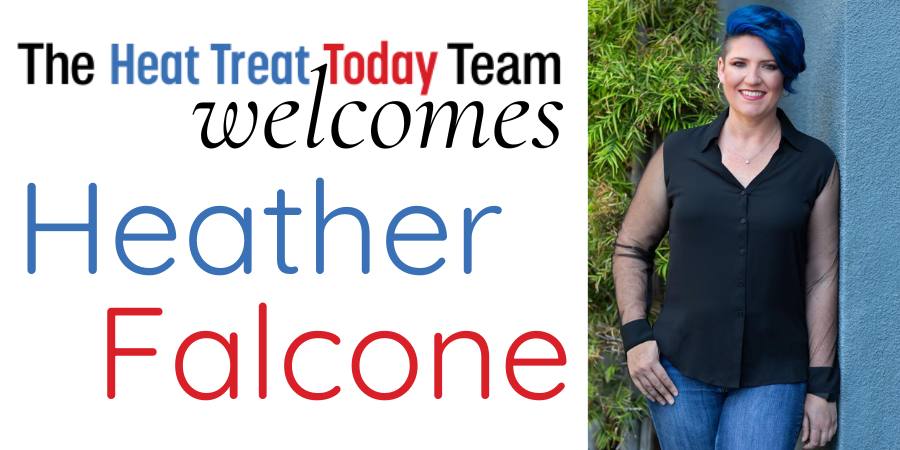
Heat TreatToday is excited to announce the addition of Heather Falcone to the editorial and podcast team, beginning on Monday, March 3, 2025. She will be taking on the responsibilities of content editor for the daily e-newsletter, original content writer, and Heat TreatRadio contributor.
Heather, the founder and principal of Falcone Consulting, LLC, is a servant leader with over 20 years of experience in heat treating, brazing, and chemical processing. She spent most of her formative years as a second-generation member of a family-owned heat treating and brazing business. As the former CEO of Thermal-Vac Technology, she successfully led the company through the pandemic, ensuring stability while propelling it into a new era that resulted in a successful exit in 2024. Passionate about challenging the status quo, she champions diverse teams and fair chance hiring, with a focus on developing successful teams that are future-proof and thriving.
Beyond her position as founder and principal at newly formed Falcone Consulting LLC, Heather is a board member, coach, speaker, and writer, advocating for small businesses, workforce development, and success for the heat treat community at large. She provides her expertise in aerospace specifications and the Nadcap process in an ongoing role as the special project consultant for Cook Induction Heating in Maywood, California. Additionally, she has played a pivotal role in industry organizations like the Metal Treating Institute, AMEC, and Nadcap, while also supporting local nonprofits such as Chrysalis and the Orange County Workforce Development Board.
“We’re thankful to have Heather joining the Heat TreatToday team,” said Doug Glenn, founder, owner, and publisher of Heat TreatToday. “I’ve known Heather for many years and have been impressed with her initiative, courage, and fearlessness in everything she does. As an organization that is deeply invested in making sure in-house heat treaters have the information they need to become more efficient and profitable, Heather will be an excellent addition to our editorial team. She knows the industry; she knows what our readers need. And as we all know, the happier the readers, the happier our advertisers.”
Heather is an Ironman triathlete, a Seven Summits enthusiast who has summitted Mt. Kilimanjaro and trekked in the Everest region, and a loving wife and mother to two teenage boys.
For more information, click here for Heather’s LinkedIn page, here for Falcone Consulting’s website, or here for her Heat TreatToday 40 Under 40 recognition in 2019.