


editor’s page

Message from the Editor: An Editorial Eye on AI

Heat Treat Today publishes twelve print magazines a year and included in each is a letter from the editor. This letter is from the August 2025 Annual Automotive Heat Treating print edition. In today’s letter, Bethany Leone, managing editor at Heat Treat Today, describes the parameters, limitations, and benefits of using artificial intelligence in our heat treatment publication.


You have questions; AI has answers. But we have expert editorials.

Heat Treat Today delivers practical, accurate, and trustworthy information to a very niche and critical industry in North American manufacturing. With AI tools becoming more accessible and powerful, we want to be transparent about how we leverage them to maintain high editorial standards.

First, “The Don’ts”

Simply put, we don’t let AI replace our direct access to expert technical advice or content. Your heat treat efforts are too important for us to give you articles that have not been reviewed and cross-examined by our team, which is trained to review heat treat industry content.

Compose Technical Articles

We don’t use AI to generate technical articles for direct publication. Authenticity is at the heart of our editorial process, and our readers rely on us to deliver information straight from credible sources — directly from operators, engineers, and experts.

In our editorial department, technical content undergoes rigorous editorial review; we don’t rely on AI here. Our editors’ eyes are trained to catch and improve areas of technical confusion, so our readers receive help from the best practical heat treat information.

Learn Technical Concepts

I do not want to overstate this idea, because AI does generate helpful answers to common queries; you will note below that we appreciate this handy, interactive research assistant! But when it comes to learning a concept thoroughly, and especially for the first time, we prioritize validated sources:

  • Our in-house technical advisors
  • Reputable books and resources
  • Trusted websites from industry authorities

We do this to ensure accurate interpretation and traceability of knowledge.

Let me give an example: If I ask public AI for the most relevant quenching issues operators face, the answers it will give me will be based on material — often marketing material — that it can access online. While not incorrect, we always draw our material from resources with direct, on-the-floor experience to give you the benefit of more robust research and proven, hands-on expertise. (Furthermore, you can ask AI that question, too! We want to give you the benefit of more robust research and proven, hands-on expertise.)

And “The Dos”

AI can be an incredibly effective tool for supporting aspects of our editorial and communication processes. The following examples show how AI pushes us to actualize our creative juices, helps us think more clearly, and gives us time to hone more compelling and relevant content.

Hyperdrive the Early Draft

AI helps us create early drafts of editorials based on structured outlines. This accelerates the writing process, teasing out rough thoughts into a foundation that our editors will refine and often rewrite to enrich with targeted insights. Ever heard of writer’s block? Sometimes, AI is just what we need to get the ball moving!

Find Technical Gaps

Although we are not content experts, we often have a hunch when some technical aspect is missing or incorrect. AI can be helpful to scan sections where we have questions and provide suggested context for such sections — or simply tell us that we are being delusional. Once identified, our team collaborates with experts to address knowledge gaps or inconsistencies.

Research Tech Qs and News

AI helps us cut to the chase. Serving as a dialogue partner, AI conversations help editors refine research questions before consulting our technical experts and authors. This allows us to approach consultations with greater clarity, maximizing the value of expert input.

Additionally, AI scans our online lineup of industry news sources to find relevant stories, offering a more curated alternative to traditional RSS tools.

Refine Headlines & Article Summaries

Critical reader engagement calls for compelling and technically correct phrasing. For a niche trade publication, you might see how AI can help stimulate the creative iteration process to help us avoid the same wording. The headlines and introductions to articles in this magazine probably had an AI-hand help!

Revisit Technical Concepts

I’ll be frank: editors are not content experts! But as editors in this industry, we train ourselves on common concepts (and sometimes very marginal topics) enough to ensure we best assist expert authors and contributors. Therefore, we use AI to revisit technical concepts to refresh our understanding.

Since this is a “refresh,” we can discern when AI wants to do its own thing or emphasizes a concept a bit too much.

To summarize, AI is not an author nor an expert; it’s an editorial tool that spurs us on. We will continue to value people and their contributions in the ever-developing world of manufacturing.


Bethany Leone
Managing Editor
Heat Treat Today
Contact: Bethany Leone at bethany@heattreattoday.com


Message from the Editor: An Editorial Eye on AI Read More »
Integrity in the Industry

Heat Treat Today publishes twelve print magazines a year and included in each is a letter from the editor. This letter is from the May 2025 Sustainable Heat Treat Technologies print edition, and serves as the final message from Jayna McGowan, a dear member of the Heat Treat Today team.

Jayna McGowan
40 Under 40 Coordinator
Heat Treat Today

Recognizing a job well done, an individual striving for excellence in their work, and someone who demonstrates leadership potential for years to come is not only a form of integrity in the workplace, but an opportunity to encourage a company and an industry to be the best it can be. A work environment that does not recognize excellence risks undermining it, leaving employees demoralized as they tackle the daily challenges inherent to their work. Those who have worked in both environments — the one that pursues and recognizes excellence and the one that does not — know the value of the former. The individual and the company both benefit from recognizing excellence. 

This is why it has been an absolute privilege to coordinate Heat Treat Today’s 40 Under 40 initiative. Getting to learn about the accomplishments of rising stars in the heat treat industry and then to share those with our readers speaks to the overall integrity of the people and companies in the industry. My favorite part about communicating with individuals who have been nominated is their tendency to be surprised by their nomination — in their minds, they are simply doing their job the way they know how to do it, which makes it all the more encouraging to hear that someone noticed their effort and wants them to be honored for it. 

Another aspect I have enjoyed about supervising 40 Under 40 is seeing how the individuals recognized are contributing to the heat treat industry as a whole. Here at Heat Treat Today, we see firsthand how individuals honored in past years are willing to share their experiences and expertise by authoring articles or being interviewed for a Heat Treat Radio episode. Several highlights of these alumni contributions from the past year include: 

The example set by these individuals and so many others has the potential to inspire and inform the entire heat treat industry.  

Finally, how can you 1) model the integrity of recognizing a job well done in the industry and 2) encourage young leaders like these to continue pursuing excellence? One way is to nominate a North American heat treater you know for the 40 Under 40 Class of 2025. Nominations officially open May 19 and close June 27.  

While I will be stepping away from coordinating this initiative to raise my twin girls due in a couple months (future heat treaters?), please reach out to incoming coordinator, Kelsha Wells (kelsha@heattreatoday.com), with any questions about the nomination process.

Contact the Editorial Team at editor@heattreattoday.com


Integrity in the Industry Read More »

Adapting Old Technology for the Future

Heat Treat Today publishes twelve print magazines a year and included in each is a letter from the editor, Bethany Leone. In this installment, which first appeared in the February 2025 Air & Atmosphere Heat Treating print edition, Bethany looks at preservation planning on a brownfield through the eyes of a historian and asks the question, “Is it possible an old system can, with modifications, give heat treat operations added value that a newer system cannot?

Feel free to contact Bethany at bethany@heattreattoday.com if you have a question or comment. 


Some readers may know my background is in historical research. In 2022, I found myself supporting a Pittsburgh architect as his team worked on preservation planning on a brownfield: The Carrie Blast Furnaces. Was Carrie a girlfriend? That’s one answer. I never got a good story on that, though.

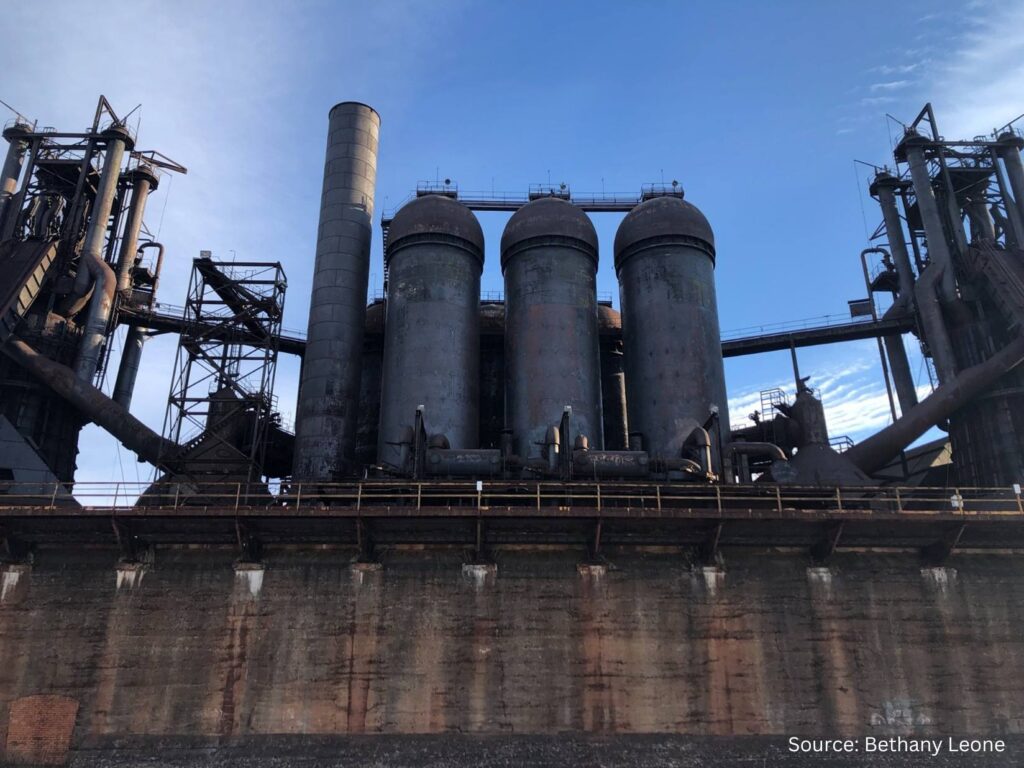
Among existent structures at the site are the power house, the no. 6 cast house, a dust catcher, a blowing engine house, and two remaining blast furnaces, no. 6 and no. 7. Rusted, massive, and with evidence of guerrilla art everywhere, the “abandoned” site was never really forgotten by the locals who fought to preserve its legacy in the region.

View of the ore yard in front of blast furnaces no. 6 and no. 7 with a red ore bridge overtop

The Carrie Blast Furnaces site is located in the midst of what was a key iron producing region with plants all around the city of Pittsburgh, Western Pennsylvania, parts of West Virginia, and Eastern Ohio. The Pittsburgh district was the largest iron and steel producing region in the world between the late nineteenth and early twentieth centuries.

This industrial site supported U.S. pre-World War II integrated iron production along the Monongahela River. Andrew Carnegie integrated the Homestead Steel Works operations in 1898, the extensive industry marked by tangled railways to transport materials to plants across the landscape.

Various acquisitions and expansions to the space had made it a critical workhorse in America’s manufacturing, eventually becoming a part of U.S. Steel’s Homestead Works. Yet after the world wars, the demand for steel plummeted. Steel manufacturing was consolidated at other locations. Foreign imports increased. Alternative materials were adopted for domestic products. Blast furnaces no. 6 and no. 7, built in 1906–1907, ceased operations in 1978; the rest of the site closed in 1984.

View of six stoves with blast furnace no. 7 (left) and blast furnace no. 6 (right)

Today, Rivers of Steel operates the brownfield. Straddling both Swissvale and Rankin communities, the site has gone under preservation efforts so it can offer the public historic site tours, arts events, hands on education, and outdoor events. But while the technologies can no longer be used on the site, the remaining structures may still yield value to the community.

From an historic preservation perspective, architectural redesign plans intend to keep as many of the structures as is safe and functional for current and future use. Some of the obvious challenges that exist in brownfields are visible to the naked eye: How to insulate or redesign a blowing engine house building and what suppliers are able to fix and replace the broken windows? Can the dust blower have an alternative purpose or is it a hazard to keep on a site that hosts public events? These are relatively simple issues as compared to the subterranean challenges — toxins leaking from latent pipes is the big one. Paired with environmental preservation efforts of redeeming the landscape for safe public use and recreation, making an industrial brownfield something suitable for long-term public benefit requires a host of planning — and unplanning.

Yet the past investments infused into building Carrie Blast Furnaces give value to the future projects, tangible, and intangible.

The stock house where raw materials would be dropped off before carted up to the top of the blast furnaces

The conversation about abandoning older air/atmosphere furnace systems reminds me of this lesson. Is it possible an old system can, with modifications, give heat treat operations added value that a newer system cannot? What with improved furnace insulation, and especially with even advancing furnace monitoring and even technology that leverages carbon emissions within an operation, perhaps certain heat treat operations can create something better and more efficient, leveraging existing investments.

As is the case in historic preservation, an investment can’t always be salvaged or even remembered. We don’t just think about past values or present concerns but future value. I would think the same must be the case for heat treat operations. In navigating the demands of the present economic realities and standards, preparations for the future, while honoring the legacy of workers (and, perhaps, investments) that made it possible is tricky.

Currently, activity at Carrie Blast Furnaces is focused on rebuilding sluiceways for visitors and converting the blowing engine house into a visitor’s center. Hopefully, debate will continue about the rehabilitation investments to come. When it comes to heat treat operations, may we also have great debate in wrestling with old, not so-sexy technologies and whether to adapt or adopt new ones.

Bethany Leone
Managing Editor
Heat Treat Today

Contact Bethany at bethany@heattreattoday.com.


Find Heat Treating Products And Services When You Search On Heat Treat Buyers Guide.Com


Adapting Old Technology for the Future Read More »

Heat Treat’s “7-Year Itch”

Heat Treat Today publishes twelve print magazines a year and included in each is a letter from the editor, Bethany Leone. In this installment, which first appeared in the January 2025 Technologies To Watch print edition, Bethany reports on the changing landscape of the industry and the resulting challenges, according to a poll on LinkedIn. Respondents shared their views on uniformity and temperature control, residual stresses, managing downtime, and more, and our editor gives her summary of the feedback.

Feel free to contact Bethany at bethany@heattreattoday.com if you have a question or comment. 


January 2025 Magazine

Now granted, heat treating isn’t in a romantic relationship, but this 2025, there are many relationships that have vied for the industry’s attention over the past decade plus. 2025 seems to be the year to scratch the itch that heat treaters have: Is it time to try something new?

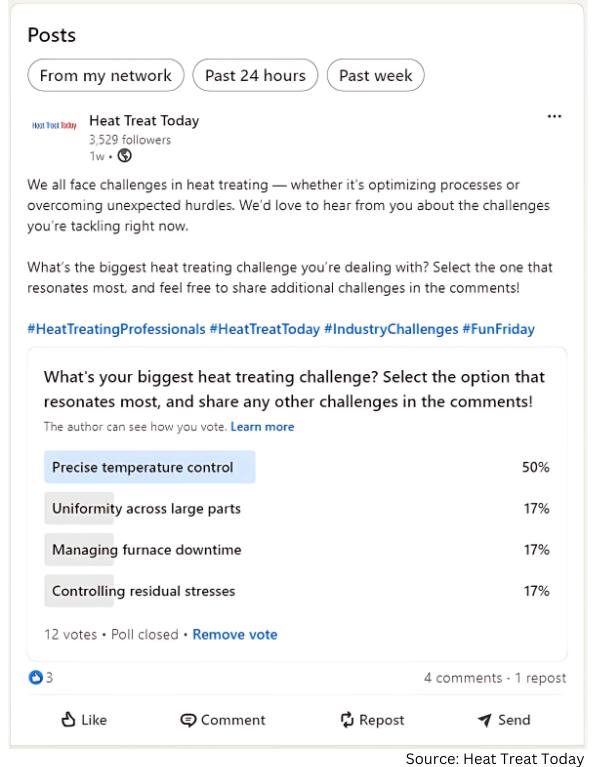
Recently, Heat Treat Today released a poll on LinkedIn. We asked what the number one challenge that heat treat experts faced in the North American manufacturing industry. There were several big-ticket items that we offered: Precise temperature control, uniformity across large parts, managing furnace downtime and controlling residual stresses. Unsurprisingly, temperature control was voted as the top challenge of the four choices, though it was surprising that few respondents piped in on the topic of residual stresses.

Yet perhaps the most important engagement came from a commenter who addressed using legacy materials in changing industry requirements. How closely are we thinking about the future that materials — use of legacy materials as well as different legacy materials — have on our work in heat treatment? (Ok, your work. We all know that I’m leaving the discovery and application to you!)

As the commenter noted, the choices in the poll are all critical characteristics, and therefore factors heat treatment practitioners should already be concerned with. If you are looking at your heat treat operation’s relationship with a variety of processes and technologies and think that the relationship is ideal as can be, great.

But if you are in the “seven-year itch” camp — that is, there is some relationship with a process or technology that is on the rocks — this new annual magazine we are releasing each January highlights the heat treat technologies to watch for in 2025. It’s time to reevaluate the relationship your heat treat operations have with current technologies.

Technological Relationships Under Consideration

The heat treat industry is navigating a rapidly evolving landscape shaped by new materials and technologies. Additive manufacturing (AM), or 3D printing, introduces unique material requirements that challenge traditional heat treating. Complex geometries and the use of non standard alloys in AM demand processes tailored for uniformity and precision at an unprecedented level. These disruptions, coupled with constant innovations by researchers in materials science, are prompting a reevaluation of whether conventional heat treating methods are needed as is, or even at all. Check out the AM quiz on page 24 to get up-to-speed on some of these developments.

Meanwhile, robotics and AI are revolutionizing how operations are managed. AI-powered predictive maintenance is becoming indispensable, helping to minimize furnace downtime by identifying potential failures before they occur. Machine learning enhances furnace control systems by refining temperature cycles and gas flow in real time, ensuring consistency and efficiency. How are these systems working for heat treaters? Read the case study article on page 10.

Digitalization technologies, such as smart sensors and IoT-enabled systems, are making it easier than ever to monitor and analyze heat treating operations. These tools, combined with advanced software, empower operators to make data driven decisions and reduce energy consumption. Several articles in last month’s magazine release focused heavily on these technologies, but the conversation persists in the commentaries found on pages 17 and 27.

The question for 2025 is clear: Are heat treaters ready to adopt these innovations and adjust their processes to align with the needs of tomorrow’s manufacturing? Have your operations found the perfect relationship with these new technologies? Tell me what you’re finding to be most difficult to address in 2025 so we can examine that relationship in future editions.

Bethany Leone
Managing Editor
Heat Treat Today

Contact Bethany at bethany@heattreattoday.com.


Find Heat Treating Products And Services When You Search On Heat Treat Buyers Guide.Com


Heat Treat’s “7-Year Itch” Read More »

Autonomous Solution for Industry

Heat Treat Today publishes twelve print magazines a year and included in each is a letter from the editor, Bethany Leone. In this installment, which first appeared in the December 2024 Medical & Energy Heat Treat print edition, Bethany addresses the ongoing discussion about automation in industry, the data on how it affects labor, and the way forward for manufacturing and the government.

Feel free to contact Bethany at bethany@heattreattoday.com if you have a question or comment. 


You can afford it.

Supervisors, you can afford to raise wages. Skilled laborers, you can afford to purchase a home.

Maybe you’ve heard these hopeful statements before? You can afford it, says economist Mark P. Mills, executive director of the National Center for Energy Analytics, by leaning on automation. Far from destroying jobs, tools like AI and robotics enhance productivity and require highly skilled laborers who, in turn, can and should be compensated. This editor’s page summarizes some of Mills’ main points and how these might be considered in the heat treat industry.

Labor Market Needs Automation

In a recent article released in City Journal, the economist draws attention to what he sees as a new norm for the labor market: the successful bargaining for higher wages by the Longshoremen’s Association. The result of the union’s strike means a starting salary of $80k and a mid-career salary of $150k. Mills terms this “The Great Inversion,” where we see salaries for the trades supersede 90% of salaries for college graduates.

His argument that this is the new norm rests on three points. The first is that population has been in decline; this is exacerbated in the trades by the fact that the average age for skilled tradesmen is older than the average age across U.S. manufacturing.

Secondly, though there is a trend of young workers choosing a career in the trades, not enough would fill the generational chasm that is opening as the older generation leaves the workplace. This means there is still a demand for skilled labor.

Thirdly, industrial manufacturing creates consumable goods, for which there is no end to want, unlike in food and agriculture where there is a limit of consumption. As people grow wealthier, they can afford more “wants” — even if it’s going out to eat at restaurants where iPads automate server-kitchen communications.

Even with the population decline, individuals continue to gain wealth and want to spend it, Mills explains. In this situation, particularly where we have efforts and interests in America restoring industrial productivity, the argument is that automation will allow companies to keep up with the demand for consumable goods while filling the labor gap. This result means a need for upskilling workers to work with robotics, automation software, and AI on the manufacturing floor.

Automation in Heat Treat

In the heat treat industry, I’ve heard several perspectives on this topic. Robotics and automation don’t take away jobs, some claim; they only improve labor market jobs that are there. At another’s operations, the installation of an automated piece of instrumentation didn’t result in any immediate layoff, but did result in the company not having to train an operator to fill a position since that position was no longer available.

The fact is that the pro-automation side relies on addressing situations where there is a lack in able workers in the labor market. This demonstrates that jobs are being filled by automation.

Turning to employment opportunity, it is hard to argue with Mills’ outlook that automation in jobs increases wages and profits. He supports this claim saying, “data show that, over the last half of the twentieth century, even as manufacturing productivity rose (that is, fewer labor-hours per output), the U.S. manufacturing workforce remained surprisingly unchanged and really started to shrink only when an increasing share of manufactured goods were imported — namely, when the production and labor were exported.” Interestingly, while he acknowledges the role of companies in offshoring goods in the last century, he puts focus on the difficult environment for businesses in meeting the government regulations in America. Therefore, he offers three steps forward addressed at government (in)action:

  1. The U.S. government must look for ways to make the country more amenable to industrial expansion that go beyond subsidies with caveated use.
  2. Policymakers must avoid intervening in the economy when a system isn’t broken. (Here, Mills addresses cost and reliability issues tied to state and federal energy policies.)
  3. The trifecta of policymakers, unions, and manufacturers need to welcome advances in automation.

Mills points out that in order for automation to be successful, skilled laborers need to welcome it and help it, emphasizing that, like the Longshoremen’s Union strike, automation allows for wage increase.

My question to you in the heat treat industry is: What is your job function in the industry? How have you benefited from automation (AI, robotics, digitalization) initiatives in the industry? What concerns — or hopes! — do you see that have yet to be addressed? Write to me. And if any article on digitalization in this magazine strikes you, I would love to hear that, too.

References

Mills, Mark P. “The Longshoremen’s Strike and the Great Inversion.” City Journal, October 8, 2024. https://www.city-journal.org/article/the-longshoremens-strike-and-the-great-inversion.

Contact Bethany at bethany@heattreattoday.com.


Find Heat Treating Products And Services When You Search On Heat Treat Buyers Guide.Com


Autonomous Solution for Industry Read More »

Purdue Heat Treating Consortium

Heat Treat Today publishes eight print magazines a year and included in each is a letter from the editor, Bethany Leone. In this letter, Bethany reports on her visit to the September meeting of Purdue Heat Treating Consortium where industry leaders presented key technical and operations decisions in heat treating. The academic partnership encourages research into topics such as sustainability and technology alternatives. Read more of what Bethany learned from her attendance at this dynamic and forward-looking consortium in this letter, which first appeared in the November 2024 Vacuum print edition.

Feel free to contact Bethany at bethany@heattreattoday.com if you have a question or comment. 


What heat treat issue do you need fixed? At Purdue Heat Treating Consortium’s (PHTC’s) September meeting, I witnessed industrial manufacturers targeting key technical and operations decisions in heat treat through an academic partnership.

Since summer of 2022, the research driven School of Materials Engineering at Purdue has positioned itself as a partner to industrial leaders in the Midwest. Their main goal: advance research of precompetitive projects.

I spoke with one member who commented on the beginnings of PHTC: “Some of the Midwest, I’d say, user companies . . . wanted a Midwest school and more research-oriented university. To have Purdue be able to fill that was perfect; that’s some place that we recruit from, where we know has a lot of depth of professors that would be able to contribute, and which has facilities that would be able to be a part of. So, it was a really good partner to make that change with.”

At the recent quarterly meeting, I sat amongst several dozen representatives from Amsted Rail, Caterpillar, Cummins, Rolls Royce, ECM USA, and other member companies as we settled in for a day of research presentations. Foremost in members’ minds was feasibility in real world application.

Topics included developing sustainable quenchant alternatives and identifying a method for greenhouse footprint analysis that would meet standards. The presentations of ongoing research were each met with intent nods of satisfaction, questions scrutinizing the data, and proposals on what specific direction industry players wanted to see examined.

Purdue Heat Treating Consortium’s (PHTC’s) September meeting where projects about developing sustainable technology were presented, as well as research topic findings

A mix of faculty and graduate students presented the five research topic findings. Guided by professors, the young people develop and execute research plans to address objectives determined by member voting at previous sessions. When I inquired what type of value this research held and the quality of the presenters, industry members were quick to speak highly of their abilities and the actionable research results.

Specifically, one member commented to me that the lifecycle work was proving to be helpful. Explorations like this give a “gauge of what we are able to meter on some of our own furnaces . . . and to have some common ways of describing emissions.” He continued, “that leads to either confirmation that we’re doing things right or to adjusting what we’re doing.”

Other topics that have been of interest address property variations when austempering certain materials and the quench oil work. Even when members may not apply all research results gained from the studies, ancillary work being done within a study — such as machine learning — offers additional value.

The group’s strength is collaborative action: as research objectives evolve, the academic contingent adapts. One paper was met with a peppering of cross-examination questions, the result being a large consensus as to the end value of this research. A plan to reconvene outside of regular sessions to provide industry testing data was determined, and industry members eagerly voiced their desire to contribute to this special moment.

Following presentations, the meeting came to a close. Voting members first determined which research to continue. Then, we toured the Manufacturing and Materials Research Laboratories at Purdue. The members witnessed various methods of metal 3D printing materials in action and handled printed parts of different alloy compositions.

Rounding out the day was an optional networking reception at a local pub and grill, Walt’s, where conversations around personal interests bled into reflections on research at PHTC.

My special thanks to Mark Gruninger, Managing Director for Industrial Consortia and Centers, and Mike Titus, Associate Professor of Materials Engineering and Technical Director of PHTC, for their invitation and warm welcome.

Contact Bethany at bethany@heattreattoday.com.


Find Heat Treating Products And Services When You Search On Heat Treat Buyers Guide.Com


Purdue Heat Treating Consortium Read More »

Finding Curiosity

Heat Treat Today publishes eight print magazines a year and included in each is a letter from the editor, Bethany Leone. In this letter, Bethany ponders the variables that set leaders apart from the rest of the workforce. Are you a curious person? Does a pursuit of knowledge inform the approach you take to your place in the industry? Read more of what Bethany has discovered about the qualities of leaders in this letter, which first appeared in the September 2024 People of Heat Treat print edition.

Feel free to contact Bethany at bethany@heattreattoday.com if you have a question or comment. 


Leadership is nothing new. The buzz continues as we each have to lead, or be led, in every capacity of life. Too easily, that buzz becomes white noise, truisms filling an otherwise empty page. And that’s actually okay. I don’t mean that it’s good to become numb to valuable information, but the talk around leadership is confined to finding different ways to identify old truths. What we emphasize from space to space can only encapsulate a portion of leadership.

But this summer found me preparing for a book study I was to lead. (Would recommend the read: Till We Have Faces.) The questions to orient the group were sent in June, and we looked forward to converging our thoughts in a discussion mid-August. As the day approached, I found myself wrestling with ways to lead in a way where the group would not be harnessed to my way of thinking, nor would the reins be so loose that the discussion wanders into flat silence.

Coincidentally, I came upon podcast episode #66 on Rust Belt Rundown, interviewing a chronic entrepreneur. One old truism that I heard afresh was this:

Be a facilitator: Stay curious, asking the right questions at the right time.

It got in my head. “How does one stay curious?” This I had attempted again and again — in management, giving interviews, teaching — with varying measures of success. But I hadn’t unlocked this mindset. I pondered this in light of the upcoming book discussion.

The day came. I reconsidered what the plan would be. And we talked. And the discussion flourished. Somehow, I had remained curious. Was it just that? And why now?

A book group is a good place to explore curiosity.

It seems that curiosity was more than a mindset to assume, neither was it just a practice of asking questions at the right time. Its power comes in conjunction with several other attributes of leadership:

  • Know your expertise. It is not impossible to lead others if one is not an expert, but the best mentors, leaders, teachers, and managers all know what they know (and what they don’t know). For myself, the discussion was more enjoyable since I didn’t have to wrestle with the onslaught of new ideas; I could stay curious and consider when to ask the right question.
  • Know your exit strategy. What is the end goal of your leadership? Perhaps, like how my book discussion was to bring a group to a deeper place of shared understanding for independent thought others empowered, as with training new hires on inspection machinery. Whatever it is, know what you as a leader want to see happen when you “exit” the situation. This will determine how you begin, how you endure, and (of course) how you exit.
  • Know your lifestyle goal. This comes in opposition to “exit strategy,” but often, the end game is to become something or do something sustainably for life. It may mean, as it did for me, a mindset to not solve a problem that someone is working through and letting them work through tests, failures, and ultimate success for themselves.
  • Never undervalue character. It doesn’t matter how successful you are. A leader without character is only a powerful person. You may make things move, but you will move more people against you than with you.

The last of these four qualities is often the one that catches my eye when the final 40 Under 40 honorees are announced in each September magazine edition (click here to see the 2024 awardees). Perhaps this is the result of so many intelligent people lined up in rows of accomplishments. But somehow still, that father quietly serving a local charity apart from his vocation or young woman being thrilled to take on challenges because it assures a better working environment for her team kindles a desire to follow. In this magazine edition, there’s also a special focus on Heat Treat Veteran MG TJ Wright, and his willingness to take responsibility for the lives of those whom he leads only makes his accomplishments glow brighter (perhaps to his chagrin).

Being a leader isn’t the result of reading about it and forcing oneself to fake a certain set of skills. While those helpful truisms and guideposts about staying curious and asking the right questions can be helpful to prescriptively recognize leadership, the roots of a leader are deeper. In this edition, you’ll see these roots in hunger to know the industry, commitment to take the first step (even if the step trips us or turns us backwards), and ever-conscious care to place your people first.

Contact Bethany at bethany@heattreattoday.com.


Find Heat Treating Products And Services When You Search On Heat Treat Buyers Guide.Com


Finding Curiosity Read More »

EVs Are Up & Down, Does It Matter?

Heat Treat Today publishes eight print magazines a year, and included in each is a letter from the editor, Bethany Leone. In this letter, Bethany reviews the recent dip in enthusiasm about electric vehicles (EVs) and raises some questions about what this means for the future of the industry. This letter first appeared in the August 2024 Automotive print edition.

Feel free to contact Bethany at bethany@heattreattoday.com if you have a question or comment. 


How much do you care about whether or not electric vehicles (EVs) are being manufactured?

I have a family member who loves his Tesla. Honestly, it’s quite epic. The engineering is seamless; the ride is smooth. Out west, the incentives to buy, paired with the warm climate, made it a sensible move. Top it off with an at-home charging station and plenty of access to compatible charging stations in his city, and you’ve got it made.

The constant stream of new information about electric vehicles brings a juxtaposed vision of amazing technological realities alongside stubborn supply chain and infrastructure mishaps.

In Q4 2023, demand reached an all-time high, with 8.1% of all new vehicle purchases being EVs. Yet 2024 has seen turbulent lows (Q4 2024 market share lower than Q1 2020) and Hertz being caught $750 million in debt after a failed EV integration strategy. This has since tapered, though interest in hybrid grows rapidly.

With the narrow adoption of EVs, as well as the uncertain projections of the automotive industry based on Tesla’s movements, the impetus to learn more about heat treating components for this new technology may feel . . . less than imperative.

But there are two realities to consider.

1. New Tech Ebb & Flow

The slump in EV enthusiasm is often attributed to limited access to reliable charger ports.
Source: CanvaPro

Uncertainties abound with any new technology, especially one that carries the burden of contributing to decreasing carbon emissions. (At the current rate, sales will not allow the market to reach the Biden administration’s 50% EV sales goal by the 2030 target.)

EVs are losing traction in market demand: The excitement from early wave adopters seems to have come to an end. The long-anticipated second wave of users from the middle class may not happen this year. And grumblings about range anxiety, long charge time, high insurance and repair costs, and battery efficiency in cold weather environments continue to keep customers from the lot.

The biggest burden nationwide has been limited access to reliable charger ports, especially for non-Tesla drivers. The WSJ covered this problem in an LA case report, noting that almost half of non-Tesla chargers had one of these top three issues:

  1. Out of order
  2. Payment issues
  3. Connection issues between charger and vehicle

In the U.S., nearly half (46%) of current EV owners are likely to switch back to ICE, McKinsey & Company reported in June 2024. The culprits ranked by the full global set of responders indicated the following reasons for their hesitation.

  • 35% Charging infrastructure in public not yet good enough for individual
  • 34% High total costs of ownership
  • 32% Driving patterns on long distance trips too much impacted
  • 24% Cannot charge at home
  • 21% Needing to worry about charging is too stressful
  • 16% Changing mobility requirements
  • 13% Do not like the driving experience
Among other issues under discussion is the efficiency and sustainability of recycling batteries, and the reality is that EV sales are slowing, yet this is likely the natural lag before further improvements and a second wave adoption.
Source: CanvaPro

But to be fair, these are growing pain problems. The issue of access to charging stations is set to be alleviated within the next year as major EV automakers adapt to shared charging station technology. Car manufacturers including Audi, BMW, Ford, and GM signed an agreement that will allow their EV models to use the NACS charging stations developed by Tesla.

For dense, old cities where there is no room for a personal garage at the home and parking is first come, first serve — this is coming from someone who lives and drives in Pittsburgh — at-home charging solutions will need to be created, but it’s not impossible.

And the issue of clean electrification infrastructure, cost, and recycling batteries continues to be discussed, to varying degrees of success. So, while the reality is that EV sales are slowing, this is likely the natural lag before further improvements and a second wave adoption.

2. Heat Treating Is Inspired, Not Limited, by EV Advances

While going electric in your in-house heat treat operations may have you looking to integrate induction hardening for your gears and valves, the future of EV does not seem to impact the value of significant skills your department needs to learn across automotive heat treat. “When it comes to heat treating,” writes Rob Simmons, metallurgical engineering manager at Paulo, “innovations are rarely exclusive to EVs.” (Read his full article about processes and components here.)

It’s encouraging. We will still brace for change across the automotive industry because of new demands from the EV sector. Despite slowing demand, the increasing attention on hybrid vehicles will certainly keep us busy making vehicles lighter, more durable, and more efficient.

Contact Bethany at bethany@heattreattoday.com.


Find Heat Treating Products And Services When You Search On Heat Treat Buyers Guide.Com


EVs Are Up & Down, Does It Matter? Read More »

Message from the Editor: What Are the EPA Scopes?

Heat Treat Today publishes eight print magazines a year, and included in each is a letter from the editor, Bethany Leone. This letter first appeared in May 2024 Sustainability print edition.

Feel free to contact Bethany at bethany@heattreattoday.com if you have a question or comment. 


In a 2022 episode of Heat Treat Radio, Justin Dzik, a business development manager at Fives North American Combustion, Inc., forecasted a shift in our industry: “If you go down far enough in the [EPA] scopes, obviously that includes processes for heat treatments of steel. Who knows how long that will take, but for sure, that is probably the future path in the next quarter century or so.” As Michael Mouilleseaux’s column on page 12 of this magazine demonstrates. [Read Michael’s column here. – Editor] Dzik’s prediction about the need for understanding environmental regulations shaping our future is not far off.

Later in 2022, I attended a technical talk on environmental regulations and how to calculate emissions in heat treat operations. Much of the talk was spent defining terms, which I was surprised by; where were all of the interesting graphs and action items? The presenter knew something that I did not: heat treat industry experts still needed to build a foundation of definitions to understand this topic, before making decisions.

Who Needs To Understand EPA Scopes?

Not everyone has studied environmental regulations in depth. Basically, if you aren’t the one responsible for tracking emissions and cutting emissions in your operations, you do not need to know these scopes. (If that’s you, you may stop reading and continue to the next column!)

However, if you either are (a) obligated to report GHGE (greenhouse gas emissions) at your site or are (b) responsible for cutting GHGE, or you want to have a stake in these conversations, this column is for you. Given that this whole magazine is about sustainable technologies, this is your “back pocket” introduction to the EPA’s GHGE scopes for heat treaters.

EPA Scopes Defined

These three EPA greenhouse gas emissions classifications were originally created as part of the agency’s efforts to trace their own environmental impact and set goals to reduce these emissions. For in-house heat treat operations, knowing what these “scopes” mean will help you identify what carbon cutting initiatives apply to you and what is under your control.

The scopes classify GHGEs that occur from the operations of a business or agency. Each define where the emissions are produced and who is responsible for producing them; together, this is a way to assess the business’s overall “environmental impact.”

3 Scopes

Scope 1 are the direct emissions that the company owns or can control; this is descriptive of all emissions that are the direct result of burning fossil fuel on-site, including emissions from transportation vehicles.

Scope 2 describes indirect emissions that are produced from generating electricity.

And Scope 3 describes indirect emissions created from a company’s value chain; that is, emissions produced when another entity created or delivered a product the company uses.

Application

Understanding what can and cannot be controlled helps frame strategic environmental targets. For instance, while scope 2 emissions are indirect, the source of your electricity (whether it involves GHGE or not) affects your carbon footprint. Since it falls outside the direct scope “1,” it will require more strategic thinking when considering any operational transitions that use electricity, like adding an induction hardening line.

The more indirect, often the more secondary effects there may be when pursuing environmental impact reducing changes. For example, promoting remote work to reduce scope 3 emissions related to employee transportation is often desirable from an employee satisfaction standpoint. However, this introduces new variables: Do employees commute to coworking spaces? What is the GHGE impact of their work-from-home setups? Are there social well-being consequences of this shift, negative or positive?

To use these scopes to define environmental stewardship goals, we also need to ask the right questions about our context:

  • What areas need upgrades?
  • What are the economic and social outcomes of these actions?
  • Do we need to reassess technologies that our operations should invest in?

Sustainability Heat Treat Resources

That’s the “back-pocket” summary. There are more robust resources on epa.gov and plenty of videos on YouTube when you search “epa scopes about.” Here are additional heat treat-specific resources:

  • On December 6, 2023, Gasbarre’s Bryan Stern presented a webinar “Understanding Carbon Footprint and Costs of Atmosphere and Vacuum Processing.”
  • Locate IHEA’s Sustainability Terms & Definitions on their website, loaded with applicable notes on these terms and more. https://www.ihea.org/page/SustainabilityTerms
  • Attend FNA 2024. Technical Session topics will be released this month. https://www.furnacesnorthamerica.com/sessions
  • Search “scope” on www.heattreattoday.com to read these articles:
    • “Sustainability Insights: Vacuum Heat Treating in a Carbon-Conscious Market”
    • “Sustainability Insights: How Can We Work To Get the Carbon Out of Heating? Part 1”

Contact Bethany at bethany@heattreattoday.com.


Find Heat Treating Products And Services When You Search On Heat Treat Buyers Guide.Com


Message from the Editor: What Are the EPA Scopes? Read More »

Message from the Editor: Digitalization: An Ever-Expanding Frontier

Heat Treat Today publishes eight print magazines a year, and included in each is a letter from the editor, Bethany Leone. This letter first appeared in the May 2023 Sustainable Heat Treat Technologies print edition.

Feel free to contact Bethany at bethany@heattreattoday.com if you have a question or comment.


In order to create a more sustainable future for heat treaters, operators may be looking to “digitalization” as an immediate step for their heat treat systems. Digitalization is an amorphous term that can describe a few things.

One definition of digitalization curated for the heat treat industry is: the integration of advanced digital technologies (like cloud technologies, 3D visualization, simulation, analytics and collaboration tools, and even robotics) with heat treat equipment and all other aspects of production (order fulfillment, certifications, communication systems, etc.) to create a “digital twin” — that is, a holistic virtual representation of heat treat operations. By transitioning analog data and manual operations to a digital system, the end goal of creating a “digital twin” of all heat treat operations can be actualized, allowing heat treaters to monitor and analyze in real-time and create simulations and predictions about equipment performance.

This term tends to be broader than just “digitization” — the act of digitizing analog technologies to digital form — though the two terms are often used interchangeably.

An interest in digitalization makes a lot of sense. For one, updating manufacturing plants with digital practices is a huge draw for young people: “People want to work for a technologically advanced company that they can feel good about,” according to Josh Hale, managing recruiter at International Search Partners, when he spoke on Heat Treat Radio . Additionally, Covid-19 labor constraints accelerated adoption of IIoT (industrial internet of things) technologies — digitalization being just one of many. But there are also several intrinsic promises that digitalization has to offer manufacturers, for example:

  1. Efficiency: creating efficient operations that streamline business processes
  2. Accuracy: increasing accuracy by achieving precise control over temperature, atmosphere, and other process parameters
  3. Data and Analytics: real-time monitoring/data collection and rapid data analysis
  4. Safety: reduced need for manual interventions, thus avoiding accidents and improving operator safety

From a sustainability perspective, digitalization means heat treaters can monitor, analyze, predict, test, and adapt energy efficiencies in their operations. This magazine features a conversation with experts in heat treat with an eye for energy, and they’ve commented on this specific topic. “With higher computational capacity on the controllers on a per furnace basis,” John Clarke, technical director at Helios Electric Corporation notes, “we have the ability to start executing real-time analysis on the furnace and potentially implement a thermodynamic model of the furnace and how it’s operating.” Several representatives from Watlow illustrate this point: “Poor thermal uniformity can lead to scrap and rework of material, which both result in excess energy consumption.” Read the eight-page conversation with six international expert contributors on page 19.

But there are drawbacks to adopting this new technology, and in the midst of all of this “good,” I do wonder how difficult this transition has been — or can be — for some in-house heat treaters. Challenges when considering this technology include:

  1. Initial Investment. The initial investment in new technology is always present, and so is the question of who will “dish out the dough.” Will the furnace supplier try to absorb upgrading expenses? Or does it fall to the end-user buying the furnace or upgrade?
  2. Operational Complexity. However easy to operate a technology is now, it was not always the case. I once thought typing at a computer was the most difficult thing in the world. Now, I’m so familiar with a keyboard that I can look over at my husband texting on his phone and know (to a degree) the message he is typing, just by watching his thumb position. What skills does your team have to learn a new system? How much time will it take to train 50%–75% of them? How long until you feel confident in the process?
  3. Overdependence on Technology. We depend on digital technologies for many things (thank you, alarm clocks!), but is the level of dependence compromising something valuable? And to what degree? When it comes to cybersecurity threats, for example, what type of dependence on technology exposes you to more risk versus fortifying your internal systems?

The promises and challenges of digitalization will continue to face-off in offices and plant floors. While the boundary line of digital acceptance may shift, this new frontier towards creating “a holistic virtual representation of heat treat operations” means new technologies and processes that will be tested and adopted by heat treat pioneers, possibly you.

As with any frontier, there are known and unknown dangers. Let us know how your company is considering digitalization and what opportunities are golden nuggets or simply fool’s gold: editor@heattreattoday.com.

Special thanks to Mike Löpke (head of software & digitalization at Nitrex Metal) and Jeffrey Halonen (CEO of Steelhead Technologies) for their insights.

Bethany Leone, Managing Editor, Heat Treat Today

Contact Bethany Leone at bethany@heattreattoday.com.


Find Heat Treating Products And Services When You Search On Heat Treat Buyers Guide.Com

Message from the Editor: Digitalization: An Ever-Expanding Frontier Read More »

Skip to content