

Argonne National Laboratory

Heat Treatment Essential for 3D-Printed Nuclear Reactors

Argonne scientists have been investigating 3D-printed steels for use in next-generation nuclear reactors. In two studies, they used X-ray diffraction and electron microscopy to reveal how heat treatments can help 3D-printed steels endure nuclear service.

Heat Treat Today has added additional resources for heat treaters, those in the nuclear energy sector, and new professionals in the industry who would like to learn more throughout this release. Make sure to click the links throughout to access all of the information!


Crucial components within nuclear reactors are often made using stainless steel; it fortifies falls and withstands decades of extreme heat, pressure, and irradiation. Additive manufacturing — or 3D-printing — offers a way to produce complex stainless steel parts more efficiently, however it can leave behind defects in the microscopic structures of steel parts, impacting their performance. Two recent studies have shown how additively manufactured steels compete with their conventional counterparts.

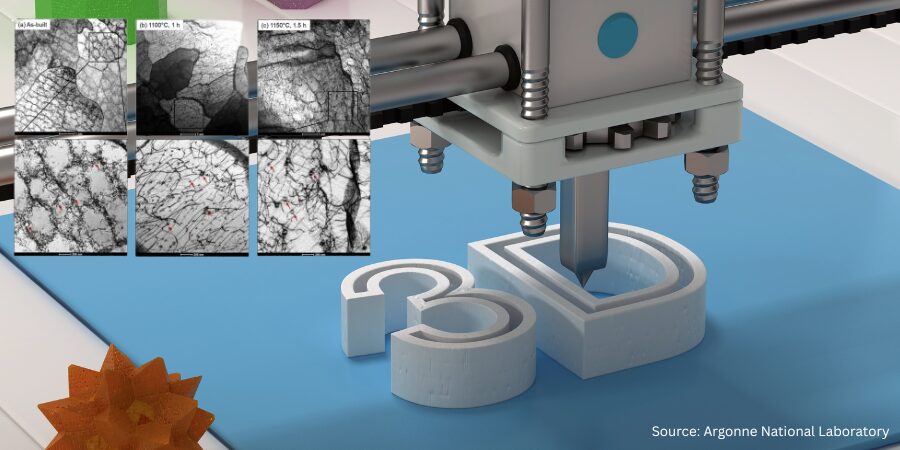
A grid of six images, arranged in three columns of two, shows nano oxides in 316H stainless steel at the micrometer and 200 nanometer scales. The nano oxides are shown as dark spots and grain boundaries within the otherwise smooth, light gray steel.
Scanning transmission electron microscopy images of 3D-printed 316H stainless steel before (a) and after (b and c) two heat treatment techniques. Red arrows indicate nano oxides, which greatly impact the steel’s response to heat treatment.
Source: Argonne National Laboratory

Researchers at the U.S. Department of Energy’s (DOE) Argonne National Laboratory used X-ray diffraction and electron microscopy to discover nanostructures of steel made with an additive manufacturing method called powder bed fusion (LPBF).

They printed two samples of stainless steel alloys with LPBF. In one study, they focused on 316H, an established type of stainless steel for structural components in nuclear reactors, and in the other they focused on Alloy 709 (A709), a newer alloy designed for advanced reactor applications. Both studies revealed the differences between 3D-printed steel and conventionally wrought steel, and also highlighted how printed steels responded to various heat treatments.

Before these steels can be relied upon in reactor environments, the nuclear industry has discovered their growing need for a deeper understanding of how to control 3D-printed steels.

“Our results will inform the development of tailored heat treatments for additively manufactured steels,” said Srinivas Aditya Mantri, an Argonne materials scientist who co-authored both studies. ​“They also provide foundational knowledge of printed steels that will help guide the design of next-generation nuclear reactor components.”

Using Heat Treatment for Repair

In LPBF, a laser melts precise designs into a metal powder one layer at a time until a solid, 3D metal object is formed. The repeated heating and cooling caused by the laser changes the microstructures of the steel.

Printed steels, for example, show higher numbers of dislocations — a defect of non-uniform shifts in a steel’s structure. Dislocations strengthen steel, but they also increase its internal stress, leaving it more vulnerable to fracture.

Heat treatment is a way to relieve this stress. Heat treatment changes the microstructures of a metal and can repair dislocations as high temperatures allow atoms to shift. Recrystallization is a product of heat treatment where new, strain-free grains replace the original structure. However, keeping some dislocations can have benefits of promoting precipitation of particles that can improve a material’s performance.

3D-printing 316H, a Standard for the nuclear industry

In one of the studies, researchers focused on 316H, comparing the microstructures of wrought and LPBF-printed samples by scanning electron microscopy (SEM) and scanning transmission electron microscopy.

Three images in a row depict dislocations in the microstructures of Alloy 709 stainless steel at three length scales, labeled: 1 micrometer, 500 nanometers and 100 nanometers. The dislocations appear as dark cracks and lines across the steel, which otherwise appears smooth and light gray.
Transmission electron microscopy images of 3D-printed and heat treated Alloy 709 stainless steel. The experiments revealed a high number of dislocations in their microstructures.
Source: Argonne National Laboratory

At a second office, they used in situ X-ray diffraction experiments. At beamline 1-ID, the team evaluated the samples using high-energy X-rays while they underwent varying heat treatments of solution annealing.

“The high flux of photons provided by the APS allowed us to track the evolution of the microstructures in real time during the dislocation recovery process,” said Xuan Zhang, another materials scientist at Argonne and co-author on both studies. ​“That’s something you can only achieve with a synchrotron X-ray facility like the APS.”

What was revealed is that recrystallization was inhibited by nano oxides, which are nanoscale defects common in 3D-printed steel.

“Nano oxides act as a sort of barrier to the movement of dislocations and the growth of new grains, causing some dramatic differences between the response of LPBF-printed and wrought steels to heat treatment,” Zhang said. ​“For example, the printed samples started to recrystallize at temperatures several hundred degrees higher than their wrought counterparts.”

The effects of these discoveries on the mechanical properties of the metal are essential, particularly strength under tension and resistance to creep. Creep is the slow deformation of a material under consistent mechanical load, which is relevant for nuclear applications.

3D-printing A709, An Up-And-Coming Heavy-Hitter

The other study focused on A709, a newer advanced stainless steel designed for high-temperature environments such as inside sodium fast reactors. Researchers studied samples of A709 printed with LPBF, making it the first experimental look at an additively manufactured form of the alloy.
While investigating the strengths of the heat treated samples under tension, both at room temperature and 1022°F (550°C) — a temperature relevant to sodium fast reactors — the printed A709 showed higher tensile strengths than the wrought A709. This is most likely on account of the printed samples beginning with more dislocations, which also led to the formation of more precipitates during heat treatment.

“Our research is providing practical recommendations for how to treat these alloys,” said Zhang, ​“but I believe our biggest contribution is a greater fundamental understanding of printed steels.”

Press release is available in its original form here.


Heat Treatment Essential for 3D-Printed Nuclear Reactors Read More »
Boriding Innovation Highlighted for US DOE Secretary

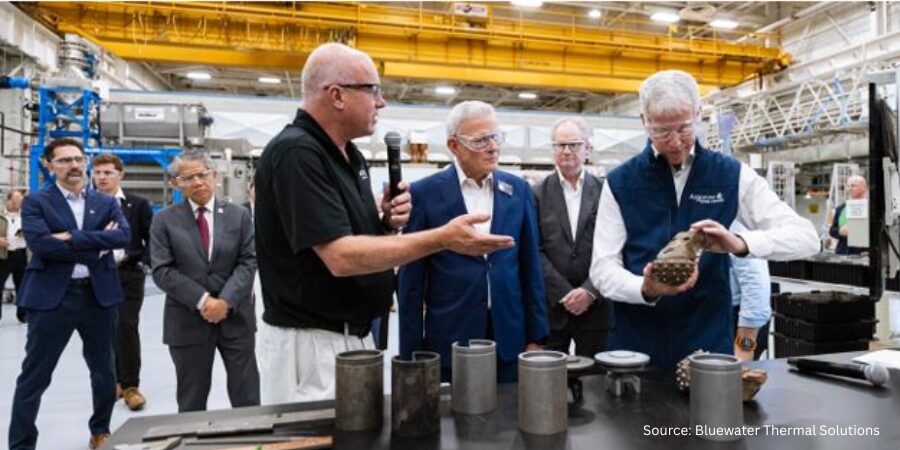
Bluewater Thermal Solutions showcased its contributions to innovation in the energy and industrial sectors, including Ultra-Fast Boriding at Argonne National Laboratory. U.S. Department of Energy’s Secretary, Chris Wright, engaged in a dialogue there on the future of transportation, manufacturing, and critical materials research.

Craig Zimmerman
Director-Technical
Bluewater Thermal Solutions

Craig Zimmerman, Director-Technical at Bluewater, joined fellow leaders from national labs and industry at Argonne’s Materials Engineering Research Facility (MERF). Bluewater highlighted its collaborations with Argonne National Laboratory’s pioneering work in Ultra-Fast Boriding surface hardening technologies for down-hole oil production operations, which play a vital role in supporting domestic energy production.

“We’re deeply committed to advancing U.S. manufacturing through technical innovation,” said Zimmerman. “Participating in this event alongside Secretary Wright and our colleagues at Argonne highlights the successful development and transfer of new technology from Argonne to Bluewater Thermal Solutions.”

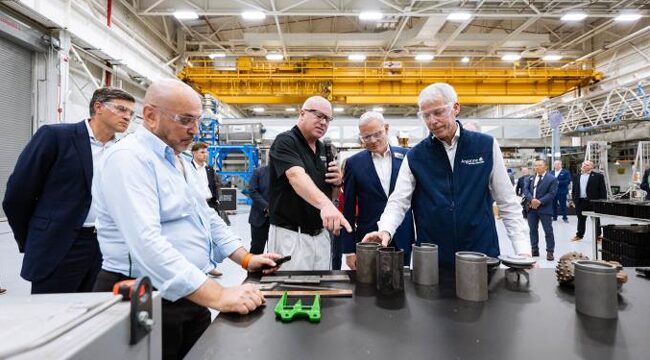
U.S. DOE Secretary surveys components at Argonne National Laboratory.
Source: Bluewater Thermal Solutions

Argonne’s mission is to accelerate innovation from discovery to deployment, strengthen domestic supply chains for critical materials, and make the movement of people and goods more efficient and sustainable. Bluewater’s contributions help scale thermal technologies that bolster reliability.

Press release is available in its original form here.


Boriding Innovation Highlighted for US DOE Secretary Read More »

Argonne Coating Improves Wind

Despite the rigors of scientific inquiry and the methodical approaches of the world’s most talented researchers, sometimes science has a surprise in store. Such was the case when a group of researchers from the U.S. Department of Energy’s (DOE’s) Argonne National Laboratory and the University of Akron discovered that a particular form of carbon coating not necessarily designed for wind turbines may indeed prove a boon to the wind industry — a serendipitous finding that was recently highlighted in the journal Tribology International

Due to the strenuous environment inherent in wind turbine drivetrains, key components such as actuators, bearings and gears are prone to failure, meaning turbines require regular maintenance that helps drive up the price of wind energy. Prolonging the life of these components could greatly reduce the cost of wind power, the fastest growing source of energy in the world, thereby making it an even more attractive energy source.

These failures are often due to a phenomenon known as micropitting in which the repeated rolling and sliding cycles in the gears and bearings of turbines lead to cracks on the surface of drivetrain components. Further contact only exacerbates the cracking once it begins, chipping away at the metal and increasing the severity of the existing cracks until costly maintenance is necessary or, even worse, the drivetrain fails.

Enter Argonne’s Tribology and Thermal-Mechanics Section and its Surface and Lubrication Interaction, Discovery and Engineering (SLIDE) initiative, which investigates how lubricants and materials interact and develops novel lubrication and coating concepts that reduce friction, and therefore micropitting, prolonging component life across a range of energy technologies.

And sometimes they get a little lucky. Such was the case when SLIDE researchers applied this “diamond-like” (some of the carbon-to-carbon bonding in the coating is similar to that of diamonds) coating to wind turbine components, which was not the intended use.

“We felt that if it was working under other sliding conditions, it might work in wind turbine drivetrains as well,” said SLIDE’s Ali Erdemir, an Argonne Distinguished Fellow. “Initially, our expectations were low, as we thought the coating would wear out due to the high stresses inherent in wind turbines, but that didn’t happen.”

So far the coating, named N3FC, has proven its worth through more than 100 million testing cycles with no appreciable micropitting. Erdemir admits that they don’t know exactly how far it could go, as it has surpassed the time limit of SLIDE’s benchtop micropitting test rig. If the coating performs similarly under real-world conditions, it could mean huge savings in terms of maintenance and prevention of failure in wind turbines nationwide — to the tune of millions of dollars, said Erdemir.

But first, he added, they need to learn exactly why it works.

“We don’t yet understand the exact mechanism,” said Erdemir. “The general belief is that component wear life extension requires a much harder coating, as more hardness reduces wear. But in this case the coating has less hardness than the base steel, so conventional thought doesn’t apply.”

The team is now eager to work with companies and see how N3FC performs in the field. Until then, they will stay busy trying to discover the mechanism behind this surprising scientific development. “We would love to get to the bottom of this and design even better coatings,” said Erdemir.

The team is also testing the coating in sealing applications for compressors. As a low-friction surface coating, it may also prove beneficial in natural gas and hydrogen environments. “It appears to have multiple capabilities in terms of performance,” said Erdemir.

While much of the work was done in Argonne’s tribology laboratory, Raman spectroscopy (which uses monochromatic light, usually from a laser) was performed at the laboratory’s Center for Nanoscale Materials, a DOE Office of Science User Facility.

The research was funded by DOE’s Office of Energy Efficiency & Renewable Energy (Vehicles Technologies Office and Wind and Hydropower Technologies Office).

Team members include Argonne researchers Giovanni Ramirez, Osman Eryilmaz and Aaron Greco, as well as Gary Doll of the University of Akron and Harpal Singh of both Argonne and the University of Akron.

Argonne National Laboratory seeks solutions to pressing national problems in science and technology. The nation’s first national laboratory, Argonne conducts leading-edge basic and applied scientific research in virtually every scientific discipline. Argonne researchers work closely with researchers from hundreds of companies, universities, and federal, state and municipal agencies to help them solve their specific problems, advance America’s scientific leadership and prepare the nation for a better future. With employees from more than 60 nations, Argonne is managed by UChicago Argonne, LLC for the U.S. Department of Energy’s Office of Science.

Argonne Coating Improves Wind Read More »

Skip to content