PUBLISHER’S PAGE

The Show Must Go On – Thank Goodness!

Heat Treat Today publishes eight print magazines a year, and included in each is a letter from the publisher, Doug Glenn. This letter first appeared in Heat Treat Today‘s June 2021 Buyers Guide print edition.


Doug Glenn
Publisher and Founder
Heat Treat Today

We’re seeing the backside of COVID as it slouches off into the sunset. Masks are coming off. People are standing less than six feet apart. Hands are being shaken as opposed to elbows being bumped. And planes, trains, buses, interstate highways, office buildings, and restaurants are starting to fill up again with real live people.

So are convention centers.

Such is the case in the North American heat treat industry. . . and none too soon. ASM International recently announced that their IMAT event which includes the long-standing Heat Treat Society sponsored Heat Treat Conference and Exposition (aka Heat Treat Show) will be live and face-to-face this coming September 14-16, in St. Louis. Amen and amen!

Heat Treat Today is one of the sponsors of the ASM Heat Treat Show, and we couldn’t be happier to get together with all of our friends and colleagues at this year’s event. On page 8 of this edition, Eric Hutton explains a bit more about the event. Be sure to read his column. This publication will be heavily promoting the Heat Treat Show as something good and worthy of your attendance. Considering that the last major face-to-face industry event was the 2019 ASM Heat Treat Show, it will be a real blessing to be back in a booth, shaking hands and catching up with industry colleagues, customers, and prospects.

“People are happier and make better decision when they are well informed” has been the driving force behind all that Heat Treat Today does. Our goal is to help people become well informed, and with nearly 24 months since the last face-to-face event, there is certainly a lot of informing that needs to happen. That’s why we’re excited to be one of the key promoters of this year’s event. We hope that you’ll take the time to attend the show, and bring your entire heat treat department with you.

Another way we keep people well informed is by helping them connect with suppliers who can provide them with the equipment, supplies, components, and/or services that they need. That’s exactly what this month’s issue is all about – connecting buyers and sellers of heat treat equipment and services. This is Heat Treat Today's 1st Annual Buyers Guide. We’re super pleased with how it has turned out, and we are absolutely certain that next year’s Heat Treat Buyers Guide will be even bigger and better.

In the Heat Treat Buyers Guide, you will be able to find ANY heat treat equipment, supplies, components, sub-systems, or heat treating services that is known to man. If not, let us know and we’ll see if we can add it to the list of improvements for next year. On page 6, our managing editor, Karen Gantzer, explains how to get the most out of this resource. That’s a page worth referencing.

And don’t forget, all of the information presented in this annual print version of the Heat Treat Buyers Guide is updated continually at www.HeatTreatBuyersGuide.com. In the online version, you’ll be able to access the very latest information. When this print issue was going to the printer, there were still a significant number of heat treat industry suppliers who had not updated their listings. By this time next year, there will definitely be more, so don’t forget to check out the online version of this Heat Treat Buyers Guide for the very latest.

If you don’t find what you’re looking for, please let us know. We’re always glad to help.

Whether it’s the Heat Treat Buyers Guide or the upcoming ASM Heat Treat Show, we hope you become and stay well informed in 2021. If there’s anything we can do to help, please let us know. We’re wishing you the very best in 2021 – a true face-to-face, closer than six feet, hand shaking, blessed year.

The Show Must Go On – Thank Goodness! Read More »

Publisher’s Page: Where’d You Learn THAT?

Heat Treat Today publishes eight print magazines a year, and included in each is a letter from the publisher, Doug Glenn. This letter first appeared in Heat Treat Today‘s March 2021 Aerospace print edition.


Last month, this magazine featured a heat treat IQ issue. The issue had everything you need to know about IQ (integral quench) furnaces – the most rugged and widely used furnaces in the heat treat world. The magazine wasn’t really dealing with a person’s IQ (intelligence quotient), but it did get me thinking about how our current and future readers learn about heat treat.

Reading something on the Internet about heat treat can be a risky venture. “I read it on the Internet; therefore, it must be true.” That statement sarcastically makes the point that “I read it on the Internet; therefore, it might very well might NOT be true.” The statement casts doubt on the veracity of anything you might read on the “Interweb.” How is it then that professionals in the heat treat industry learn heat treat stuff these days? Where are they getting their information and how can we be sure that it’s true, accurate and helpful?

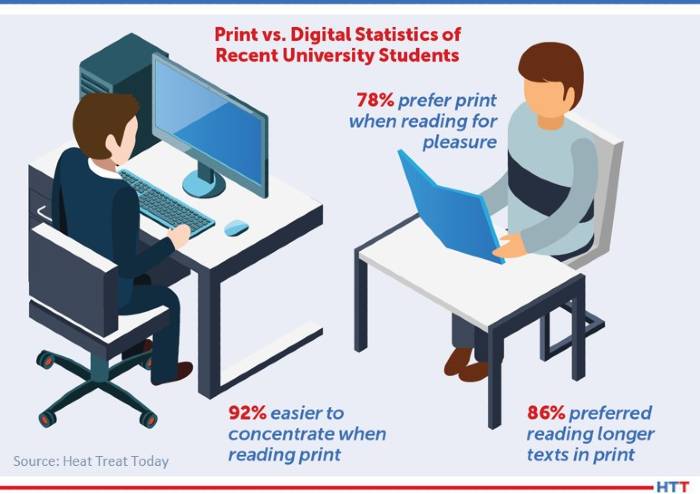
Although it’s “cool” to think and say that “digital” is all the rage, multiple studies say otherwise. These studies confirm that material delivered in a hardcopy print format is more believable, trusted, and keeps the reader’s attention for longer than digital content.

Heat Treat Today’s 20-something year old podcast and daily e-newsletter editor, Bethany Funk, – who is also an excellent researcher – pulled together some interesting research regarding print and digital delivery of educational content. According to one study she found from MarketingSherpa, “. . . more people said that they trusted print ads than any other medium.”

Notice that the above research was conducted with UNIVERSITY STUDENTS (youngins as we like to call them) and that the study was performed in 2015 – not that long ago.

While digital learning is good, the evidence seems to point to hardcopy learning as being the preferred method – even for younger folks. Who’da guessed?

Undoubtedly, digital delivery of content is here to stay, and the cost to produce that content is sometimes exceptionally low. Low cost of production inexorably leads to an excess of supply and poor quality. That’s what we’re seeing today – a lot of information and a lot of question

Here’s the remedy. We’re here to help. Our editors will find, filter, and format heat treating content so that it is most applicable, useful, and helpful to you. If you search the internet for “heat treat,” you’re going to come up with a whole lot of stuff that has nothing to do with industrial heat treating – think wood, biomedical, dental, food processing, etc. – all of which have “heat treat” in their name but have very little to do with the type of heat treating in which you are interested.

If you’re interested in learning about heat treating, I suggest Heat Treat Today – hard copy magazine, website, e-newsletters, and Heat Treat Radio. We’re here to help you learn.


Publisher’s Page: Where’d You Learn THAT? Read More »

Standardization vs. Innovation

This brief original content column by Heat Treat Today’s publisher, Doug Glenn, is from the most recent print magazine, Air and Atmosphere 2021. Are standardization and innovation in competition with one another, or do they assist each other? Which one is better to have? Read this article weighing the economics, business, and cultural realities of both.


Doug Glenn
Publisher and Founder
Heat Treat Today

In the heat treat industry, I wonder what effect standardization has had on innovation. This is a somewhat loaded question given the number of companies in the North American heat treat industry that are invested in industry standards such as AMS2750, CQI-9, and a large alphabet soup bowl of other standards. I’d like to hear your specific stories about how standardization has been helpful or harmful. Maybe Heat Treat Today can do a future article on the topic if we get enough responses. But in lieu of those real-life anecdotes, let’s think for a moment about the relationship between innovation and standardization.

First, I think that nearly everyone would agree that innovation is a good thing and should be encouraged. Many of today’s conveniences are the result of yesterday’s innovations. Certainly, not EVERY innovation is good, but encouraging a company, economy, or culture of innovation is far and away preferred to the absence of innovation.

Second, we should also acknowledge the benefits of standardization. Repeatability is the hallmark of high production societies. Knowing that you’re always going to get the same burger at any McDonald’s across the country is a huge selling point for that fast food giant. And when it comes to mission-critical or life-critical goods or services, who would not want the assurance that “past performance is a good indicator of future results.” I prefer my heart surgeon to do the same thing every time!

Third, let’s be clear that standardization and innovation are, by nature, mortal enemies in the sense that each tends to destroy the other. An atmosphere of standardization, where everything is always done the same – over and over again – is antithetical to shaking things up and trying new and sometimes odd things. Likewise, an atmosphere of innovation, cuts directly across the same sameness of standardization. If you do it differently one time, standardization is destroyed.2021 print mag 02

There is wonderfully simple and brilliant book written by the towering mind of Ludwig von Mises called Bureaucracy which contrasts bureaucratic organizations with profit-driven organizations. I recommend it highly (search Bureaucracy, von Mises) and it has something to say about the differences between bureaucratic organizations, which are highly standardized by nature, as well as being profit-driven organizations that tend to be less standardized and more innovative. One of his points is that there is a place for both in the world. The military, for example, is not a good place for question-asking and innovation, especially in the midst of a battle. In a military setting, do what you’re told without question and don’t deviate/innovate. In a profit- driven business, however, this same mindset is not so healthy – take for example the postal system or another bureaucratic organization where responsiveness to customer needs is not highly valued.

Some may say that there is a standardized process for being innovative. Could be.

Where’s the balance and how do we know if/when we’ve gone too far in either direction?

I’d be interested to hear your heat treat stories of when and why standardization or innovation is good, and especially how these two live comfortably together.


Standardization vs. Innovation Read More »

Publisher’s Page: Fracking

Doug Glenn
Publisher
Heat Treat Today

Heat Treat Today publishes four print magazines a year, and included in each is a letter from the publisher, Doug Glenn. This letter first appeared in Heat Treat Today‘s Medical and Energy Heat Treating magazine, December 2020.


Home heating oil is going for $1.49 per gallon. 525.4 gallons was just pumped into the two, 275-gallon fuel oil tanks in the basement of my 1900’s-era farmhouse. Eleven months ago, when I last filled those tanks, fuel oil was selling for $2.35 per gallon. $1.49 is the lowest price I’ve paid in the 10 years I’ve lived in this drafty old house, and it represents a 36% drop in price.

Let’s put the blame on fracking for the price drop. We can’t really blame COVID – although we can and should blame COVID for nearly everything else that went wrong in 2020, but not the drop in fuel oil prices specifically, and energy prices in general.

My acquaintance and friend, Dr. Mark W. Hendrickson, retired  adjunct faculty member, economist, and fellow for economics and social policy with the Institute for Faith and Freedom (www.faithandfreedom.com) at Grove City College (www.gcc.edu), my alma mater, in western Pennsylvania, recently published a short and thought-provoking article about fracking. You can read Dr. Hendrickson’s entire blog post by clicking here (if you’re reading this in digital format – which apparently only roughly 30% of you are), or if you’re reading this in the “old-fashioned” print edition (roughly 70% of you!), I’ll summarize a few of the more salient points below, or you can jump on your computer and Bing or Google “mark hendrickson faith freedom why fracking is a big issue.” It will pop up as one of the first search results. More on this article in just one moment. But first …

Since this issue covers heat treatments in the energy and medical industries, please notice the article in this issue that deals with heat treating a fracking pump valve seat. The article is an edited version of one of four Heat Treat Radio interviews conducted with Integrated Heat Treating Solutions CEO, Joe Powell. If you’re involved in the oil and gas industry or any other energy related industry, this fracking article will be of interest to you. Joe explains how his company more than doubles the life of a mission-critical valve seat in a down-hole fracking pump by introducing some very, very unique heat treating and quenching processes. (Spoiler: the secret is in the quenching!) Read and enjoy – or if you’d prefer to listen, click here.

Now, back to Dr. Mark Hendrickson’s blog post on fracking, Why Fracking is a Big Issue. Dr. Hendrickson points out “the strange tendency of many people who have benefited from economic advances to denounce and vilify the source of their prosperity, a sort of ‘bite-the-hand-that-feeds-you’ phenomenon.” The “denouncing and vilifying” of fracking is one good example of this strange psychosis.

Hendrickson continues, “The enormous boost that cheap natural gas gives to the American economy is reason enough to continue with fracking, but there are also important geopolitical, health, and environmental benefits to natural gas.” Geopolitically, fracking has made the US energy independent. In terms of human health and safety, natural gas is “far safer for workers to extract than coal, and burning it causes much less pollution than coal.”

Much more could be said; much more is said in Hendrickson’s short article. I recommend his article to you.

I like paying $1.49 per gallon for my fuel oil, but I’m not in favor of that price if there is an obvious harm being done to a specific person. Dealing with legitimate environmental, health, and safety issues verifiably caused by fracking is reasonable and good; completely eliminating fracking seems extreme. Long live $1.49 (or less) fuel oil prices for all!

Publisher’s Page: Fracking Read More »

Publisher’s Page: Happy Thanksgiving

Thanks for 2020 – as interesting as it has been.

Thanks for extra time at home with family and friends this year.

Thanks for helping us to understand that we don’t have to be in the office for long hours to get work done.

Thanks for the business we were able to keep.

Thanks for face-to-face meeting technology (like Zoom) … and the necessity of learning how to use it.

Thanks for sheltering-at-home-induced stir craziness and the realization that people are important.

Thanks for reminding us that seeing a person’s full face is far better than seeing their eyes only.

Thanks for people who smile with their eyes.

Thanks for people-loving people who hate masks but wear them to protect their fellow man.

Thanks for freedom-loving people who don’t wear masks because they believe government has overstepped.

Thanks for those who care for our physical bodies when we get ill.

Thanks for those who take care of our spiritual bodies when we get sick, sinful, weary and/or afraid.

Thanks for all those handshakes we took for granted before COVID.

Thanks for all those less-than-six-foot encounters before COVID.

Thanks for the deeper understanding of what the word “normal” means.

Thanks for the hope of brighter days ahead.

Thanks to all of you Heat Treat Today readers and advertisers who have made 2020 such an enjoyable year. All of us pray God’s richest blessing on you and your family over the upcoming Thanksgiving and Christmas holiday season.

In everything give thanks, for this is God’s will for you in Christ Jesus. Holy Bible, 1 Thessalonians 5:18


–  Doug Glenn, publisher, Heat Treat Today  (November 2020)


(photo source: Davies Design Studio at unsplash.com)


Publisher’s Page: Happy Thanksgiving Read More »

Publisher’s Page: The Bright Side of COVID-19

Heat Treat Today publishes four print magazines a year, and included in each is a letter from the publisher, Doug Glenn. This letter first appeared in Heat Treat Today‘s Automotive Heat Treating magazine, June 2020.


Doug Glenn, Publisher, Heat Treat Today

For the record, the 2020 North American heat treat industry has been severely impacted by COVID-19. Everyone I’ve talked to agrees that the reality of 2020 will pale in comparison to the hopes and dreams for 2020 back in January and February of this year. March and April usually bring spring-like optimism, but this year those two months were marked by a grinding of the US economy to a nearly complete standstill, the heat treat industry included. As one of our Latvian foreign exchange visitors said in his broken English, “NOT GOOD.” Thus, it has been; and thus, it is even as of this writing.

Every situation, however, is 20% situation and 80% what you make of it, so let me suggest four positive things that will come out of this historic economic tragedy.

#1 “Sheltering at home” for 6-8 weeks might help us all slow down. For the vast majority, we’ve all been slowly heated in the waters of busyness to the point where we think it is normal. During my recent conversation with the executive director of an industry association, this person said, “I’m in favor of anything that will help us all slow down.” This person was fully convinced that our “normal” pace is not healthy. Perhaps this person was right. One other individual I spoke to was “forced” to ignore work for two weeks. His company furloughed individuals and sternly warned them NOT to check emails while furloughed because the company could be sued if furloughed workers were actually working. The national market manager that told me this story did so from his personal cell phone while preparing to paint a room in his house. No work for him. Like many of us, he had to slow down.

#2 Interacting face-to-face with other human beings is important. I know that many of you introverts are loving the forced isolation, but even you must admit that after a week or more seeing no one, it would be nice to be able to at least go somewhere where you can actually see and talk to other human beings besides those with whom you are confined to quarters. My favorite example of this are all of the technologically savvy young people who live on their phones. As long as they have their phones, they’re content. Come to find out, many of these now homebound young ones are now MISSING SCHOOL, not so much for the academics, but more for the interaction with their peers – even if it is sitting next to each other with their heads in their phones! People matter. COVID is helping us remember.

#3 COVID, or more accurately, the RESPONSE to COVID, is helping us all remember just how quickly we can lose our freedoms. For many of us, we lost the freedom to go to work, we lost the freedom to freely assemble, we lost the freedom to travel where and when we like, we lost the freedom to walk around without a mask, we lost the freedom to walk up a grocery store aisle in either direction, and we’ve even lost the freedom to worship where and when we like. Some even argue that we’ve lost our freedom of speech! Try asserting the opinion that the actual COVID virus is not significantly more dangerous than a normal flu. Try it once; you’ll not do it again! Of course, most of these freedoms will be lost only temporarily and for a good cause – our safety. But please remember what King Mongkut (Yul Brynner in The King and I) said about finding safety from others, “Might they not protect me out of all I own?” Or take it from Ben Franklin – “Those who would give up essential liberty, to purchase a little temporary safety, deserve neither liberty nor safety.” 

#4 And finally, COVID is helping us all see just how quickly life can change … and this is a good thing … because it is true. We think we are safe, we think we are secure, we think that life will always be this way, we think we are in control. We are wrong. There’s only One in control – assuming you believe in God – and we are not Him. This might be a scary thought for some – to not be in control. But, it is better to live in an unpleasant reality than a dangerous fantasy. COVID is helping us deal with reality.

So, there’s a lot of good coming from this pandemic. Here’s to a more modestly paced life, here’s to time with friends and family, here’s to liberty, here’s to remembering Who’s in charge … and here’s to your health and safety and a return to a more “normal” North American heat treat market.

Publisher’s Page: The Bright Side of COVID-19 Read More »

Publisher’s Page: The Most Interesting Non-Heat Treat, Heat Treat Story You’ll Ever Watch

Doug Glenn, Publisher, Heat Treat Today

Heat Treat Today publishes four print magazines a year, and included in each is a letter from the publisher, Doug Glenn. This letter first appeared in Heat Treat Today‘s Aerospace Heat Treating magazine, March 2020. 


The first time I heard the name “Rodriguez” was at the 2015 ASM International Heat Treat Show during the “The Heat Is On” networking reception held at The Waterview Loft at Port Detroit – the same location it was held this last year (2019). I was standing beside a to-remain-nameless president of a furnace manufacturing company who had traveled extensively in his pre-heat treat days. While we were chatting at one of the outdoor cocktail tables on a lovely Detroit night, a middle-aged couple (and by that I mean a couple who were roughly my age, 54 at the time) came up and stood with us. Striking up a conversation with them, as I’m known to do with complete strangers, it became clear to us, both by their accent and by the content of the conversation itself, that they were from South Africa. They were here in the States to attend the Heat Treat Show.

When the “to-remain-nameless” furnace manufacturing president found out that this middle-aged couple was from South Africa, his eyes lit up. With enthusiasm somewhat uncharacteristic of his personality, he asked them – with great anticipation – “Do you know Rodriguez?” They looked at him as if he had two heads and after a short glance at each other replied, “Of course!” The to-remain-nameless president then looked at me, a man of roughly the same age as these two middle-aged individuals, and said, “Do YOU know Rodriguez?” Feeling a bit in the dark, I answered honestly, “No; who is Rodriquez?”

Suffice it to say, I did a lot of listening from that point forward in the conversation. It was fascinating and, to be frank, somewhat unbelievable.

As with any good story, it is best not to say too much, especially about how the story ends, but the story of Rodriguez is a fascinating story that you will NOT believe. And it is heat treat related – kind of.

I’ll tell you a bit more about Rodriguez here, but you must PROMISE to search for and watch the documentary about Rodriguez, Searching for Sugar Man. You can watch it on Netflix, and you may be able to find it other places as well. Trust me, it will be a worthwhile investment of time and, if you’re like most people who I’ve steered in that direction, your response will be something like, “No way! Not possible.”

In fact, Rodriguez was a heat treater. If you listen carefully at roughly the 1-hour mark in the documentary, you’ll find out that Rodriguez worked in the heat treat department for Chrysler, its Lynch Road Assembly plant in, interestingly enough, Detroit! According to Wikipedia, the “Lynch Road Assembly [Plant] was a Chrysler assembly plant located… near Coleman A. Young International Airport. It is now the location of The Crown Group, a powdered coatings manufacturer which supports the automotive manufacturing industry.”

That is as “heat treat” as the documentary gets, so don’t expect any more.

You need to watch this documentary, you and your entire family. My four kids were all in their teen years when we first watched Searching for Sugar Man. They were mesmerized once we got into it. Suffice it to say that Rodriguez was a musician besides being a heat treater, and what happened to him is, well… unbelievable.

If, nay, WHEN you watch it, please drop me an email (doug@heattreattoday.com) and tell me what you thought. Also, if you know of any other non-heat treat, heat treat stories, or simply movies where heat treat is mentioned, please let me know. I’m trying to compile a list of movies where at least heat treat gets a mention.

Publisher’s Page: The Most Interesting Non-Heat Treat, Heat Treat Story You’ll Ever Watch Read More »

Publisher’s Page: Infinite Energy from the Earth

Heat Treat Today publishes four print magazines a year, and included in each is a letter from the publisher, Doug Glenn. This letter first appeared in Heat Treat Today‘s Medical & Energy Heat Treating magazine, December 2019


Doug Glenn, Publisher, Heat Treat Today

The fingers of heat treat reach into nearly every area of our life. Some of the effects of heat treating are obvious, like the landing gear on an airplane that is able to take repeated high-impact landings without snapping in two. There are other effects of heat treating that are not as obvious but are no less important. Take for example the amazing things that go on inside that same airplane’s jet engines at super-high temperatures and super high stress and strain levels. The jet engine is a modern marvel usually taken for granted by millions of travelers each day.

Graphene has the potential of being able to transport heat from the core of the
earth to the surface with essentially zero losses.

Some of the effects of heat treating are mundane. One of my favorite examples of a very practical and understandable heat treatment is the annealing process for aluminum foil. “Why is it,” I ask, “that you are able to bend this thin sheet of metal and yet it doesn’t shatter, break, or even crack?” Answer: heat treat–specifically, foil annealing.

In this issue, we take a look as some rather fascinating heat treatments in the medical and energy industries. It’s not that these two industries have anything to do with each other; they really don’t. In fact, much of what is done in the medical industry is done in vacuum furnaces in cleanroom settings. Energy heat treatments, on the other hand, can be done in a vacuum, especially when stainless steels or other more exotic materials are used (think nuclear reactors), or they can be done in the down and dirty atmosphere furnaces and oil quench tanks. But they are both heat treat-intense industries and both worthy of some attention–thus we’ve combined them into one issue.

Pulling Energy from the Earth’s Core

One of the more fascinating “heat treat” applications is the emerging possibility of being able to extract what appears to be an infinite supply of energy from the earth’s core using a material that will transfer the energy from the core to the surface with essentially zero losses. The material capable of doing this is graphene, and the graphene is currently made in vacuum furnaces. In fact, there are a number of vacuum furnace companies in the heat treat industry that are dabbling in this field.

The ability to extract energy from the core of the earth with essentially zero losses is the focus of the Limitless Energy Graphene Project headed by Manoj Bhargava and Ravi Sajwan. These gentlemen propose to transfer energy from roughly 4.5+ miles below our feet to the surface by using graphene, which is 100-times better at conducting than copper, lighter than air, and stronger than steel.

It transfers heat ultra-efficiently. According to Mr. Sajwan, if you apply 100°F to one end of a graphene pathway, you’ll instantly get 100°F heat at the other end of the pathway, but the middle of the pathway will remain perfectly cool. What they’re describing is 100% heat transfer with zero transmission losses. And according to Mr. Bhargava, you can go 10 feet or 10 miles, and the result is the same.

The temperature 4.5 miles below our feet ranges anywhere from 1,000°F to 7,000°F. Imagine being able to dig just deep enough to reach temperatures capable of boiling water and bring those temperature to the surface to fuel electricity-creating, steam-powered turbines.

Graphene is an atomic-scale hexagonal lattice made of carbon atoms.

If you’re not familiar with graphene, go to “The Google” and search for “What is graphene?” You’ll have no problem finding many explanations. I suggest looking for a short video from the University of Manchester.

CLICK HERE to be taken to an amazing YouTube video entitled, “5 Amazing Renewable Energy Ideas & Solutions for the Future.” HTT

Publisher’s Page: Infinite Energy from the Earth Read More »

Publisher’s Page: A Short (and Mostly Accurate) History of Publishing in the Heat Treat Industry

Heat Treat Today publishes four print magazines a year, and included in each is a letter from the publisher, Doug Glenn. This letter first appeared in Heat Treat Today‘s Trade Show Edition, September 2019.


Doug Glenn, Publisher, Heat Treat Today

There is a history in every industry and it is fascinating to go back and see how we’ve gotten to where we are, especially when you think about trade publications in the heat treat industry. These publications are quite a bit more important than many know. They’ve helped advance the industry and have played a major role keeping the industry abreast of the latest technologies.

In the heat treat world, the first industry publication appeared in the Steel City, Pittsburgh, Pennsylvania, compliments of I. Stanley Wishoski. In 1924, Mr. Wishoski published the first edition of Fuels & Furnaces, which changed its name to Industrial Heating in the early 1930s. Industrial Heating is still around pumping out excellent heat treat content every month.

Mr. Wishoski’s son-in-law, Charles (Chuck) McClelland, assumed ownership of Industrial Heating. Some industry veterans, Mike Kasprzyk of INEX, Inc. for example, actually met Mr. McClelland, a privilege I had only once in passing.

Charles (Chuck)
McClelland, owner/
publisher of Industrial
Heating up to 1988

There were four individuals associated with Mr. McClelland that have contributed significantly to the publishing industry. Stan Lasday was hired by McClelland and was the editor of Industrial Heating for years, retiring in roughly 1994. Two of Chuck McClelland’s daughters worked for Industrial Heating: Beth McClelland and Becky McClelland. Becky is still working for the publication. Kathy Pisano, a name very familiar to hundreds of heat treat industry vendors, is also still employed by Industrial Heating. Both Kathy and Becky are, by my estimation, two of the great unsung heroes of the heat treat publishing world.

In roughly 1989, the McClelland family sold Industrial Heating to what is today BNP Media. Jim Henderson was the owner of BNP at that time and his righthand man was Dave Lurie who was responsible for assimilating the new publication into the company. Dave did a masterful job building Industrial Heating from being the #2 or #3 magazine in the industry to being the number one publication. In fact, during his tenure and the 20 years that I was with the publication, Industrial Heating tripled in size and is still the leading publication in the industry under the leadership of publisher Erik Klingerman and seasoned editors Bill Mayer and Reed Miller.

Dave Lurie, with BNP
Media, published
Industrial Heating in the
early 1990’s.

In the early 1990s, the number one heat treating publication was Heat Treating. It was owned by Chilton/CBS and later sold to Penton Publishing. Penton struggled with it and changed the size of the publication and its name to Heat Treating Digest. It soon failed and folded.

The Monty (www.themonty) started sometime in the 1990s as the first online only heat treating media outlet. Gordon Montgomery’s son, Jordan, is now involved and seems to be pushing the site to new heights.

Another very competent publishing company from Pelham, Alabama, Media Solutions, started Thermal Processing in the 2000s. This publication was a spinoff of their gear magazine, Gear Solutions. I can personally attest that this is a good group of people doing good work. David and Teresa Cooper along with Chad Morrison are the key players at Thermal Processing.

ASM International started and shuttered one or more heat treat publications over the years – remember Heat Treating Progress? HTPro is ASM’s current mostly-online heat treat e-newsletter. ASM, of course, is a publishing power-house, but mostly with books, not so much with industry publications.

Heat Treat Today, the magazine you’re reading now, started in 2016.

Today’s Heat Treat Media Brands

So that’s how we got to where we are today with three print media brands in the North American heat treat market: Industrial Heating, Thermal Processing, and Heat Treat Today, and a couple of digital-only brands, The Monty and HTPro. But more importantly, it is through one or more of these industry trade publications that you’ve learned more than you know about the technologies, processes, products, and companies in the ever-changing heat treat world. HTT

Publisher’s Page: A Short (and Mostly Accurate) History of Publishing in the Heat Treat Industry Read More »

Publisher’s Page: Electric Vehicles & Heat Treating: Our Death Has Been Greatly Exaggerated

Heat Treat Today publishes four print magazines a year, and included in each is a letter from the publisher, Doug Glenn. This letter first appeared in Heat Treat Today‘s Automotive Heat Treating magazine, June 2019   


Doug Glenn, Publisher, Heat Treat Today

If you believe YouTube, the very first car was a Benz Motorwagen (1885). It was petro-powered. For the last 134 years, there have been only petro-powered vehicles.

Cars aren’t going away (drivers might be going away, but not cars!), but evidence seems to point to the soon extinction of the petro-powered vehicle. Every major automobile manufacturing company has a horse in the game. Volvo, the Chinese-owned Swedish car company, has committed to building ONLY all electric or hybrid cars starting in 2019. It plans to introduce five new, all electric models between 2019 and 2021.

What of the heat treat supply chain? Will automotive heat treating dry up to a paltry percentage of what it is now? Will automotive electrification usher in new heat treat opportunities?

Without a doubt, electrification will bring in a brave new world to heat treating, but I’ve not seen anyone present a good, in-depth analysis of how the heat treat world will be impacted. If you’ve seen such a presentation, I’d like to know.

What Will Go Away

What can be said is pretty straightforward. Assuming the current trajectory continues, the petro-powered engines that have propelled our vehicles for that last century and a half will slowly start to disappear. In their place will be electric motors and battery power. Specifically, gears and transmissions will take a significant hit. Currently, the heat treatment of gears is one of the largest segments of heat treating with all the carburizing, nitriding, carbonitriding, ferritic nitrocarburizing, and a seemingly endless number of other surface or through heat treat processes. Per car, there are more gears heat treated than any other single component. Pistons, fuel injectors, cylinders, rings, and anything else related to the internal combustion engine will wane as the popularity of EVs waxes.

As one of our heat treat consultants says in this issue’s article, “Heat Treat Brain Trust on Industry Innovations That Have Enhanced Automotive Heat Treating in Recent Years,” we have to also consider the upstream supply chain that will be affected by the displacement of the internal combustion engine. What about tooling and toolmakers and the heat treating they currently do? What about the heat treating that is required after soft machining and then again after hard machining? Keep looking further and further back the supply chain to discover who else will be impacted by electrification.

It will be a paradigm shift, a mega-trend, a tsunami of epic proportion . . . maybe even a train wreck in slow motion.

But that is the saving grace. None of this is going to happen overnight. So if your horse is hitched to the internal combustion engine, the 2020s is a good time to start looking for another ride home from the dance.

“Without a doubt, electrification will bring in a brave new world to heat treating, but I’ve not seen anyone present a good, in-depth analysis of how the heat treat world will be impacted.”

What Won’t Go Away

On the other hand, there’s plenty that will not be going away. Body panels and structural components/frames, suspension parts (although they may change due to the vehicles having a motor on each of their four wheels), and non-engine related stampings and forgings will all make the cut. But even these parts are not completely safe. The push for lighter, stronger vehicles will continue to push designers to consider lighter materials with equivalent or superior functionality. Take wheels for example. Carbon fiber is superior but too expensive for the average pocketbook, but high-end vehicles are already sporting these high-tech wheels. The days of aluminum wheels may be limited. Auto manufacturers will continue to push for less expensive, higher performing materials which, in some cases, will include non-metallic, non-heat treatable composite materials.

(Photo source: Wolfgang Eckert from pixabay.com)

What’s Coming

On May 8 of this year, our publication ran the following article: “First Aluminum Sheet Battery Enclosure Helps Electric Vehicles Go Farther on a Single Charge.”  In that article, Novelis Inc.’s Pierre Labat, VP of Global Automotive, announced the first aluminum sheet battery enclosure for “the rapidly growing electric vehicle and battery sectors.” Batteries. Hitch your wagon to anything battery related!

Additionally, electric motor production and anything upstream in that supply chain would be a safe bet to investigate.

No one has ever accused me of lacking imagination, but I’m having a difficult time seeing a net gain for heat treaters in the coming EV swell. Then again, the free market and human innovation – which is especially strong in these United States – is a wonderful thing. We will adapt. Fortunately, we have some time – probably two decades of slow change. Embrace the change. Prepare for the future.

Publisher’s Page: Electric Vehicles & Heat Treating: Our Death Has Been Greatly Exaggerated Read More »

Skip to content