

PUBLISHER’S PAGE

EV Batteries — Weak Link in the Chain?

Heat Treat Today publishes eight print magazines a year, and included in each is a letter from the publisher, Doug Glenn. This letter first appeared in August 2024 Automotive Heat Treat print edition.

Feel free to contact Doug at doug@heattreattoday.com if you have a question or comment. 


In a thought-provoking RealClear Energy (“The Many Problems With Batteries” at RealClearEnergy.org) post on May 30, by Iddo K. Wernick, Ph.D., senior research associate at The Rockefeller University’s Program for the Human Environment and 2013 and 2014 candidate for the Nobel Prize in Literature, Dr. Wernick raises some challenging questions about the belief that battery technology will develop quickly enough, if at all, to achieve net zero by 2050. The complete elimination of combustion, including internal combustion engine (ICE) vehicles, is, in fact, the stated goal of the U.S. Department of Energy — see the Letter from the Publisher in the Heat Treat Today May 2024 Sustainability print issue.

In this issue of Heat Treat Today, we’re talking about heat treatments that are common for the automotive industry, an industry abuzz with talk of EVs and, by necessity, the use of EV batteries. Some of the basic facts and questions raised by Dr. Wernick bear repeating here.

  1. “Batteries provide the essential lynchpin in plans to reduce global carbon dioxide emissions . . . . The dramatic global expansion of in-battery energy storage over the coming decades is deemed necessary to facilitate the growth of wind and solar power and electrified transportation.” In other words, if batteries don’t advance significantly, net zero by 2050 is not going to happen.
  2. Dr. Wernick next points out that “batteries store energy less efficiently than hydrocarbon fuels and release that energy far more slowly than fuels do during combustion.” In fact, the energy density of relatively seldom-used and less efficient “biomass fuels like straw and animal dung is twenty times greater than . . . today’s best lithium-ion batteries, and gasoline has an energy density over 50 times greater.” In other words, with all the technical advances in battery storage over the past decades, batteries are still 50 times less effective and efficient than ICE vehicles.
  3. And while energy densities are substantially lower than carbon-based combustion fuels, a more serious obstacle will be mining (yes, energy-intense, pollution-creating mining) enough minerals to produce these batteries. According to a report issued by the Internation Energy Agency, “supplying the many critical minerals necessary for [the] enormous increases in battery manufacturing” will require “a projected five to 30 times increase in demand for the different battery metals by 2050.” Given the green movement’s propensity to shun any type of mining anywhere, it would appear that battery manufacturers are in the same situation that Moses was in when the Egyptians demanded more bricks but didn’t provide more straw.
  4. China’s dominance in critical battery minerals and battery manufacturing is also mentioned as problematic.
  5. He also covers the inherent bulkiness of batteries: “The inherent bulkiness of battery energy storage quickly shows itself in real world applications. Using current technologies, half of the power produced by the battery pack of an electric vehicle goes to moving the batteries themselves, a basic problem for a mobile power source.” (My emphasis added.)
  6. Some reasonable solutions are offered by Dr. Wernick such as, “incremental changes to the energy system that might reduce emissions more effectively and have greater potential for implementation. Consider the fact that increasing power production from natural gas and nuclear energy could reduce carbon emissions more effectively than building and maintaining the elaborate physical infrastructure necessary for solar and wind and batteries. Or the fact that hybrid electric vehicles require much smaller battery packs, leverage consumer familiarity, and may offer more promise for reducing aggregate vehicular emissions than do fully electric vehicles in the long run.”
Doug Glenn
Pubisher
Heat Treat Today

Our current world leaders and influencers appear to be somewhat unrealistic and myopic on net zero by 2050. They seem to be ignorant that technologies and materials development are both slow moving and market-driven beasts which cannot be rushed. I don’t know too many people who are opposed to EVs simply because they are electric, but I do know oodles of thinking people who understand that making a quantum leap from ICE vehicles to EVs is something best “driven” (pardon the pun) by the market, and that it takes time.

Contact Doug Glenn at doug@heattreattoday.com.


Find Heat Treating Products And Services When You Search On Heat Treat Buyers Guide.Com

EV Batteries — Weak Link in the Chain? Read More »

Publisher’s Page: Heat Treat Kids . . . and their Parents

Heat Treat Today publishes eight print magazines a year, and included in each is a letter from the publisher, Doug Glenn. This letter first appeared in June 2024 Buyers Guide print edition.

Feel free to contact Doug at doug@heattreattoday.com if you have a question or comment. 


The Heat Treat Today team does a lot of fun things throughout the year, but Heat Treat Kids is probably the most fun. If you haven’t seen it, I’ll give you a link toward the end of this column so you can see some of the cute kids and the cute answers to some kid-level questions. For those of you who are old enough, it harkens back to Art Linkletter’s “Kids Say the Darndest Things” TV program. If you’ve never heard of Art Linkletter, click this link.

Once a year we run the Heat Treat Kids feature in one of our print magazines. It seems a bit out of place for a technical trade journal to run such a non-technical feature, we admit that. Then again, it is really not all that out of place. One of the abiding principles that we live by at Heat Treat Today is the understanding that “it is all about people.” While the vast majority of our content is technical in nature and typically deals with inanimate equipment, processes, or technologies, the truth is we only write about these with the hope that they will make peoples’ lives better. It seems too obvious, but it is often forgotten: what we do, we do for people. If you look closely enough at our website or in nearly any of our various e-newsletters and print publications, you’ll see these words: We believe people are happier and make better decisions when they are well informed. The focus of the statement is “people” and our desire to see them “happier.”

Our desire to see people happier and making better decisions boils over into all the different areas of what we do. For example, we’ve converted our September print editions (which are typically distributed at either Furnaces North America or the ASM Heat Treat Show) into our “People of Heat Treat” edition. There are typically very few technical articles in the September edition, but it is rife with content about various people in the North American heat treat market. It’s in this edition we announce each year’s 40 Under 40 honorees . . . which we’ve been doing since 2018. So far, we’ve bestowed this honor on 240 rising young heat treat leaders. By the way, nominations for 40 Under 40 are always open. If you know a rising young leader in the industry, please nominate them at www.heattreattoday.com/40under40promo. [40 Under 40 nominations for 2024 closed June 28, 2024; this year’s class will be announced on September 9, 2024. – Editor] We will also include our annual “Endings” feature in the September edition; this is a feature where we acknowledge the death of some key people in the industry

September is a fun and very well-read edition, but it is not the only place where we focus on people. You might notice that Heat Treat Today often includes pictures of people on our magazine covers, and we almost always include a picture of a person in our weekday e-newsletter, Heat Treat Today. We also include the picture of the article authors in our magazine.

And finally, in our monthly Heat Treat Radio podcast, we periodically highlight a Heat Treat Legend or a Heat Treat NextGen. Both of these periodic features are simple interviews with heat treat people to learn more about them and what makes them tick. The Legends feature is where we interview some industry “old timers” who have had a significant impact on the industry. Heat Treat NextGen is where we interview up and coming leaders in the industry.

The edition you hold in your hand is our annual Heat Treat Buyers Guide. It is chock-full of equipment information . . . hardly a face to be seen. Nonetheless, we’re hopeful that all of this equipment information will help you be happier and make better decisions.

Doug Glenn
Pubisher
Heat Treat Today

As a final note, if you’d like to take a look at some extremely cute and often funny Heat Treat Kids, please find this feature online in the December 2023 edition. The content we provide in every edition of Heat Treat Today is targeted at making the parents of these kids well informed, able to make better decisions, and happier.

Contact Doug Glenn at doug@heattreattoday.com.


Find Heat Treating Products And Services When You Search On Heat Treat Buyers Guide.Com

Publisher’s Page: Heat Treat Kids . . . and their Parents Read More »

Publisher’s Page: The DOE Is Coming After YOUR Job

When it comes to who should lose their jobs because of changing times, I’d much rather leave the decision up to the market and millions of individual decisions being made independently around the world . . .”

Heat Treat Today publishes eight print magazines a year and included in each is a letter from the publisher, Doug Glenn. This letter first appeared in the May 2024 Sustainable Heat Treat Technologies print edition.


Yes, the headline is intentionally provocative and even a bit of an exaggeration, unless you are employed in an industry that either makes or heavily uses combustion equipment. If that’s you, then the headline is NOT an exaggeration.

To prove that it is not, I’d like you to meet Mr. Isaac Chan, a DOE employee. Mr. Chan, whom I met in March of this year at an Industrial Heating Equipment Association Annual Spring Meeting is a genuinely nice person with no ill intent toward any living soul. He is also the program manager at the DOE’s Office of Industrial Efficiency and Decarbonization.

Let’s pause for just a moment before we talk more about Mr. Chan and acknowledge that the name of this DOE Office, “Industrial Efficiency and Decarbonization,” will be, in some specific cases, an oxymoron. In specific industries, given the best available technologies (BAT), mandated decarbonization would cause industrial inefficiency.

Back to Mr. Chan. As I’ve stated, he is a very nice person, but the job he and hundreds of others at the DOE are being paid to do with taxpayer dollars is explicitly targeted at changing the energy composition of U.S. industry with the undeniable effect of putting many, if not all, combustion processes in the ash heap of history along with all those employed therein.

On the fourth slide of a presentation entitled, “Cross Sector Technologies Meeting: Day 2, Next-Generation Enabling Technologies,” presented by Mr. Chan on May 30, 2023, we find the following:

  • DOE Commitment to Industrial Decarbonization (slide title)
  • “Industrial Heat Shot — Developing technologies to reduce process heating GHG emissions by 85% by 2035”
  • “Industrial Decarbonization Roadmap — Net-zero CO2 emissions by 2050”

The same slide goes on to list four international organizations that the U.S. has joined to “decarbonize” energy-intensive industries. Those four organizations are:

  • Net-Zero World Initiative
  • G7 Industrial Decarbonization Agenda
  • Mission Innovation’s Net-Zero Industries Mission
  • UNIDO’s coordinated Industrial Deep Decarbonization Initiative

Who Decides

The issue here is who decides if the world will decarbonize or not. I personally have no axe to grind on whether combustion people stay employed or not. Economies change. Energy sources change. People in those industries lose and gain jobs. And assuming these changes are the result of millions of decisions freely made by millions of individuals daily, we can safely consider these changes to be progress. But when a change from one fuel to another — gas to electricity or carbon to no carbon fuels in this case — is pushed from the top down, when it is forced on us by “guideline” or “mandate” using our own money, that is not progress.

The market should decide. A free, unfettered market where millions of people make decisions daily is a more reliable indicator of what the people want than the well-meaning individuals in the DOE — no disrespect to any of these good people.

When it comes to who should lose their jobs because of changing times, I’d much rather leave the decision up to the market and millions of individual decisions being made independently around the world, than to a small group of well-meaning individuals who believe they know what is best for the world.

Let’s let the market do what it does so well. Let the market choose the winners and losers.


Find Heat Treating Products And Services When You Search On Heat Treat Buyers Guide.Com


Publisher’s Page: The DOE Is Coming After YOUR Job Read More »

Is It Time To Rethink the “Quality” Movement?

“It’s really difficult to speak against ‘quality.’ Who doesn’t want quality?” Read on to discover Doug’s thoughts on this topic.

Heat Treat Today publishes eight print magazines a year and included in each is a letter from the publisher, Doug Glenn. This letter first appeared in the March 2024 Aerospace Heat Treat print edition.


With door plugs flying out of airplanes at scary-high altitudes, it seems an appropriate time to revisit where we are in quality initiatives in the North American heat treat industry from an equally high, 30,000-foot perspective.

It’s really difficult to speak against “quality.” Who doesn’t want quality? Those who even bring it up are bound to be looked at with suspicion. Let the suspicion begin, because I would like to bring it up.

One Standard To Rule Them All

This image has an empty alt attribute; its file name is Reader-Feedback-announcement-of-survey-20220728-e1666277618505-edited.jpg
Contact us with your Reader Feedback!

Since my early days in the heat treat industry (late 1980s), there have been discussions about “quality” standards and certifications. I first remember QS-9000, a standard imposed on automotive industry suppliers by the Big 3: General Motors, Ford, and Chrysler. The understanding was if you (a supplier to the Big 3) work and achieve QS-9000, then you won’t need to worry about complying with any other quality certifications, especially from one of the Big 3; it was one standard to rule them all, to borrow language from Lord of the Rings.

Before QS-9000, each of the Big 3 could demand that you comply with their specific quality standards, and each of them could (and would) audit your processes, costing suppliers significant time and money. Saving these costs by complying with JUST ONE standard that would make the Big 3 happy was the driving force behind QS-9000.

But QS-9000 ceased to exist on December 14, 2006, and was replaced by one or two other standards systems (depending on how you look at it). So much for one standard.

During the 1980s and 1990s, the quality industry saw enormous growth. “Quality Assurance” (QA) departments burgeoned, “Quality Managers” became more prevalent, and standards organizations, like SAE and ISO, flourished. Quality had become an industry of its own. In fact, my previous employer, BNP Media, publishes Quality Magazine just to serve the growing quality industry. Quality is now a living, breathing organism that, like all living things, is interested in self-propagation and survival.

“Quality” or Consistency?

One of the first thoughts I remember having about the corporate quality initiative I was involved with was the distinct lack of a definition of what “quality” really meant. For many of the standards, they did not really care what you did (whether or not you did quality work), they just wanted you to prove you had documented your work, that your people knew said documentation existed, and they were following the processes you had described in documentation.

That doesn’t sound so much like true quality so much as it sounds like a consistency check for documentation. Certainly, documenting and complying with documentation is a good thing. To that extent, the quality movement has certainly helped many companies.

“. . . current “quality” standards . . . act [more] as an anchor on a fully throttled ship . . . .”

Doug Glenn, Publisher, Heat Treat Today

“Quality” or Conformity?

As the current “quality” movement stands, it seems to be more of a hindrance to quality than a help. Today, most of the current quality standards that exist, as much as they may help in some instances, act as an anchor on a fully throttled ship — slowing progress and innovation.

Regularly, we hear about new technologies that are very innovative. These new technologies, if they could be adopted, would undoubtedly increase true quality and lower costs. They are, however, not being commercialized at a significant rate because suppliers have to conform to quality standards, and it would take heaven and earth to change those standards. In this sense, the quality movement is inhibiting quality instead of supporting it.

Love-Hate Relationship

Even many in the quality industry are aware of this hinderance. Over the past several months, I’ve spoken with quite a few quality people who think their industry is bloated and, in many cases, counterproductive. But it is a huge part of their livelihood. When I ask them if they think the industry would be better off without a quality movement, nearly all of them have a hard time letting go . Most think it would be a bad thing if quality standards and audits went away.

Perhaps in a future column, I can give you one scenario of how we could pivot away from the current “quality” system to a more market-oriented quality system which would do a better job promoting both quality and innovation .

Doug Glenn, Publisher, Heat Treat Today

For more information contact Doug at doug@heattreattoday.com.


Find Heat Treating Products And Services When You Search On Heat Treat Buyers Guide.Com

Is It Time To Rethink the “Quality” Movement? Read More »

Letter from the Publisher: $1,000,000.000 (Canadian)

Heat Treat Today publishes eight print magazines a year, and included in each is a letter from the publisher, Doug Glenn. This letter first appeared in the January/February 2024 Air & Atmosphere Heat Treat print edition.

Feel free to contact Doug at doug@heattreattoday.com if you have a question or comment. 


On the evening of October 11, 2023, at the El Conquistador Resort in Tucson, Arizona, a crowd of roughly 300 individuals associated with the Metal Treating Institute experienced something I’m quite sure NO ONE in the room had ever experienced before. Following that evening’s gala dinner event, Mr. Wally Bamford (more about Wally below) addressed the crowd with a few remembrances and thoughts on the over 50 years he has spent in the North American heat treating industry and then announced to the crowd that he and his wife Betty were establishing a $1,000,000.00 scholarship fund to be administered by the Metal Treating Institute’s Educational Foundation.

In typical Wally Bamford style, Wally tacked on the word “Canadian” (as if to minimize the amount!) after wowing the crowd with “one million.” This resulted in both a roaring round of applause mixed with sprinkles of laughter for Wally’s characteristic humility and humor. The smile on Wally’s face was so genuinely happy.

Wally Bamford donating $1,000,000.00 CN at the 2023
MTI Fall Meeting (Source: MTI)

What a great guy! Even before this exceptionally generous donation, Wally was known to be one of the most kind, gracious, and generous individuals in the industry. He and Betty were one of the first people my wife Mary and I met when we first entered the industry back in 1994. The four of us, along with two other couples, went hiking in the mountains near Whistler, British Columbia, on one of the free afternoons of an industry annual meeting. It was a memorable time not only for the beauty of the scenery but also for the kindness and impressive physical fitness of both Wally and Betty. Consistently, from hat day forward, Wally and Betty have been stalwarts in the industry — always kind, always interested in other people.

For those who don’t know Wally, he is now in his late 80s or early 90s and was the founder of Can-Eng Furnaces International Ltd. He’s been involved with a variety of commercial heat treating ventures as well as high-temperature furnace manufacturer, Harper International. His list of accomplishments is too long to list here but suffice it to say that Wally is a true heat treat legend and a genuinely nice person.

Buster Crossley, of Texas Heat Treating in Austin, Texas, is the current president of the MTI Educational Foundation. Along with Tom Morrison (CEO of MTI) and me (the current treasurer of the Foundation), he gratefully and humbly received Wally’s very generous donation. According to Mr. Crossley, the donation and earnings from the donation will be used over the next 10 years to establish a strong and lasting scholarship program to be administered by the Foundation.

The North American heat treating industry is a better place with Wally and Betty Bamford. Everyone affected would like to say a HUGE thank you to both of them for their exceptionally generous donation.

Find Heat Treating Products And Services When You Search On Heat Treat Buyers Guide.Com

Letter from the Publisher: $1,000,000.000 (Canadian) Read More »

Letter from the Publisher: 2023: The Year that Was . . .

Heat Treat Today publishes eight print magazines a year, and included in each is a letter from the publisher, Doug Glenn. This letter first appeared in December 2023 Medical and Energy Heat Treat print edition.

 Feel free to contact Doug at doug@heattreattoday.com if you have a question or comment. 


. . . not as bad as predicted. In fact, it was a pretty darn good year for the North American heat treat industry.

Russia and Ukraine

Doug Glenn, Publisher, Heat Treat Today

This time last year, there were many predictions about a pending economic slump in varying degrees of severity. Russia’s invasion of Ukraine on February 22, 2022, was front-page news most of 2022. When Russia cut off the flow of natural gas from Russia to Europe through the Nord Stream 1 pipeline in September 2022, Europe, and much of the world, planned on a very cold winter and cooling economies around the world in 2023. While Europe certainly took a hit with energy prices that were sometimes 3x what they had been, most of the rest of the world adjusted quite nicely. Even the
United States did well in 2023 despite our federal government’s insistence on reducing and eliminating petroleum-based flows of energy which are in abundant supply.

Titanium supplies were also predicted to take a huge hit with Russia being one of the chief suppliers. But since a May 2022 high of roughly $19/ kg, the price of titanium has been dropping steadily back into a pre-conflict price of roughly $6/kg. Only $2/kg higher than the average price of titanium from 2017 to 2022. Not bad.

Of course, the macro effects of the billions of dollars that the U.S. has sent to Ukraine remain to be seen; in economic terms, 2023 turned out to be not as bad as predicted when it comes to the Russia-Ukraine conflict, at least for the U.S.

2023 Recession . . . that Wasn’t

“And for 2024, let’s be optimistic and prayerful that God will again be merciful and not reward us as we deserve!”

Thanks to the U.S. federal government’s now widely agreed upon over-reaction to COVID in the form of “quantitative easing” (meaning pumping the economy full of money created out of thin air), nearly everyone in 2022 was predicting a significant economic recession in 2023. It was just a matter of when, not if. At the time of writing this (early November), it doesn’t appear likely that the U.S. will see a recession in the remaining months of the year. In fact, most of the company leaders that I’ve spoken to this year have reported (surprisingly) strong orders, growing backlogs, and very little signs of slowing inquiry levels. Nearly everyone is busy with no end in sight. Even in the face of rising interest rates — the highest in nearly 30 years — capital equipment purchases seem to be clipping along very nicely. Everyone is surprised, but happy.

Israel, AI, and Other Disruptors

That’s not to say the world and the North American heat treat market’s place in the world is all roses. It is not. 2024 will have its own list of significant
challenges, not the least of which is growing global instability à la China, Iran, Russia, Israel, etc. and the U.S.’s participation therewith. The advent of digital currencies could be another disruptor. Artificial Intelligence (AI) seems to be approaching at warp speed — no one is quite sure what it is, but we’re all pretty sure it will have an impact.

Regardless of what God has in store for us in 2024, 2023 has certainly not been as bad as it was predicted to be in December 2022. For that we can be thankful. And for 2024, let’s be optimistic and prayerful that God will again be merciful and not reward us as we deserve!

All of us at Heat Treat Today wish you, your family, and your business a Merry Christmas and a blessed and prosperous 2024.

Find Heat Treating Products And Services When You Search On Heat Treat Buyers Guide.Com

Letter from the Publisher: 2023: The Year that Was . . . Read More »

Letter from the Publisher: The Success of Heat Treat Boot Camp

Heat Treat Today publishes eight print magazines a year, and included in each is a letter from the publisher, Doug Glenn. This letter first appeared in November 2023 Vacuum Heat Treat print edition.

Feel free to contact Doug at doug@heattreattoday.com if you have a question or comment. 


Doug Glenn
Publisher
Heat Treat Today

Forty-one relative newbies to the North American heat treat industry attended this year’s Heat Treat Boot Camp in Pittsburgh.

Contact us with your Reader Feedback!

There are four reasons why sending someone to Heat Treat Boot Camp is a good business decision:

Technical and Commercial Content

The content is right on target. The technical information is presented in layman’s terms so beginners can understand. Thomas Wingens, of WINGENS LLC, does a great job explaining rudimentary concepts like austenite, martensite, phase transformations, lattice structures, and other potentially intimidating concepts.

The non-technical content is presented by yours truly and gives attendees a solid understanding of the importance of heat treating, the equipment and components used, the companies that manufacture the equipment, and resources for staying up to date.

Attendees did have one request: extend the event so that more time could be spent on the topics. That’s a nice criticism to hear, and we’re considering extending the event to include another half day.

Connecting with People

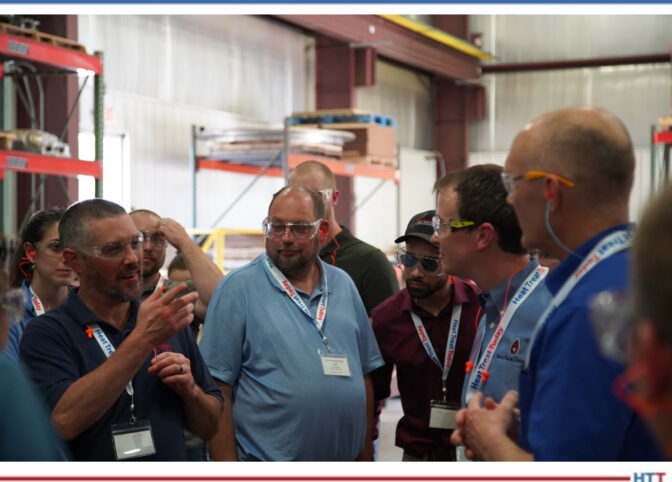
Penna Flame Industries in Zelienople, PA, hosted nearly 30 Heat Treat Boot Camp attendees. On the right, Andrew Orr of Penna Flame and Doug Glenn of Heat Treat Today listen to a question from Christopher Carson, Modern Industries, Inc. (Source: Heat Treat Today)

One of the most valuable parts of the event was the networking. It’s nice to know there are others in the industry who are also early in their careers and need to learn heat treat basics. The mix of attendees was quite diverse, including in-house heat treaters, commercial heat treaters, and industry suppliers.

Two Excursions

Following an evening adventure on the Duquesne Incline, attendees gathered
at the DoubleTree in Downtown Pittsburgh for some classic “yinzer” dining and
fellowship. (Source: Heat Treat Today)

At the end of the first full day of classes, the entire group loaded a school bus (yes, a yellow school bus) and took a brief drive to the famous Duquesne Incline which goes to a fantastic view of downtown Pittsburgh.

The final day ended with another school bus trip to a local commercial heat treat plant where attendees saw heat treat equipment in operation. Penna Flame Industries in Zelienople, PA, hosted nearly 30 of us. Andrew and Michael Orr, third-generation family owners, did an excellent job showing the group around their flame and induction hardening heat treat operation.

Food

There were also plenty of good opportunities for networking during the six food functions — and the food was fantastic. There is nothing better than chatting over food. This year’s group excelled at mealtime fellowship!

Most Importantly

Deidra Minerd, owner of Euclid Heat Treating, summed up the most important benefit of sending someone to Heat Treat Boot Camp:

“Thank you for taking good care of one of our new employees . . . at the Heat Treat Boot Camp. He said he really enjoyed it and learned a lot. As soon as he returned, he said he’d like to take part in more training. It’s encouraging that his time at Heat Treat Boot Camp inspired him to pursue more knowledge to further his career.”

Hopefully, we’ll see you or someone from your company next year. Dates for Heat Treat Boot Camp 2024 will be announced before the end of this year. Stay tuned.


Find heat treating products and services when you search on Heat Treat Buyers Guide.com


Letter from the Publisher: The Success of Heat Treat Boot Camp Read More »

Letter from the Publisher: In Praise of Industrial Heating

Heat Treat Today publishes eight print magazines a year, and included in each is a letter from the publisher, Doug Glenn. This letter first appeared in September's 2023 People of Heat Treat print edition.

 Feel free to contact Doug at doug@heattreattoday.com if you have a question or comment. 


Doug Glenn
Publisher
Heat Treat Today

BNP Media, once the largest privately- owned industrial publishing company in the U.S., announced recently they are closing down the legendary heat treat industry magazine, Industrial Heating, effective August 31, 2023.

Some might think this news would be a source of joy in the Heat Treat Today camp, since it is the elimination of a competitive publication. But I can tell you that it is crushing news — crushing for me, personally, having spent 20 tremendous years as the publisher of Industrial Heating from 1994 to 2013, and crushing for the North American thermal processing industry, because a nearly 100-year old iconic magazine no longer exists.

Contact us with your Reader Feedback!

Someone needs to sing the praises and acknowledge the greatness of what was Industrial Heating, so here we go.

In 1924, in the heart of steel city Pittsburgh, Pennsylvania, a gentleman by the name of Stanley Wishoski started Fuels and Furnaces to meet the information needs of the budding steel industry. Fuels and Furnaces was published under that name for seven years and was then rebranded as Industrial Heating in 1931. The publication stayed in the Wishoski family for 64 years, being run much of the time under the direction of Chuck McClelland, son-in-law of Stan Wishoski. Some of you old timers might remember Chuck McClelland or Industrial Heating’s long time editor Stan Lasday. In August of 1988, Business News Publishing Company (now BNP Media) purchased the magazine from Chuck McClelland.

Industrial Heating people shown in this circa 2005 photo are (left to right): Becky McClelland, Mike Holmes, Beth McClelland, Kathy Pisano, Doug Glenn, Reed Miller, Susan Heinauer, and Brent Miller.

In 1988, Industrial Heating was the number two magazine in the industry behind a publication called Heat Treating, which was at one time owned by Chilton Publishing Company, a company that was, I believe, part of ABC (American Broadcasting Co.). Dave Lurie of Business News Publishing Company saw to it that Industrial Heating grew into the number one spot in the industry in short order. By the mid-1990s, Industrial Heating was the leader.

All through the 1990s and well into the 2010s, Industrial Heating was the kingpin of the North American heat treat industry. During this span, Industrial Heating started Industrial Heating Brazil, Industrial Heating China, and even Industrial Heating India. FORGE magazine, which also closed this August, was founded during this time.

Furnaces North America (FNA) was started by Industrial Heating in 1995. The Metal Treating Institute helped by providing the technical content for the event. Industrial Heating owned and produced FNA ’95 (Cleveland, OH), FNA ’96 (Dearborn, MI), and FNA ’98 (Las Vegas, NV). Then, we sold it to the Metal Treating Institute for $1.00 and an (undisclosed!) percentage of revenue for the next seven events.

For two to three years, Industrial Heating even cooperated with ASM International to publish what is today known as HTPro eNews. The magazine also made the transition from an all-print publishing world to a digital and print publishing world — at least initially. No small feat.

Industrial Heating people shown in this circa 2005 photo are (left to right): Steve Roth, Bill Mayer, Kathy Pisano, Reed Miller, Doug Glenn, Larry Pullman, Mary Glenn (wife of Doug Glenn, not an Industrial Heating employee)

One of the magazine’s most successful products was its annual Buyers Guide, which (just to give you a sense of how successful) often brought in more than $500,000 in ONE MONTH. Annual revenues were in the millions, and profit margins were impressively high. The magazine was enormously successful.

What made Industrial Heating so successful was the people working there. During its heyday, the real “secret” behind the success was people like Jim Henderson, owner and president of Business News Publishing at the time; Dave Lurie, one of the best bosses I’ve ever had and a natural born leader; Kathy Pisano, see my Publisher’s Page about Kathy in Heat Treat Today’s August 2022 Automotive edition; Reed Miller, one of the best and longest-tenured editors the magazine ever had; Bill Mayer, a hard-charging, talented editor; Becky McClelland and Beth McClelland, both granddaughters of Stan Wishoski and daughters of Chuck McClelland; Brent Miller, who had no relation to Reed Miller, but was an outstanding graphic artist; Ed Shaud, father of the actor Grant Shaud from Murphy Brown fame; and Ed Kubel, of ASM fame. Mike Holmes, Kristine Haben, Dick Schiffman, Larry Pullman, Steve Roth, Susan Heinauer, Patrick Connolly, Keith Patrick, and the dozens of administrative and support staff at BNP Media headquarters in Troy, Michigan were also part of this outstanding team. It was this group and their unwavering focus on innovation and on what was best for the customer that made Industrial Heating a powerhouse . . . revenues and profits followed.

Industrial Heating cover from February 1945, a testament to the power of the written word in society.

In fact, at its peak, Industrial Heating was one of the three largest revenue producers at BNP Media. When I left Industrial Heating at the end of September 2013, it was indisputably the 800-pound gorilla in the North American heat treat industry. Ten years later, it is closing down. Theories about Industrial Heating’s closing are many. Whatever the reason, it is more important to recognize the publication for its dominant place in the North American heat treat market and for its nearly 100 years of existence. Thank you, Industrial Heating and the people who worked there, for the decades of excellent content curation. You truly are “The International Journal of Thermal Processing.” The industry is worse off today than yesterday. It is a sad day.


Find heat treating products and services when you search on Heat Treat Buyers Guide.com


Letter from the Publisher: In Praise of Industrial Heating Read More »

Letter from the Publisher: Heat Treat Green Is Coming

Heat Treat Today publishes eight print magazines a year and included in each is a letter from the publisher, Doug Glenn. This letter first appeared in Heat Treat Today's March 2023 Aerospace Heat Treating print edition.


Doug Glenn
Publisher and Founder
Heat Treat Today

Depending on where you live, “green” started to appear outside in March.

Contact us with your Reader Feedback!

Such was the case this March with Heat Treat Today. Our efforts were “greening up” around here as well. With the push for sustainability and environmental corporate responsibility, we decided to start the industry’s first and only “green” heat treat annual magazine edition and quarterly e newsletter. The Heat Treat Today team has been working on these items for several months now, but we are officially announcing them this month and encouraging you to watch for them both in May.

Whether you’ve been mandated to make your in-house heat treat operation more sustainable, or you want to do it simply because it’s the right thing to do, we’re here to help.

NEW Green Technologies in Heat Treat Annual Print Edition

Heat Treat Today's May print magazine will be the inaugural yearly focus on Green Technologies in North American heat treat. We’ll have articles and special editorial sections focused on sustainable technologies currently or soon-to-be available in the North American heat treat industry. This highly-focused issue will give industry suppliers a chance to shout loud and far about the technologies they have that will help you make your in-house heat treat operation more sustainable and productive. We anticipate topics such as:

  • Induction heating equipment
  • Electrical furnaces and ovens, including vacuum furnaces
  • High-efficiency gas-fired equipment
  • High-efficiency burners
  • Efficiency-maximizing control systems
  • Energy-saving insulating materials
  • Emission control or capture
  • Eco-friendly quench media
  •  Economizing cooling systems
  • Industrial gas economizing systems
  • High-efficiency radiant tubes
  • High-efficiency heating elements

Potentially, there will be many other topics added to this list. There should be something for everyone who is interested in making their in-house heat treat operations, or commercial heat treat shop, more sustainable. I hope you look forward to receiving your copy and enjoying the content . . . in May!

NEW Quarterly Heat Treat Green E-Newsletter

Sustainable technologies come into the market more than once a year, so, Heat Treat Today is launching a new quarterly e-newsletter this May that focuses on sustainable heat treat technologies for the North American marketplace. This e-newsletter, aptly named Heat Treat Green, will also focus on emerging and currently available sustainable technologies and products that will help your heat treat operations reduce environmental waste in a responsible manner. We anticipate that this e-newsletter will be deployed in the months of February, May, August, and November each year.

Do You Have a Green Story To Tell?

In both the annual magazine edition and the quarterly e-newsletter, we’d be interested in publishing your in-house heat treat sustainability story if you have one to tell. Our readers benefit from hearing what other manufacturers are doing to make their heat treat operations more sustainable. Many chief compliance officers or others in your organization responsible for promoting sustainable practices are typically quite interested in telling their sustainability stories. If that’s you or your company, we’d like to help you get the word out to the North American heat treat industry. Please contact our editors at editor@heattreattoday.com, and we’ll be sure to be in touch

Finally, if you’re a supplier to the North American heat treat industry and your product has a sustainability story to tell, you also should contact our editors: editor@heattreattoday.com.

Keep your eyes peeled for Heat Treat Green!


Find heat treating products and services when you search on Heat Treat Buyers Guide.com


Letter from the Publisher: Heat Treat Green Is Coming Read More »

Letter from the Publisher: ± 0.1°F – The Debate

Heat Treat Today publishes eight print magazines a year and included in each is a letter from the publisher, Doug Glenn. This letter first appeared in Heat Treat Today's February 2023 Air & Atmosphere Furnace Systems  print edition.


Doug Glenn
Publisher and Founder
Heat Treat Today

When dealing with temperatures in excess of 1000°F, one would think that a ±0.1°F variation would not be a big deal. Apparently, not!

Contact us with your Reader Feedback!

As of the most recent AMS2750 standard, 1/10th of a degree Fahrenheit matters — and if your process recorders are not recording temperatures down to 1/10th of a degree, you are out of compliance.

This is a big deal and a real hardship for many in the Heat Treat Today audience.

At the most recent Nadcap meeting held in Pittsburgh this last October, I had the chance to discuss this most recent stringent requirement with some of the people who were responsible for putting it in the standard. Even after talking to them, I’m not sure I fully understand why it is we went in this direction, and I’m not alone.

The Background

"the new AMS2750 standard requires accuracy to 1/10th of degree."
Source: Heat Treat Today

Here’s a very short explanation of how we got here. Both Revision D and E of AMS2750 required compliance temperatures to be ±2°F or ±1.1°C (“or ±0.2%” was added in Revision E). That pesky “.1” in ±1.1°C appears to be the source of this most current “situation.” The folks using °C were recording temperatures down to 1/10th of a degree, while the folks using °F — which was not a small number of people — were
not. So, the standards committee needed to make a decision on what to do about this discrepancy. The options were to round up or down or to the nearest integer for both °F and °C people OR require EVERYONE to record their temperatures down to 1/10th of a degree. After surveying end-users, the committee decided that end-users wanted to be required to record the 1/10th of a degree rather than round it up or down to the nearest integer. Thus, the new AMS2750 standard requires accuracy to 1/10th of a degree.

Thoughts

  1. Even as I type it, it doesn’t make sense. Why would end-users want to record temperatures down to 1/10th of a degree? If you’re at 1750°F, a full 1°F amounts to only 0.05% of your total temperature. It is inconceivable that 1% makes that much of a difference in nearly 100% of all standard heat treat processes. In those very few processes where temperature tolerances ARE required to be that tight, SAE’s AMEC committee could have come up with a separate standard.
  2. Most temperature recorders and reporting devices don’t currently allow for the display of anything to the right of the decimal, especially above temperatures at or above 1000°F. That’s because no instrumentation company in the history of heat treating ever anticipated that end-users would want to know, much less be required to record, anything to the right of the decimal.
  3. Even if recorders and other instruments were capable of displaying 1/10th of a degree readings, most temperature sensing devices are  nowhere near that accurate. Special case T/Cs can do it in certain situations, but by and large, thermocouples are calibrated to ±2°F or higher. How much sense does it make to worry about recording 1/10th of a degree accuracy from a thermocouple (and wire) that is rated at ±2°F or ±5°F.
  4. Let’s pretend for a minute that our thermocouples could accurately and consistently record temperatures down to 1/10th of a degree. The question that really needs to be asked is: Just because we CAN do it, does that mean we SHOULD do it? As stated earlier, for that vast majority of heat treatment processes a full degree of temperature variance won’t typically make a difference.

As some of the people I’ve talked to about this situation have readily admitted, well-intended quality committees such SAE’s AMEC committee, who have inadvertently started this little kerfuffle, are not perfect. This would be a case in point. The men and women who make up the heat treat industry’s quality systems are excellent people: highly detailed and well-motivated. But, as all of us are, they are prone to over-do the things they’re good at. In this case, that’s deciding to take it down to 1/10th of a degree when rounding to the next closest integer probably would have done the trick.

Postscript: I’m open to your responses to this column, positive or negative. And, assuming there is no foul language or threats of physical violence (!), we would be glad to publish your comments. Please let us know what you think: htt@heattreattoday.com


Find heat treating products and services when you search on Heat Treat Buyers Guide.com


Letter from the Publisher: ± 0.1°F – The Debate Read More »