





READER FEEDBACK

Reader Feedback: On Heat Treating Firearms

Our Reader Feedback feature allows us to facilitate discussion between Heat Treat Today‘s content contributors and hard-working folks in the shop who have questions about an article.


This Reader Feedback exchange followed an inquiry to our publisher Doug Glenn about government regulation of heat treatment of firearms which we threw out to a few of our consultants and individuals who have knowledge and expertise in this field — and we added a few questions of our own. Our experts are Doug Shuler, lead auditor with Pyro Consulting LLC; John Quaglia, president of Bennett Heat Treating and Brazing; and Jamie Jones, president of Solar Atmospheres. If you have any questions about this or other topics you’ve seen covered on any Heat Treat Today platform, please submit them to editor@heattreattoday.com.


Do you know if any type of firearms license is required to heat treat firearm components?

Doug Shuler

Doug Shuler: It depends on which components are being heat treated.  Barrels, slides, etc. do not require a license, but if the receiver (the part with the serial number) is heat treated, a license is required and the heat treater is subject to ATF audits. . . . Basically, if serialized parts are heat treated it must be done under an FFL (Federal Firearms License) so the ATF can audit the whereabouts of any firearm at any time.

John Quaglia

John Quaglia:  To the best of my knowledge, based upon some pretty extensive experience heat treating firearm components for one of my customers, the only license I am aware of is an FFL which is required to heat treat serialized receivers. If the components are military or ITAR controlled, you must be registered with the DDTC and have ITAR certification, [as well as] for domestic (commercial firearms) if you are heat treating serialized components of a firearm (the receiver). Barrels, slides, sights, magazines, springs, firing pins, etc., are all easily acquired and interchangeable between firearms and therefore require no special permitting.

Jamie Jones

Jamie Jones: The US Department of Justice authorizes the ATF to regulate those who are manufacturers, dealers, collectors, and importers of firearms and destructive devices. Part of that regulation requires a license (Federal Firearms License [FFL]) be applied for and held by those who are involved with any of the above. For a contract heat treat company, this essentially only pertains to serialized components. Under the “manufacturing” definition, the ATF considers any activity which results in the manufacture of firearms for sale or distribution (including installing parts in or on firearm frames and receivers, and processes that primarily enhance a firearm’s durability), constitutes firearms manufacturing, and requires a manufacturer’s license.  The FFL does not include components related to fully automatic firearms or suppressors.  In order to possess and process those serialized items, the ATF requires a manufacturer’s FFL plus a special occupational tax stamp (SOT).  Prior to issuance of the FFL, the ATF will conduct an on-site audit of the operation and person(s) applying for the license/stamp.  The FFL needs to be renewed every three years.

What is the most challenging part of heat treating gun parts?

Spring Loaded Firing Pin thetruthaboutguns.com

JQ: Managing distortion is probably the most challenging as most components are very close to being finished machined. Special racking and methodizing is often required. Marquenching, ausquenching, and vacuum processing are often employed to minimize or eliminate the possibility of distortion. Also, due to the small size and complex geometry present, inspection of the parts is difficult. It is important to clarify the testing location with the manufacturer prior to punching hardness holes into areas of the parts that may be exposed after assembly. After all, manufacturers want their guns to look nice afterward. We have experienced delayed rusting on barrels due to the combination of steel wire and the 4150 barrel reacting to cause anodic corrosion after processing in a salt bath which would only expose itself after a few days. We would ship parts that were perfect, and two days later I would be on the phone with my customer trying to explain a mysterious rust line through the rifling in the barrel. We solved this with some tooling changes.

JJ: Frankly, it is no more challenging or different than heat treating any other parts for any other industry. Some parts are routine and some are challenging. Some materials are more challenging than others and some designs are more challenging than others.

Which parts are the most difficult and why?
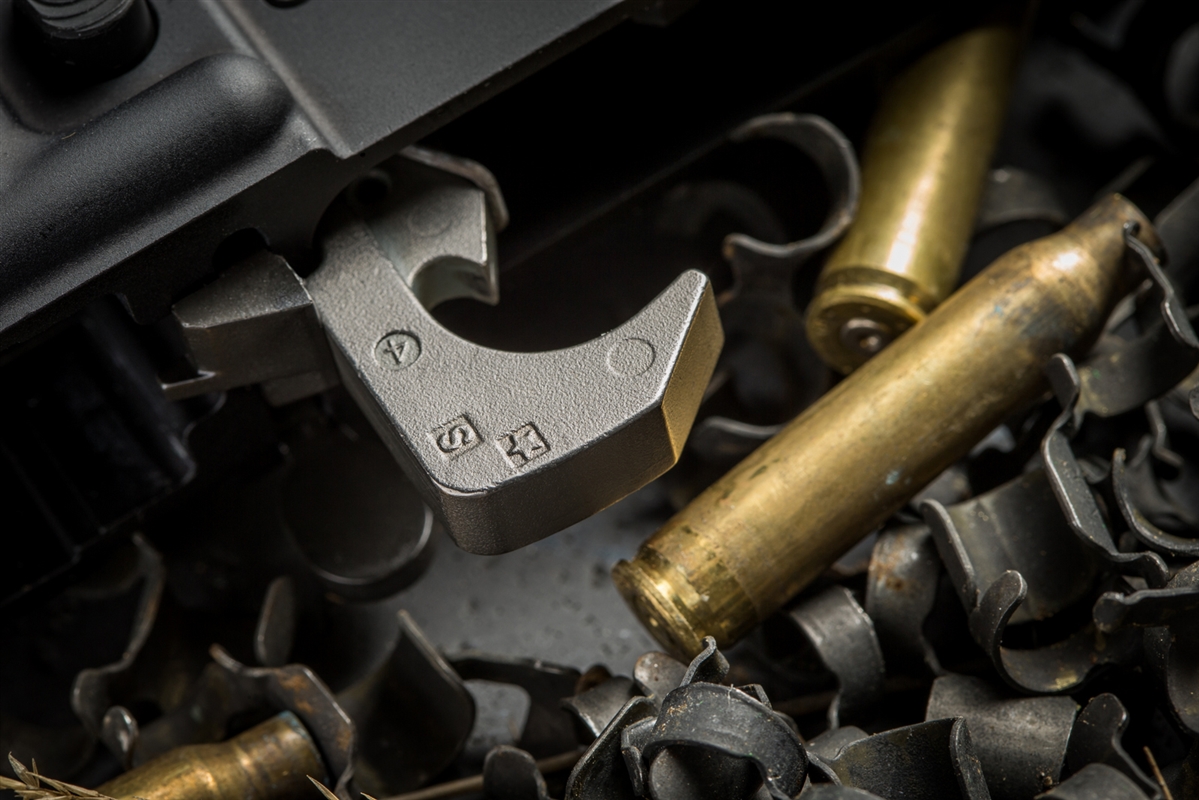
BCM PNT™ Trigger Assembly Bravo Company USA

JQ: They all present challenges. Slides and barrels present challenges due to the non-symmetrical nature which require special setup procedures. These also tend to have lots of crevices and blind or small holes which trap quenchants, salts, cleaning materials which tend to lead to unhappy customers unless the parts are thoroughly cleaned. Magazines present challenges because they are thin steel stampings which tend to distort due to the quench and induced stressed relieving themselves during heating. I could write a book on the challenges we have faced with the processing of gun parts.

JJ: Parts that require carburizing which have been machined to a finished or near-finished state, with intricate designs, cut-outs, and varying cross sections are the most challenging; a perfect example of this is an AR bolt carrier.  This kind of challenge is why we developed our version of low-pressure vacuum carburizing, as we now don’t need to worry about severe quench distortion or carbon potential control. With traditional carburizing, the austenitizing temperature of the steel can change if too much carbon diffuses into the corners and edges.  This can lead to retained austenite and carbide formation.  Our process negates that phenomenon by using precisely controlled boost-diffuse controls instead of carbon potential.  Our process also leaves the parts bright, with no post carburizing blasting or cleaning operations required.

Is it the materials that make it difficult or is it the configuration of the part?

JQ: The materials tend to be common that most heat treaters have worked with before so from a metallurgical standpoint I would say that the materials are not the problem. The configuration of the parts is definitely worse. Non-symmetrical parts tend to distort more than symmetrical parts. It also makes it difficult to inspect the parts. Test in the wrong area and you have spring-back or rocking. As I mentioned earlier, if you test in the wrong area the customer cannot sell the part. Some gun manufacturers have test methods that are unconventional, testing a shallow case depth using an HRC scale, so that the hardness reading is a combination of the case hardness, case depth, and core hardness.

JJ: It seems like you are assuming it is difficult all of the time! Please see my answer to question 2 above.

Are there any other special processes or regulations that need to be followed when heat treating gun parts? If so, what are they?

JJ: This answer is not to be taken as legal advice. If you want to apply for an FFL, or you get an FFL, you need to know the regulation. It is serious business: if you don’t follow regulation, you could end up in prison. You need to keep detailed records of EVERY serialized component that you receive, process, and ship. You don’t want to be on the tail end of a missing part or parts, especially if you don’t know about it. If something goes missing you need to report it immediately. Of course, reporting it could mean losing your license. So my advice to anyone considering this is: BE GOOD AT TRACEABILITY and RECORD KEEPING!


We welcome your inquiries to and feedback on Heat Treat Today articles. Submit your questions/comments to editor@heattreattoday.com.

Reader Feedback: On Heat Treating Firearms Read More »

Reader Feedback: On Ceramic Coatings

Here is what readers are saying about recent posts on Heat Treat Today. As is our policy, we allowed the original author to preview and respond to this reader feedback. See Greg Odenthal’s response at the bottom of this post.

Submit your reader feedback comments to editor@heattreattoday.com.


William (Bill) Jones of Solar Atmospheres Inc. on the Heat Treat Radio podcast interview with Greg Odenthal of ITC Coatings. Click here for the podcast (transcript here):

William R. Jones, FASM, Solar Atmospheres Inc.

Re: Heat Treat Radio: ITC Coatings

This would be a poor selection for a vacuum furnace as it is well known that ceramic coatings and the like are hydroscopic and will absorb water from the atmosphere when opening the furnace to air for work unloading and reloading, with adverse effects on following vacuum pump down, i.e., to pump out the absorbed water vapor.

With respect to ceramic lined refractory insulated atmospheric furnaces: I can respect the coating for sealing an older furnace lining for porosity and lining leaks to the outer furnace wall and for improving re-radiation to the work load with well-known surface emissivity improvement. This is not an easy coating to apply and will require maintenance “man-hours”. So one has to balance the coating time and coating cost compared to furnace out of production cost. Furnaces are like airplanes, when sitting on the ground for any purpose, they lose money.

Now, when looking at furnace hot zone efficiency, one has to review power losses both before and after changes such as coatings. With an electric furnace a totalizing wattmeter or with a gas totalizing gas meter similar to our utility company meters. Such data needs to be presented for both furnace before and after coatings on an exact furnace and production cycle.

William R. Jones, FASM

Solar Atmospheres Inc.


We offered Greg Odenthal of ITC Coatings the opportunity to respond:

Greg Odenthal, Director of Engineering & Technical Operations, ITC| International Technical Ceramics, LLC

Mr. Jones,

I cannot agree or disagree with you regarding your opinion that ITC Coatings are a poor selection for vacuum furnaces as we have never tested in nor targeted this industry. It is true that ceramic coatings are hydroscopic; however, I’m not sure just how much water/moisture a layer of ceramic coating only 1 to 2 mils thick will absorb. With that being said, any moisture absorbed would wick away in a very short period of time. Whether or not they are good for the vacuum heat treating industry is still up for discussion.

As for your comment regarding that this is not an easy coating to apply, I must tell you that you are wrong. I have been onsite on just about every installation that we have done and our crew size can be very small. For an average size heat treat or forge furnace — for example, 32’ L x 16’ H x 15’ W with a new ceramic fiber lining — a crew of two men can and have coated the entire square foot surface area in an eight (8) hour shift. The cost of the coatings and labor to install is pennies on the dollar compared to the cost of regularly scheduled downturns every 3 to 4 months to pack joints and cracks with new fiber, trying to prevent heat loss and increasing fuel consumption. We have current customers that have not done any refractory maintenance in four to five years and now only have one outage per year for their yearly furnace inspection. Once installed, the ITC Coatings increase a furnace’s efficiency by reducing refractory maintenance, reducing fuel consumption, improving temperature uniformity, improving product quality, improving turnaround times, along with a host of additional benefits, thus preventing the furnace from costing the customer money, unlike your grounded airplane analogy.

In regard to hot zone efficiency and gas/power reduction, we have been working with the gas supply companies in Canada who are currently monitoring our customers’ fuel usage and see the reductions. They are now beginning to give current and potential customers money for this type of upgrade, upwards of 50% of the cost to install ITC Coatings. We do not just sell ceramic coatings, we provide the customer with a complete engineered solution along with a total Btu savings analysis for each furnace we quote. Each Btu savings analysis is unique to that furnace and based on operational data supplied by the customer. We have also provided before and after thermal imaging of the furnace as proof that the heat transfer/loss through the refractory and to the shell is less, so you do not necessarily need totalizing meters to prove energy savings.

If you would like to learn more about ITC Coatings and our technology, I encourage you to contact me and discuss this topic in greater detail.

Regards,

Greg Odenthal

Director of Engineering & Technical Operations

ITC| International Technical Ceramics, LLC


We welcome your inquiries to and feedback on Heat Treat Today articles. Submit your questions/comments to editor@heattreattoday.com.

Reader Feedback: On Ceramic Coatings Read More »

Reader Feedback: On TUSs and SATs

Here is what readers are saying about recent posts on Heat Treat Today. Submit your comments to editor@heattreattoday.com.


On Jason Schulze’s article, “AMS2750E: The Importance of Temperature Uniformity” (click here to see original article):

READER QUESTION (from a heat treat supplier across multiple industries):  My vacuum furnace uses a type S thermocouple, and there is no access to perform the SAT. Is there an alternative? (We supply to aerospace and must be in accordance with 2750E.)

Jason Schulze (Conrad Kacsik) for HTT:Jason Schulze, Aerospace Heat Treating
If you do not have access to the hot-junction (measuring tip) of the control thermocouple, an option would be to purchase a dual-element thermocouple.
If you are not familiar with dual-element thermocouples, they have two thermocouples in one small Inconel sheath. You can purchase a Type N and a Type S in a single sheath. The type N can be used as a resident SAT thermocouple. This will give you access to the connection-end of both the control thermocouple and a resident SAT sensor that is in the same sheath.
The only set-back in this situation would be the re-calibration or replacement of the dual element thermocouple every 3 months (per AMS2750E – Resident SAT sensors).

READER QUESTION: [I] just have two questions, one in regards to SAT and one in regards to TUS.

[Question 1] When SAT testing a lead sensor, let’s just say for the purpose of this example this lead sensor is a type “k” base metal thermocouple, is it acceptable to test this sensor against an SAT sensor which is also type “k”? I see that for resident SAT, the sensor should be of a different type, but for non-resident SAT, is this acceptable?

[Question 2] My other question is in regards to TUS, specifically para 3.5.18 of AMS2750E. I see that in this paragraph two options are addressed. I have a decent understanding of the first requirement, the second option is where I’m getting a bit confused which states ” . . . or if the difference between the measured temperature at the current recording locations and the actual respective hottest and coldest measured areas is less than the SAT tolerance for the applicable furnace class.” How does one calculate this difference?

Jason Schulze for HTT:

[To question 1] As long as the SAT thermocouple is not a resident SAT thermocouple, you are permitted to use the same type (i.e., K, J, T, etc.) as the thermocouple being tested.

[To question 2] I’ll use an example to work the next question. We will assume the furnace is a Class 2 (±3°F SAT difference). Let’s say a previous TUS had a hot location at #5 and it was +6°F. On a new TUS,  the location changed to #9 and is now +2°F. The difference between the previous location and the current one is 4°F. This 4°F difference is more than the applicable SAT tolerance of ±3°F, therefore, the location would need to be moved from #5 to #6.

READER REPLY:  In regards to the TUS requirement, I’m assuming the actual M.P. Reading(s) from the current hottest and coldest locations don’t get compared to the respective hottest and coldest locations on the TUS report? For example, I have a furnace that’s classified as class 1 (±5) surveyed at 385°F. The TUS report is stating that the lowest T/C location was 382°F T/C 8. I have now exceeded half the maximum temperature uniformity tolerance (2.5°F), therefore I must relocate unless the difference between the “current recording location” and the actual respective coldest location per the TUS is less the SAT tolerance. I was under the impression that as long as the cold location per the report T/C 8 382°F, when compared to the furnace low multipoint reading during the survey – being less than 2°F, it would not require relocation as my “current recording location” when compared to the actual respective cold location is less than the SAT tolerance. My understanding now is that the process control sensors are not used for this difference calculation but rather the TUS sensor representing the low location? I believe that the “current recording location” statement is where I’m getting thrown off a bit.

Jason Schulze:

You are correct in stating that the comparison is made between the previous and current hot or cold (respectively) locations and not the control thermocouple. AMS2750E is not that easy to follow in some instances so any confusion is understandable.


READER QUESTION (from a metals castings provider for aerospace and defense):  For 1020°F SAT, if test instrument/thermocouple reads 1015°F and temperature controller reads 1020°F, it is acceptable to program -5°F bias/offset in controller so temp controller reads 1015°F, matching test instrument/thermocouple, correct?

Jason Schulze for HTT:

You are able to utilize offsets to the limits of AMS2750E table 6 or 7 to correct both TUSs and SATs. Instrument calibration is a bit different. AMS2750E does not invoke limitations regarding an offset due to instrument calibration.

Your comment regarding the application of a -5°F offset to correct the SAT would, in fact, be permitted according to AMS2750E. One thing that would be required is, if the SAT failed and that is why the offset is needed, there would need to be an internal corrective action and product impact investigation.


We welcome your inquiries to and feedback on Heat Treat Today articles. Submit your questions/comments to editor@heattreattoday.com.

Reader Feedback: On TUSs and SATs Read More »

Reader Feedback: On TUS

Here is what readers are saying about recent posts on Heat Treat Today. Submit your comments to editor@heattreattoday.com.


Jason Schulze, Aerospace Heat Treating
Jason Schulze, contributing editor to Heat Treat Today, author of "AMS2750E: The Importance of Temperature Uniformity"

Joe Powell, President, Intensive Quench Technologies, on Jason Schulze's article, "AMS2750E: The Importance of Temperature Uniformity" (click here to see original article):

Interesting to me how big a deal specs make on temperature uniformity in the hot zones, and how little attention is paid to quantifying the uniformity of the quench cooling process!  But we all know predictable distortion and uniformity of mechanical properties can only happen when the quench cooling is uniform!


Bill Jones, CEO Solar Atmosphere, on Jason Schulze's article, "AMS2750E: The Importance of Temperature Uniformity" (click here to see original article):

Let us assume a standard box furnace air atmosphere operating at 1650f with a plus-minus 25f delta T. What first areas would you recommend to look for improvement.

Jason Schulze (Conrad Kacsik) for HTT:

When I had issues achieving uniformity, I typically focus on the position of the control thermocouple 1st, then work my way to other items.

From the article "Jason Schulze on AMS2750E: The Importance of Temperature Uniformity"

Bill Jones:

AMS 2750, etc, is fine for setting specification and procedure. In some cases unreasonable and meaningless in operation, for example, a 1-degree overshoot on ramp rate by a control TC can result in a major NADCAP finding even though work TC's are well below set point. Okay, so we do a TUS and it fails, so now you have to locate and solve the furnace problem or very possibly mis-survey TC placement. Now, I don't recommend changing control TC placement away from factory location or position at all. The OEM is supposed to run a full TUS survey prior to shipment in his plant. In other words, go back to those locations before introducing new problems. Now, a furnace may be 5 or 10 years in service with many HZ "aging" problems. These issues must be located and addressed. Another major fault is TC survey plugs, jacks, and deteriorated wiring all leading to measurement error and survey failure. This entire TUS subject is an art with many pitfalls with not too many really experienced technicians.

Jason Schulze for HTT:

I do agree that there are aspects of some requirements that do not actually affect production processing. Since my experience is metallurgical, that is where my examples would reside.


We welcome your inquiries to and feedback on Heat Treat Today articles. Submit your questions/comments to editor@heattreattoday.com.

Reader Feedback: On TUS Read More »

Skip to content