

In aerospace heat treatment, few specifications carry as much weight — or as much apprehension — as AMS2750. This Technical Tuesday installment, adapted from a recent Heat Treat Radio conversation with ATP President Andrew Bassett and podcast producer/host Heather Falcone, offers insight into the evolution of AMS2750 and practical strategies for managing pyrometry compliance.
This informative piece was first released in Heat Treat Today’s August 2026 Annual Automotive Heat Treating print edition.
The Evolution of AMS2750
For many heat treat operations, AMS2750 represents the backbone of pyrometry compliance, yet it also presents a complex web of requirements that must coexist with broader quality management systems, client specifications, and audit expectations. Despite decades of revisions and clarifications, pyrometry continues to generate a disproportionate share of audit findings.
According to Andrew Bassett, president of Aerospace Testing and Pyrometry (ATP) and a long-time member of the teams responsible for writing the specification, the challenge is not simply the complexity of the standard; it’s how organizations manage it day to day.
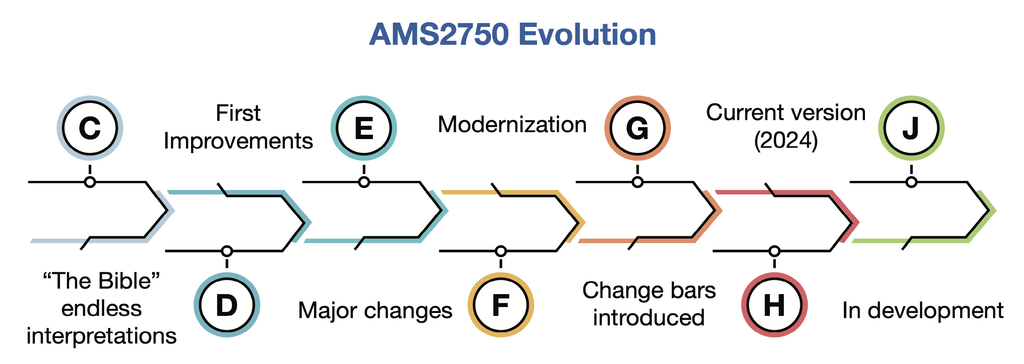
When Andrew first entered the industry, AMS2750 was at Revision C, a version many longtime heat treaters remember well. “Those who’ve been around long enough know that this revision of the spec was like the Bible,” Andrew says. “You gave it to a hundred different people, and you got a hundred different interpretations.”
Ambiguity in early versions of the specification created inconsistent interpretations across the industry. Over time, successive revisions, particularly the transitions through Revisions D and E, introduced significant changes aimed at improving clarity and consistency. The current Revision H reflects years of refinement.
Even so, Andrew believes the industry can continue improving how the specification communicates its intent. “My goal personally is to make sure that document is clear and understandable,” he explains. “Even if it’s 300 pages and we use stick figures and crayons to explain what the intent is — I’m okay with that.”
While aerospace heat treating specifications are generally clear about their purpose, pyrometry has historically been viewed as more difficult to interpret. Andrew hopes continued revisions and education will eventually eliminate that perception.
To Aerospace and Beyond
Although AMS2750 originated as an aerospace specification, its influence has expanded. According to Andrew, the standard is now widely used internationally and has been adopted by industries outside of aerospace manufacturing. In particular, the U.S. Food and Drug Administration has begun requiring compliance with AMS2750 for certain medical manufacturing processes. This means companies producing items such as dental drill bits or orthopedic implants must follow the same pyrometry standards used in aerospace heat treatment.

The expansion highlights the importance of understanding the intent of the specification, not just the literal wording of its requirements, for accurate interpretation at specific heat treat operations. For many organizations, achieving that understanding requires training and careful study.
Andrew notes that explaining the specification in practical terms has become increasingly important. When Andrew originally began providing training on AMS2750 at ATP, it was a 6- to 8-hour day class, providing a 30,000-foot view of the standard. Now, this has evolved into an easier to digest training program extended over two days at a “crop-dusting training level” that is designed to help suppliers interpret and apply the standard in real operating environments.
The Challenge of Managing Compliance
Understanding AMS2750 is one challenge; managing it alongside other requirements is another. Many heat treaters must balance pyrometry requirements with broader quality management frameworks such as ISO and Nadcap, as well as client-specific specifications from aerospace primes.
Andrew emphasizes that the first step in managing this complexity is gaining a clear understanding of what work is being performed and who the ultimate client is. For example, a commercial heat treater may receive a purchase order from one supplier, but the parts may ultimately be destined for a major aerospace manufacturer with its own pyrometry requirements. Without that insight, organizations can unknowingly miss critical compliance obligations. Once the applicable requirements are understood, companies must establish systems to manage them consistently, particularly when multiple specifications overlap or conflict.
In some cases, individual client specifications may differ from or extend beyond AMS2750 requirements, creating additional layers of oversight. For example, certain aerospace primes have their own pyrometry requirements that differ slightly from the standard. Managing those differences across multiple furnaces, calibration schedules, and testing procedures can quickly become a significant administrative challenge.
Documentation Drives Compliance
For many heat treaters, managing pyrometry compliance historically meant relying on manual systems: spreadsheets, paper logs, and physical binders containing calibration reports, temperature uniformity surveys (TUS), system accuracy tests (SAT), and thermocouple records.
Andrew remembers those early days well. “When we would get a new client, I would go buy a bunch of notebooks from Staples and put in their little dividers of a pyrometry program together,” he recalls. While the system worked, spreadsheet-based tracking introduced the possibility of human error, as it relied heavily on manual data entry and careful recordkeeping. But Andrew emphasizes, “When it comes to compliance audits, human errors cannot happen.”
Why Pyrometry Generates So Many NCRs
One of the most striking statistics in aerospace heat treatment audits is that 80% of nonconformance reports (NCRs) is tied to pyrometry. For someone involved in writing the specification, that statistic raises an important question: why?

Andrew believes part of the issue lies in how requirements are interpreted and implemented across different organizations. Even when the specification is clear, documentation gaps or process breakdowns can lead to findings.
A common example involves maintenance documentation. When a furnace undergoes preventive or unscheduled maintenance, the work must be recorded and reviewed to determine whether additional pyrometry testing is required. In some cases, maintenance may be completed and documented, but the required quality approval is never recorded.
These types of seemingly small documentation gaps can easily lead to NCRs during audits.
Moving Compliance from Paper to Platform
As documentation requirements have grown more complex, many aerospace heat treaters have found that the real challenge is not only collecting the data; it is organizing, reviewing, and presenting it in a way that satisfies auditors. Nadcap accreditation, AMS specifications, and client requirements all demand rigorous process monitoring and recordkeeping.
Recognizing these challenges, ATP developed Aerospace Compliance Software (ACS), a software platform designed to support aerospace compliance and documentation requirements tied to standards such as AMS2750 while also helping companies prepare for Nadcap audits and maintain the documentation expected by aerospace primes and OEMs.
“Now we have a system that’s 100% not just a pyrometry tool — it’s also a compliance tool,” says Andrew. “New features we keep adding into the system is with the focus on compliance, just not pyrometry-related tools.” This includes preventative maintenance leak rate testing checks and thermocouple replacement schedules. Andrew adds, “It’s also and most importantly a self-checking software to not only the industry specifications, but client internal specifications. It doesn’t have to be solely what AMS2750 says,” allowing users to verify compliance with various specifications.
By organizing documentation in a structured, traceable format, tools like ACS can help heat treaters more easily verify compliance with aerospace requirements and prepare for audits. As specifications continue to progress, many in the industry are turning to digital systems to simplify documentation while maintaining the level of process control that aerospace work demands.
The Value of Industry Participation
For Andrew, one of the most effective ways companies can improve their understanding of compliance requirements is by participating directly in the industry organizations that shape them. “This is something I preach constantly with our client base,” he says. “If you’re Nadcap accredited, firstly, go to a meeting.”
Misconceptions about who is involved in writing the standards often deter heat treat industry representatives. “I had this myth early on in my career that this golden group of aerospace gods were creating standards,” Andrew recalls. “When I showed up to the meeting, there were more suppliers there writing the standards than there were the primes.” That participation ensures the specification reflects real-world operations, and it gives companies a voice in the requirements they must ultimately follow.
Staying Ahead of the Standard

In aerospace heat treating, compliance is never static. AMS2750 will continue to evolve, though Andrew expects future revisions to focus primarily on clarification rather than sweeping changes. The current review efforts for Revision J is already underway. As with previous updates, the committee maintains a running list of questions and issues that arise after each release. These items are reviewed and incorporated into future revisions when appropriate.
Maintaining precise pyrometry practices and ensuring that information is recorded and readily available during audits is key to complying with AMS2750. Standards like AMS2750 remain central to ensuring thermal processes are controlled, repeatable, and fully traceable. For heat treaters operating in aerospace, success increasingly depends not only on achieving the correct metallurgical results, but also on demonstrating compliance through clear, well-managed process data.
The Benefit of Knowledge Sharing
After more than three decades working with pyrometry and industry standards, Andrew says the most rewarding part of his work remains helping others understand the requirements. “Anytime I meet somebody and we talk pyrometry, my business card comes out,” he says. “If there’s a question you have, I’m more than happy to answer it to the best of my abilities.”
For him, the goal is simple: ensuring that suppliers understand the specification well enough to succeed. This is more than just passing audits; it means building robust and reliable thermal processing systems. Because in the end, managing AMS2750 is not just about checking boxes. It’s about building the knowledge and systems that keep the entire heat treating process running accurately, consistently, and safely.
This article was written by Heat Treat Today’s Editorial Team.