In this Technical Tuesday installment, Heat Treat Today founder and publisher Doug Glenn sat down with Steelhead Technologies CEO Jeff Halonen to discuss the company’s recent acquisitions of Visual Shop and Bluestreak. Learn what the acquisitions mean for current users, including support and migration timelines, and how Steelhead plans to bring decades of heat treat-specific expertise into its ERP platform.
This informative piece, adapted from Heat Treat Radio #136: Steelhead Acquires Visual Shop and Bluestreak — What Heat Treaters Need to Know, was first released in Heat Treat Today‘s September 2026 People of Heat Treat print edition.
Steelhead Technologies recently acquired two software platforms familiar to the commercial heat treating industry: Visual Shop, a Cornerstone Systems product, and Bluestreak. The acquisitions bring roughly 240 Visual Shop and Bluestreak clients under the Steelhead umbrella and raise practical questions about support, costs, product development, and what comes next for users of both systems.
Heat Treat Today founder and publisher Doug Glenn spoke with Steelhead Technologies CEO Jeffrey Halonen about the acquisitions and what commercial heat treaters can expect in the coming years.
The Companies and Their Software
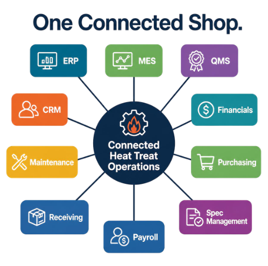
Steelhead Technologies provides an all-in-one AI-powered ERP platform designed for job shops and manufacturing operations, connecting production management with quality, specification compliance and tracking, scheduling, accounting, CRM, reporting, and other business functions.
Halonen called Visual Shop one of the first commercially available systems built specifically for the heat treat market. Visual Shop has served process-oriented job shops for more than 30 years. Approximately 150 enterprises currently use Visual Shop, about half of which are commercial heat treaters. The ERP system was developed for metal finishing, heat treating, coatings, and related industries, with heat treat functionality including furnace-load tracking, specifications and certifications, process temperatures and times, order tracking, shipping, and invoicing.
Bluestreak has similarly deep roots in the industry. The QMS and MES platform was initially developed for heat treating and focuses on production workflow, integrated quality management, traceability, and compliance documentation. It has approximately 90 clients, about 60% of which are commercial heat treaters. “Bluestreak is a QMS and MES,” Halonen said. “They’re more specialized on the heat treating.”
The Acquisition Timeline
Although Steelhead acquired Visual Shop and Bluestreak within weeks of each other, Halonen said the deals developed separately, with different circumstances behind them and their timing largely coincidental. With Visual Shop, Halonen said the age and architecture of the software meant significant development would eventually require rebuilding the product. “It was just at a juncture where there’s either a tremendous amount of investment — many, many millions of dollars — to start from scratch, essentially, on a brand new product, or we could provide a structured transition over to a more modern system where there’s a definitive path,” he said.
Bluestreak, by comparison, was growing and had strong client retention. Retirement considerations for Bluestreak president and founder Todd Wenzel also played a role. Bluestreak also brings years of heat treat-specific software development, particularly around specifications, certifications, furnace compliance, and other quality requirements. “Bluestreak is on its fourth generation,” Halonen commented. “It’s been working with heat treaters for many, many years.”
Halonen acknowledged that the experience of these two software leaders in the space is important as Steelhead expands its presence in the heat treat industry. “Especially with commercial heat treating, there’s a tremendous amount of nuance,” he said. “We need to approach this with humility.”
Next Steps for Visual Shop and Bluestreak Clients
For existing clients, neither system is disappearing immediately. Visual Shop and Bluestreak are now under the Steelhead umbrella, but their existing support teams remain in place. “For Visual Shop, right now nothing changes,” Halonen said. “You have the same product, call the same exact team.”
The longer-term picture is different. Steelhead is targeting the end of 2027 for sunsetting support for Visual Shop. Many Visual Shop users have perpetual licenses, and Halonen emphasized that retiring support does not mean those users will suddenly lose access to the software. The primary change will involve continued support.
Bluestreak has a longer runway, with its timeline extending into 2028. Its existing support team also remains in place. At the same time, Steelhead intends to bring heat treat-specific functionality developed within Bluestreak into its own platform. “We’re working very closely as a single team to provide all the features that Bluestreak has developed over the years that are great for heat treaters and pulling those into Steelhead,” Halonen said.
One point is clear for users of both products: future software development will be focused on Steelhead’s technology. “All proactive R&D investment in technology is going into the Steelhead platform,” Halonen said.
Cost Considerations
For Visual Shop users considering a transition to Steelhead, price will be an important part of the decision. Halonen acknowledged that Steelhead carries a substantially higher software price.
Steelhead argues that shops should compare total operating costs rather than software prices alone, including separate accounting or business software and employee time associated with order entry, invoicing, and other administrative processes. “What we’ve found, though, is that if you look at the cost of operating your business on Visual Shop — not just the dollars you pay for Visual Shop — you actually see a cost reduction for Steelhead,” Halonen said. Whether that calculation holds true will depend on the individual operation. Heat treaters will need to weigh software costs against staffing, current processes, ancillary systems, desired functionality, and implementation requirements.
For Bluestreak users, Halonen said the pricing gap between their current system and Steelhead is smaller, although a difference remains.
Migration and Support
The acquisitions could simplify one challenge for clients who choose to migrate to Steelhead: transferring existing data. Steelhead now has access to the source code and database structures of the acquired platforms, as well as the employees familiar with them. “The data you have in Visual Shop and the data you have in Bluestreak can be mapped over in a much more efficient, and much more granular, manner than otherwise would be,” Halonen said.
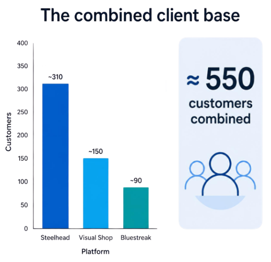
The Visual Shop and Bluestreak teams — approximately eight and nine people, respectively — remain in place to support existing products and assist with integrations or migrations. Together with Steelhead’s roughly 310 existing clients, the acquisitions bring the company’s total client base to approximately 550.
Halonen said Steelhead also intends to control the pace of implementations rather than taking on migrations faster than its teams can support them. “If we’re in a position where we’re not 100% confident that it’s going to be successful for our client, we’re going to use the calendar to our advantage and make sure we’re not overscheduling or overburdening,” he said.
Where Development Goes from Here
Steelhead’s long-term strategy is to combine heat treat-specific knowledge from the acquired companies with its broader ERP platform. For Halonen, that starts with the fundamentals heat treaters rely on every day. “How can I do furnace calibrations? How can I create this certification? What’s my operator’s experience going to be?” he said, describing the questions heat treaters bring to Steelhead. “They’re absolutely correct to focus on that.”
Steelhead also plans continued development of automation and AI tools, including its existing AI-assisted order entry and analytics. But Halonen said those capabilities depend on getting the underlying systems right first. “None of that works unless you have a rock solid foundation,” he said.
What Heat Treaters Should Know Going Forward
The acquisitions do not require Visual Shop or Bluestreak users to make an immediate software change, but they do establish a clearer direction for both platforms. Visual Shop is targeted for end of life at the end of 2027, while Bluestreak’s timeline extends into 2028. Existing support remains in place, while future R&D is being directed toward Steelhead.
For affected heat treaters, that creates a window to evaluate their options. Which heat treat-specific capabilities are essential? What other systems or manual processes operate alongside the current software? What data must be preserved? What will implementation require from employees? And what will each option cost when software and business processes are considered together?
Three platforms are now under one company, and the software landscape serving heat treaters has shifted. The next couple of years give shops time to determine what that shift should mean for their own operations.
This article was written by Heat Treat Today’s Editorial Team.