In this episode of Heat Treat Radio, host Doug Glenn sits down with Jeff Halonen, CEO and co-founder of Steelhead Technologies, to discuss the company’s recent acquisitions of Visual Shop and Bluestreak. Halonen explains what brought the deals together, what the acquisitions mean for current users, and how Steelhead Technologies plans to integrate the platforms and their heat treat-specific capabilities. The conversation also explores the company’s broader investment in technology, AI, and the future of software for commercial heat treaters.
Below, you can watch the video, listen to the podcast by clicking on the audio play button, or read an edited transcript.






The following transcript has been edited for your reading enjoyment.
Introduction (00:05)
Doug Glenn: Well, welcome everyone to another episode of Heat Treat Radio. I’m your host, Doug Glenn, the founder and publisher of Heat Treat Today.
Today I have the great privilege of speaking with Steelhead Technologies CEO, Jeffrey Halonen. We’re going to be talking with Jeff about his company’s recent acquisition of two competitors in the commercial heat treating sector of our market.
At Heat Treat Today, our primary market is not commercial heat treaters. It’s an important sector, but it’s about 15% of our total circulation. Most of the rest of it is in the captive market. But today, we’re going to be talking about this commercial market, and it should be a special interest to anyone in that commercial heat treating market, especially if you are a current user of Bluestreak or Visual Shop, or of course, a Steelhead Technologies product.
First, can you tell us about yourself and Steelhead Technologies?
Jeff Halonen: Thanks for having me, Doug. I appreciate the differentiation between captive and commercial heat treaters. For commercial heat treaters, their products can by anything that flies, goes into space, data centers, computers, etc. So, I think that commercial heat treaters find themselves in one of the most important seats in manufacturing because of the pace of iteration. If you think about it, if you’re doing brake rotors, and it’s the same brake rotor for 40 years, you’re going to bring that in-house. It makes sense to buy the oven.
But if you’re changing your designs every six months, which is what happens in aerospace and data centers, etc., then commercial is the clear path.
My name is Jeff Halonen. I’m a mechanical engineer. My career started at General Motors. I got into some heat treating, but it was super mild compared to what everyone gets into, as in body structures — there’s a lot of thermal management components to assembling a vehicle.
I’m one of the co-founders of Steelhead, and we are a technology partner for job shops. We serve primarily commercial heat treaters, but also metal finishers, platers, powder coaters, Nadcap, wet paint, thermal spray, and also some fabrication shops as well. Our customers may have as low as three people, but typically it’s 20 to 300 people, somewhere in that range where they’re big enough to have a lot of problems, and then they’re also a job shop. Parts are coming in, phone calls, high-volume, fast-paced. These aren’t $10,000 invoices, $20,000 invoices — they are smaller, a few hundred or thousand dollars, and there’s high volumes of them.
Everyone is dealing with the problems of labor turnover and other challenges. It’s a very nerve-wracking business. The revenue volatility is kind of extreme a lot of times, and your visibility and your control over that revenue volatility is not high. There’re ways you can diversify, but there’s challenges.
We have a core philosophy that job shops are actually ideally suited to leverage technology to the hilt to compensate for all of these challenges.
It’s almost like you’re in an environment where the facts change every hour, every day. This means that knowing what’s going on and making decisions quickly becomes even more important. It’s like the F-35 fighter jets that have those goggles with all the quick stats. Why? Because in a dog fight, the faster you make decisions and have data, the better off you are. Whereas if you’re canoeing across a lake, you don’t really need a lot of real-time KPIs.
We’re huge on technology, and we work with job shops all day long.
The Product (03:53)
Doug Glenn: Are you an ERP (enterprise resource planning) system or how would you classify your product?
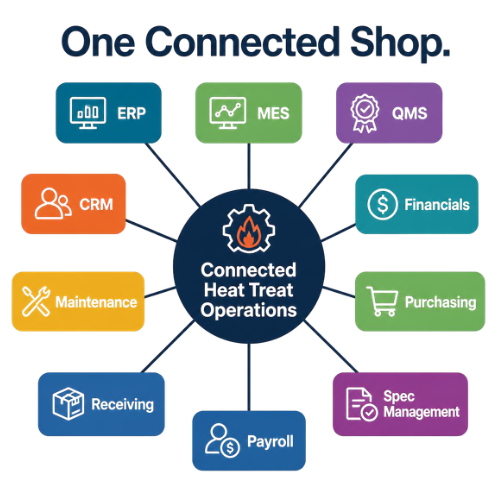
Jeff Halonen: We’re all in one, to the extent we can be. That includes ERP, financials, native accounting, MES (manufacturing execution system), spec management, QMS (quality management system), quality management, CRM (customer relations management), timesheet, payroll integration, maintenance, purchasing, receiving, etc.
We have found that smaller businesses do not like to jump into 20 different software programs because you’re shoveling data all over the place. Even something like purchasing — how is that related to maintenance? Well, you had to replace a motor, and then you had to purchase a motor, then you had to receive it, but it went to one of four buildings. You don’t know where it’s at. The magic is in the connectivity of everything, and then if adding AI on top of that, you’re a fully connected business.
The Acquisition Timeline (04:42)
Doug Glenn: So, enterprise-wide, top to bottom.
Now the big news is this acquisition that just recently took place, and that’s what we want to talk about today. First off, let’s just get some facts about the acquisition. When did it happen?
Jeff Halonen: Yeah, so there’s a separate story and arc and strategy of how it made sense for all parties with both of them. As far as timing, Bluestreak was a couple weeks ago, and then Visual Shop was three or four weeks before that.
The timing is relatively coincidental — it just happened. The conversations just so happened to move in parallel. Timing-wise, there’s no explicit link between the two acquisitions, other than the fact that they both picked up steam around the same time as each other.
Doug Glenn: That’s right. Can you describe the companies involved?
Jeff Halonen: Visual Shop is a Cornerstone Systems product out of Illinois. They’ve been around — they’re essentially the pioneers in heat treating and metal finishing, as far as having a commercially off-the-shelf product available with support and service for heat treaters.
And then Bluestreak out of Wisconsin, which is really similar in terms of focus, but Bluestreak’s a much more modern system, cloud-based offering. Both companies have a huge disposition towards high service, which is something we’re really happy to see as we kind of bring the companies together.
Our number one core value is customer obsession, and we understand that it’s not just software. If your business is completely static, you have 10 employees, and it’s just the same business for 20 years; you don’t need a ton of service. But most of these shops are growing and adding capabilities, and that’s a common ethos across the two of them.
Visual Shop has about 150 enterprises on the software today, and Bluestreak has about 90. Half of Visual Shop customers are commercial heat treaters, and 60% of Bluestreak are commercial heat treaters.
Doug Glenn: The other percentages that are not commercial heat treaters are outside the heat treat industry. Still probably job shops, but outside the heat treat industry.
Jeff Halonen: Correct. Highly tangential. The same parts are going in and out of heat treaters to blasting shops, copper plating shops, etc. It’s typically metal finishing for the remainder.
The Acquisition Arc (07:35)
Doug Glenn: You mentioned earlier about the arc of each acquisition, the timeline, and the reasoning. Can you tell us about the arc of each of those acquisitions?
Visual Shop
Jeff Halonen: With Visual Shop — this product was launched around 1992. It hit a point where continuing to improve essentially requires a complete rebuild. The position of the business, and the financial position of both Steelhead and Visual Shop, is that it’s a very affordable product.
It was the lowest cost product available for job shops, which was great, but the result of that was that there were not a lot of resources to invest in building the product and accelerating development. So, it was just at a juncture where there’s either a tremendous amount of investment — many, many millions of dollars — to start from scratch, essentially, on a brand-new product, or do we provide as it kind of gets towards the end of life, a structured transition over to a more modern system where there’s a definitive path. There’s someone you can call. Obviously, there are many paths that every shop can take, but it provides a smooth transition.
Now the entire Visual Shop team is now part of team Steelhead. Nothing changes for Visual Shop customers — they still call Visual Shop. It’s the same product, the same service. But now there’s a path for migration there.
Bluestreak
On the Bluestreak side, the company was actually growing. Bluestreak is a great product. It has great retention numbers, approximately 97% gross dollar retention, which is a common metric in software — that’s exceptional. So Bluestreak’s clients are loyal. They love the product. Todd and the rest of the Bluestreak team have built an incredible product for heat treating.
The product captures a lot of the nuance around specifications, certifications, and oven compliance, like blocking and tackling. That’s one thing we’ve come to appreciate over the years — you can have flashy AI tools, but shops cannot focus on the upside, on the growth, unless the fundamentals of how they run their business are rock solid.

They need to feel that they’re on rock-solid concrete. If they cannot create a certification, if Battelle Helicopter calls us and asks for documentation of something and they are not confident it can be provided — if they are not confident in the accuracy of instruction provided to operators or the ability to process parts correctly — the company cannot even focus on the nice upside of technology.
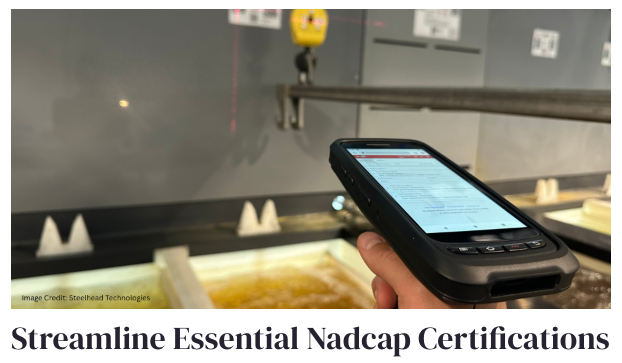
All that to say, the partnership with Bluestreak is a really exciting one for Steelhead to be able to build absolutely bulletproof heat treating technology. Todd (Wenzel) and our engineering team — the Steelhead engineering and product team — are in close contact, and there are things that Bluestreak has built that are on its fourth generation. They have been working with heat treaters for many, many years. So, we’re working very closely as a single team to provide all the features that Bluestreak has developed over the years that are great for heat treaters and pulling those into Steelhead.
Bluestreak is a QMS and MES, and then Steelhead is the broader platform, including ERP and finance. We also have an MES, but they’re more specialized on the heat treating. We are kind of integrating and combining features and products to get a great rock-solid foundation in place.
Like doctors say, first do no harm, and then press the gas on AI. I was just at a shop yesterday, a large heat treater. When I walked into the office, there were employees doing invoicing, and it looked like 1997. Hey, the machine works, right? There were some profitability challenges that they were working to address, but for other business functions, that’s where it gets really exciting.
Some may wonder if they can even look at AI. Everyone is in a margin-pressed environment. Everyone has costs. If you look at the overhead it takes to run your shop, and you can reduce that meaningfully by tens of percent, that goes straight to the bottom line. Now you can go buy those $3 million ovens that you love to buy, or you can walk to the trade show with a little more swagger because you got a little extra net margin at the end of the day to invest back in the business instead of dumping that into processing paperwork.
We have a couple AI products out today, AI order entry and AI analytics, to get your team to where you can literally chat with your business — have an AI agent that’s like a CFO or a quality manager — so your team can spend time solving the problems instead of digging through charts.
The exciting part is that’s these are the first of 10–15 AI products on our roadmap. But none of that works unless you have a rock-solid foundation.
Doug Glenn: Need to have the foundation.
Jeff Halonen: That is the number one priority. What we found is if we sit here and talk about AI, that’s fine. But how can I do furnace calibrations? How can I create this certification? What’s my operator’s experience going to be? And you know what — they’re right. They’re absolutely correct to focus on that. We’re taking the order of operations very seriously, but it’s still very exciting.
Acquisition vs. Competition (12:44)
Doug Glenn: Two more questions on the acquisition itself. Why buy as opposed to just competing them out of the market?
Jeff Halonen: Yeah, it’s a good question. I’ll take them separately because it is different for both of them. With Visual Shop, the product works. The business operates. It’s fairly common for us to meet with shops that have more financial challenges that are running on that system. That’s like an invisible, parasitic tax. But what they do see is, a) it works, and b) it’s a very low cost. You’ll have businesses doing $20 million in revenue, spending $6,000.
I know our products are a little more premium offering, and we would like to bring the absolute best we can bring. Even globally, as far as what businesses pay for technology, Visual Shop is a very low price. There’re a couple reasons this acquisition makes sense.
For one, it’s actually good for the customers. Visual Shop’s customer base and revenue have been decreasing. They had about $1.2 million in revenue and about 150 customers, and those numbers have been decreasing for about four years.
It just gets to a point where there’s just no good options. And with those options, the timelines are really compressed.
So, in many ways, we’ve extended the timeline and increased the stability that’s available. There were also many mental hurdles with the Visual Shop side. We’ve had many people send us all-caps emails saying, “Thank you for buying Visual Shop.” It would be from the lieutenants — the quality manager, the production manager, the general manager — because they suffer. They are the system. It’s like their nights and weekends, and their stress levels — that is the system.
Sometimes you have a situation where the finance decision is, “Hey, this low-cost system will work, so therefore take no action.” But they’re not seeing all the costs that are kind of hidden there. So that’s where this acquisition makes a lot of sense. It provides a stable path, but also a bit of an impetus for folks to reevaluate next-generation or modern options.
Steelhead has attracted a bit of investment. We are growing quite aggressively. I would say we’re pushing the limits of what technology can do for job shops, and that’s resulted in a lot of exciting growth. But the thing I’ve been pushing with our team is humility. Especially with commercial heat treating, there’s a tremendous amount of nuance. The vocabulary alone will humble you if you haven’t been in that environment for a while.
The messaging to our team was, “Hey, we need to approach this with humility.” That’s where the Bluestreak partnership is exciting, because it’s different from Visual Shop in the sense that Bluestreak was growing and in a good spot profitability-wise.
Todd was looking at retirement options as well — there were some time dimensions there. This acquisition wasn’t as acute as Visual Shop, as far as continuity plans for customers and creating predictability.
The reason why the Bluestreak deal made sense is because we believe heat treaters are a critical portion of the manufacturing ecosystem. There are all these oil tankers trying to get out to the open sea, all the fabrication shops, the space launches. I think they’re going from 110 space launches a year to 220. They’re literally doubling space launches from 2026 to 2027. And then you have all these startups, and that’s great. You have 500 oil tankers here, but now it’s got to get through this. That’s the role of commercial heat treating. It’s others too — anodizing, plating, and others — but heat treating is certainly a part of that constriction if you look at the manufacturing picture.

That’s why it made sense to combine Bluestreak’s rock solid understanding of how you run a heat treating shop reliably. This is how you pass your Nadcap audits every time. Then incorporate the larger business platform to try and boost the margin and growth opportunity and get on offense.
The Bluestreak product progress has been slowing over the last several years. We believe there’s an opportunity to step on the gas in terms of what technology can deliver. That’s where that partnership makes sense.
It puts us in a position to have a bulletproof offering. Here’s the source code for Bluestreak, here’s the source code for Steelhead, and here’s the developers that made both of them work together to make sure we’re putting the absolute best product in the hands of heat treaters.
The Financial Investment (18:17)
Doug Glenn: One last question about just the acquisition itself. Can you talk about the financial aspect of the acquisition?
Jeff Halonen: I’m one of six co-founders of the company. We bootstrapped it for a year. I’m an ex-automotive engineer from Michigan. We did get to a point where we realized that if we want to grow, we may have to pursue financial backing, and we did. We pursued venture capital.
For the first four years, we were venture-backed. Venture is a very aggressive type of investor. There’s a lot to read about there. They do serve a great role in society. There are not a lot of people that would give $2.5 million to a guy with a PDF who’s hollering at a webcam saying, “We’re going to go do this thing.” They have some downsides, too.
Last November, we transitioned to having four venture capitalists as part of the company. We’re down to one now. Then a growth equity firm stepped in called Mainsail. They have around 30 ERPs in their portfolio. This is what they do all day long. It was an $84 million investment that they made, and part of that was relieving the venture capitalists of their seat at the table. Part of that investment was operating capital to invest in growth. It’s right in the name, growth capital.
I’ve had shops ask me what their intentions are as investors. That’s a rock-solid question. Growth equity is a variant of private equity. They are looking for a financial outcome five years out on the horizon. However, ask yourself what leads to that outcome. This is capitalism, and just like every commercial heat treater in the world — if you provide a great product to your customer on time, you have a financial outcome.
A world where there’s a misalignment of incentives, specifically, almost doesn’t exist. If Mainsail is looking for a return on their investment five years from now, the next financial sponsor, whoever it is, will be looking at one number first and foremost, and that’s retention — gross retention.
We’re an ERP. We have one-year contracts with our customers. That’s a very modest contract length in the ERP world. That means our customers can choose a different path every single year. If we aren’t retaining customers, then we’re also not the cheapest. Every year customers have to say, “It’s still worth it.” That puts an immense onus on us to deliver.
So, the only path for us is to succeed and to provide a successful outcome for the financial sponsors — who, by the way, are financing a ton of development R&D, many millions of dollars of development going into heat treating.
There’s a lot of positivity here for everyone. There’s a ton of alignment here, and retention of customers is number one, and the only way we can retain customers is to provide unbelievable value year after year.
If we aren’t improving their margins and we aren’t helping them grow, then it’s going to be tough sledding for us. But that’s what we look towards every day. That’s why customer obsession is our number one core value. It’s really the only path forward.
The Clients (21:45)
Doug Glenn: I did want to talk about customers too, because I’ve heard a couple of different things just in talking with some people in the industry about the recent activity here. Will Cornerstone customers and Bluestreak customers be impacted essentially the same?
I’ve heard that Cornerstone customers are essentially going to have to abandon their system, more or less, but Bluestreak customers will be able to maintain their system. Can you tell us how it’s going to impact each of those two different clienteles?
Jeff Halonen: There’s some aspects that are the same for both. The first is that within the product portfolio now, we have Steelhead, Bluestreak, and Visual Shop, all under the Steelhead umbrella. All proactive R&D investment in technology is going into the Steelhead platform. We’ve already invested millions of dollars into heat treat technology in the Steelhead platform.
The architecture is very modern and advanced. The platform will actually have a FedRAMP-moderate-equivalent version available early next year. We’re targeting January of next year, which means if you’re CMMC, it’s extremely easy just to switch to the FedRAMP cloud product, and the burden of becoming CMMC Level 2 goes away.
Out of the three products, all new R&D, all the AI products, will be invested into Steelhead. However, we also want to make sure there’s business continuity for all the shops using the Visual Shop and Bluestreak product. All Visual Shop and Bluestreak customers are Steelhead customers. Customer success is number one priority. For Visual Shop, right now nothing has changed. You have the same product, call the same exact team. There’s no change at all.
However, we’re targeting the end of 2027 for the end of life on Visual Shop. Many Visual Shop customers have perpetual licenses, meaning they’ve been using it for free, essentially unsupported, into perpetuity. There are quite a few shops that have been doing that already for a long time. There are a few that are on subscription, but the vast majority are perpetual, which means its support. It’s the ability to pick up the phone and make a call, not like, “I have access to software,” and the software just went away the next day.
We are targeting the end of 2027 for Visual Shop. For Bluestreak, that timeline is extended beyond that. But the same — all new R&D is going into the Steelhead product, and the functionality that customers know and love inside of Bluestreak is being invested into the Bluestreak product, and that timeline’s out into 2028 for end of life on that one.
The Cost (24:29)
Doug Glenn: Is there a substantial cost differential, I assume, between what you guys will be charging Cornerstone customers and what they are/were paying?
Jeff Halonen: I’m happy to address this question. I just can’t stress enough — if you go out there and just say, “I’m not going to buy Steelhead, I’m going to go buy some other software,” you will not find another Visual Shop price. Ultimately, that did contribute to the outcome. As such, there will be a significant jump in price on the Visual Shop side.
What we’ve found, though, is that if you look at the cost of operating your business on Visual Shop — not just the dollars you pay for Visual Shop — you actually see a cost reduction for Steelhead. Steelhead is actually cheaper than running Visual Shop almost every time. But it requires you to consider counting the cost of the three employees doing order entry and the two employees doing invoicing. You have to consider the real cost of running Visual Shop. You have to count the whiteboard, the walking around. There’s the real price, and it’s a pretty big price jump.
Also, you benefit from the technology and the AI tools. We just released two AI tools in the last couple of months. Ultimately, it is a shift of saying, “Hey, I believe in technology, I believe technology can help drive my business,” versus saying, “I just need a system to do packing slips and invoices, and it should be as close to $0 as possible, and I don’t care about it getting better, and I don’t think AI applies to my business.”
That’s the mentality of some shops and that’s fine. But the reality is that it’s impossible for us economically to provide the same level of service. We’re on site all the time. I was on site yesterday. We’re on airplanes all the time. I’m out of Detroit, Minnesota, Texas, California, Pennsylvania, etc.
It’s not just a bunch of software, and you figure it out. It’s software, plus help getting it launched and implemented. When we have a new tool, we can provide that help. It’s very much a symbiotic relationship.
We specialize in the ERP and technology on the change management side. Our customers specialize in their business, and each business is different, so they’re teaching us, “Hey, this is how our business works; this is the requirements we have.” And we’re saying, “Okay, this is how we can use our technology to achieve that outcome.”
For Bluestreak, it’s similar. The gap is much smaller though. Bluestreak is directionally towards Steelhead pricing, but there’s still a gap there from Bluestreak to Steelhead. There are some efficiencies to be gained to close that gap, but it’s more about really leaning into leveraging technology for your business.
Companies also have to consider what they are paying for accounting software. What are you using for ERP? How are you running all these other ancillary systems surrounding your MES, QMS? It’s essentially an expansion of the footprint as well, which offsets a lot of the cost. There’s efficiency gain there, then there’s also access to the entire AI investment and much more modern product.
The Impact (27:48)
Doug Glenn: I have two more questions. We talked about the impact on customers. What is the impact to Steelhead Technologies? You’ve substantially increased the number of customers, and therefore the need for customer support. What type of changes are being made inside of Steelhead to meet that — the number of phone calls coming in, the number of emails coming in, and other challenges?
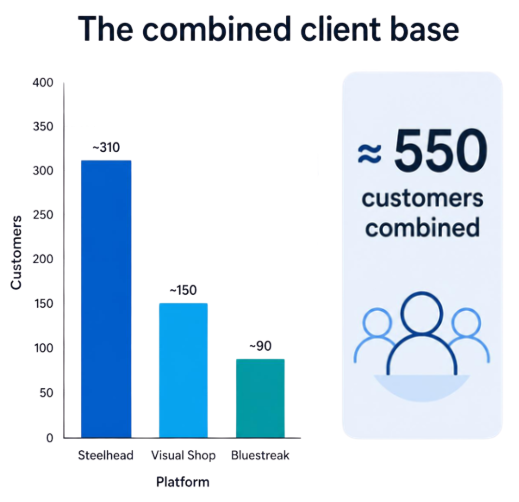
Jeff Halonen: Steelhead has around 310 customers, Visual Shop has around 150 customers, and then Bluestreak has around 90. In total, around 550 customers. In 2025, we successfully deployed around 95 accounts, meaning completed the handoff. They’re in support, steady state. There’s obviously always continuous improvement, but the surgery is done. They’re running completely flat out. The growth has continued to accelerate since then. I don’t know what the number is going to be this year, but I wouldn’t be surprised if it got closer to double that.
We have around 120 folks on the Steelhead team, and the Visual Shop and Bluestreak support is unchanged. It’s still there. There’s roughly eight and nine folks on the Visual Shop and Bluestreak teams, respectively — not only supporting the continued use of Visual Shop and Bluestreak products, but then during any integration, or if you do choose to essentially upgrade to Steelhead product, you now have an opportunity where both vendors are same vendor. Like with migrating data, and other aspects like that.
Steelhead’s investing a tremendous amount in automation because we have access to database structure on both sides. We have access to source code on both sides. We have access to engineering on both sides. So, the data you have in Visual Shop, the data you have in Bluestreak, can be mapped over at a much more efficient and granular manner than otherwise would be.
We are also growing our team. So, shoot us a note. We have a career page on our website.
We have a fairly substantially staffed team, and there’s some healthy growth going on there. If we’re in a position where we’re not 100% confident that it’s going to be successful for our customer, we’re going to use the calendar to our advantage and make sure we’re not overscheduling or overburdening, to a point that’s detrimental to the customer.
When we look at a customer or a partnership, 10 to 15 years is our ideal case scenario. Rushing to start a project when we’re not ready to capitalize on it, to save a couple of months, a couple of weeks or something like that, is just not smart. It’s very shortsighted, and we seek to avoid that.
The Message (31:00)
Doug Glenn: One last question for you. One of the advantages of doing this interview is that you can send out a main message. What message would you like to communicate to current customers of Steelhead, of course, and customers of Cornerstone and Bluestreak?
Secondly, what message do you want to give to the untapped market — the companies that you don’t have right now that you’d like to reach?
Jeff Halonen: We don’t serve injection-mold job shops; we don’t serve machining job shops. There’s a lot of job shops we don’t serve, because we understand that the nuance and the depth and detail matters. So, serving heat treating, as an example, was not just like whim, right? It’s a very intentional move, but the message is very simple: investment. Steelhead has historically invested a ton into technology for job shops, and these acquisitions represent another very material investment.
They would only make sense if you planned to continue investing. As you pay attention to the news and you see AI in every other headline, you may wonder what you are going to do about AI. We use AI a lot internally, and what we found is if you just go buy a bunch of random software and try to patch AI on top of everything, it’s okay for one-off little errands. Everyone can do that. You’re going to get five or ten percent more efficient by using AI in a one-off, à la carte method.
But to truly leverage AI — which equates to a new material that’s 90% cheaper or 40 times stronger — you have to bake it into the bones of your business, into the operating system of your business.

That’s what we’re really excited to continue investing in. One fear that job shops might have is about leveraging AI. There’s this new superpower that’s out there, and it’s tough just to be on your own and bolt it all together yourself.
It’s actually quite complex to leverage it to its maximum. What we’re looking to provide to job shops is a turnkey product and service. Someone that literally comes on site, helps your operators adopt the system, configured just to your industry, and then bolts a ton of AI on top of it. It’s got your finance, your inventory, your certifications, your operator training, your scheduling — everything in one and then bolts AI on top of it.
Our mission is that job shops in the United States of America have technology that puts them actually at the front. We want these job shops to be some of the most profitable manufacturers. If you’re a job shop, go look at your biggest customer, with 12,000 employees, and 2,000 employees. Good luck. They will change, but they’re going to move so slowly. Our vision is that you wake up some day and look around and think, “I have the best setup on the planet. I’m actually way ahead of all my peers in terms of larger technology.”
We want to make that super easy, so we view ourselves as a technology partner on that, and that’s what we’re focusing on. A key takeaway is investment in technology, and this is emblematic of us doubling, tripling, quadrupling down on investing and being the absolute best technology partner we can and the same for our customers. If you’re an existing Steelhead customer, same thing. We have our foot on the gas, and we’re really excited to be the best technology partner we can be.
Doug Glenn: Super. Alright, Jeff, thank you very much. Appreciate your time. Anything we can do to be helpful to you guys, let us know.
Jeff Halonen: Excellent. Thank you, Doug. And thank you for everything that you guys do as well.
About the Guest
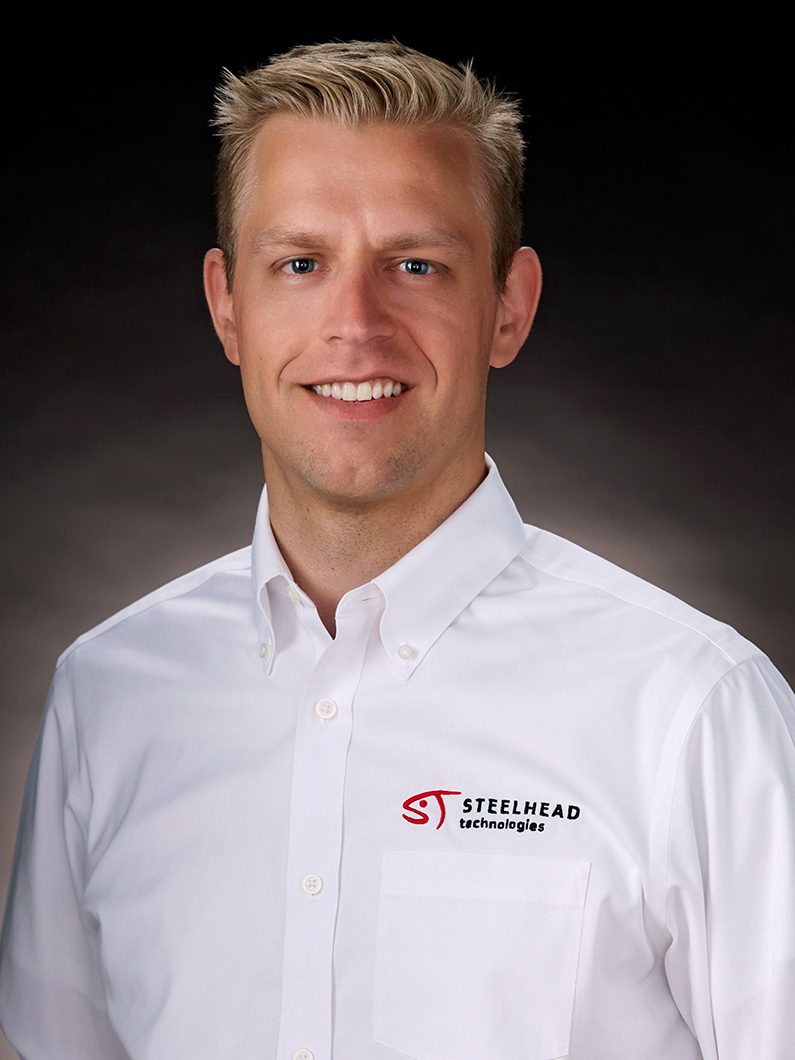
CEO and Co-Founder
Steelhead Technologies
Jeff Halonen is the CEO and co-founder of Steelhead Technologies. Before Steelhead, Jeff worked as a mechanical engineer at General Motors, gaining experience with complex manufacturing systems and large-scale production environments. Throughout his career, Jeff has walked countless job shop floors around the country, listening firsthand to owners, managers, and production teams as they work to solve bottlenecks, improve profitability, and achieve sustainable growth.
This exposure has shaped the vision for Steelhead: to provide practical, modern tools that streamline operations, reduce overhead, and help shops get ahead. Jeff pushes an aggressive AI roadmap to enable shops to double revenue without adding a single front-office headcount. His conviction is that the right technology partner can make job shops some of the most profitable manufacturers in the country.
Jeff lives in southeast Michigan with his wife and four sons. Outside of work, he hunts, fishes, and frequents the local farmers market.
For more information: Contact Jeff Halonen at jeff@gosteelhead.com.