
MTI MEMBER PROFILES

Metlab

“A heat of drill rods, each piece measuring 1 1/2 O.D. x 12’ long made from H-11 air hardening tool steel. Parts were carburized, and are being forced air cooled, and then will be tempered and straightened Parts are used in the mining industry and case hardening provides the surface hardness and toughness for superior performance in the application.”

Metlab was founded by Horace Knerr in 1928 in Philadelphia to service the airplane manufacturing business. Knerr introduced the first drop bottom gantry furnace for solution treating aluminum spars. In 1936, the company expanded its heat treating activities and moved from Philadelphia to the northern suburbs into a 125,000 square foot facility. As a strong contributor to the support of American manufacturing for the war effort, they had a staff of about 350 people and heat treated numerous components for airplanes, tanks, armaments, and other parts. In 2001, Metlab acquired the John V. Potero Company in Philadelphia, an 18-person heat treat company specializing in heat treating small parts and black oxide.

Today the company offers a full complement of thermal processes, heat treating both small and large parts, and also providing a local pickup and delivery service. They have a full range of capabilities, processing parts that weigh from a few ounces to up to 50,000 pounds. With the largest atmosphere-controlled pit furnaces in North America (measuring up to 15’ in diameter by 12’ deep or the two long furnaces, 6’ in diameter by 16’ deep), Metlab offers deep case carburizing of large gears, pinion shafts, bearings, and other components.

In addition, they have a complement of atmosphere controlled integral oil quench furnaces and a vertical furnace for nitriding parts up to 20’ long. An inhouse metallurgical laboratory is used for documenting hardness, microstructure, and mechanical properties to certify heat treatments and processes.

Nitriding is a core competency, with large submarine and destroyer gears weighing up to 25,000 pounds routinely heat treated. Other processes offered are hardening, tempering, annealing, spheroidize annealing, induction/flame hardening, protective atmosphere normalizing, nitriding, vacuum heat treating, cryogenic processing, stress relieving, and black oxide finishing. Major industries served with these capabilities include:

  • Aerospace
  • Agriculture: Heavy Equipment
  • Medical
  • Military
  • Mining

All of the processes offered by the company are aimed at changing the mechanical properties of the parts treated. Whether increasing the hardness (either on the surface or core to make the parts functional), softening the parts to allow them to be further processed, or black oxide finishing for decorative and corrosion resistance, the thermal treatments and/or finishing treatments are critical to the performance of the treated products.

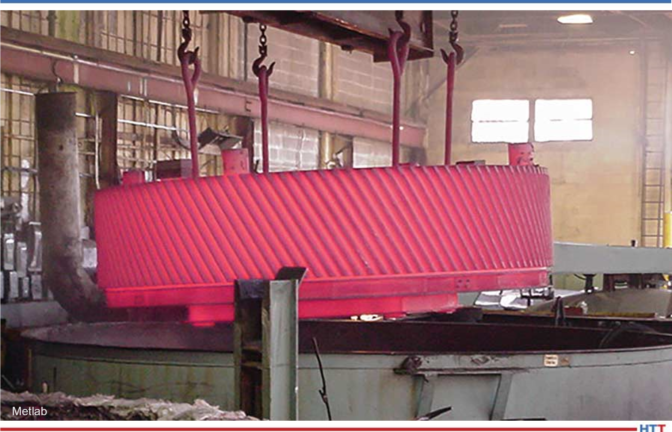
A large gear, 10’ O.D. x 3’ F.W. used on a stand in a rolling mill line. The gear, made from 18CrNiMo6-7 was carburized to 0.250” case depth and hardened to HRC 58 – 62."

Metlab is a job shop, and the parts processed as well as each application addressed is unique. As an example, the company can carburize a 40,000-pound gear to 0.200” case depth and a surface hardness of HRC 58-60 for a steel plant mill stand and not see the same gear for heat treating for another 10 years. Each day brings new challenges. With three metallurgists on staff, they partner with their customers, acting as consultative heat treaters providing the company with the best solutions for any application.

Heat treating can take some interesting turns off the expected path. A few of those projects include working with students on SAE automotive racing teams at local universities. The teams build cars for competition, and Metlab provides, at no charge to the colleges, heat treating for their projects, enabling students to economically obtain heat treat services. Another fun venture was the heat treating of antique car and airplane parts: one-off pieces needed for a restoration. And the black oxide finishing of a suit of armor for a renaissance fair “Black Knight” reenactor was another unique opportunity.

Quality, service, and competitive pricing are Metlab’s stock-in-trade. While they work in accordance with ISO and Nadcap, obtaining accreditation in the short term is a key goal. The addition of a second, larger capacity black oxide line is also underway. The company will continue to evaluate new processes and equipment and add to its arsenal of process and capabilities as markets evolve and applications demand change.

Metlab Read More »

Penna Flame Industries

Penna Flame Industries (PFI) was founded in 1968 by Garrett D. Orr, Sr. and his wife Mary Patricia (Pat) Orr to provide flame hardening services to the growing steel industry. Orr chose the Zelienople, PA site because it was centrally located between Pittsburgh, PA, and Cleveland, Ohio, which was then heavily into steel manufacturing. Garrett was employed as a sales representative for a foundry and was involved in other steel-related industries. Through this experience, he recognized the need for flame hardening in the steel industry. In 1968, at the age of 39, he founded Pennsylvania Flame Hardening. The groundbreaking took place on April 1, 1968.

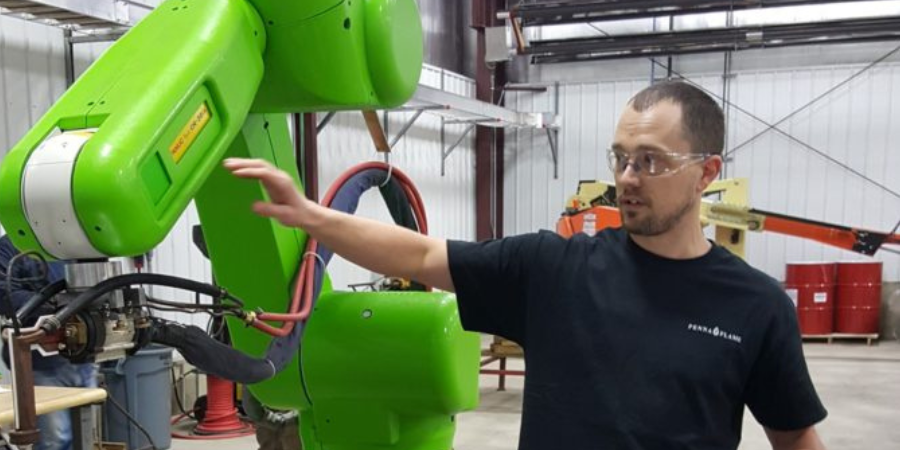
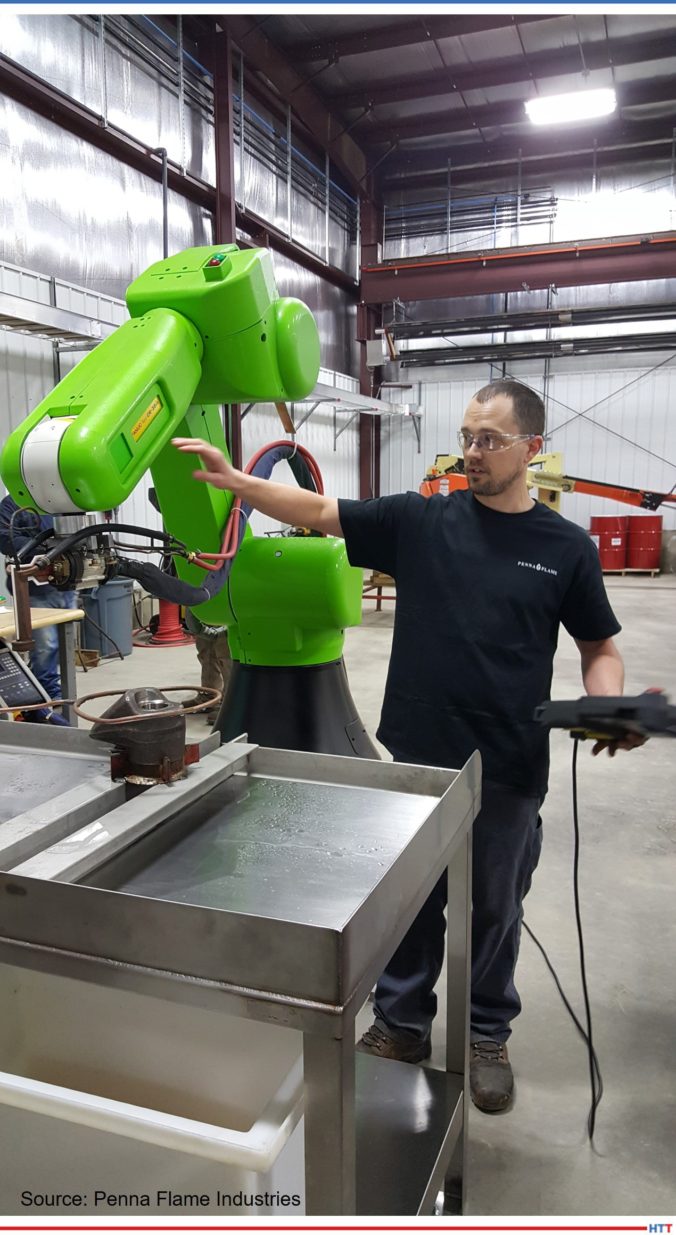
Bert demonstrates the benefits of working with a collaborative robot to induction harden steel parts. The robot gives the operator the ability to work directly next to it, as opposed to conventional robot arms where fencing and distance is required.

In 1990, James P. Orr was named president of the company, continuing his father’s commitment to the industry by adding new technology and innovations in surface hardening and roll manufacturing.

In 1995 the company added a roll manufacturing and machining facility to meet the needs of customers who wanted highly polished rolls used in the automotive and other industries. Today, PFI also serves the military, mining, and agriculture (heavy equipment) sectors.

In 2008, the company added the industry’s first robotic cell that replaced manual scanning and reduced the amount of setup required for tooling, thereby increasing precision and repeatability. The company has since added three additional robotic cells.

The computerized robotic surface hardening systems have revolutionized the surface hardening industry. These advanced robots, coupled with programmable index tables, provide an automation system that helps decrease production time while maintaining the highest quality in precision surface hardening.

A few benefits of this service are:

  • Increased wear resistance
  • Higher hardness and longer life
  • Less processing time
  • Higher efficiency and productivity
  • Maintain tensile strength
  • Quick turnaround of the project
  • Consistent, repeatable process
  • Less distortion when compared to furnace treatment

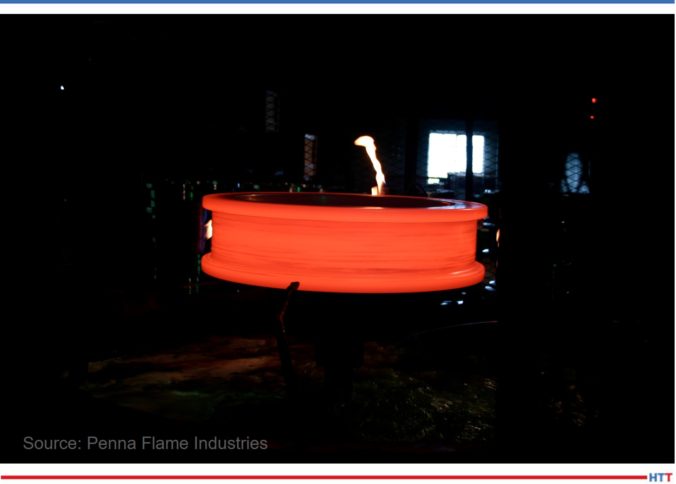
A crane wheel, in the process of being flame hardened, glowing red hot about to submerged in a quench bath.

Additional services include flame hardening, robotic flame hardening, robotic induction hardening, roll hardening, roll manufacturing, roll straightening, hardness testing, wheel and axle assembly, deep cryogenics, stress relieving, and tempering.

In 2017, the company expanded its facility to incorporate the world’s largest spin flame hardening tank (80-inch diameter) and added a collaborative robotic cell that induction hardens and allows the operator to work right next to the robot without having safety fences.

Here’s a fun fact: while PFI doesn’t know the final destination of many of the parts they heat treat, they have flame hardened wheels that are in the roofs of professional sports stadiums and fields that roll out.

As they look to the future, James P. Orr, together with his sons Michael (Vice President) and Andrew (Vice President) are poised to lead the 28 employee-strong company into the next generation of products and services.

Penna Flame Industries Read More »

Paulo

"We want to make sure our customers succeed, and we do that by bringing our unique approach to every job." These are words that describe the mission of Paulo, a company whose areas of expertise reside in heat treating, brazing and metal finishing.

A family business founded in 1943 by Ben and Pauline Rassieur in St. Louis, Missouri, Paulo now employs 400 people and provides almost every form of heat treatment as well as zinc plating and phosphating, black oxide, brazing, and hot isostatic pressing (HIP)—their most recent addition.

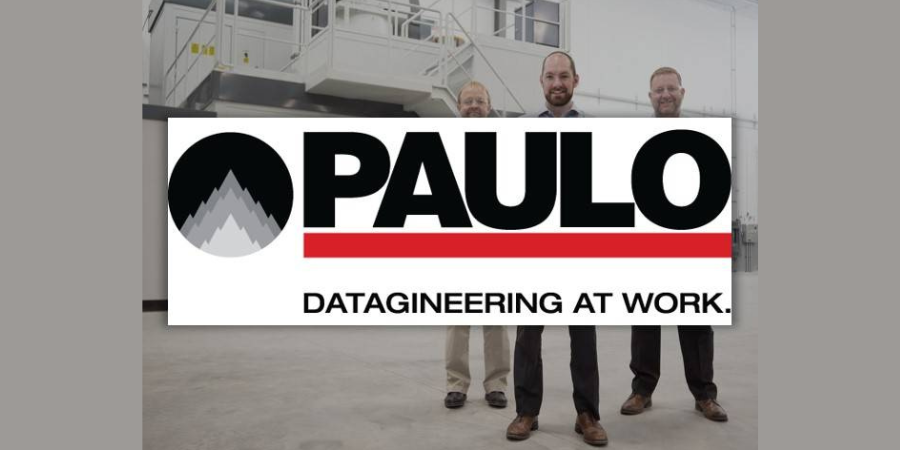
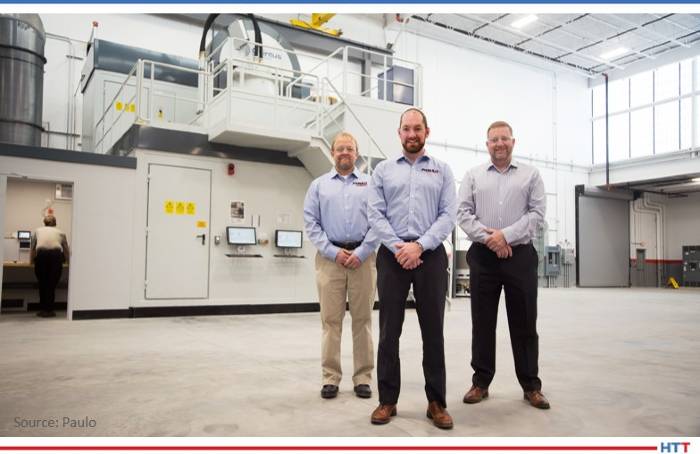
(left to right) Scott Russ, William Rassieur, and Scott Herzing

The company’s large metallurgical engineering staff performs testing, process development and improvement, and compiles metallurgical reports. Through the strategic location of their six facilities and the varied processes offered, they are equipped to partner with organizations up and down the supply chain to handle everything from overnight tool and die work to millions of pounds of production work for a variety of industries all with the support of their control systems and built-in contingency planning.

A few of the services they offer are through hardening, carburizing, nitriding/FNC, solution treating/aging, austempering, and HIPing. A few of the equipment capabilities include integral quench, mesh belt, vacuum, tip-ups, and HIP.

An important heat treating capability that helps them to succeed in the company’s mission is the ability to collect data and control furnace conditions in order to deliver consistent repeatable results. Additionally, as the largest privately held heat treater in North America, they can invest to support customer’s growth as they did recently in Monterrey, Mexico, announcing a large expansion that will double the square footage.

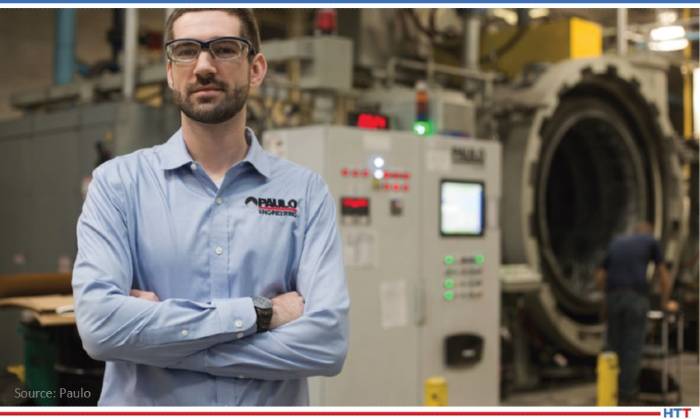
Derek Denlinger
Paulo

Paulo has heat treated interesting and memorable parts, from those used in space and on airplanes to those that supported PPE during the pandemic. Two that had big impacts on the company’s trajectory was the brazing of 106mm artillery shells and fuel pump housings.

"Datagineering" is a word the company created to explain the blending of the best in automation, data, and human expertise. As they look to the future, their continued implementation of the company-coined verb will aid in supporting customers, continuing overall improvement, and developing technically to push boundaries and deliver the best results.

Paulo Read More »

Franklin Brazing and Metal Treating

Although Franklin Brazing and Metal Treating (FBMT) was founded in the 1960s, the current owners, Timothy and Margaret (Peg) Mathile purchased the company in October of 1995. In 2000, they invested in building a 51,000 square foot permanent facility located in Lebanon, Ohio.

On June 1, 2017, Peg was made majority owner of the partnership and became intimately involved in the business. As an owner/operator, however, she saw the need to “refound” Franklin Brazing and Metal Treating. “It is wonderful to have history and longevity, which proves that there is enough capital for the company to continue; but what is most important is who Franklin Brazing is today,” she said.

According to Peg, “I didn’t really have experience in manufacturing or heat treating, but I sensed that no matter how great our facilities or systems were, if I didn’t have the right people in the right place with the right attitudes, nothing else would matter. So, for the first several years, I focused on culture and people first and foremost, with an eye on facilities and systems improvements. I also believe that everything is about relationships, regardless of the industry.”

That focus on relationships became a driving force in the company’s values of teamwork, excellence, integrity, and respect in every aspect of Franklin’s culture. There is a palpable energy throughout the organization that comes from honoring its values as well as a commitment to quality systems and continuous improvement. Peg believes in the adage, “Don’t just tell me, show me.”

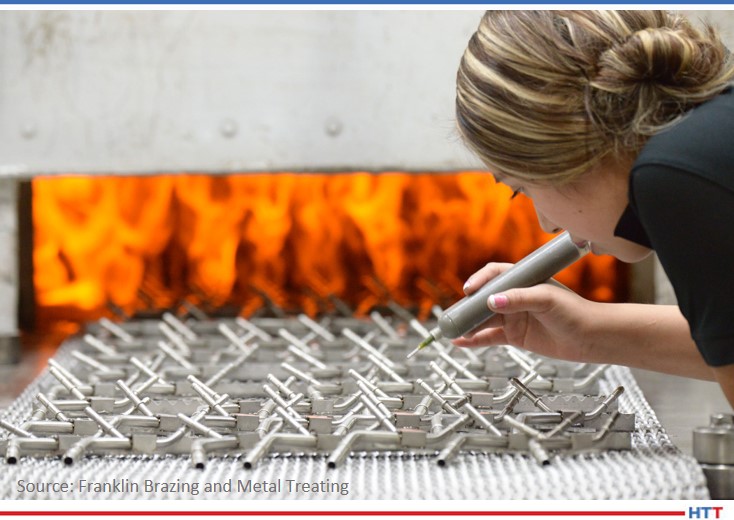
Franklin Brazing and Metal Treating provides annealing, assembly, and brazing services using continuous belt furnace brazing with pure atmospheres. FBMT works with carbon and stainless-steel parts that are needed for the automotive, heavy trucking, agriculture, medical, food service, and aerospace industries. The true value-add at Franklin is that the services are performed by seasoned full-time associates who have a deep understanding and experience of the processes and what it takes to produce good parts.

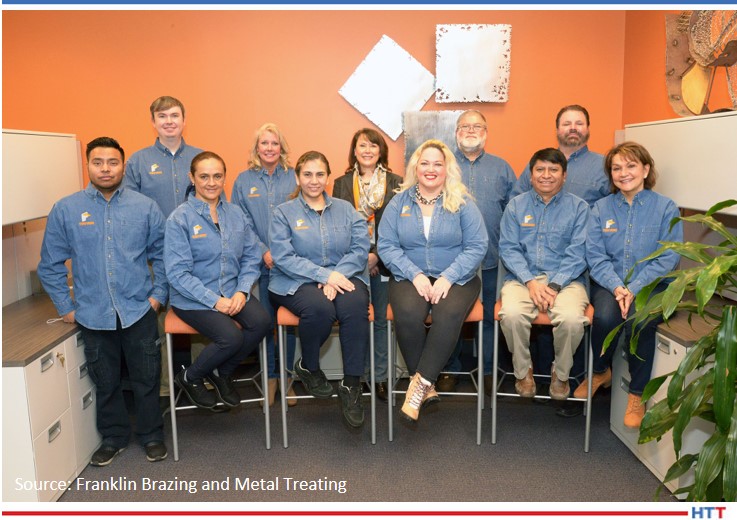
Source: Franklin Brazing and Metal Treating

Recent improvements include a new cooling tower, chiller system, enhanced duct work, LED lighting in the plant, a renovated breakroom for the associates, a quality room for the engineering staff, a new HVAC system for the front offices, and upgrades in technology systems.

The updated technology is not only used for improving efficiency and data analysis, but also for communication. It has been key to improving operations and has had a significant impact on relationships with clients. Franklin’s ability to effectively communicate enhances collaboration, which allows FBMT’s clients to more efficiently manage their supply chains, reduce the cost of rework and scrap, and better serve their clients.

FBMT places a high priority on education and training. There is a commitment to enhance the associates’ knowledge through investing in educational opportunities and training. “We have a wonderful team and when opportunities are provided for people to grow, everybody wins,” Peg said. “The associate wins, the company wins, and most importantly, our clients win.”

Franklin Brazing and Metal Treating Read More »

Metalex Thermal Specialties

Metalex Thermal Specialties is a Metal Treating Institute member and one of Colorado’s premier commercial heat treaters who prides themselves on high-quality and ultra-fast turnaround times. Originally founded in 2005, but recently acquired by James Legacy Corporation, they have been serving the industrial, medical, and automotive sectors as well as other industries in and around Colorado.

Their vacuum/bright hardening process sets them apart from other heat treaters. This process ensures parts come out clean with no discoloration. Bright hardening can be performed for a wide variety of processes.

Source: Metalex Thermal Specialties

Their pit furnaces allow them to perform age hardening under various atmospheres such as nitrogen, argon, or hydrogen. They even have a proprietary process for knife blades that allows them to be vacuum hardened without distortion. Metalex can even process some steels under vacuum that are typically oil hardened, which provides the required hardness without the issues oil hardening can create.

Metalex provides the following services:

  • Bright hardening (vacuum hardening) of many tool steels, stainless steels, and more
  • Oil hardening of 4000 series alloys, tool steels, and other oil harden steels
  • Age hardening of stainless steels and aluminum
  • Annealing of virtually any metals
  • Stress relieving of martensitic and austenitic steels, and titanium
  • Normalizing
  • Brazing
  • Induction hardening
  • Carburizing
  • Creep flattening
  • Cryo processing

Equipment capabilities:

  • 2-bar nitrogen quench large capacity furnace for vacuum hardening, age hardening, brazing, stress relieving, and annealing
  • Small vacuum furnace for age hardening, and tempering
  • Pit furnace for age hardening
  • Pit carburizing furnace for oil hardening, carburizing, tempering, annealing, normalizing, and stress relieving
  • 5 tempering ovens
  • 2 tempering furnaces for age hardening and tempering
  • 1 large capacity tempering furnace
  • Ultra-low temperature freezer

Source: Metalex Thermal Specialties

Customer retention is high because of the quality they receive from the vacuum hardening, the cleanliness of their parts, and most importantly, the expertise and customer care from the people that make up Metalex. Combined, their employees have over 50 years of experience in the heat treatment industry. Everyone is focused on providing the best quality to their customers.

Metalex is excited about the future. In addition to the current renovation of their building, they are looking to greatly expand their capacity and capability over the next 5 to 10 years. One way to achieve that is with the future addition of another large vacuum furnace, and a much larger oil and carburizing IQ furnace. They are working to become Nadcap and MedAccred accredited, improving quality, and expanding the industries they serve.

Metalex Thermal Specialties Read More »