MTI MEMBER PROFILES

MTI Member Profile: Detroit Flame Hardening Co.

Detroit Flame Hardening Co. does many things well, but one thing they excel at is flame hardening. In fact, they have built proprietary, only-at-Detroit-Flame post-processes that have truly set them apart as a master of flame hardening.

In general, during the flame hardening process, flames are directed carefully to the surface of a carbon or alloy metal and later quenched. But at this company, processes are a little more specialized. Here, their clients can choose a specific, targeted surface and receive high hardness only in that area. They flame harden using the hottest flames produced from oxygen, propylene, and acetylene (which they generate on site). Doing this successfully requires extensive knowledge of metals, the end application, and what gas to use at what temperature to achieve the correct case depth hardness. The unique process, the result of the more than 80 years of experience housed at the company, reduces the cost of treating the part, process time, and part distortion. To round out this process, the company designed a proprietary quenching method that may include water, oil, air, or synthetics.
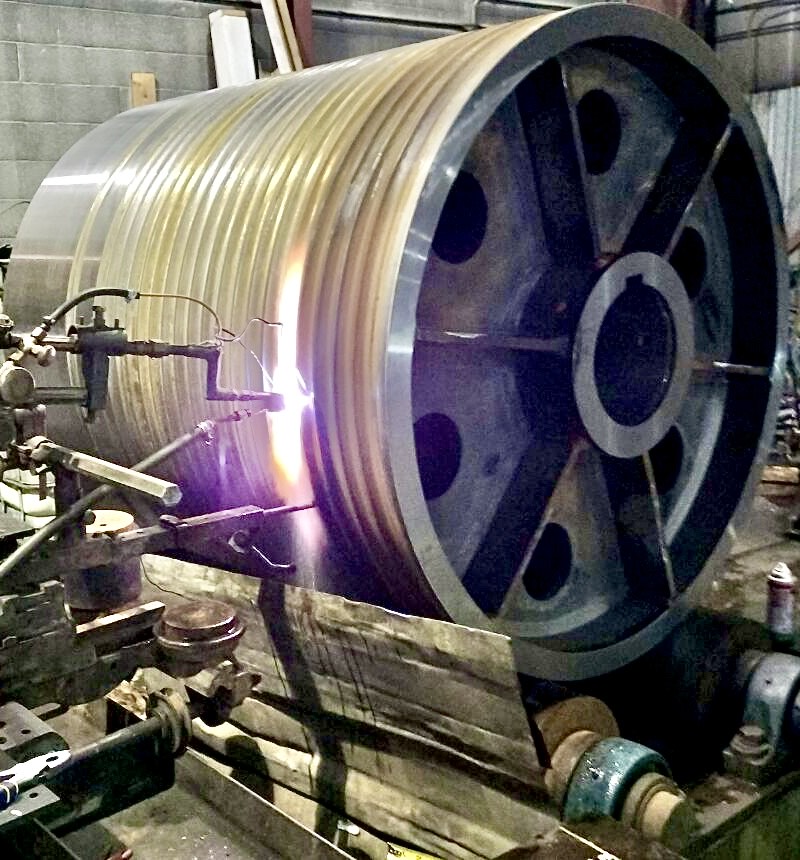
Large rope drum for offshore oil rig at Cleveland location

The quenching method is not the only process that is highly unique to Detroit Flame Hardening. The company also boasts a specially adapted straightening press and an entire straightening department for flame hardening parts that require a bit of post-process attention to remain within specification. This department can accommodate straightening demands within .015″ TIR and is able to remove difficult “twists.” Additionally, the on-site precision straighteners can work with any cold precision straightening and some hot straightening.

After being hardened with the specialized flame hardening process, quenched with the proprietary quench method, and straightened with exclusively-adapted presses, parts undergo yet another unique Detroit process: a session with the company’s own Detroit Hardness Tester. This portable machine was engineered and manufactured by experts in metallurgy and has been rigorously pre-tested to ensure positive operation and reliable accuracy. The pocket-size design includes a steel ball, precisely weighted and shaped, that is dropped from a specific height to produce an accurate Rockwell C hardness reading. This design has made the Tester highly regarded by plants and machine shops.

Armed with this level of customized expertise, Detroit Flame Hardening has locations in Detroit, Cleveland, and Cincinnati, serving the entire USA with a focus on the automotive, aerospace, and military (as well as other) industries. Known for their cutting-edge solutions and innovations, this fourth-generation family business has delved deeply into the flame hardening process to better serve others.

For more information:

Detroit Flame Hardening Co.

17644 Mount Elliott St.
Detroit, Michigan 48212

detroitflame@detroitflame.com
www.detroitflame.com

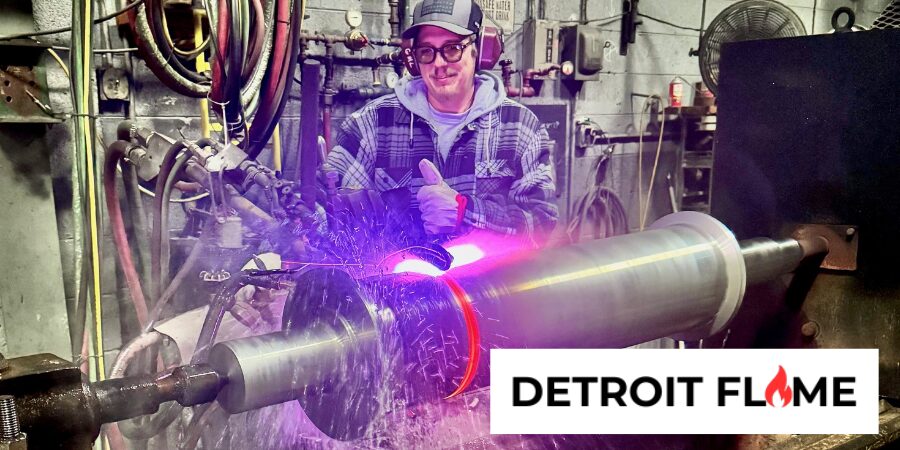
Main image: Matt Geddes, regional operations manager, flame hardening a roll at the Detroit location

MTI Member Profile: Detroit Flame Hardening Co. Read More »

MTI Member Profile: Stack Metallurgical Group

From its roots in Seattle to its facilities across the western United States, Stack Metallurgical Group has built a legacy defined by precision, quality, and innovation. Founded in 1946, the company began with a few repurposed World War II furnaces and a small team dedicated to serving local foundries. Over time, it expanded its capabilities, added new furnace technologies, and became a trusted partner to some of the leading manufacturers in the Northwest.

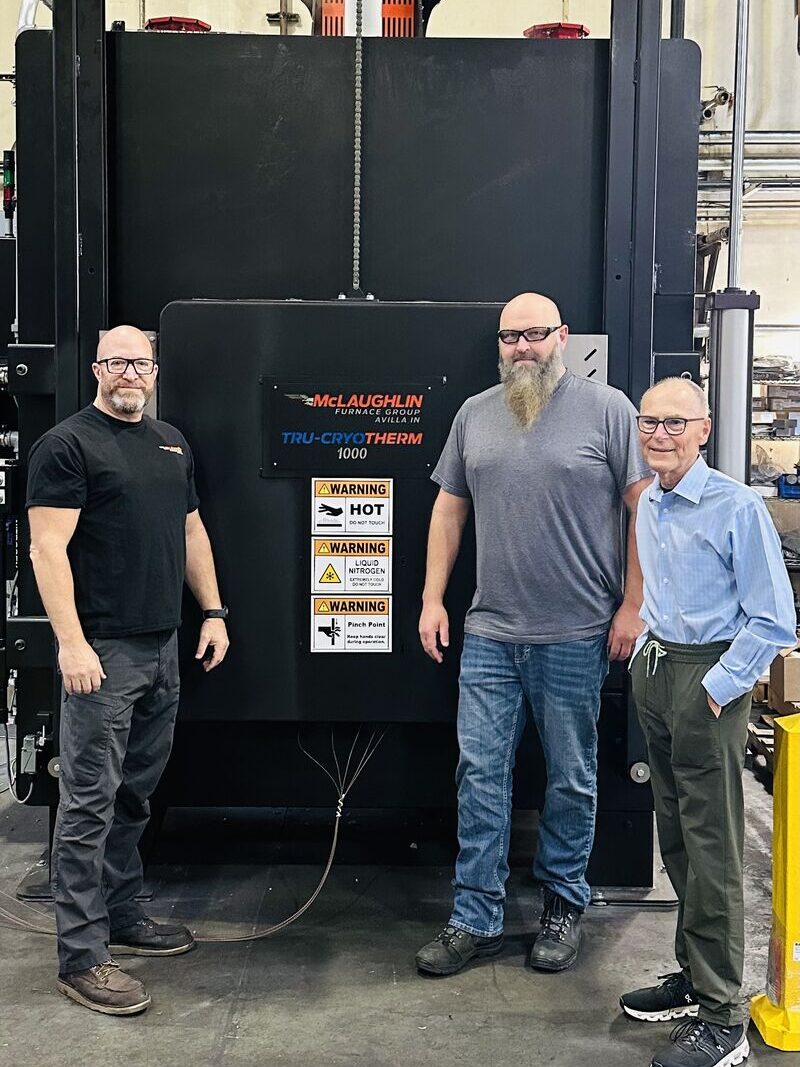
New Furnace Day! Jeff McLaughlin, Brad Kaufman (Portland Operations Manager), and Dave Ederer (Owner) in front of Stack Metallurgical’s new temper-freezer unit

As the business evolved over the decades, acquisitions and expansions shaped it into the organization known today. In 1982, the Stack Metallurgical Group consolidated in Portland and added multiple vacuum furnaces to increase capacity. A full-service facility followed in Spokane in 1984, and a new site, Aerospace Aluminum Processing, was established in Salt Lake City in 2015. These additions created a broad network capable of meeting the demanding needs of aerospace, defense, and advanced manufacturing industries.

At its core, the company remains focused on delivering heat treating excellence backed by decades of experience and technological investment. With over 75 years of service, it supports clients producing everything from rocket engines to precision cutlery, maintaining approvals across a comprehensive list of industry standards.

Among its many capabilities, vacuum heat treating stands as the cornerstone of the heat treater’s expertise. This process, essential for alloys such as nickel and titanium, provides unmatched control and consistency — critical qualities for aerospace, power generation, and high-performance tool applications. Complementing vacuum processing are extensive Endothermic heat treating operations for ferrous alloys, enhancing hardness, wear resistance, and toughness, along with aluminum heat treating and anodizing services that strengthen components and improve corrosion resistance.

The company’s facilities house six internal-quench Endothermic furnaces, more than two dozen air furnaces, and over fifteen vacuum furnaces across its Portland and Spokane locations. In Portland and Salt Lake City, aluminum quench and aging furnaces support aerospace and precision manufacturing work, while the Salt Lake site also features an advanced anodizing line and multiple paint booths for finishing applications.

Beyond equipment and technology, the company’s greatest strength lies in its relationships. The organization has long operated with a client-first philosophy, one that views every heat treat job as a collaboration. Every employee takes personal ownership of each component that passes through their care. This approach, built on partnership and dedication, has earned the trust of manufacturers across the industry.

Partnership has long been a defining value, especially with regional tool and knife manufacturers. Working closely with these partners, the team develops specialized processes that enhance product performance, helping create some of the toughest, sharpest, and most consistent tools available today.

Equally vital to the company’s legacy of enduring quality are its people. Many employees have been part of the organization for more than a decade, with several bringing multiple decades of experience. This continuity has fostered a culture of craftsmanship, accountability, and deep technical knowledge, qualities that customers recognize and trust.

Future growth will follow the same guiding principles that have carried the company for generations: hiring exceptional people, investing in new equipment, and expanding capabilities to serve a growing manufacturing base. As U.S. production advances, Stack Metallurgical Group remains committed to helping clients achieve superior results through dependable heat treating and metal processing solutions.

With more than seven decades of proven performance, the company continues to set the standard for precision, quality, and care, proving that craftsmanship, which built on consistency and innovation, never goes out of style.

For more information:

Stack Metallurgical Group

5938 N Basin Ave
Portland, OR 97217

sales@stackmet.com
www.stackmet.com

Main image: Stack Metallurgical Group’s largest vacuum furnaces at Stack Portland’s Vacuum Department, shortly after commissioning in 2015


MTI Member Profile: Stack Metallurgical Group Read More »

MTI Member Profile: Contour Hardening

If you had to describe Contour Hardening, Inc., in one phrase, it would be: Engineers solving problems. When a client encounters a part failure, this heat treater believes their work has just begun. Founded in 1986 by two engineers (one a metallurgical engineer and one a gear engineer), the company has been solving complex problems with unique, custom designed solutions ever since.

The first problem Contour’s two founding engineers solved was how to handle gears that have such irregular shapes but still need a high degree of case depth and pattern accuracy. What they created is the unique and patented Micropulse™ Process. In the ‘80s, their strategy was to build this advanced, computer-controlled induction heating technology into custom-designed induction hardening machines for OEM manufacturers and tier 1 suppliers. This patented process is a slightly different hardening solution than other available options. Specifically, this process prioritizes keeping the part below the critical temperature zone. Heat times can be controlled to the millisecond, and the time at which the part is above critical temperature can be as low as 0.15 seconds. In addition to this tight temperature control is the ability to use dual frequencies, which provides the custom solution the founding engineers sought after: A heat pattern that precisely contours to the surface of the part.

Zion’s ZSCAN induction scanner outfitted with full-service controls

Equipment — or lack of customized equipment — is another problem to solve on Contour’s list. The company often functions as most commercial heat treaters do, receiving work to process in their on-site equipment. This equipment includes 12 case hardening machines and nitriding and ferritic nitrocarburizing machines. Custom designed equipment, however, also leaves the company’s Indiana or Mexico facilities and is delivered to clients as needed. This is because the company functions with the motto that pre-designed machines are not always best, and sometimes, you just have to build the machine around the part, not the part around the machine. This motto has led Contour to solve many a client’s failure with a unique, built-to-client-speculation machine, delivered on time.

What is Contour’s next set of problems to solve? In the upcoming years, the company is looking forward to providing solutions to bridge the gap between design constraints and manufacturing feasibility. Unmanned drones and electric vehicles are two of the key players in this area. On a broader scale, the company hopes to find a solution that fits the torque requirements of electric motors, as well as keeps the size of components small. Whatever the next problem may be, this group of engineers and heat treaters is prepared to tackle it.

For more information:

Contour Hardening, Inc.

8401 Northwest Boulevard
Indianapolis, IN 46278
United States

nmerrell@contourhardening.com
www.contourhardening.com

Main image: Transmission gear above Curie temperature, contouring the surface


MTI Member Profile: Contour Hardening Read More »

MTI Member Profile: Euclid Heat Treating

Euclid Heat Treating began in 1946 in a single garage with only two types of equipment — salt furnaces and open-fired furnaces. Today, their facilities include several buildings in Ohio which hold numerous types of equipment to serve their automotive, aerospace, and medical clients. Variety is what makes a heat treater stand out, and this expansion from one garage to multiple buildings with diverse equipment began the journey that would make Euclid able to meet industry needs.

At the company, the use of a multitude of process and equipment offerings is motivated by a desire to fulfill the client’s needs. Euclid takes it as a great compliment when clients say, “Oh, you do that, too?” The company can start by normalizing or annealing the client’s bar stock for the part, stress relieve it during the machining process, quench/temper and carburize it, blast it post-heat treatment, and then deliver it back to the client. These various value-adding services (like blasting, straightening, and fixturing flattening blades) have all been set in place in response to client needs that have popped up over the company’s 79 years in business.

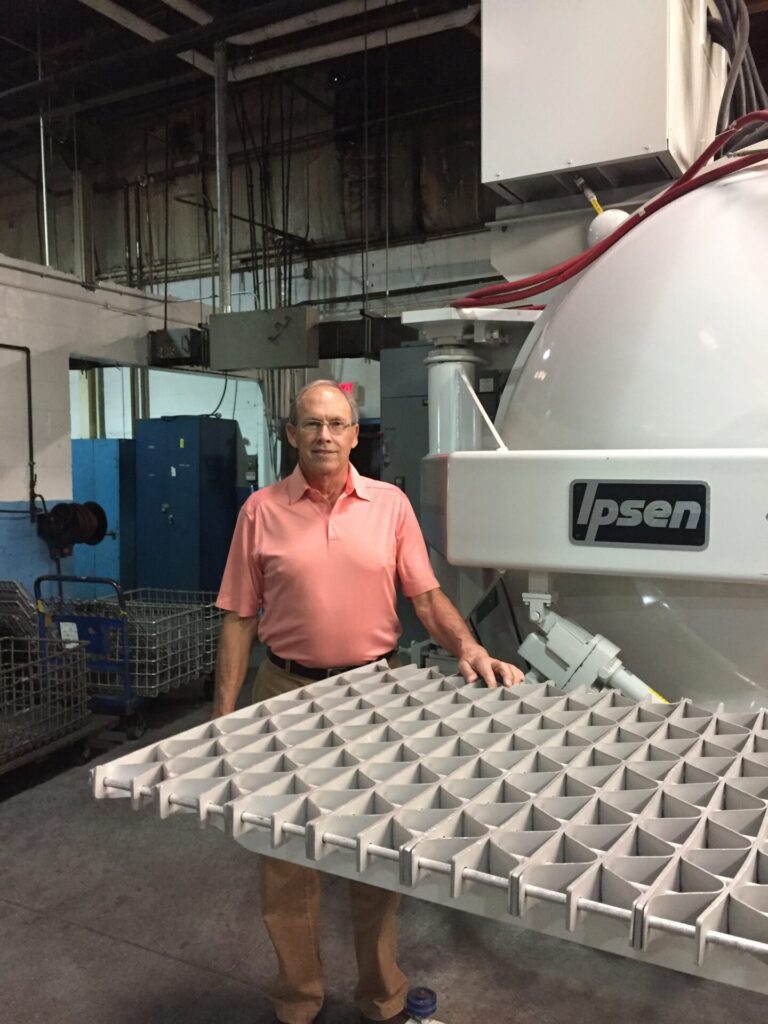
Owner John H. Vanas stands next to one of the newest pieces of equipment, an Ipsen vacuum furnace

With this focus on meeting a variety of client needs, having only one method of quenching is not sufficient. This heat treater believes their most important process is not during heating, but what they can provide through their quench fixturing capabilities. Because correct orientation and part support during quenching is paramount for uniformity of the quench and to the dimensional stability of the part, Euclid has a large inventory of fixtures that range from small, slim pins to large, multi-diameter shafts and thick roll bodies. If parts need to be flattened post-heat treatment, the company has an array of draw flattening fixtures for blades, washers, and other flat parts. This number of quenching options is just one more example of the company’s commitment to offering numerous solutions.

A variety of people, with all their different skills and expertise, make these many solutions possible. Euclid prioritizes education for their more than 60 employees. These employees are involved in online training through MTI’s Online Academy, technical training with ASM, and industry training at Heat Treat Today‘s Heat Treat Boot Camp. In addition to these outside educators, the company also sets up company-led cross training and company-sponsored management, safety, and first aid training. This additional training bolsters the knowledge of each employee, adding to their ability to provide a multitude of answers to client questions.

Continuing to diversify equipment is in Euclid Heat Treating’s future. The company plans to install a new vacuum pressure quench and vacuum temper furnace, an air temper furnace, and induction automation, while continually looking for other opportunities to invest in automation. After the equipment installation, the company will focus on a building expansion that will allow for the addition of another integral quench furnace line and prepare them to meet new industry challenges.

For more information:

Euclid Heat Treating

1408 E 222nd St
Euclid, Ohio 44117

deidram@euclidheattreating.com
http://www.euclidheattreating.com

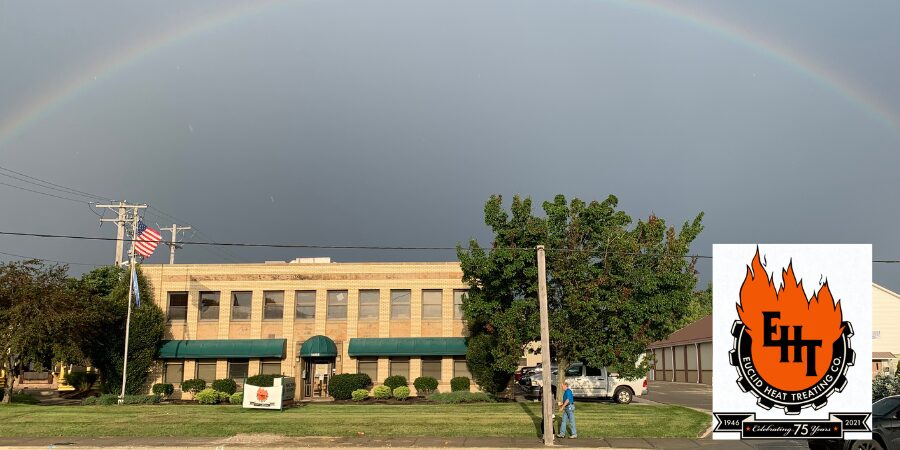
Main image: Euclid Heat Treating facility

MTI Member Profile: Euclid Heat Treating Read More »

MTI Member Profile: Zion Industries, Inc.

In a culture that does many things to a mere minimum standard, Bob Puls chose to found Zion Industries, Inc. on the standard of “Glory to God.” Seeking this high standard led the company to a specialization in induction heating, and since 1978, they have been building their knowledge on this topic. Today, the company’s expertise is demonstrated in the unique, customized services that benefit their own team as well as clients like Ford and Honda.

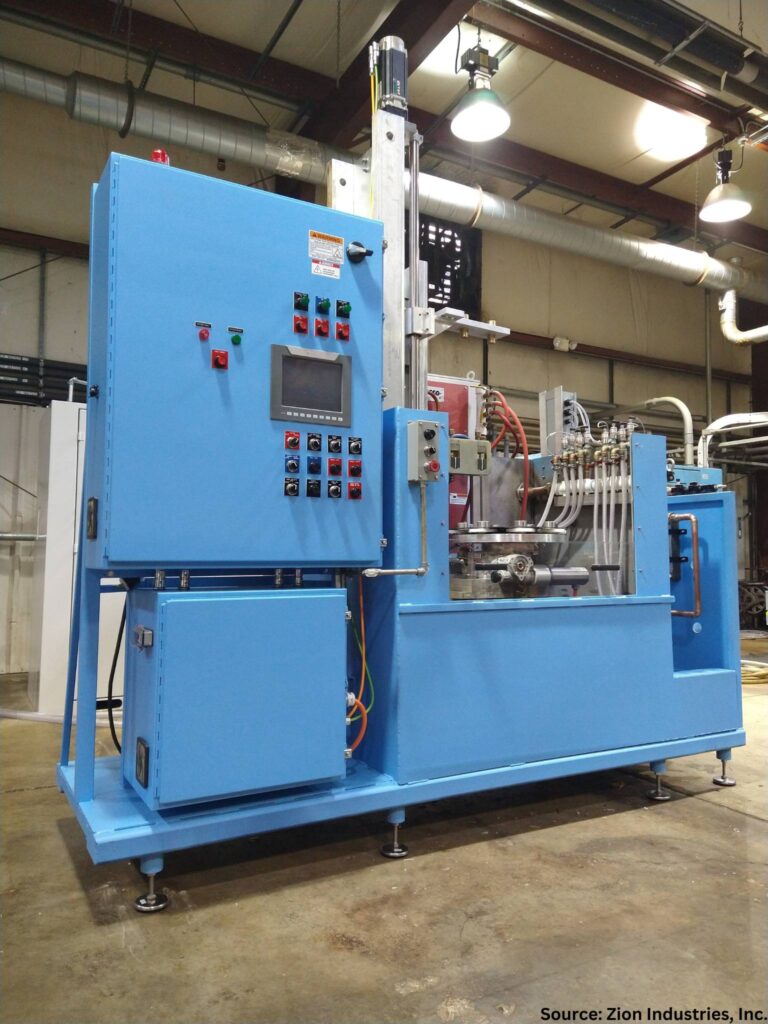
Zion’s ZSCAN induction scanner outfitted with full-service controls

Specialized, in-house induction equipment is one of the most interesting aspects of Zion Industries’ story. Across their three locations in Ohio, Michigan, and North Carolina, they have a combined total of over 30 induction machines (capable of frequencies from 3 Khz to 450 Khz and power levels from 30 Kwatts to 300 Kwatts) that were designed and built in-house. Supplementing these 30 unique machines is equipment for tempering and metallurgical inspection of all the heat treated products. The impact of this equipment is enhanced by the commitment to making their own tooling in-house, which decreased time and cost of the induction projects.

The company demonstrated their ability to create specialized solutions in-house when hardening safety critical, automotive industry parts. One instance of this was when Zion supplied latch striker parts that required a specific center case depth. This project was complicated by the fact that the part had a longer end geometry. To address this complication, the company created a completely unique, clamshell induction coil. The customization, however, did not end there. They also integrated the coil with fixtures that allowed for quenching and for sorting out suspect parts, all in the same operation.

The company offers personalized consulting services at their three locations. One aspect of these consulting services is training seminars that discuss the benefits and drawbacks of outsourcing induction heat treating versus bringing it in-house. Using the technical expertise of their 100+ employees, the company helps clients develop technology they may not currently have, but that may significantly benefit operations. The primary goal of offering consulting is to build a unique service around the client’s unique problems, rather than offering a one size-fits-all solution.

In the future, the company seeks to bring their customized, built-in-house induction equipment to new geographical markets. They will continue to upgrade their equipment and hope to integrate automation and robotics into their facilities. As Zion Industries spreads to new markets and grows internal operations, their success will continue because of their fixed focus: specialized induction heat treating.

For more information:

Zion Industries, Inc.

6229 Grafton Rd.
Valley City, OH 44280

sales@zscan.com
www.zioninduction.com

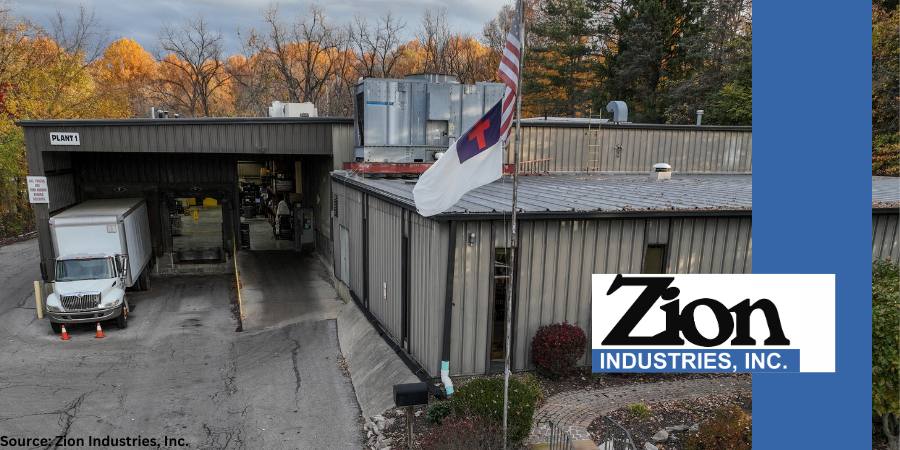
Main image: Zion Industries, Inc., facility in Valley City, OH


MTI Member Profile: Zion Industries, Inc. Read More »

MTI Member Profile: East Carolina Metal Treating, Inc.

In the North American heat treating industry, potential comes in many forms, and learning to utilize it is what can change the industry from mediocre to extraordinary. East Carolina Metal Treating, a North Carolina heat treater, has embraced the potential in their past and present heat treat equipment, new digital technologies, and their irreplaceable, diverse employees to unlock their status as a stand-out heat treater.

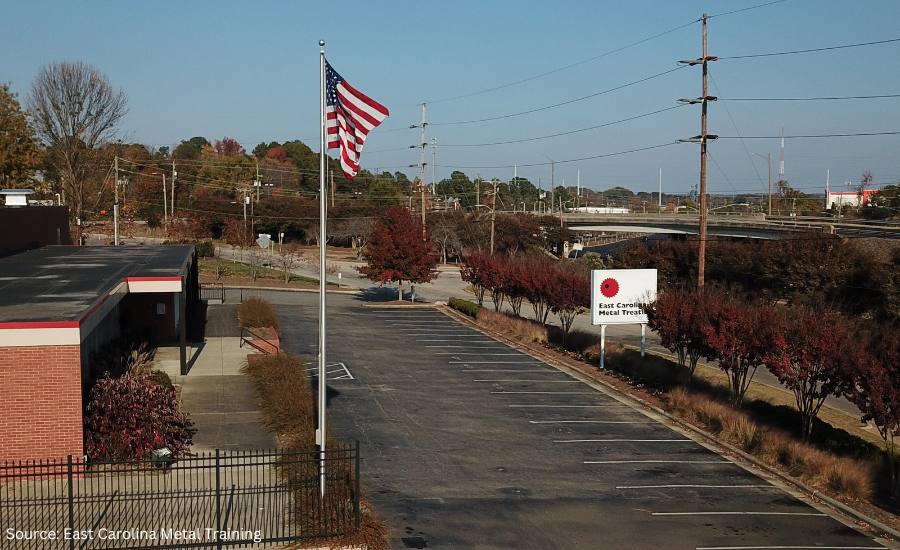
East Carolina Metal Treating facility in North Carolina

Since 1976 when they boasted only a single salt pot, East Carolina Metal Treating has increased the range of their heat treating equipment significantly. Today, the company has three cryogenic units (36 x 36 x 48 inches), five atmosphere furnaces (36 x 36 x 48 inches), and four inductions units — to name just a few. This array of equipment has enabled the company to serve a wide range of industries (including the aerospace, automotive, and medical industries) with quality service and a fast turnaround time with offerings including a metallurgical hardness testing lab.   

Embracing all the potential modern equipment brings requires new monitoring and documentation technology. This new technology, in turn, provides additional potential for continual improvement. Integral to this improvement is Bluestreak, a provider of management solutions, which provides the company with a secure, organized place to process furnace charts, customer documents, and much more. Embracing this particular technology helps the company to achieve a high level of customization in their heat treating processes as no one process is the same.

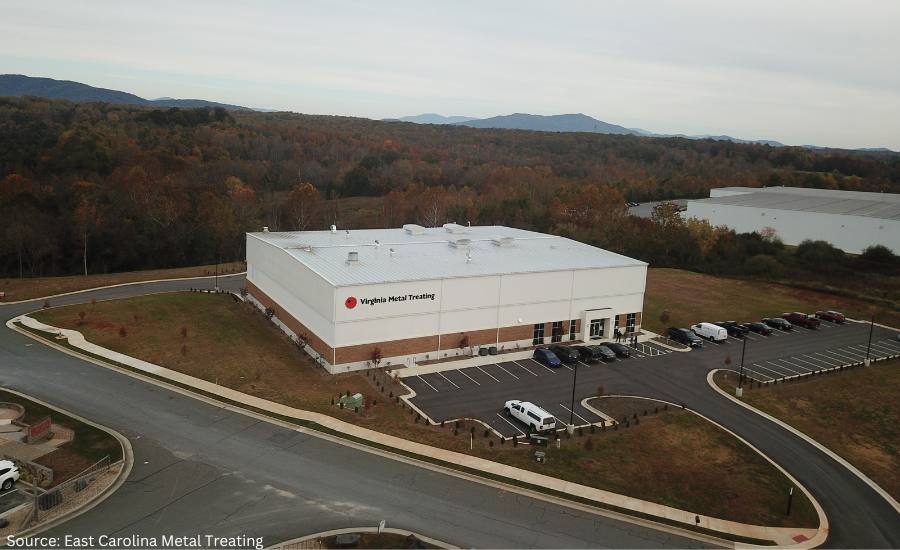
Virginia Metal Treating, Inc.

This modern equipment and new technology would be a dead end were it not for a trained team to use and apply it. Because of this, East Carolina Metal Treating makes it a high priority to utilize the potential of their team. The company believes each team member brings a different perspective on how to approach the complex problems that arise in heat treating, from the production line to the accounting department. Unlocking the potential of this 95-person team has yielded a reputation for providing quality service and a strong customer base.  

Harnessing the potential of equipment, technology, and people creates an even brighter future for East Carolina Metal Treating. In the next five to ten years, they plan to expand their range of equipment by adding aluminum quenching equipment. This will require an increase in the team’s technological capabilities, which they will address by training the 3rd generation of owner/operators, adding 20,000 square feet to their new facility in Lynchburg, VA, and creating a third facility in the southeast/mid-Atlantic region. With this ability to embrace a diverse team and new heat treat technologies, East Carolina Metal Treating is excited for a bright future.

For more information:

East Carolina Metal Treating, Inc.

1117 Capital Blvd.
Raleigh, NC 27603
United States

ecmtinc.com

quality@ecmtinc.com


Find Heat Treating Products And Services When You Search On Heat Treat Buyers Guide.Com

MTI Member Profile: East Carolina Metal Treating, Inc. Read More »

MTI Member Profile: Bennett Heat Treating & Brazing Co., Inc.

A blacksmith sweating over an open flame is not the image most heat treaters immediately identify with in 2024. In the present, heat treating tends to look more like a trained metallurgist supervising a complex brazing operation. Yet we should not throw out the blacksmith and his hammer, even though bridging the gap between past and present is a tough job. Bennett Heat Treating & Brazing Co., Inc. is known for doing just that.

This New Jersey heat treater was originally founded by Wilbur Bennett (a one-armed blacksmith turned heat treater) and was purchased by Anthony Quaglia in 1954. They make it their job to bridge the knowledge gap between the experienced and the novice heat treaters within their own team. After the sudden death of David Quaglia in 2017, John Quaglia leveraged his father’s foundational expertise to build a highly skilled team of seasoned veterans and emerging talent, which will one day include his children Anthony and Abby Quaglia. Today, Bennett Heat Treating has over 100 years of knowledge and over three generations of expertise to draw from in order to create an innovative future.

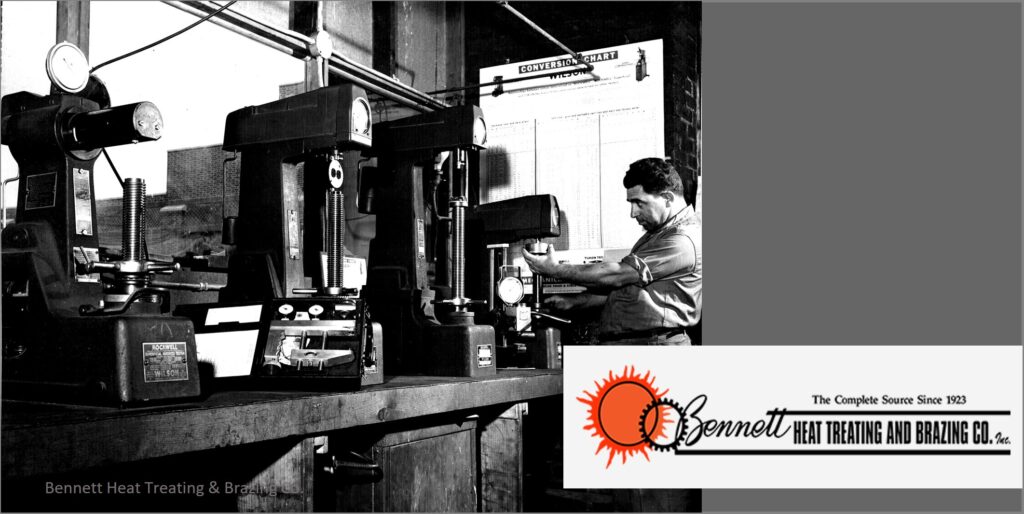
The original Bennett Heat Treating inspection department circa 1950s (Source: Bennett Heat Treating & Brazing Co., Inc.)

Technology and equipment are the keys to an innovative future, but new technology would be useless without inherited expertise. Bennett has been able to combine their modern equipment with veteran experience to create heat treating processes that are reliable. For example, their neutral salt bath with marquenching enables clients to control dimensions of parts with tight tolerances at high hardness requirements. The marquenching process is so repeatable that a few clients intentionally machine their intricate helical gears out of tolerance because they are sure Bennett’s process will return the parts to tolerance.

A solid team of knowledgeable experts who will bridge the heat treat industry’s generational gap also seamlessly meets the needs of clients. For Bennett’s major private, aerospace prime, and U.S. military clients, the metallurgical consultant team within Bennett bases its success on carefully listening to clients, identifying major lessons learned in the past, and collaborating with clients to methodize production processes that avoid past mistakes.

John Quaglia with wife Kerri and children Abby and Anthony at Bennett’s 100th year celebration (Source: Bennett Heat Treating & Brazing Co., Inc.)

John Quaglia recalls an example of how his team leads with expertise to collaborate with clients: a curved, thin part requiring nitriding on one area and optional nitriding all over it. After years of nitriding these parts, the team noted that when both sides of the part were nitrided, the edges chipped and the part would bow. Collaborating with the client, Bennett confirmed that only one side of the part needed to be nitrided. The team then developed tooling that was able to mask the part while maintaining the part’s dimensions.

In the future, Bennett Heat Treating & Brazing Co. intends to focus on gaining new equipment and building a cohesive team of employees to continue the high level of precision and quality work. No doubt, they will continue to seek to bridge the gap between seasoned heat treaters and new members on the scene through close communication — both amongst themselves and with clients. While the team will not be found in a blacksmith’s forge of the past, they will be collaborating with veteran experts and learning to apply that wisdom to meet the needs of present and future clients.

For more information:

Bennett Heat Treating & Brazing Co., Inc.

690 Ferry Street
Newark, NJ 07105

johnquaglia@bennettheat.com
www.bennettheat.com


Find Heat Treating Products And Services When You Search On Heat Treat Buyers Guide.Com


MTI Member Profile: Bennett Heat Treating & Brazing Co., Inc. Read More »

MTI Member Profile: Thermal-Vac Technology

In brazing, a filler metal is used to create a strong bond between parts. In business, what holds companies together is the shared vision of its people. That is the philosophy of the team at Thermal-Vac Technology, southern California’s premier brazing facility, where an experienced crew shares a passion for solving complex puzzles and delivering quality outcomes.

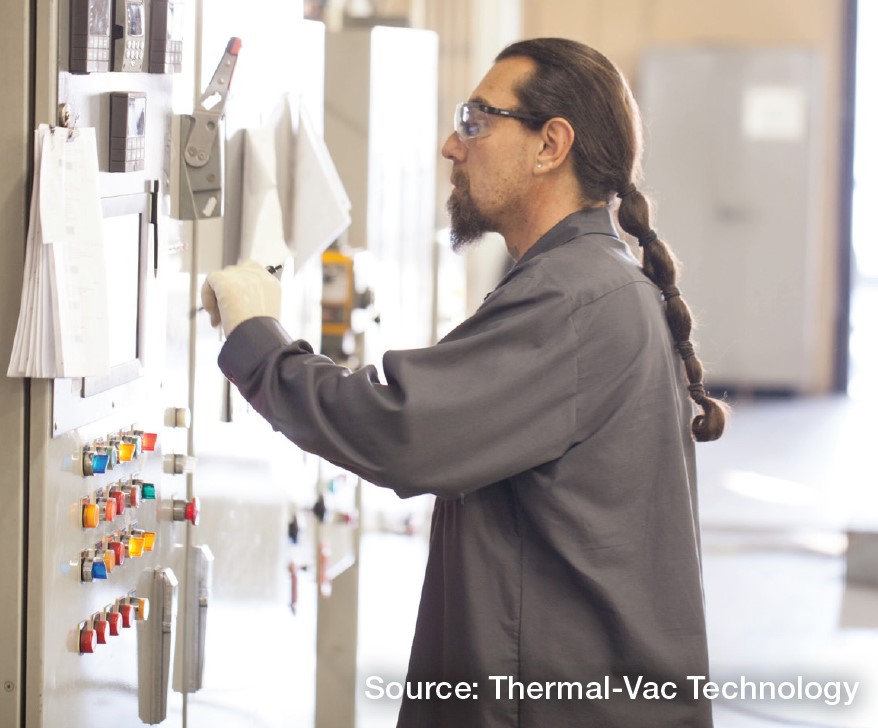
As a supplier to major aerospace programs, Thermal-Vac is united with its customers in its uncompromising approach to quality control. One of the company’s taglines summarizes its mindset: “We build good parts here; at a profit if we can, a loss if we must, but always good parts.” The company has invested in cutting-edge digital systems that provide continual insight into its brazing processes. Monitoring equipment, including digital readouts from load thermocouples inside the furnaces, gathers real-time data from part surfaces. These tools allow operators unprecedented control throughout the braze cycle and the opportunity to review in detail every step of the process to identify opportunities for improvement.

Quality control is critical for the commercial heat treater.

Incorporating digital technologies into brazing has pushed Thermal-Vac to innovate in exciting ways. Brazing is a well-defined technique, with roots going back to ancient Egypt. But today’s manufacturing requirements push the boundaries of materials science. Exotic materials, elaborate component shapes, and new end-use applications all present opportunities for innovation. Thermal-Vac’s clients have come to rely on the company to find answers to their brazing challenges. To be ready to tackle whatever its clients need, the company has assembled a large, in-house engineering team. Thermal- Vac’s engineers draw upon their specialization in the brazing field to find creative solutions in close collaboration with their customers. Some of their routine achievements include implementing a new alloy, improving component design, or creating specialized tools to achieve the customer’s planned outcome.

The proof is in the product. Thermal-Vac’s quality control standard helped it to be selected to work on NASA’s SLS-Orion project, a space exploration vehicle that will eventually send astronauts to the moon and beyond. Thermal-Vac partnered with L3Harris/Aerojet Rocketdyne in the production of rocket motors by nickel plating 10-ft long tubes that needed to be precisely plated with an even, 0.0001 inch thickness. They also hand-assembled the rocket motors’ heat shields.

The company is proud to have received the 2023 MTI Commercial Heat Treater of the Year award, which it sees as a validation of its approach to constant improvement.

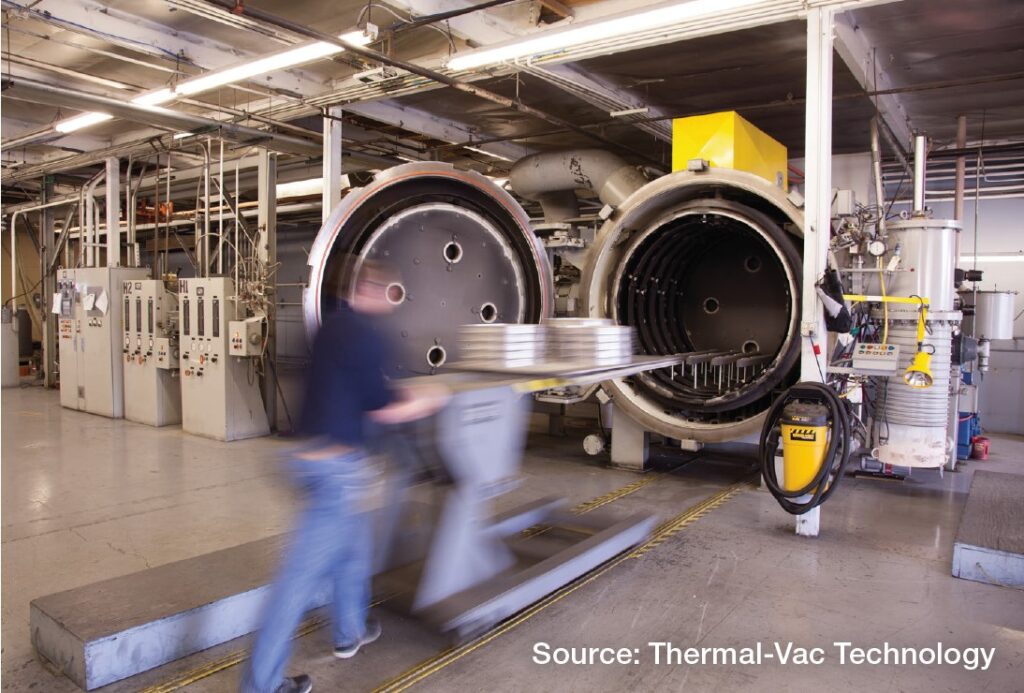
Vacuum furnace at Thermal-Vac Technology

Quality and innovation are not the entire Thermal-Vac story. CEO Heather Falcone sees the strength of the company arising from the way her 45-person team was assembled: by bringing people from all walks of life together to forge a special environment of trust and collaboration. Along with her three brothers — COO Shannon Driscol, Special Projects Expert Shane Driscol, and Sean Driscol, now president of the company’s sibling start-up company, Thermal-Vac Arizona — Heather has led the company’s commitment to diversity, equity and inclusion, and fair chance hiring practices. Heather and her brothers strive to create a workplace where everyone is valued and treated well. To do this, the company introduced well-received cultural initiatives such as a four-day work week, giving out over 20% of net profit in bonuses as featured in the Wall Street Journal, and awarded over $30,000 in charitable donations and scholarships in 2023 alone.

In recent years, Thermal-Vac Technology has been busy consolidating its operations at its Orange location. The company is pursuing numerous initiatives as it prepares for the future. Special focus will be given to streamlining operations and finding new ways to leverage technology so the company can remain agile and responsive. The company is also looking forward to continuing to foster a spirit of community in the North American heat treating industry.

For more information:

Thermal-Vac Technology

1221 W. Struck Ave.
Orange, CA 92867

sales@thermalvac.com
thermalvac.com


Find Heat Treating Products And Services When You Search On Heat Treat Buyers Guide.Com

MTI Member Profile: Thermal-Vac Technology Read More »

MTI Member Profile: Newton Heat Treating Co., Inc.

Newton Heat Treating might be located in California, but their impact is out of this world — literally. Serving a niche section of the aerospace industry since 1968, Newton Heat Treating is a company with 52 dedicated employees, working to complete highly specialized processes while retaining a merit-level of service and quality, empowering them to heat treat parts for outer space.

These highly specialized processes include cold stabilization, thermal cycling, stress relief, and the straightening of aluminum alloys. Also known as uphill quenching, cold stabilization is a cyclic thermal shock process which is used to reduce the detrimental effects of residual stresses on aluminum alloys. The use of custom fixtures and high-velocity steam instead of boiling water is what sets this process apart and makes it more efficient and cost effective. Newton is the only heat treater to perform this process, and because of that, they are working with a prime aerospace company to write an industry-standard specification for cold stabilization; this information will be available to the aerospace industry in 2024.

Furnaces such as these process client products efficiently and ensure on-time delivery. (Source: Newton Heat Treating Co., Inc.)

The primary equipment used in their processes includes the automated drop-bottom furnaces and quench
line. These furnaces process the bulk of clients’ products and have great efficiency. Though the company might not have the largest furnaces (working zones are 14’ x 5’ x 5.5’), they are nimble and will heat treat customer-supplied parts that other heat treaters do not want to touch — plus, they do it quicker than other, larger companies.

But they won’t just do jobs quicker, they will do them with five-star quality service. Newton is ITAR registered, as well as AS9100 and Nadcap certified with merit status since 2020. To ensure this standard of excellence, the last step in any process is a trip to the Final Inspection Department. There, dedicated employees inspect parts for hardness, conductivity, and cleanliness to verify the conformance of the heat treated material. This ensures success for the company’s partners: their clients.

As the last step before packing and shipping, dedicated employees in the Final Inspection Department examine parts for hardness, conductivity, and cleanliness to verify the conformance of the heat treated material. (Source: Newton Heat Treating Co., Inc.)

Their clients need this star level of quality since the atmosphere where many parts are headed is quite unforgiving: outer space, to be exact. The most interesting parts the company has treated are now orbiting in space and roaming on Mars. Parts on Voyager, an interstellar probe which is now beyond our solar system, underwent Newton’s cold stabilization process. Their thermal cycling process — a delicate process that can take up to 48 hours depending on the ramp rate, target temperatures, and number of cycles — is used on parts on Mars Rovers. With high stakes like these, keeping quality at the forefront is Newton’s goal and will continue to be into the future.

In the coming 5–10 years, the company will take small steps to become more energy efficient, environmentally friendly, and cybersecure, which will give them a giant leap into the future. Plans include replacing old equipment with new, investing more in information technology infrastructure to minimize cybersecurity issues and better protect their clients, and continuing to provide their clients with high-quality service that one might call “stellar.”

For more information:

Newton Heat Treating Co., Inc.

19235 E. Walnut Dr.
City of Industry, California 91748
United States

jrico@newtonheattreating.com
newtonheattreating.com


Find Heat Treating Products And Services When You Search On Heat Treat Buyers Guide.Com

MTI Member Profile: Newton Heat Treating Co., Inc. Read More »

MTI Member Profile: GFI Metal Treating, Inc.

Mixing close client communication, a unique record keeping system, and two special patents generates a recipe for success — at least for this Midwest heat treat company, GFI Metal Treating, Inc.

Contact us with your Reader Feedback!

Communicating closely with their clients in the agricultural, military, and construction industries, this heat treater worked painstakingly to test and perfect over 150 recipes for a variety of specifications. This process took five years and much in-house research. The research and communication have paid off, however, as they can now process an extra eight loads a day with only two or three nonconformances a year. When clients voiced diverse needs in the ever-changing industry, the company listened and began offering not only heat treating processes like carburizing and induction hardening, but also post heat treatment services such as vibratory deburr and parts cleanings.

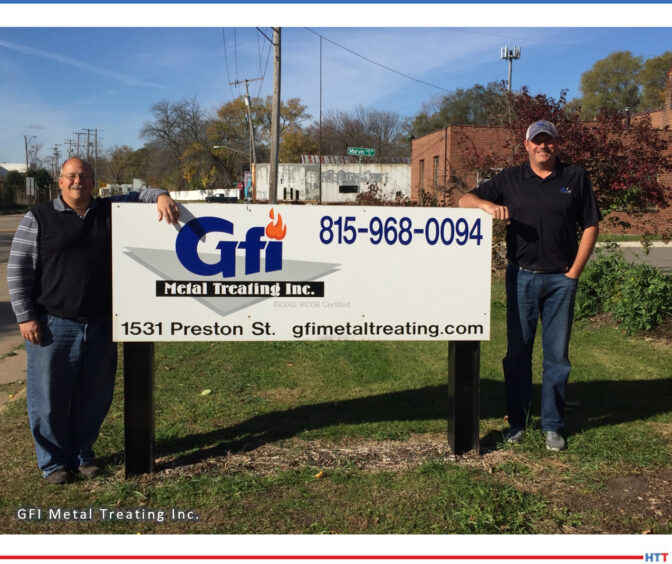
Owner Dick Francis with son and President Jason Breuer standing
outside GFI Metal Treating, Inc.

In developing these 150 recipes, a second key ingredient was at play: Their record keeping control, notably their proprietary database software, “RUN SHEETS.” RUN SHEETS follow every step in each part’s process, from prepping the basket to running the load, and can be used as a reference when needed. Parts at GFI may be processed in anything from one of two 2,500 lb IQ furnaces to one of two car bottom furnaces, and the software collects data on every step of processing each part. The database holds records since 2004, giving them a wealth of past data to be drawn upon.

The final ingredient? Two special patents pertaining to the agricultural industry. GFI hardens the top edge of crossbars for combines and holds one patent for the hardening process and one patent for the process equipment. This shows just how much they are willing to communicate with their agricultural clients, as they honed and specialized their processes and equipment to achieve these patents, creating a “print to quote” environment where all processes can be completed in house

The team at GFI Metal Treating, Inc.

The next steps in GFI’s recipe are making further developments on their three core ingredients. As they continue to focus on close client communication, growing with the client base, taking on new projects to help clients grow, and finding new clients are significant goals.

Additionally, artificial intelligence is becoming more and more a mainstay of manufacturing, and GFI is excited to see how this may affect their proprietary database software. Whatever new technology may bring — perhaps iPads will replace paper or billing will become instantaneous upon the delivery of work — the company is looking forward to adapting, and maybe even improving, their RUN SHEETS system.

Since the patented hardening equipment is so unique, equipment upkeep (and avoiding breakdowns) is a high priority for the upcoming years. The company has come a long way in a short period since their beginning in May 2000 and is excited to continue applying their recipe for success to new opportunities.


For more information:

GFI Metal Treating, Inc.
1531 Preston Street
Rockford, IL 61102-2047
United States
gfimetaltreating@sbcglobal.net
www.gfimetaltreating.com


Find heat treating products and services when you search on Heat Treat Buyers Guide.com


MTI Member Profile: GFI Metal Treating, Inc. Read More »

Skip to content