

A new method for producing hot isostatic pressing (HIP) cans could simplify manufacturing of critical components for advanced nuclear reactors while reducing reliance on constrained forging and casting supply chains.
Scientists at the U.S. Department of Energy’s Oak Ridge National Laboratory (ORNL), in partnership with A.J. Tuck Company, have developed a hybrid manufacturing process that combines 3D printing and electroforming to produce complex, leak-free HIP cans. The sealed containers are used in powder metallurgy hot isostatic pressing (PM-HIP), where metal powder is consolidated under high heat and pressure to form fully dense components.
The approach is aimed at addressing manufacturing challenges associated with advanced and small modular reactors, which require large, high-precision metal components. Limited domestic forging capacity can create production challenges for these components, while conventional HIP cans typically require several fabrication and assembly steps.
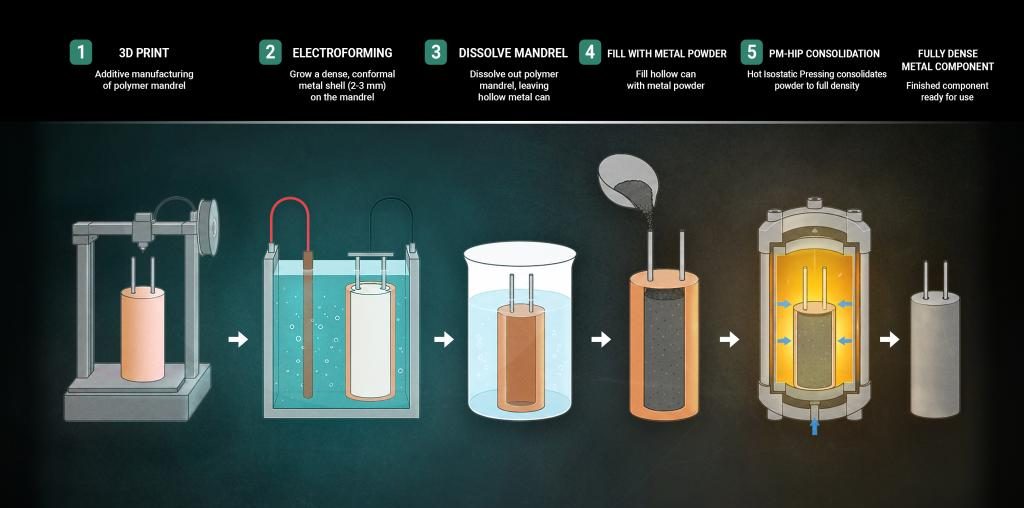
The new process begins with a 3D-printed polymer form that defines the final component geometry. Electroforming is then used to build a uniform nickel shell approximately 2–3 mm thick around the form. After the polymer is removed, the hollow metal structure is filled with metal powder, sealed, and processed using HIP to consolidate the powder into a solid component.
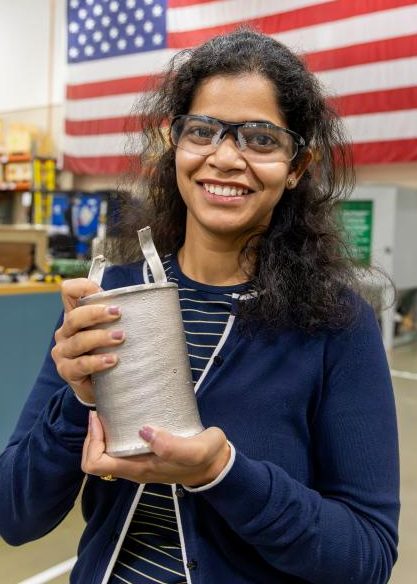
“This project shows that electroforming can successfully produce leak-free HIP cans for advanced nuclear energy applications,” said Dr. Vanshika Singh, ORNL research associate staff scientist. “This approach could make it easier to produce these components in the U.S., reducing supply chain challenges for advanced nuclear energy systems.”
During the first phase of the project, the team produced five leak-free cylindrical HIP cans measuring 6 inches tall and 4 inches in diameter. Researchers also developed an integrated port design that eliminates the separate welding of process tubes, which can be a source of failure during the HIP process.
One of the leak-free HIP cans was used to produce a 15.7-pound solid nickel component. A second phase is now underway to apply the process to a more complex geometry — either an impeller or a valve relevant to nuclear energy systems.
“Working alongside ORNL allowed us to bring our deep electroforming expertise into an entirely new domain,” said Dara Williams, president of A.J. Tuck Company. “Demonstrating that this process can produce leak-free HIP cans at this level of precision opens real doors for domestic nuclear manufacturing — and we’re just getting started.”
The technology is suited for energy applications requiring large, high-precision metal components, including reactor pressure vessels, valves, and turbine systems. The research was conducted through a cooperative research and development agreement and subsequent licensing agreement between ORNL and A.J. Trucking Company.
The ORNL portion of the project was performed at the laboratory’s Manufacturing Demonstration Facility, which is supported by the DOE’s Advanced Materials and Manufacturing Technologies Office.
Press release is available in its original form here.
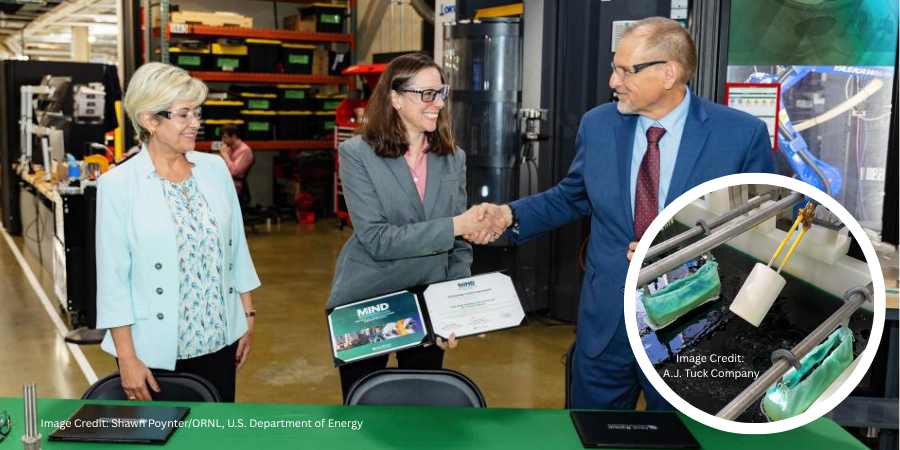
Main image shows (from left to right) ORNL’s Gina Tourassi, A.J. Tuck Company President Dara Williams, and ORNL’s Robert Wagner making a licensing agreement on Day 2 of Materials and Manufacturing Innovation Days at the MDF with a photo inset of A.J. Tuck Company electroforming a leak-free HIP can. | Image Credits: Shawn Poynter/ORNL, U.S. Department of Energy (licensing agreement) and A.J. Tuck Company (photo inset)