fringe friday

From Furnace To Your Front Door: A Morning in Heat Treatment

Heat treatment impacts almost every facet of our lives, yet few people are aware of how important this practice is to a modern way of living. Heat treatment is a process which changes the microstructure of a metal, such as hardening, carburizing, tempering, and many others.

When a metal is formed, it undergoes heat treatment in order to make it longer lasting, change its structure so that it becomes harder or softer, or reduce the tendancy toward cracking which can form during manufacturing. To help us appreciate the impact of heat treatment on our daily lives, Tiffany Ward, daily editor for Heat Treat Today, has prepared this illustrative post.


Breakfast of Champions

You wake up in the morning and roll yourself out of bed, greeting a foggy sunrise through the window. You stumble to the kitchen to fire up your cast iron skillet.
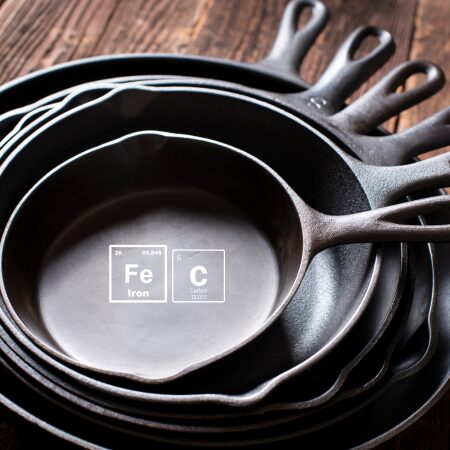
Cast iron contains a minimum of 2% carbon

At one time, that same cast iron skillet lived a provincial life, known as simply: iron. Cast iron is made from iron with greater than 2% carbon, which is in the form of graphite. When that iron was “cast,” it was melted at a high temperature, and once cooled, it transformed into a very stable material that heats and cools uniformly. Perfect for your sunny-side-up eggs.

At the foundry, someone poured the molten metal into a mold to form the exact shape your pan is in today, and then it underwent numerous heat treat processes: annealing, normalizing, tempering, and even graphitizing (a process of converting carbon into graphite). The particular processes the skillet underwent depend upon the chemistry of the cast iron.

Almost all cast iron has carbon and nitrogen added to its surface in a process called ferritic nitrocarburizing plus post-oxidation. This heat treatment gives a shallow surface layer to the pan for better wear resistance. The skillet is heated up between around 1550°F and 1650°F inside a protective atmosphere of Endothermic gas. Endothermic gas is a generated heat treat atmosphere. It is made up of approximately 40% hydrogen, 40% nitrogen, and 20% carbon monoxide. The Endothermic gas is enriched with both a hydrocarbon gas (i.e., natural gas or propane) and ammonia so that carbon and nitrogen can be added to the iron.

There are a variety of different furnaces that can be used for ferritic nitrocarburizing. Box, pit, and tip-up furnaces are used due to their large capacity. For cast iron skillets, one common choice is the pit furnace a cylindrical furnace typically located in the floor of a factory. Pit furnaces can hold a lot of heavyweight items, making them a good fit for the cookware now resting on your stove.
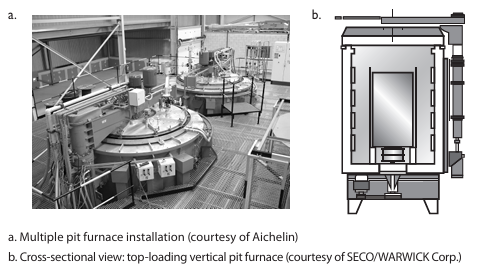
Figure Source: Herring, Daniel H., Atmosphere Heat Treatment Volume 1, BNP Media II, LLC, 2014. 

Technical Resource: An Overview of Case Hardening: Which Is Best for Your Operations?

Technical Resource: Nitriding and Nitrocarburizing: The Benefits for Surface Treatment


It Cuts Like a Knife

You pull a knife out of your drawer and begin slicing an apple. The blade reflects a beam of sun from the window, but it isn’t your best knife. You’ve noticed that some of your knives are sharper and can resharpen more easily than others; this is because of the quality of the original material used and the heat treatment process employed in manufacturing the knife.

Perhaps the knife you chose to use today was made from high carbon steel such as 1095. The blade was heat treated using a process of hardening, quenching, and tempering. After the blade was formed, it entered a continuous mesh-belt furnace and was quenched in either oil (in the case of a 1095 steel), or in the case of stainless steel or tool steel, cooled in still air.
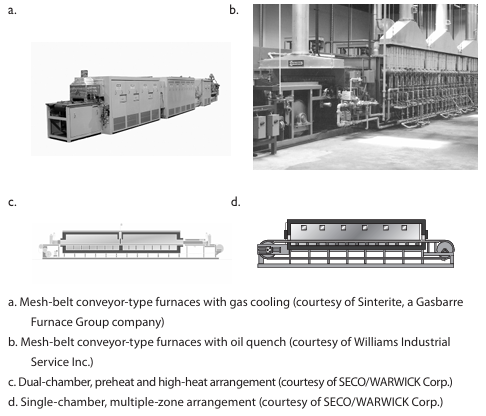
Source: Dan Herring, The HERRING GROUP, Inc.
Figure: Batch integral-quench furnace system installation (courtesy of AFC-Holcroft). Dan Herring, The HERRING GROUP, Inc.

At the same time of hardening and quenching, the handle was joined to the blade in a process called brazing. The entire knife was heated up to an austenitizing temperature and rapidly cooled in the quenching process, giving it a particular hardness level.

The hardening process can be performed in a vacuum furnace or an atmosphere furnace. The atmosphere is typically nitrogen or, more commonly, a nitrogen/hydrogen mixture. Another option is nitrogen plus dissociated ammonia (dissociated ammonia is 75% hydrogen, 25% nitrogen).

A typical temperature for the heat treatment of high carbon 1095 steel knives is 1475ºF. Stainless steels are run at higher temperatures, typically in the range of 1800º/1950ºF and tool steels even higher, to around 2200ºF.


Technical resources: Ask the Heat Treat Doctor®: How Does One Determine Which Quench Medium To Use?

Technical Resource: Heat Treat Radio #105: Lunch and Learn: Batch IQ Vs. Continuous Pusher, Part 2


Time to Look Pretty

After breakfast you head to the bathroom. You are anxious to rid yourself of unshaven scruff, carefully running a razor over your face. The razor blades were hardened and tempered for sharpness, so that you get a smooth, clean shave. 

Like knives, razor blades are hardened and are made of a medium to high carbon steel. Unlike knives, they are hardened in a continuous strip form. Envision all of your razor blades as a single, thin strip, run continuously through a furnace to heat and cool them. The blade is heated in a protective atmosphere as it runs through the furnace. On one end of the furnace is a reel that coils the strip and at the other end is an un-coiler.

Continuous style furnaces have alloy tubes inside of them that are very small in diameter, typically one inch, which run the entire length of the furnace. As the razor strip is run through the tube it is exposed to an atmosphere of nitrogen and hydrogen, typically with 3% hydrogen, to protect the razor blade surface from oxidation. Once heated, the blade enters cooling either by surrounding the tube with water or by blowing forced air on the tubes.

A process called tempering follows hardening and quenching. When you harden a material you make it stronger, but less ductile, so there is a concern that the razor blade might break. The tempering process improves ductility, removing some of the hardness but improving flexibility.

Dan Herring, The Heat Treat Doctor®, describes the balancing act this way: “On one end of the teeter totter, metallurgically, are strength properties and on the other side of the teeter-totter are ductility properties. It’s always a challenge to properly balance the teeter-totter. If you get the hardness too high, what happens to the ductility? It’s very low. As a result, the material is super hard but may crack easier. On the other hand, if ductility is too high, the material is super flexible so that it can bend like a branch of a tree in the wind, but it has little strength. You need a balance of strength and ductility in all heat treated products, which is accomplished in part by proper tempering.” 


Technical Resources: Tempering: 4 Perspectives — Which makes sense for you?

Technical Resources: Ask The Heat Treat Doctor®: What Are the Differences Between Intergranular Oxidation (IGO) and Intergranular Attack (IGA)? 


Wake Up and Smell The Heat treatment

Our lives are touched by heat treatment at every turn. Highly technical processes play their role in the formation of even the most common household items. While heat treatment may seem to some a niche industry, its impact on everyday life is ubiquitous.

A special note of thanks to Dan Herring, The Heat Treat Doctor®, for his insights and contributions which informed this post.


From Furnace To Your Front Door: A Morning in Heat Treatment Read More »

Fringe Friday: Decarbonizing the Bright Annealing Process

We’re celebrating getting to the “fringe” of the weekend with a Heat Treat Fringe Friday installment: a project that targets reducing the environmental impact of the bright annealing process. Learn more about this EU-funded initiative that is expected to impact industries using high-hydrogen-content atmospheric gas.

While not exactly heat treat, “Fringe Friday” deals with interesting developments in one of our key markets: aerospace, automotive, medical, energy, or general manufacturing.


Energy efficiency, specifically reducing the environmental impact of the bright annealing process in seamless stainless steel and nickel alloy tube production, is the goal of a new European Union-funded initiative. The recently launched LIFE H2Reuse Project seeks solutions for hydrogen recovery and reuse.

The project, coordinated by DMV (Cogne Group, formerly Mannesman Stainless Tubes) in partnership with Tenova, is expected to impact industries using high-hydrogen-content atmospheric gas, which could apply the project’s results to reduce their carbon footprint, optimize resource use, and lower operating costs.

In the bright annealing process, 100% hydrogen is used in high-temperature furnaces to produce high-performance tubes with superior surface quality, corrosion resistance, and durability. Currently, hydrogen is flared after each production cycle, leading to significant waste. The LIFE H2Reuse project aims to address this issue by developing two innovative technical solutions: recovering the wasted hydrogen from the annealing process and reusing it as fuel in radiant tubes working 100% of hydrogen. This approach represents a market-first innovation, as the recovery of atmospheric gas for reuse in industrial processes is not yet commercially available.

While hydrogen burners are already on the market, they remain in a developmental phase. The initiative will focus on enhancing their efficiency and effectiveness in real-world industrial environments. The project’s expected outcomes include significant reductions in carbon footprint, energy consumption, and resource waste, all of which will be rigorously tested to demonstrate their technical, environmental, and socio-economic benefits.

The press release is available in its original form here.

Main image: Technologies used by Tenova in the bright annealing process


Find heat treating products and services when you search on Heat Treat Buyers Guide.Com


Fringe Friday: Decarbonizing the Bright Annealing Process Read More »

Fringe Friday: Additive Manufacturing Brings Metal Processing to New Heights

We’re celebrating getting to the “fringe” of the weekend with a Heat Treat Fringe Friday a press release detailing how additive manufacturing continues to move into the metals manufacturing industry.

While not exactly heat treat, “Fringe Friday” deals with interesting developments in one of our key markets: aerospace, automotive, medical, energy, or general manufacturing.


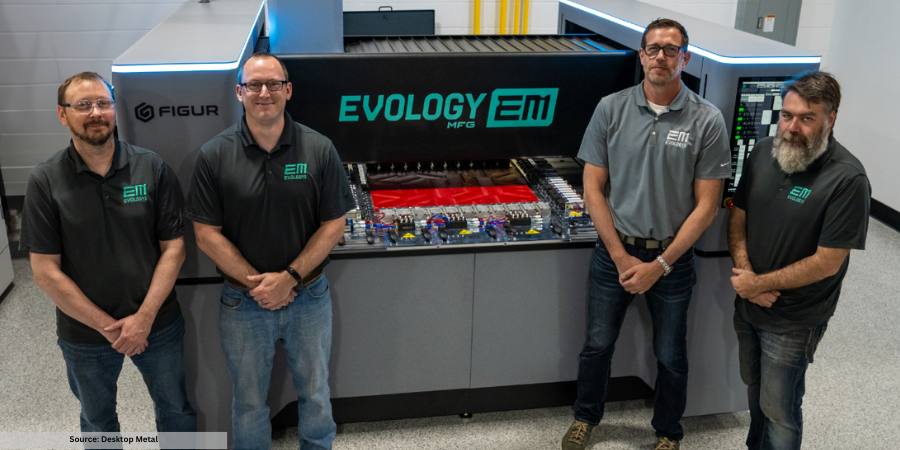
Desktop Metal, a global company at the forefront of additive manufacturing 2.0 technologies for mass production, announced that it has installed four Figur G15 Pro systems featuring digital sheet forming (DSF) technology to three manufacturers, including Evology Manufacturing in Waukesha, Wisconsin.

With 30+ years as a contract manufacturer, Evology has a full suite of both traditional and additive technologies to service companies in a wide range of industries, including aerospace, defense, automotive, agricultural, marine, mining, medical, electronics, and consumer goods. Evology serves companies ranging from small startups to Fortune 50 companies with prototyping and low-volume production, typically under 10,000 pieces.

Evology is now offering digital sheet form parts off its Figur G15 for cold rolled steel up to 2 mm thick and 6061 aluminum up to 3.175 mm thick, with more materials in development.

“We are delighted to offer our customers this cutting-edge rapid sheet metal forming technology from Desktop Metal,” said Sean Momsen, VP of Business Development and Marketing at Evology. “In addition to our ability to fabricate sheet metal parts rapidly, we also have a full suite of traditional finishing equipment to deliver finished final products to customers.”

Justin Nardone, CEO of Figur, a Desktop Metal brand, said, “We are encouraged by the continued demand we see for our rapid sheet metal forming technology, which truly saves manufacturers time and money when it comes to sheet metal production. The G15 eliminates a lot of the work required when forming metal, such as the design and manufacturing of tools and dies. Our system produces designs quickly, accurately, and repeatedly, so manufacturers are able to focus on the craftsmanship of design while getting their products to market faster and more efficiently.”

Introduced in 2022, the Figur G15 is the first commercial platform of its kind to shape sheet metal on demand directly from a digital file. A software-driven proprietary tooling system on an XY gantry forms the sheet with up to 2,000 lbs of force in a highly engineered and proprietary build zone.

With a maximum sheet size of 1,600 x 1,200 mm (63.0 x 47.2 in), the Figur G15 delivers parts with a draw depth up to 400 mm (16 in) in Z without custom forming tools, molds, dies, or presses. The G15 supports forming a range of metals and sheet thicknesses – including steel up to 2.0 mm and aluminum up to 2.5 mm – and delivers a high quality surface finish

Pro configurations of the Figur G15 include an automatic tool changer and measurement, through tool part lubrication, and automated work holding capabilities.

This press release is available in its original form here.


Find heat treating products and services when you search on Heat Treat Buyers Guide.Com


Fringe Friday: Additive Manufacturing Brings Metal Processing to New Heights Read More »

Fringe Friday: 3D Printing Premium Performance Tractor Valves

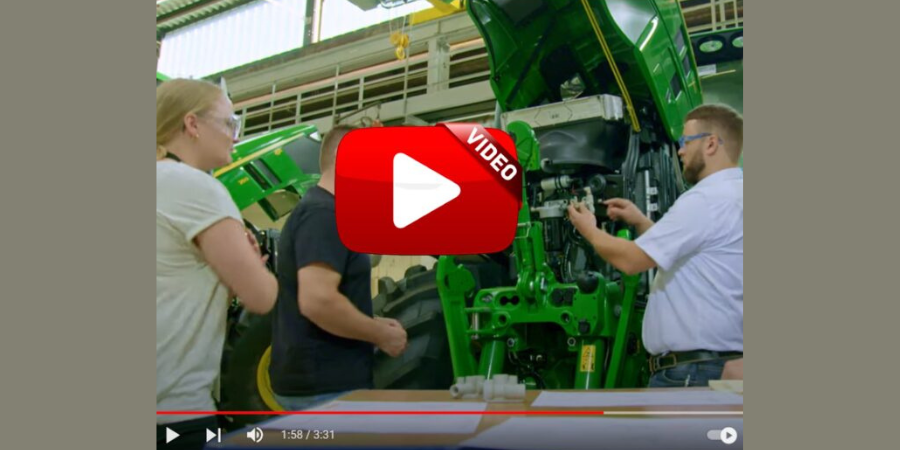
Click to watch the helpful video for the topic
Source: John Deere UK IE/YouTube

Source: Forbes

Sometimes our editors find items that are not exactly "heat treat" but do deal with interesting developments in one of our key markets: aerospace, automotive, medical, energy, or general manufacturing. To celebrate getting to the “fringe” of the weekend, Heat Treat Today presents today’s Heat Treat Fringe Friday best of the web article that investigate the success of 3D printing an engine part for John Deere.

In collaboration with GKN Sinter Metals, the project team was able to develop, qualify and introduce the Thermal Diverting Valve 3.0. – a stainless steel component in the fuel system. This is the company’s first 3D printed metal part in production. Using this production method, results are showing significant cost savings and less materials usage. R&D phase worked to develop a part that would outperform, in cold weather, the current valve. Testing in the lab and in the field have gone well; other projects could benefit including printing of replacement parts.

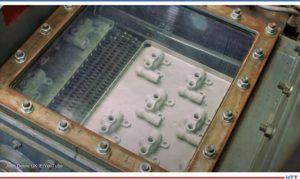
Thermal Diverter Valve 3.0 prototypes
Source: John Deere UK IE/YouTube

An excerpt: "The new thermal diverter valve on the latest versions of John Deere 6R and 6M tractors isn’t just an innovative application of increasingly accessible metal 3D printing technology, it’s the culmination of about two years of R&D."

Source: Forbes


Find heat treating products and services when you search on Heat Treat Buyers Guide.com


Fringe Friday: 3D Printing Premium Performance Tractor Valves Read More »

Fringe Friday: How to Sell Amid Global Shortages

Source: ThomasNet.com

Sometimes our editors find items that are not exactly "heat treat" but do deal with interesting developments in one of our key markets: aerospace, automotive, medical, energy, or general manufacturing. To celebrate getting to the "fringe" of the weekend, Heat Treat Today presents today’s Heat Treat Fringe Friday best of the web article discussing how to sell amidst global shortages.

We all remember the great toilet paper shortage of 2021, but supply chain issues have created shortages in other areas as well. How can manufacturers sell when warehouses may be empty and jobs may be on hold due to parts stuck somewhere in the supply chain? This video gives practical tips for how to sell to clients no matter where they are in the supply chain.

An excerpt:

"For one, companies should focus on being nimble, and that could mean adapting their sales strategy to the current circumstances. Creating promotions around goods that are readily available can help move customers over, but for those who are committed to a certain product, incentivizing or rewarding their patience can keep them from jumping ship while they wait."

Read more at "How to Sell Amid Global Shortages"

Fringe Friday: How to Sell Amid Global Shortages Read More »

Fringe Friday: Can Solar Panels Use Non-Toxic Metals?

Source: Interesting Engineering

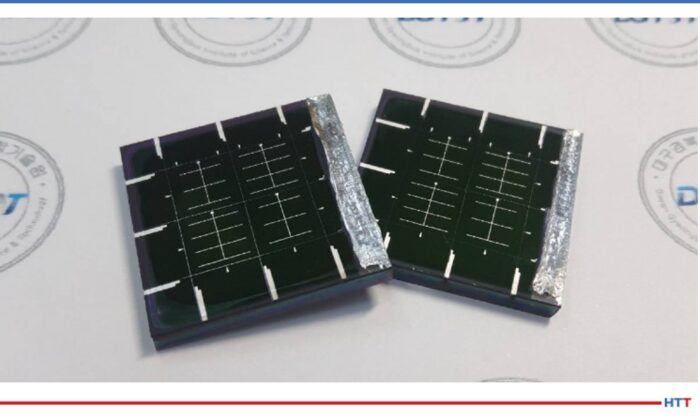
Solar Panels (photo source: InterestingEngineering.com)

Sometimes our editors find items that are not exactly "heat treat" but do deal with interesting developments in one of our key markets: aerospace, automotive, medical, energy, or general manufacturing. To celebrate getting to the "fringe" of the weekend, Heat Treat Today presents today's Heat Treat Fringe Friday Best of the Web article on efficient alloy-based solar panels. These solar panels are free of toxic metals and can be implemented in producing electronic devices, buildings, and vehicles.

Check out how scientists from Daegu Gyeongbuk Institute of Science and Technology in South Korea were able to overcome issues of underperformance in this article by Interesting Engineering: "Efficient Alloy-Based Solar Panels Created Free of Toxic Metals."

An excerpt: "'Thin-film solar cells using bronze (Cu-Sn) and brass (Cu-Zn) as base materials are composed of non-toxic earth-abundant materials, and have been studied worldwide because of their low cost, high durability, and sustainability,' said Kang[...] While theoretically they are said to perform as well as top market products, in reality, they severely underperform[...] The scientists looked for a way to bypass these flaws and produce the best quality CZTSSe (copper, zinc, tin, sulfur, and selenium) thin films. They came up with the ingenious solution..."


(photo source: marvin meyers at unsplash.com)

(photo source: gabriel chouinard at unsplash.com)


(photo source: Alin Zainescy at unsplash.com)


Fringe Friday: Can Solar Panels Use Non-Toxic Metals? Read More »