EDITOR

Message from the Editor: ASM Executive Leadership Forum

Heat Treat Today publishes twelve print magazines a year and included in each is a letter from the editor. This letter is a pre-release from the December 2025 Annual Medical and Energy Heat Treat print edition. In today’s letter, Bethany Leone, managing editor at Heat Treat Today, shares about the ASM Heat Treat show of 2025.


Attending the bi-annual Heat Treat show is always a thrill. The ASM Heat Treat Society did not disappoint, bringing a full line up of technical sessions and engaging panels to attend between walking the busy show floor, itself packed with cutting edge research presentations and informative booths of key players. I had the opportunity to attend more sessions than usual this year to hear what concerns in industry were being raised at this event. 

On Monday, October 20, ASM President Dr. Navin Manjooran, chaired the first ever Executive Leadership Forum, bridging the concerns and forecasts of industry leaders with the bold training methods of frontline academic leaders. The event was specifically hosted for the IMAT conference attendees at the collocated 33rd Heat Treating Society Conference and Exhibition. 

Dr. Manjooran underlined the intent of creating stronger collaborations between these two groups, with the first moderator, Renee Parente, director of Technology and Product Engineering at Advanced Micro Devices (AMD), further emphasizing the goal of accelerating innovation through open discussions like these. 

Industry Panel 

At this forum, the first panel included a Q&A portion moderated by Renee Parente with the following four industry panelists: 

  • Dr. Aziz Asphahani, FASM, chairman and CEO of Questek Innovations 
  • Dr. David Furrer, FASM, principal fellow and discipline lead for materials and processes at Pratt & Whitney 
  • John R. (Chip) Keough, PE, FASM, chairman and president at Lightspeed Concepts/Joyworks LLC 
  • Dr. Dehua Yang, FASM, president at Ebatco 
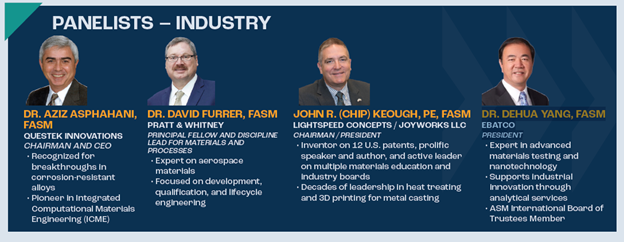
Screenshots from the ASM Executive Leadership Panel handout
Source: ASM International

From this panel came key thoughts on how research in the business world was being developed to further commercial efforts. First, there was a consensus that corporations were investing in research internally but were instead looking to start-ups to absorb the energies of research and development needs. While academic-industry partnerships were valuable, the concern over IPs was reviewed with Dr. Furrer adding that it is commitment to collaborative internal research efforts and external research industry partnerships that is most meaningful. He also added that the new generation of engineers are entering the workforce with new tools of industry at the ready to implement, and this shift needs to be welcomed to keep pace with the speed of innovation.  

Another important thread of discussion in this panel was the need to both accelerate the development of higher performance materials (Dr. Asphahani), as well as implement this development in a connected manner across engineering counterparts, like the quality, manufacturing, and design departments (Dr. Furrer) for effective product development.  

Academic Panel 

The academic panel revealed specifics on exciting current and developing efforts to train the rising workforce. Dr. Viola L. Acoff, the dean of engineering at the University of Mississippi, passionately shared the success of her breakthrough course design to retain freshmen metallurgy students through a hands one MTE 101 course, which includes access to a fully functioning foundry and efforts to grow already present real-world industry experience through industry-sponsored programs. 
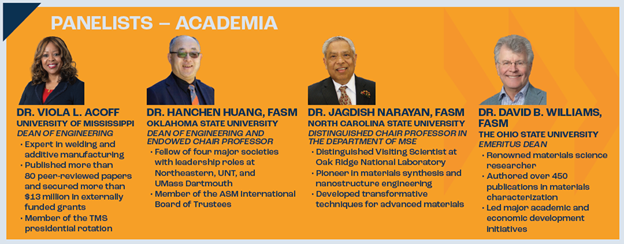
Screenshots from the ASM Executive Leadership Panel handout
Source: ASM International

While the panel acknowledged the ongoing efforts to prepare students to use AI and other technologies of Industry 4.0 (and 5.0), there was a mixture of other emphases, including: 

  • the “plug-and-play” graduate who does not need remediation training at their first job (especially emphasized by Dr. Christopher Berndt, distinguished professor, Surface Science and Engineering at Swinburne University of Technology
  • a focus on developing materials engineers who think critically 
  • a close look at the publication system, with some specifically advocating the need to rethink this system as the barometer for engaged students and commercially focused research 

The four-person academic panel was completed by Dr. Hanchen Huang, FASM, dean of Engineering and endowed chair professor at Oklahoma State University, and Dr. David B. Williams, FASM, dean emeritus at The Ohio State University. The moderator was Dr. Zi-Kui Liu, FASM, Dorothy Plate Enright Professor in MSE at The Pennsylvania State University

Audience 

I sat in a room amidst several dozen heat treat decision makers from both the commercial and teaching ground of heat treat, ranging from student and early career to research veteran and recently retired. Audience members asked their questions after both of the panels and mingled after the session to share a few words amongst ourselves and the generous speakers.  

Clearly, concern for the next generation of materials experts to meet industry needs — both in training and in availability of personnel — was of primary importance. Be it the question of how industry was investing in secondary and primary education interventions or a side discussion questioning how the leaders of both panels were driving young people toward entrepreneurial competition, the room buzzed with interest. 

Summary 

One comment Dr. Furrer shared outside of the panel session was his interest in how the focus of academia was shaping the opportunities available to upcoming industry leaders and engineers. 

Despite the government panel being unable to participate in the forum due to the ongoing government shutdown, this forum proved to be emblematic of Dr. Manjooran’s summary of ASM’s most important attribute: the ability through connections — memberships, partnerships, etc. — to advance materials worldwide.  


Bethany Leone
Managing Editor
Heat Treat Today
Contact: Bethany Leone at bethany@heattreattoday.com


Message from the Editor: ASM Executive Leadership Forum Read More »

Message from the Editor: An Editorial Eye on AI

Heat Treat Today publishes twelve print magazines a year and included in each is a letter from the editor. This letter is from the August 2025 Annual Automotive Heat Treating print edition. In today’s letter, Bethany Leone, managing editor at Heat Treat Today, describes the parameters, limitations, and benefits of using artificial intelligence in our heat treatment publication.


You have questions; AI has answers. But we have expert editorials.

Heat Treat Today delivers practical, accurate, and trustworthy information to a very niche and critical industry in North American manufacturing. With AI tools becoming more accessible and powerful, we want to be transparent about how we leverage them to maintain high editorial standards.

First, “The Don’ts”

Simply put, we don’t let AI replace our direct access to expert technical advice or content. Your heat treat efforts are too important for us to give you articles that have not been reviewed and cross-examined by our team, which is trained to review heat treat industry content.

Compose Technical Articles

We don’t use AI to generate technical articles for direct publication. Authenticity is at the heart of our editorial process, and our readers rely on us to deliver information straight from credible sources — directly from operators, engineers, and experts.

In our editorial department, technical content undergoes rigorous editorial review; we don’t rely on AI here. Our editors’ eyes are trained to catch and improve areas of technical confusion, so our readers receive help from the best practical heat treat information.

Learn Technical Concepts

I do not want to overstate this idea, because AI does generate helpful answers to common queries; you will note below that we appreciate this handy, interactive research assistant! But when it comes to learning a concept thoroughly, and especially for the first time, we prioritize validated sources:

  • Our in-house technical advisors
  • Reputable books and resources
  • Trusted websites from industry authorities

We do this to ensure accurate interpretation and traceability of knowledge.

Let me give an example: If I ask public AI for the most relevant quenching issues operators face, the answers it will give me will be based on material — often marketing material — that it can access online. While not incorrect, we always draw our material from resources with direct, on-the-floor experience to give you the benefit of more robust research and proven, hands-on expertise. (Furthermore, you can ask AI that question, too! We want to give you the benefit of more robust research and proven, hands-on expertise.)

And “The Dos”

AI can be an incredibly effective tool for supporting aspects of our editorial and communication processes. The following examples show how AI pushes us to actualize our creative juices, helps us think more clearly, and gives us time to hone more compelling and relevant content.

Hyperdrive the Early Draft

AI helps us create early drafts of editorials based on structured outlines. This accelerates the writing process, teasing out rough thoughts into a foundation that our editors will refine and often rewrite to enrich with targeted insights. Ever heard of writer’s block? Sometimes, AI is just what we need to get the ball moving!

Find Technical Gaps

Although we are not content experts, we often have a hunch when some technical aspect is missing or incorrect. AI can be helpful to scan sections where we have questions and provide suggested context for such sections — or simply tell us that we are being delusional. Once identified, our team collaborates with experts to address knowledge gaps or inconsistencies.

Research Tech Qs and News

AI helps us cut to the chase. Serving as a dialogue partner, AI conversations help editors refine research questions before consulting our technical experts and authors. This allows us to approach consultations with greater clarity, maximizing the value of expert input.

Additionally, AI scans our online lineup of industry news sources to find relevant stories, offering a more curated alternative to traditional RSS tools.

Refine Headlines & Article Summaries

Critical reader engagement calls for compelling and technically correct phrasing. For a niche trade publication, you might see how AI can help stimulate the creative iteration process to help us avoid the same wording. The headlines and introductions to articles in this magazine probably had an AI-hand help!

Revisit Technical Concepts

I’ll be frank: editors are not content experts! But as editors in this industry, we train ourselves on common concepts (and sometimes very marginal topics) enough to ensure we best assist expert authors and contributors. Therefore, we use AI to revisit technical concepts to refresh our understanding.

Since this is a “refresh,” we can discern when AI wants to do its own thing or emphasizes a concept a bit too much.

To summarize, AI is not an author nor an expert; it’s an editorial tool that spurs us on. We will continue to value people and their contributions in the ever-developing world of manufacturing.


Bethany Leone
Managing Editor
Heat Treat Today
Contact: Bethany Leone at bethany@heattreattoday.com


Message from the Editor: An Editorial Eye on AI Read More »

Message from the Editor: Lifelong Learner

Heat Treat Today publishes twelve print magazines a year and included in each is a letter from the editor. This letter is from the June 2025 Buyers Guide print edition. In today’s letter, Karen Gantzer, editor-in-chief/associate publisher at Heat Treat Today extols the virtue of continuous learning in the heat treatment industry.


May was a busy month. Much travel was part of the schedule — both business and pleasure. Our business trips, however, were filled with enjoyment in being with others and enrichment experienced through team building competitions and challenges to habits and disciplines. Upon reflection, it’s encouraging and empowering to be a lifelong learner.

As you know, heat treating involves heating and cooling metals under controlled conditions to enhance their strength, durability, and adaptability. Much like this process, learning as we age transforms our minds and perspectives, making us more resilient and capable of facing life’s challenges. Just as a metal alloy becomes tougher through repeated cycles of heating and cooling, our continued pursuit of knowledge — whether through new skills, experiences, or ideas — sharpens our minds and enriches our lives.

One of the opportunities to learn was through attending the Metal Treating Institute (MTI) Spring Meeting in San Juan, Puerto Rico. What a destination for a meeting — sunshine, ocean breezes, warm sand — someone had to go!

It’s always a joy to catch up with friends from the industry and meet new folks as we listened to heat treaters share insights from their part of the thermal processing world. We were encouraged by coaches who shared tools to become better leaders and our competitive hunger was satisfied through Beach Olympics. All providing helpful takeaways to employ when we returned to the real world.

More Heat Treat Today staff attended the OX8 Conference in Chicago, hosted by Omeda, an audience engagement platform company that we work with. This event welcomed those in the publishing world. What a treat to meet others who work with words and whose goal is to increase audience engagement.

At Heat Treat Today, we believe people are happier and make better decisions when they are well informed. This conference focused on AI and how to responsibly use it along with other software tools to increase engagement for those with in-house heat treat operations. What a fun team building time! AI is a beast, but learning just a fraction of its capabilities with others was a blast.

How can you be a lifelong learner?

One learning opportunity is this month’s Heat Treat Today June issue — our annual Heat Treat Buyers Guide. Once a year we print the latest information about where you can find and learn more about heat treat equipment, products, services, and providers. It is a treasure trove of all things heat treat.

Additionally, you can continue to learn from the monthly installments of The Heat Treat Doctor (p.12), Controls Corner (p.117), and Combustion Corner (p.118), plus explore how to save money with ceramic fiber insulation by reading the conversation between Doug Glenn and Mark Rhoa of Chiz Bros (p.108).

Like heat treated materials that withstand stress, a mind that continues to learn grows more adaptable and robust, enabling us to contribute meaningfully to others. Learn all you can and enjoy the journey!


Karen Gantzer
Editor in Chief/Associate Publisher
Heat Treat Today

For more information
Contact Karen Gantzer at: Karen@heattreattoday.com


Message from the Editor: Lifelong Learner Read More »

Integrity in the Industry

Heat Treat Today publishes twelve print magazines a year and included in each is a letter from the editor. This letter is from the May 2025 Sustainable Heat Treat Technologies print edition, and serves as the final message from Jayna McGowan, a dear member of the Heat Treat Today team.

Jayna McGowan
40 Under 40 Coordinator
Heat Treat Today

Recognizing a job well done, an individual striving for excellence in their work, and someone who demonstrates leadership potential for years to come is not only a form of integrity in the workplace, but an opportunity to encourage a company and an industry to be the best it can be. A work environment that does not recognize excellence risks undermining it, leaving employees demoralized as they tackle the daily challenges inherent to their work. Those who have worked in both environments — the one that pursues and recognizes excellence and the one that does not — know the value of the former. The individual and the company both benefit from recognizing excellence. 

This is why it has been an absolute privilege to coordinate Heat Treat Today’s 40 Under 40 initiative. Getting to learn about the accomplishments of rising stars in the heat treat industry and then to share those with our readers speaks to the overall integrity of the people and companies in the industry. My favorite part about communicating with individuals who have been nominated is their tendency to be surprised by their nomination — in their minds, they are simply doing their job the way they know how to do it, which makes it all the more encouraging to hear that someone noticed their effort and wants them to be honored for it. 

Another aspect I have enjoyed about supervising 40 Under 40 is seeing how the individuals recognized are contributing to the heat treat industry as a whole. Here at Heat Treat Today, we see firsthand how individuals honored in past years are willing to share their experiences and expertise by authoring articles or being interviewed for a Heat Treat Radio episode. Several highlights of these alumni contributions from the past year include: 

The example set by these individuals and so many others has the potential to inspire and inform the entire heat treat industry.  

Finally, how can you 1) model the integrity of recognizing a job well done in the industry and 2) encourage young leaders like these to continue pursuing excellence? One way is to nominate a North American heat treater you know for the 40 Under 40 Class of 2025. Nominations officially open May 19 and close June 27.  

While I will be stepping away from coordinating this initiative to raise my twin girls due in a couple months (future heat treaters?), please reach out to incoming coordinator, Kelsha Wells (kelsha@heattreatoday.com), with any questions about the nomination process.

Contact the Editorial Team at editor@heattreattoday.com


Integrity in the Industry Read More »

Message from the Editor: Big Ideas

Evelyn Thompson
Assistant Editor
Heat Treat Today

Heat Treat Today publishes twelve print magazines a year and included in each is a letter from the editor. This letter is from the April 2025 Annual Induction Heating & Melting print edition, and serves as a farewell from Evelyn Thompson, a dear member of the Heat Treat Today team.


In 2015, my dad came home with yet another big idea. As the last remaining Glenn kid at home — a bit of an angsty 16-year-old living in the attic above my dad’s home office — I had plenty of experience with my dad’s big ideas, enough to know, “This isn’t going to work out.” To give you some examples, here are a few of my dad’s other big ideas:

  • “Cappuccino eggs.” Exactly what it sounds like — a gas station cappuccino poured over scrambled eggs.”
  • “I’m thinking about selling vegetables at the local farmer’s market.” He is in no way a farmer.
  • “Let’s invite a few complete strangers to intimate family gatherings!” This made for some pretty awkward family dinners.
Source: Evelyn Thompson
The infamy of Dad’s big cappuccino egg idea lives on in the minds of all three Glenn kids.

The track record was not looking good for the big idea of 2015. And that big idea was: “I’m thinking of making a career change in my early 50s while paying for three student loans. I’m going to start my own thermal processing magazine!” Sounded like cappuccino eggs to me. Needless to say, I did not believe in him.

Much to my surprise, though, this big idea stuck.

Throughout my last few years of high school, my dad would come home every day, walk up to his office, put his backpack down, boot up his computer, and get comfortable at his standing desk. From my attic perch, I could hear him tippety-type away. When I ventured down, he’d say, “Ev, come take a look at this!” “This” was a mid-sized email list he’d compiled from his phone contacts.

“I’m putting together news items to send out on a semi-regular basis. I call it ‘Chatter.’” And that Chatter will go straight into everyone’s junk folder, I thought.

But I was wrong about Chatter, and I was wrong about my dad’s big idea.

Today, the Heat Treat Daily e-newsletter (what Chatter became), has a circulation of more than 4,000 industry members. My dad employs over ten people, and Heat Treat Today is the number one thermal processing magazine in the North American heat treating industry. Making a drastic career change in his 50s wasn’t such a bad idea. He was right after all.

Doug and Evelyn at Evelyn’s wedding in 2020

As I wrap up my time as assistant editor at Heat Treat Today to have my second kiddo, I am beginning to realize my dad was right after all on a few other things, too.

Here they are, for posterity’s sake:

  • “Don’t worry about money, just do what you love.”
  • “Always do the right thing.”
  • “Sleep is underrated.”
  • And lastly (most importantly to me): “God does not make junk.”

Contact the Editorial Team at editor@heattreattoday.com.


Message from the Editor: Big Ideas Read More »

1 Big Event vs. 7 Industry Events

Heat Treat Today publishes twelve print magazines a year and included in each is a letter from the editor, Bethany Leone. In this installment, which first appeared in the March 2025 Aerospace Heat Treating print edition, Bethany gives a preview of important events ahead in 2025 for the heat treating industry.

Feel free to contact Bethany at bethany@heattreattoday.com if you have a question or comment. 


Just about now, the demands of one big event — welcoming a newborn into our family — will be monopolizing my time for the next few months. While I am more than happy to set aside work to get to know this little person, let’s not deny that I’m missing out on quite a few amazing industry events!

The late spring period of the year sees more people willing to travel, and so events abound for our industry. This editor’s page highlights just a few things that you can enjoy (and that I will be missing) between now and June.

March Highlights

The end of March kicks off the trade show season in Las Vegas, NV. At TMS 2025, metallurgists gather from March 23 to 27 to discuss industrial innovations. With more than 100 symposia on the docket, the sessions are divided into 11 tracks. These categories include additive manufacturing, advanced characterization methods, and light metals. The exhibition includes a poster presentation space. Suffice it to say, this event is intended for heat treat researchers and implementers who are looking to hear about practical innovations in the materials space.

April Highlights

Four years ago, I attended the International Conference on Hot Isostatic Pressing (HIP) in Ohio. This April 6 to 10, the city of Aachen, Germany, will be hosting the conference. Attend sessions and tour plants in the area over the course of several days. Additive manufacturing coupled with HIP as well
as heat treating with HIP vessels will be part of the discussion. The event page says, “Improvements in HIP technology … have the potential to strengthen the competitiveness of many companies which are active in emerging industrial areas.”

During that same week, heat treaters will be gathering in Detroit, MI, for RAPID + TCT from April 8 to 10. For those interested in staying at the top of industrial innovation in additive manufacturing and industrial 3D printing, this is the event to watch. Browse real-world solutions at the show and dig into the details at technical sessions. Being that this is the largest AM show in North America, it is worth a visit if this is a technology your operations are curious about or interested in understanding better.

The following week, CastExpo will be attracting suppliers, peers, and customers to the casting market. Happening in Atlanta, GA, from April 12 to 15, this is primarily a time once every three years to network and advance strategy. Among the different topics addressed through exhibits, presentations, and featured events, two are particularly noteworthy for the U.S. manufacturing industry in 2025: reshoring and supply chain & logistics. Of ever-growing importance are topics such as artificial intelligence & machine learning and simulation.

If you are interested in any part of the ceramics supply chain — be it sourcing material or implementing new technologies, the Ceramics Expo USA in Novi, MI, will be the event to attend from April 28 to 30.  is annual event, like many, offers space to collaborate and new partners to create solutions.

May Highlights

Launch your May with AISTech 2025 returning to Nashville, TN. The annual iron and steel conference offers opportunities to connect and hear advances
happening in the industry. There are so many opportunities to connect with suppliers in the industry and advance one’s understanding of what is happening. From May 5 to 8, you can take the pulse of what direction this segment of American manufacturing is headed and how to prepare.

Bonus Event

While nominations are always open, Heat Treat Today’s 40 Under 40 launch will be happening in May 2025. Jayna McGowan led the charge last year,
and the team already is excited to see what in-house heat treat professionals in North American manufacturing will be nominated and recognized this year. Visit www.heattreattoday.com/40under40 for more information about how to nominate.

I’m looking forward to reconnecting with the industry folks later this summer. In the meantime, there are a few Heat Treat Kids onesies I’m needing to sort …

Bethany Leone
Managing Editor
Heat Treat Today

Contact Bethany at bethany@heattreattoday.com.


Find Heat Treating Products And Services When You Search On Heat Treat Buyers Guide.Com


1 Big Event vs. 7 Industry Events Read More »

Adapting Old Technology for the Future

Heat Treat Today publishes twelve print magazines a year and included in each is a letter from the editor, Bethany Leone. In this installment, which first appeared in the February 2025 Air & Atmosphere Heat Treating print edition, Bethany looks at preservation planning on a brownfield through the eyes of a historian and asks the question, “Is it possible an old system can, with modifications, give heat treat operations added value that a newer system cannot?

Feel free to contact Bethany at bethany@heattreattoday.com if you have a question or comment. 


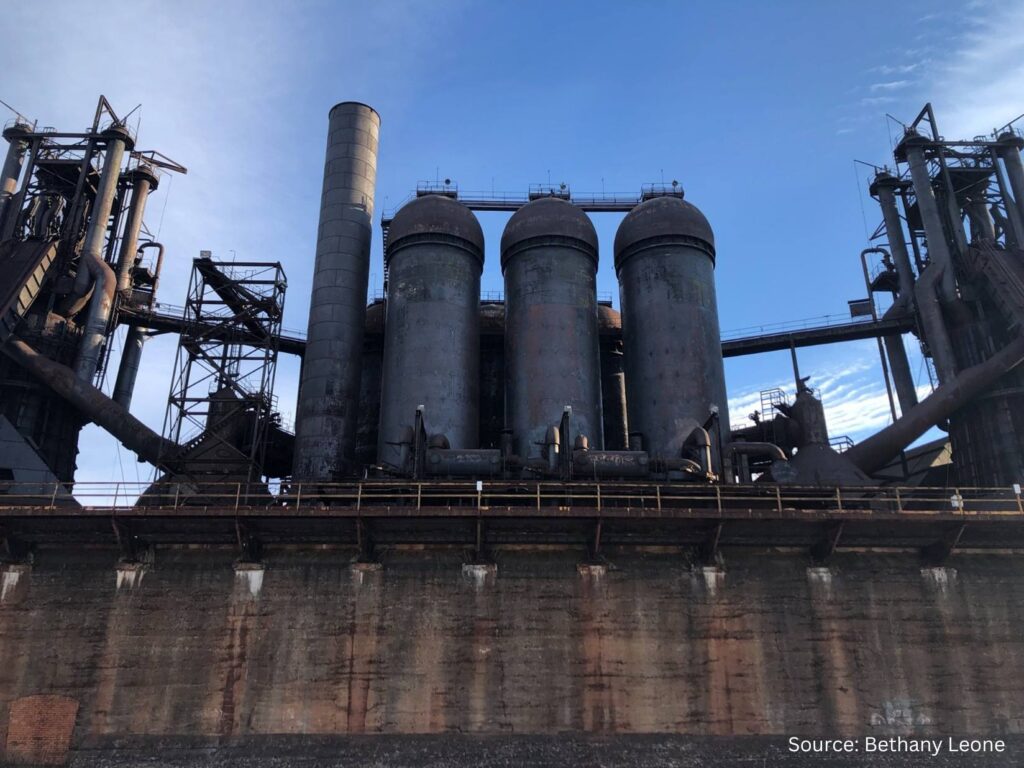
Some readers may know my background is in historical research. In 2022, I found myself supporting a Pittsburgh architect as his team worked on preservation planning on a brownfield: The Carrie Blast Furnaces. Was Carrie a girlfriend? That’s one answer. I never got a good story on that, though.

Among existent structures at the site are the power house, the no. 6 cast house, a dust catcher, a blowing engine house, and two remaining blast furnaces, no. 6 and no. 7. Rusted, massive, and with evidence of guerrilla art everywhere, the “abandoned” site was never really forgotten by the locals who fought to preserve its legacy in the region.

View of the ore yard in front of blast furnaces no. 6 and no. 7 with a red ore bridge overtop

The Carrie Blast Furnaces site is located in the midst of what was a key iron producing region with plants all around the city of Pittsburgh, Western Pennsylvania, parts of West Virginia, and Eastern Ohio. The Pittsburgh district was the largest iron and steel producing region in the world between the late nineteenth and early twentieth centuries.

This industrial site supported U.S. pre-World War II integrated iron production along the Monongahela River. Andrew Carnegie integrated the Homestead Steel Works operations in 1898, the extensive industry marked by tangled railways to transport materials to plants across the landscape.

Various acquisitions and expansions to the space had made it a critical workhorse in America’s manufacturing, eventually becoming a part of U.S. Steel’s Homestead Works. Yet after the world wars, the demand for steel plummeted. Steel manufacturing was consolidated at other locations. Foreign imports increased. Alternative materials were adopted for domestic products. Blast furnaces no. 6 and no. 7, built in 1906–1907, ceased operations in 1978; the rest of the site closed in 1984.

View of six stoves with blast furnace no. 7 (left) and blast furnace no. 6 (right)

Today, Rivers of Steel operates the brownfield. Straddling both Swissvale and Rankin communities, the site has gone under preservation efforts so it can offer the public historic site tours, arts events, hands on education, and outdoor events. But while the technologies can no longer be used on the site, the remaining structures may still yield value to the community.

From an historic preservation perspective, architectural redesign plans intend to keep as many of the structures as is safe and functional for current and future use. Some of the obvious challenges that exist in brownfields are visible to the naked eye: How to insulate or redesign a blowing engine house building and what suppliers are able to fix and replace the broken windows? Can the dust blower have an alternative purpose or is it a hazard to keep on a site that hosts public events? These are relatively simple issues as compared to the subterranean challenges — toxins leaking from latent pipes is the big one. Paired with environmental preservation efforts of redeeming the landscape for safe public use and recreation, making an industrial brownfield something suitable for long-term public benefit requires a host of planning — and unplanning.

Yet the past investments infused into building Carrie Blast Furnaces give value to the future projects, tangible, and intangible.

The stock house where raw materials would be dropped off before carted up to the top of the blast furnaces

The conversation about abandoning older air/atmosphere furnace systems reminds me of this lesson. Is it possible an old system can, with modifications, give heat treat operations added value that a newer system cannot? What with improved furnace insulation, and especially with even advancing furnace monitoring and even technology that leverages carbon emissions within an operation, perhaps certain heat treat operations can create something better and more efficient, leveraging existing investments.

As is the case in historic preservation, an investment can’t always be salvaged or even remembered. We don’t just think about past values or present concerns but future value. I would think the same must be the case for heat treat operations. In navigating the demands of the present economic realities and standards, preparations for the future, while honoring the legacy of workers (and, perhaps, investments) that made it possible is tricky.

Currently, activity at Carrie Blast Furnaces is focused on rebuilding sluiceways for visitors and converting the blowing engine house into a visitor’s center. Hopefully, debate will continue about the rehabilitation investments to come. When it comes to heat treat operations, may we also have great debate in wrestling with old, not so-sexy technologies and whether to adapt or adopt new ones.

Bethany Leone
Managing Editor
Heat Treat Today

Contact Bethany at bethany@heattreattoday.com.


Find Heat Treating Products And Services When You Search On Heat Treat Buyers Guide.Com


Adapting Old Technology for the Future Read More »

Heat Treat’s “7-Year Itch”

Heat Treat Today publishes twelve print magazines a year and included in each is a letter from the editor, Bethany Leone. In this installment, which first appeared in the January 2025 Technologies To Watch print edition, Bethany reports on the changing landscape of the industry and the resulting challenges, according to a poll on LinkedIn. Respondents shared their views on uniformity and temperature control, residual stresses, managing downtime, and more, and our editor gives her summary of the feedback.

Feel free to contact Bethany at bethany@heattreattoday.com if you have a question or comment. 


January 2025 Magazine

Now granted, heat treating isn’t in a romantic relationship, but this 2025, there are many relationships that have vied for the industry’s attention over the past decade plus. 2025 seems to be the year to scratch the itch that heat treaters have: Is it time to try something new?

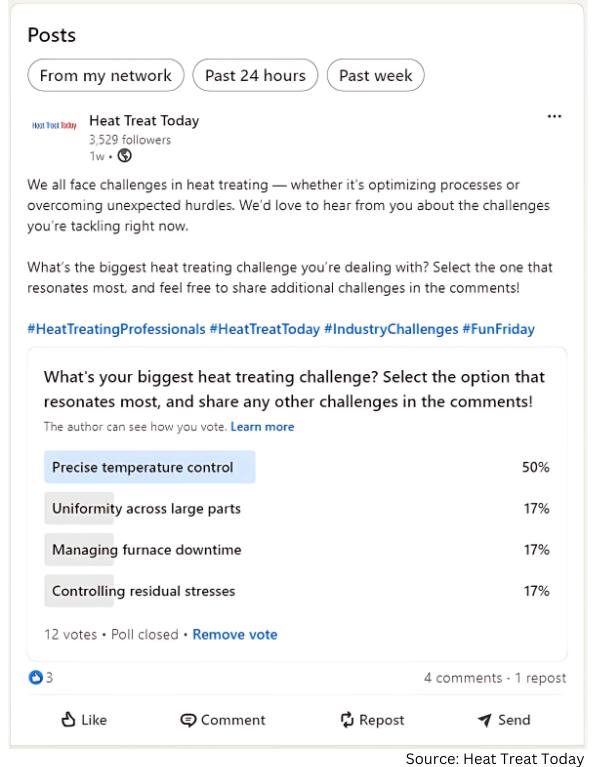
Recently, Heat Treat Today released a poll on LinkedIn. We asked what the number one challenge that heat treat experts faced in the North American manufacturing industry. There were several big-ticket items that we offered: Precise temperature control, uniformity across large parts, managing furnace downtime and controlling residual stresses. Unsurprisingly, temperature control was voted as the top challenge of the four choices, though it was surprising that few respondents piped in on the topic of residual stresses.

Yet perhaps the most important engagement came from a commenter who addressed using legacy materials in changing industry requirements. How closely are we thinking about the future that materials — use of legacy materials as well as different legacy materials — have on our work in heat treatment? (Ok, your work. We all know that I’m leaving the discovery and application to you!)

As the commenter noted, the choices in the poll are all critical characteristics, and therefore factors heat treatment practitioners should already be concerned with. If you are looking at your heat treat operation’s relationship with a variety of processes and technologies and think that the relationship is ideal as can be, great.

But if you are in the “seven-year itch” camp — that is, there is some relationship with a process or technology that is on the rocks — this new annual magazine we are releasing each January highlights the heat treat technologies to watch for in 2025. It’s time to reevaluate the relationship your heat treat operations have with current technologies.

Technological Relationships Under Consideration

The heat treat industry is navigating a rapidly evolving landscape shaped by new materials and technologies. Additive manufacturing (AM), or 3D printing, introduces unique material requirements that challenge traditional heat treating. Complex geometries and the use of non standard alloys in AM demand processes tailored for uniformity and precision at an unprecedented level. These disruptions, coupled with constant innovations by researchers in materials science, are prompting a reevaluation of whether conventional heat treating methods are needed as is, or even at all. Check out the AM quiz on page 24 to get up-to-speed on some of these developments.

Meanwhile, robotics and AI are revolutionizing how operations are managed. AI-powered predictive maintenance is becoming indispensable, helping to minimize furnace downtime by identifying potential failures before they occur. Machine learning enhances furnace control systems by refining temperature cycles and gas flow in real time, ensuring consistency and efficiency. How are these systems working for heat treaters? Read the case study article on page 10.

Digitalization technologies, such as smart sensors and IoT-enabled systems, are making it easier than ever to monitor and analyze heat treating operations. These tools, combined with advanced software, empower operators to make data driven decisions and reduce energy consumption. Several articles in last month’s magazine release focused heavily on these technologies, but the conversation persists in the commentaries found on pages 17 and 27.

The question for 2025 is clear: Are heat treaters ready to adopt these innovations and adjust their processes to align with the needs of tomorrow’s manufacturing? Have your operations found the perfect relationship with these new technologies? Tell me what you’re finding to be most difficult to address in 2025 so we can examine that relationship in future editions.

Bethany Leone
Managing Editor
Heat Treat Today

Contact Bethany at bethany@heattreattoday.com.


Find Heat Treating Products And Services When You Search On Heat Treat Buyers Guide.Com


Heat Treat’s “7-Year Itch” Read More »

Autonomous Solution for Industry

Heat Treat Today publishes twelve print magazines a year and included in each is a letter from the editor, Bethany Leone. In this installment, which first appeared in the December 2024 Medical & Energy Heat Treat print edition, Bethany addresses the ongoing discussion about automation in industry, the data on how it affects labor, and the way forward for manufacturing and the government.

Feel free to contact Bethany at bethany@heattreattoday.com if you have a question or comment. 


You can afford it.

Supervisors, you can afford to raise wages. Skilled laborers, you can afford to purchase a home.

Maybe you’ve heard these hopeful statements before? You can afford it, says economist Mark P. Mills, executive director of the National Center for Energy Analytics, by leaning on automation. Far from destroying jobs, tools like AI and robotics enhance productivity and require highly skilled laborers who, in turn, can and should be compensated. This editor’s page summarizes some of Mills’ main points and how these might be considered in the heat treat industry.

Labor Market Needs Automation

In a recent article released in City Journal, the economist draws attention to what he sees as a new norm for the labor market: the successful bargaining for higher wages by the Longshoremen’s Association. The result of the union’s strike means a starting salary of $80k and a mid-career salary of $150k. Mills terms this “The Great Inversion,” where we see salaries for the trades supersede 90% of salaries for college graduates.

His argument that this is the new norm rests on three points. The first is that population has been in decline; this is exacerbated in the trades by the fact that the average age for skilled tradesmen is older than the average age across U.S. manufacturing.

Secondly, though there is a trend of young workers choosing a career in the trades, not enough would fill the generational chasm that is opening as the older generation leaves the workplace. This means there is still a demand for skilled labor.

Thirdly, industrial manufacturing creates consumable goods, for which there is no end to want, unlike in food and agriculture where there is a limit of consumption. As people grow wealthier, they can afford more “wants” — even if it’s going out to eat at restaurants where iPads automate server-kitchen communications.

Even with the population decline, individuals continue to gain wealth and want to spend it, Mills explains. In this situation, particularly where we have efforts and interests in America restoring industrial productivity, the argument is that automation will allow companies to keep up with the demand for consumable goods while filling the labor gap. This result means a need for upskilling workers to work with robotics, automation software, and AI on the manufacturing floor.

Automation in Heat Treat

In the heat treat industry, I’ve heard several perspectives on this topic. Robotics and automation don’t take away jobs, some claim; they only improve labor market jobs that are there. At another’s operations, the installation of an automated piece of instrumentation didn’t result in any immediate layoff, but did result in the company not having to train an operator to fill a position since that position was no longer available.

The fact is that the pro-automation side relies on addressing situations where there is a lack in able workers in the labor market. This demonstrates that jobs are being filled by automation.

Turning to employment opportunity, it is hard to argue with Mills’ outlook that automation in jobs increases wages and profits. He supports this claim saying, “data show that, over the last half of the twentieth century, even as manufacturing productivity rose (that is, fewer labor-hours per output), the U.S. manufacturing workforce remained surprisingly unchanged and really started to shrink only when an increasing share of manufactured goods were imported — namely, when the production and labor were exported.” Interestingly, while he acknowledges the role of companies in offshoring goods in the last century, he puts focus on the difficult environment for businesses in meeting the government regulations in America. Therefore, he offers three steps forward addressed at government (in)action:

  1. The U.S. government must look for ways to make the country more amenable to industrial expansion that go beyond subsidies with caveated use.
  2. Policymakers must avoid intervening in the economy when a system isn’t broken. (Here, Mills addresses cost and reliability issues tied to state and federal energy policies.)
  3. The trifecta of policymakers, unions, and manufacturers need to welcome advances in automation.

Mills points out that in order for automation to be successful, skilled laborers need to welcome it and help it, emphasizing that, like the Longshoremen’s Union strike, automation allows for wage increase.

My question to you in the heat treat industry is: What is your job function in the industry? How have you benefited from automation (AI, robotics, digitalization) initiatives in the industry? What concerns — or hopes! — do you see that have yet to be addressed? Write to me. And if any article on digitalization in this magazine strikes you, I would love to hear that, too.

References

Mills, Mark P. “The Longshoremen’s Strike and the Great Inversion.” City Journal, October 8, 2024. https://www.city-journal.org/article/the-longshoremens-strike-and-the-great-inversion.

Contact Bethany at bethany@heattreattoday.com.


Find Heat Treating Products And Services When You Search On Heat Treat Buyers Guide.Com


Autonomous Solution for Industry Read More »

Purdue Heat Treating Consortium

Heat Treat Today publishes eight print magazines a year and included in each is a letter from the editor, Bethany Leone. In this letter, Bethany reports on her visit to the September meeting of Purdue Heat Treating Consortium where industry leaders presented key technical and operations decisions in heat treating. The academic partnership encourages research into topics such as sustainability and technology alternatives. Read more of what Bethany learned from her attendance at this dynamic and forward-looking consortium in this letter, which first appeared in the November 2024 Vacuum print edition.

Feel free to contact Bethany at bethany@heattreattoday.com if you have a question or comment. 


What heat treat issue do you need fixed? At Purdue Heat Treating Consortium’s (PHTC’s) September meeting, I witnessed industrial manufacturers targeting key technical and operations decisions in heat treat through an academic partnership.

Since summer of 2022, the research driven School of Materials Engineering at Purdue has positioned itself as a partner to industrial leaders in the Midwest. Their main goal: advance research of precompetitive projects.

I spoke with one member who commented on the beginnings of PHTC: “Some of the Midwest, I’d say, user companies . . . wanted a Midwest school and more research-oriented university. To have Purdue be able to fill that was perfect; that’s some place that we recruit from, where we know has a lot of depth of professors that would be able to contribute, and which has facilities that would be able to be a part of. So, it was a really good partner to make that change with.”

At the recent quarterly meeting, I sat amongst several dozen representatives from Amsted Rail, Caterpillar, Cummins, Rolls Royce, ECM USA, and other member companies as we settled in for a day of research presentations. Foremost in members’ minds was feasibility in real world application.

Topics included developing sustainable quenchant alternatives and identifying a method for greenhouse footprint analysis that would meet standards. The presentations of ongoing research were each met with intent nods of satisfaction, questions scrutinizing the data, and proposals on what specific direction industry players wanted to see examined.

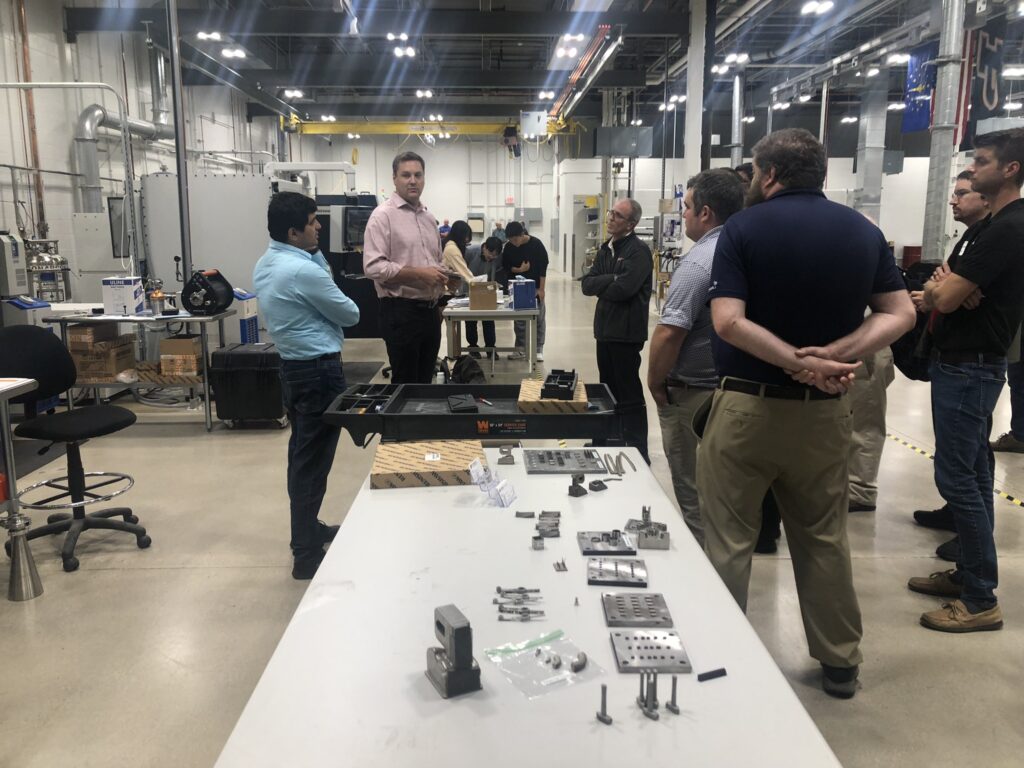
Purdue Heat Treating Consortium’s (PHTC’s) September meeting where projects about developing sustainable technology were presented, as well as research topic findings

A mix of faculty and graduate students presented the five research topic findings. Guided by professors, the young people develop and execute research plans to address objectives determined by member voting at previous sessions. When I inquired what type of value this research held and the quality of the presenters, industry members were quick to speak highly of their abilities and the actionable research results.

Specifically, one member commented to me that the lifecycle work was proving to be helpful. Explorations like this give a “gauge of what we are able to meter on some of our own furnaces . . . and to have some common ways of describing emissions.” He continued, “that leads to either confirmation that we’re doing things right or to adjusting what we’re doing.”

Other topics that have been of interest address property variations when austempering certain materials and the quench oil work. Even when members may not apply all research results gained from the studies, ancillary work being done within a study — such as machine learning — offers additional value.

The group’s strength is collaborative action: as research objectives evolve, the academic contingent adapts. One paper was met with a peppering of cross-examination questions, the result being a large consensus as to the end value of this research. A plan to reconvene outside of regular sessions to provide industry testing data was determined, and industry members eagerly voiced their desire to contribute to this special moment.

Following presentations, the meeting came to a close. Voting members first determined which research to continue. Then, we toured the Manufacturing and Materials Research Laboratories at Purdue. The members witnessed various methods of metal 3D printing materials in action and handled printed parts of different alloy compositions.

Rounding out the day was an optional networking reception at a local pub and grill, Walt’s, where conversations around personal interests bled into reflections on research at PHTC.

My special thanks to Mark Gruninger, Managing Director for Industrial Consortia and Centers, and Mike Titus, Associate Professor of Materials Engineering and Technical Director of PHTC, for their invitation and warm welcome.

Contact Bethany at bethany@heattreattoday.com.


Find Heat Treating Products And Services When You Search On Heat Treat Buyers Guide.Com


Purdue Heat Treating Consortium Read More »